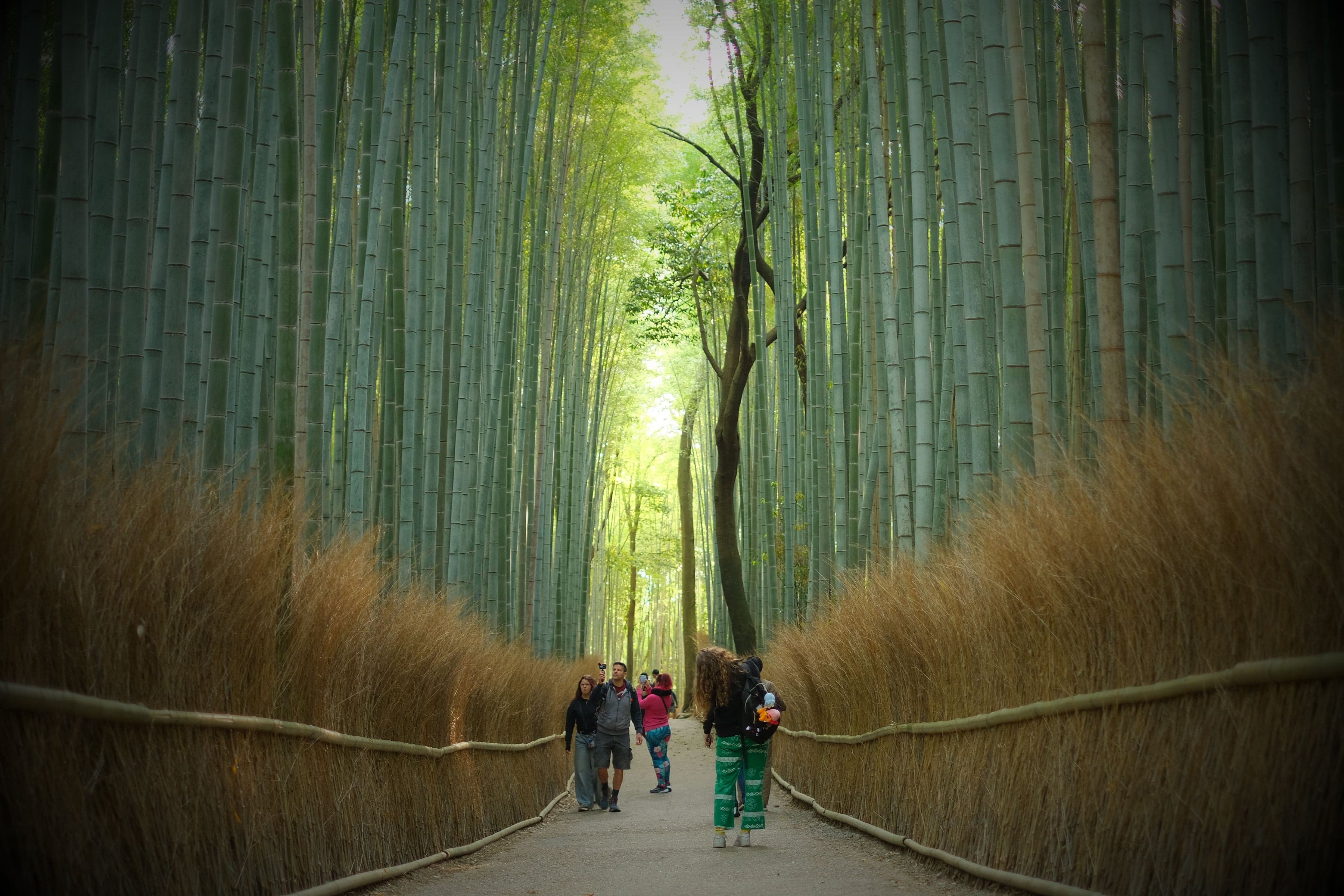
From the Kimono Forest past Tenryu-ji's gate, Nonomiya Shrine and the bamboo grove, up to Kameyama Park's lookout over the Hozu gorge, then down to the river boats and along the water to Togetsukyo Bridge.
Start · Kimono Forest: A Grove Made of Cloth
DirectionsStops
- 1
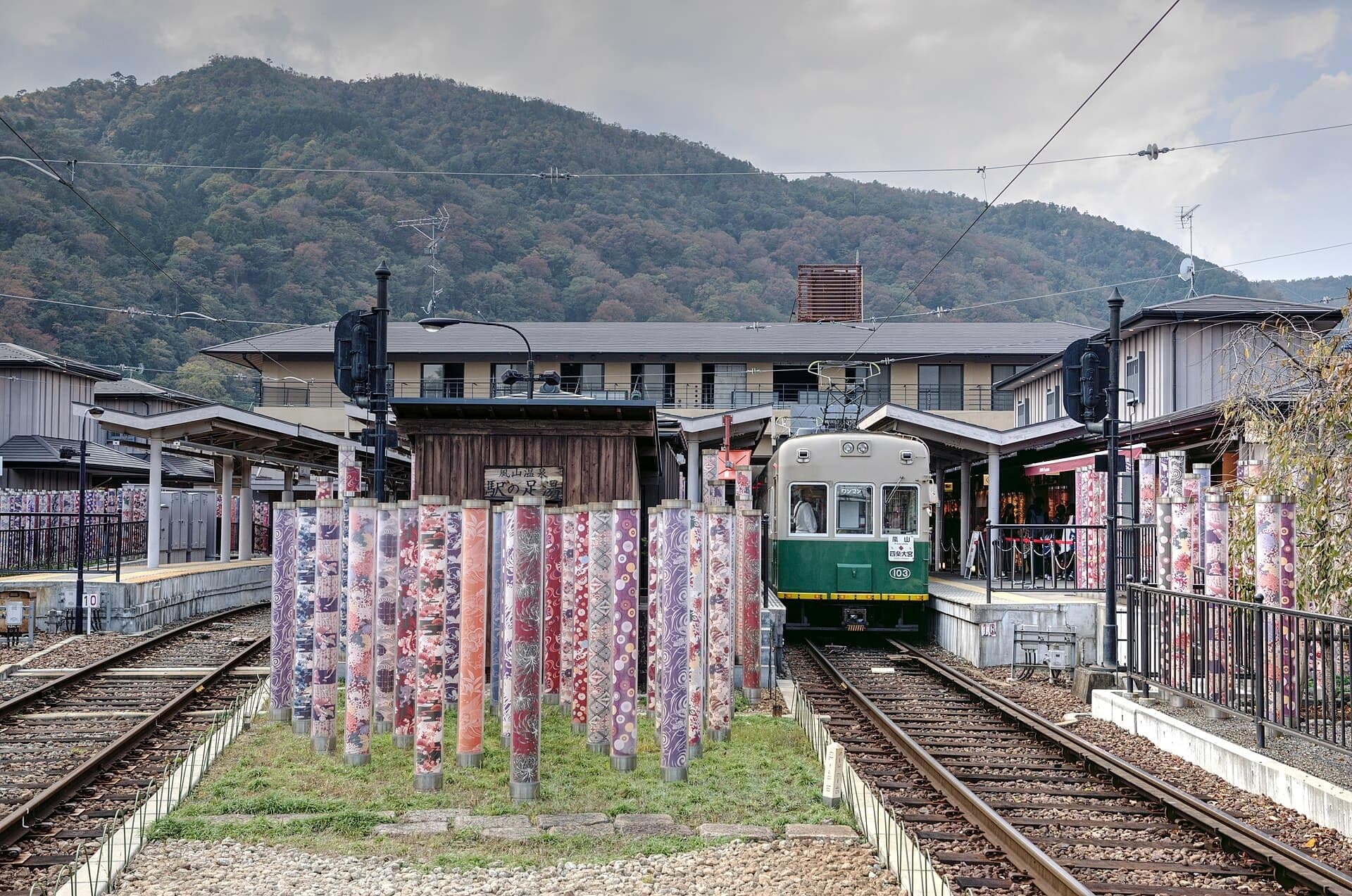
Kimono Forest: A Grove Made of Cloth
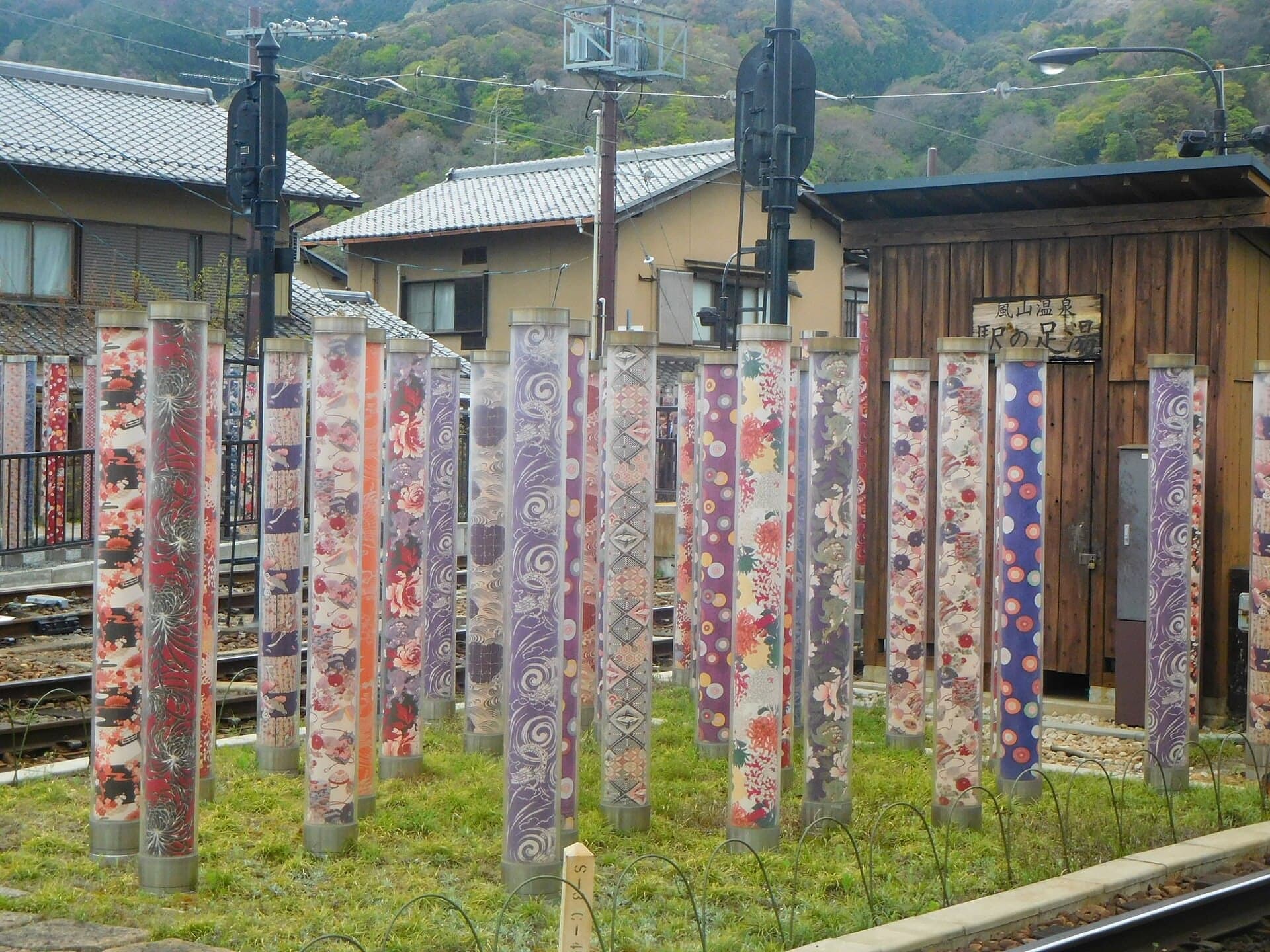
A grove of six hundred poles wrapped in Kyoto-dyed kimono fabric, inside Randen Arashiyama Station.
- 2
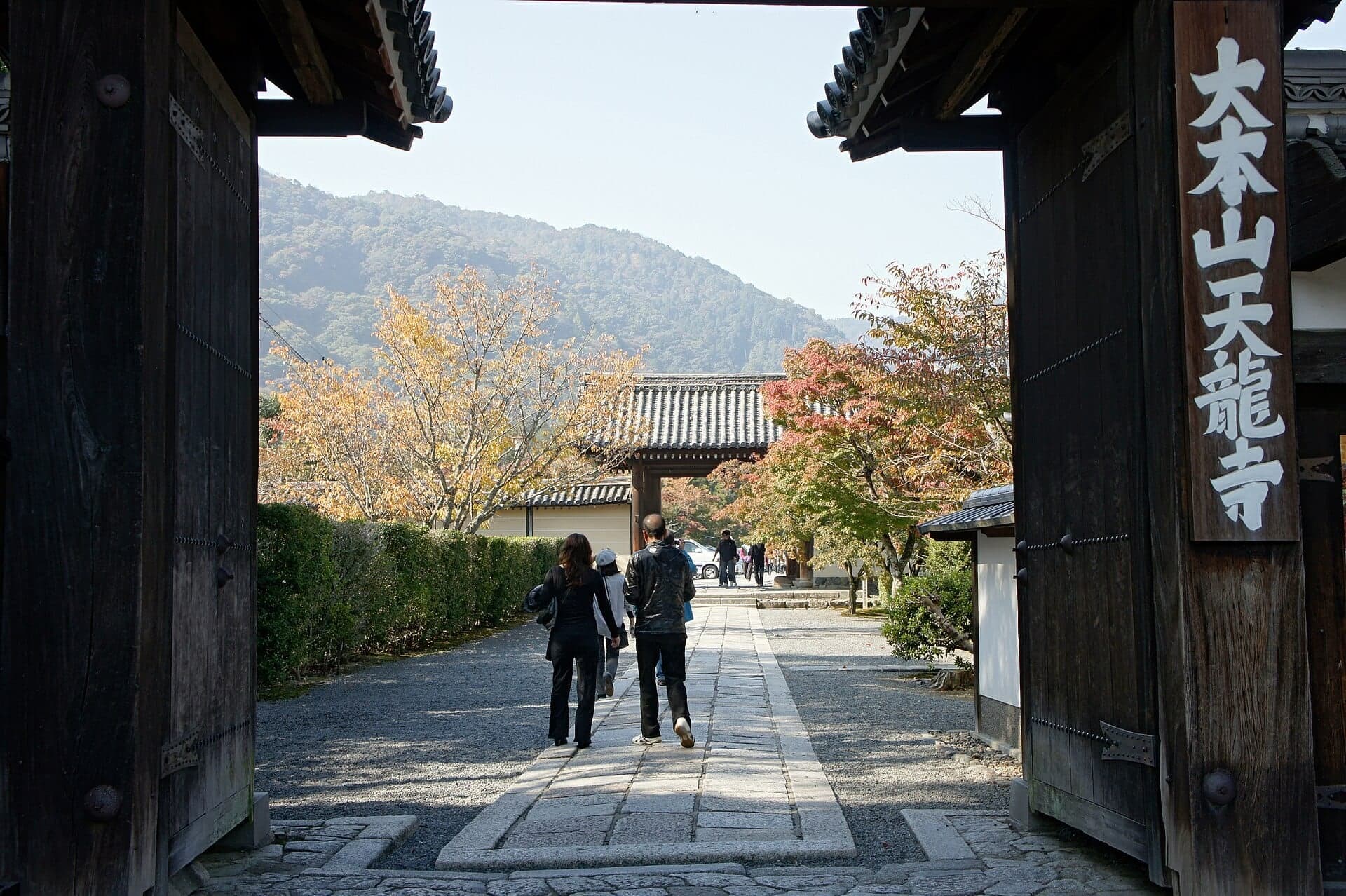
Tenryu-ji Gate: The Garden That Borrows a Mountain
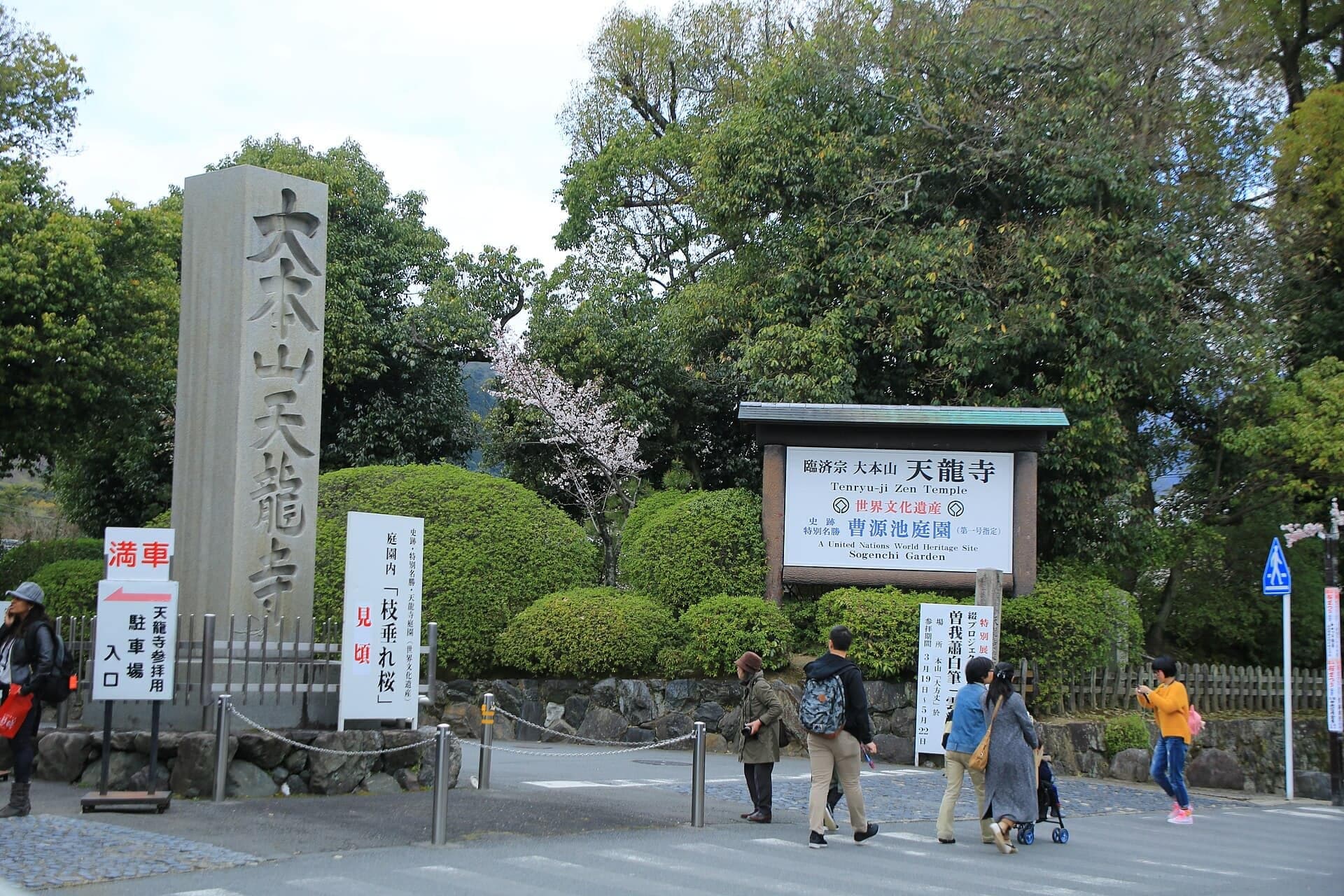
Tenryu-ji's street entrance leads to a temple founded in 1339. Its ticketed garden borrows the mountain across the river.
- 3
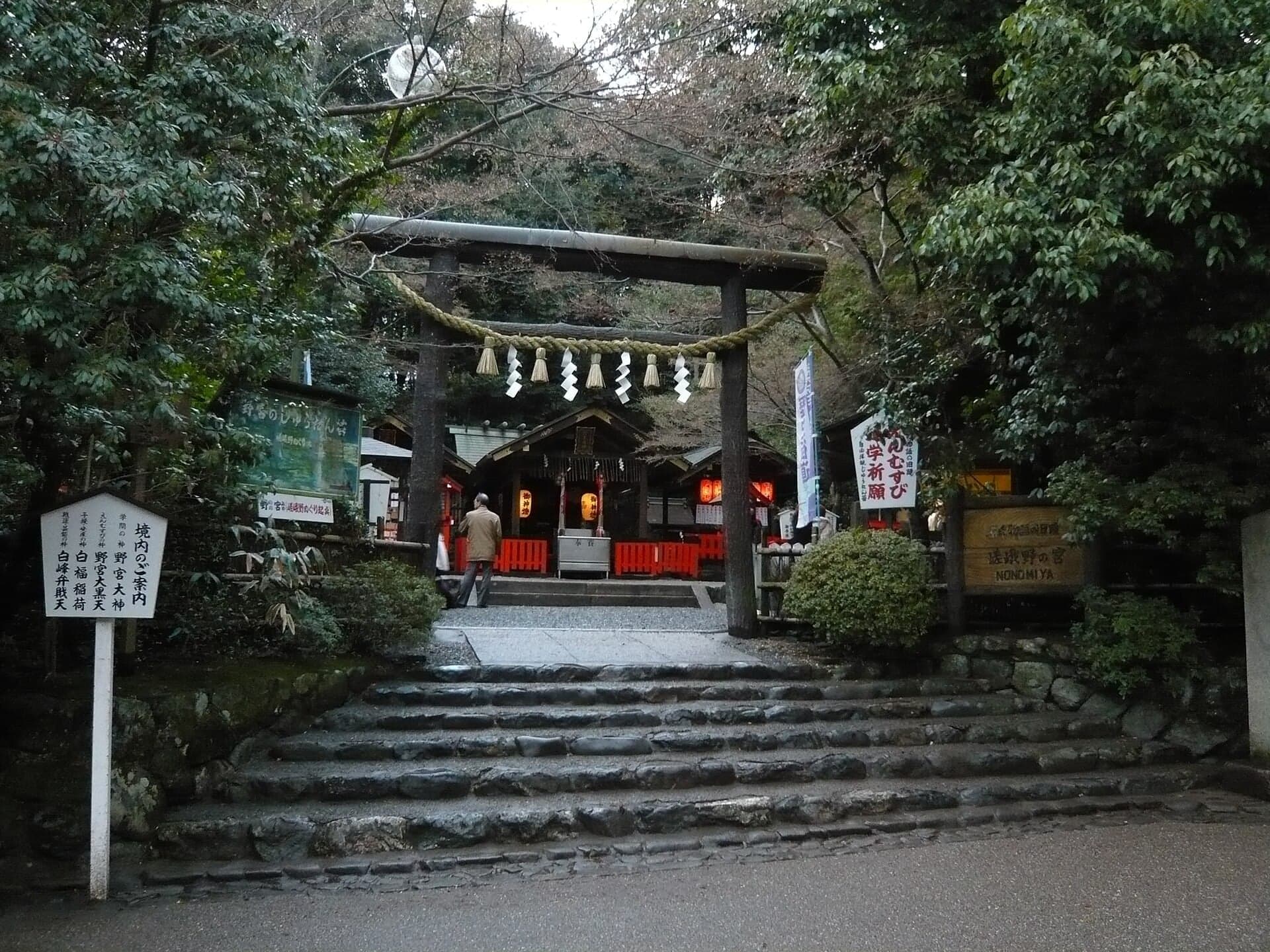
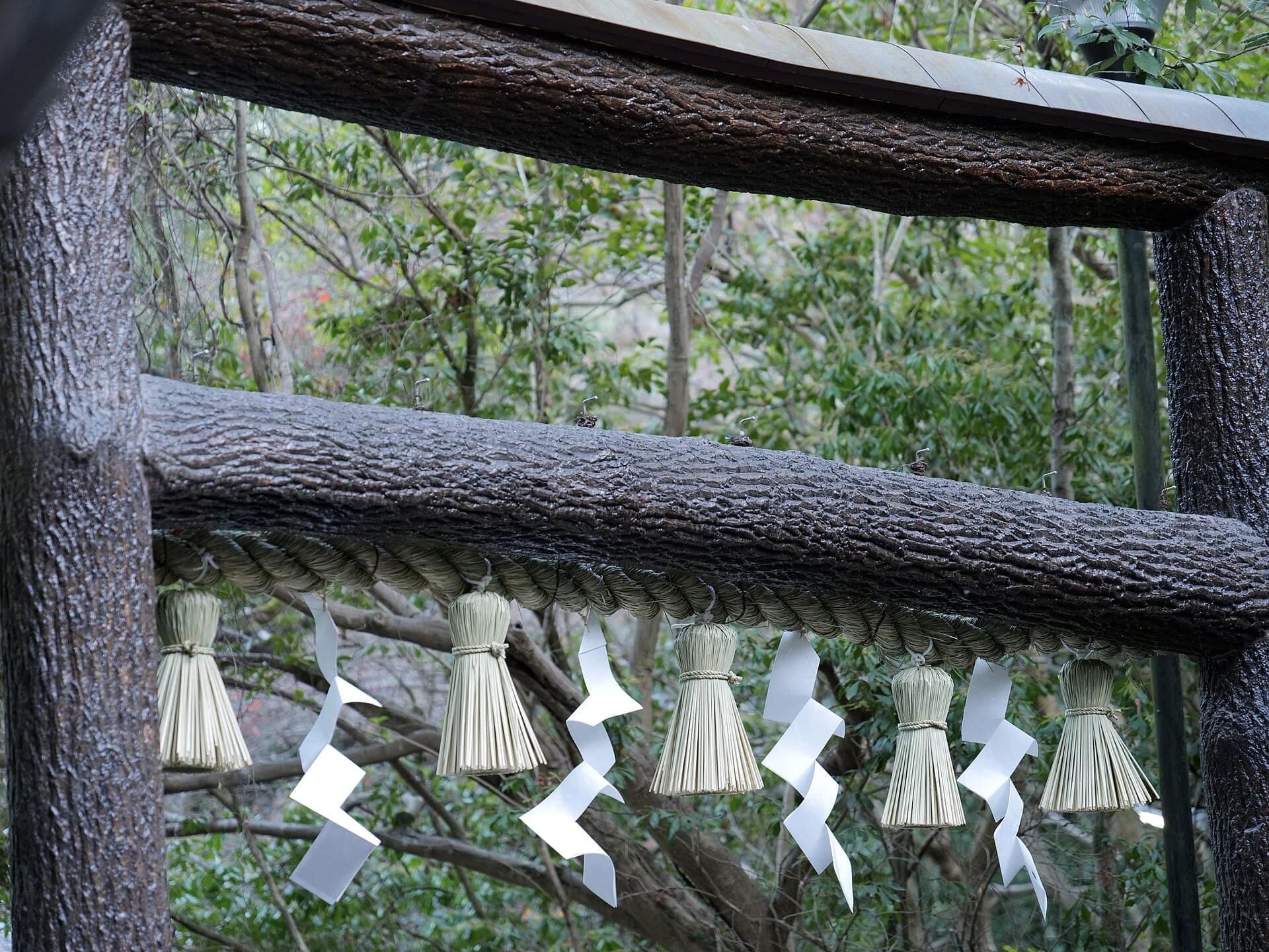
Nonomiya Shrine: The Torii With Its Bark On
A small shrine behind a bark-covered oak torii, where imperial princesses purified themselves before serving at Ise.
- 4
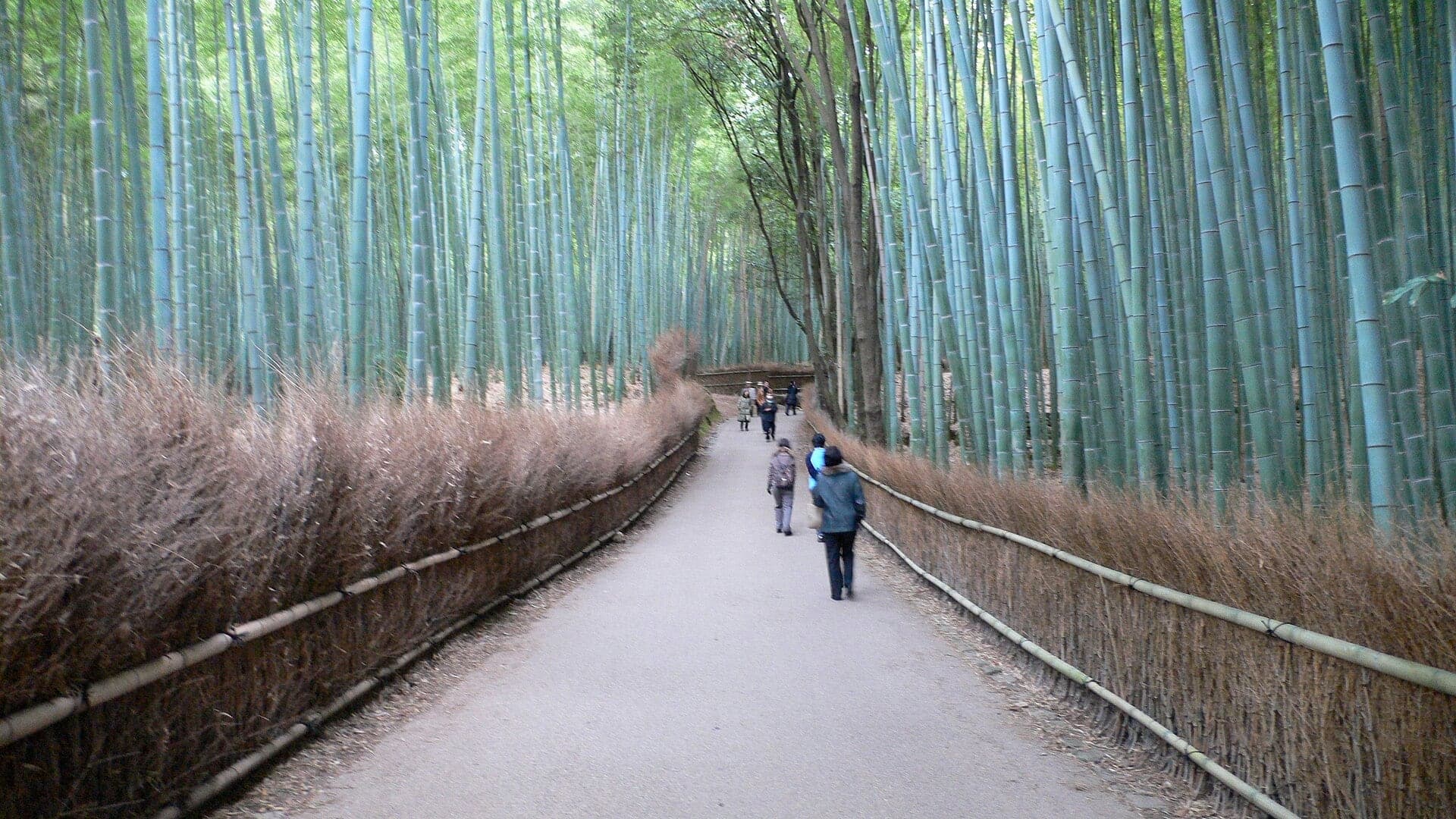
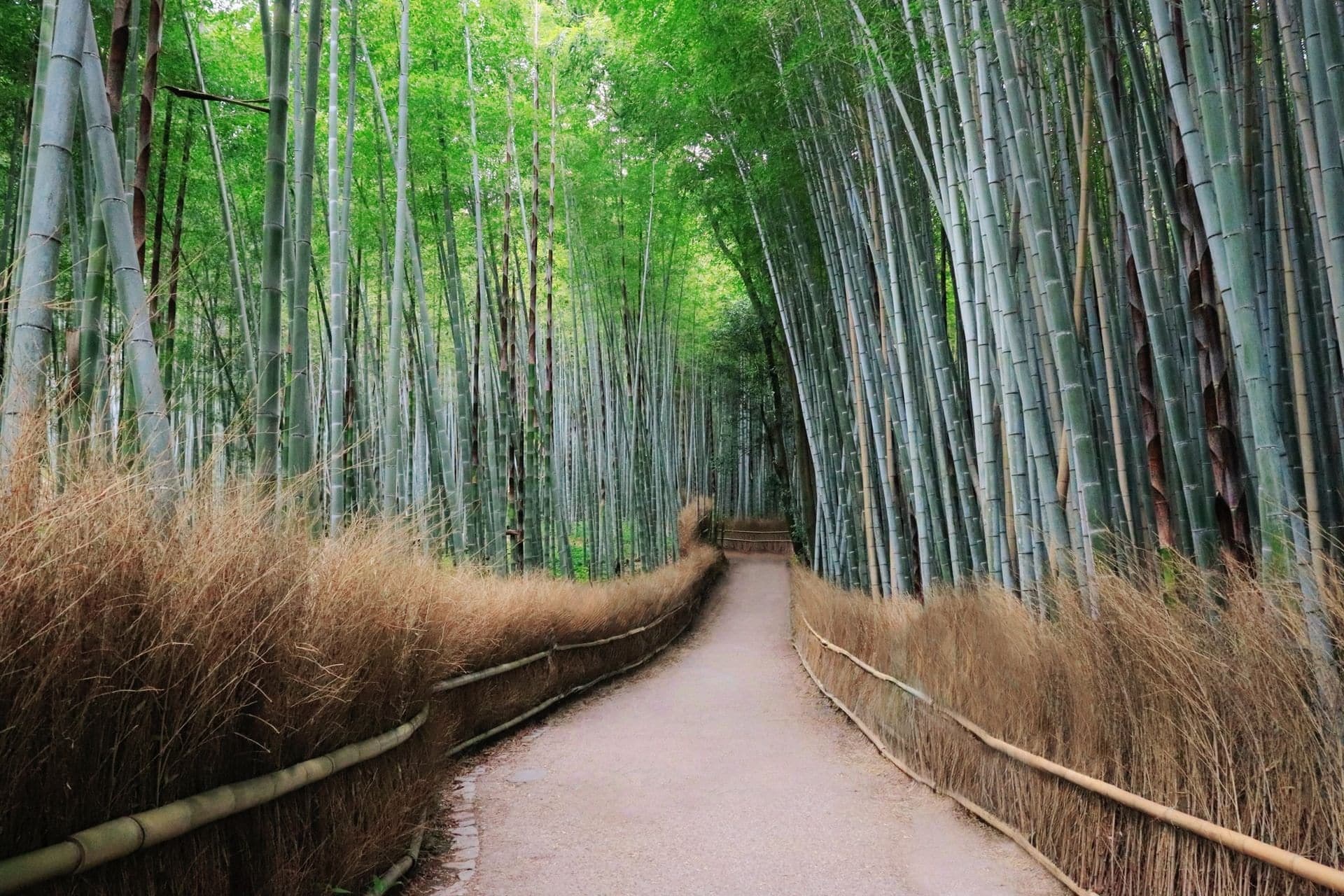
Bamboo Grove: A Forest That Is Kept
Arashiyama's bamboo path is a landscape people work to keep. Its fences of bamboo branches have recently been repaired.
- 5
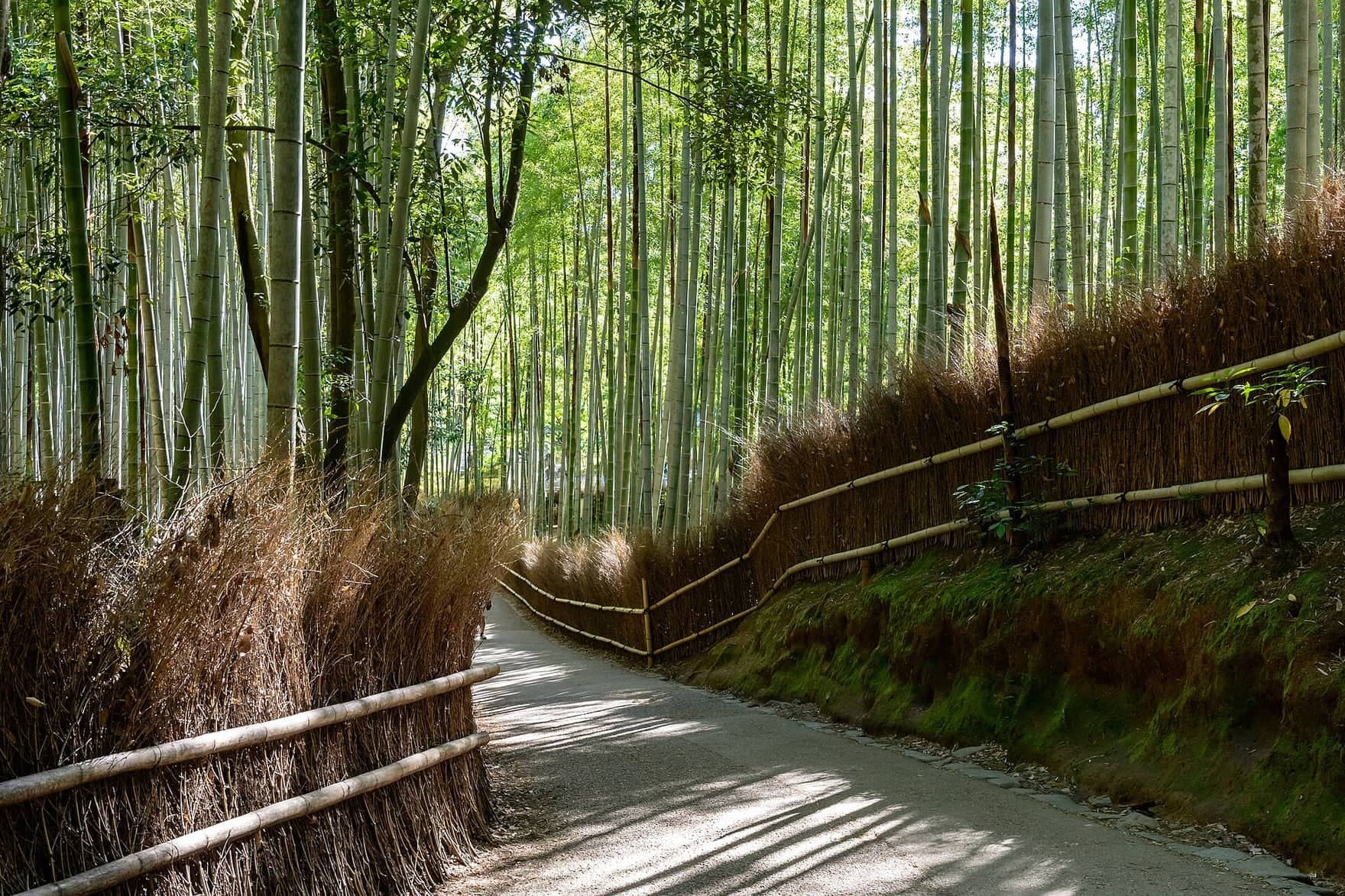
Top of the Bamboo Grove: An Actor's Garden
The bamboo path turns here by a film actor's hillside villa. Okochi Sanso, behind its gate, is ticketed.
- 6
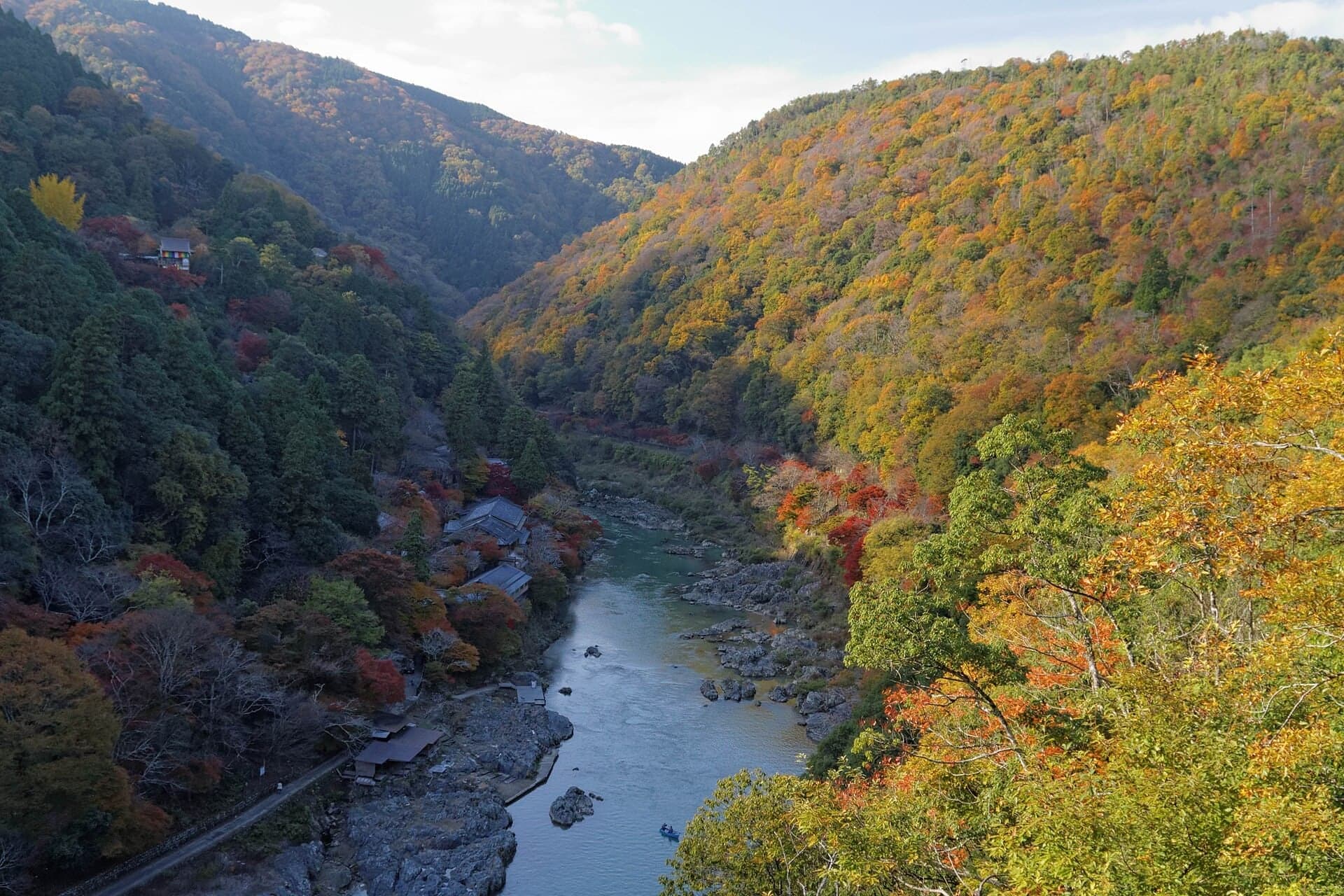
Kameyama Park Viewpoint: Above the Hozu Gorge
A lookout deck in Kameyama Park over the Hozu river gorge. The 1927 scenic designation named this park as the place to view Arashiyama.
- 7
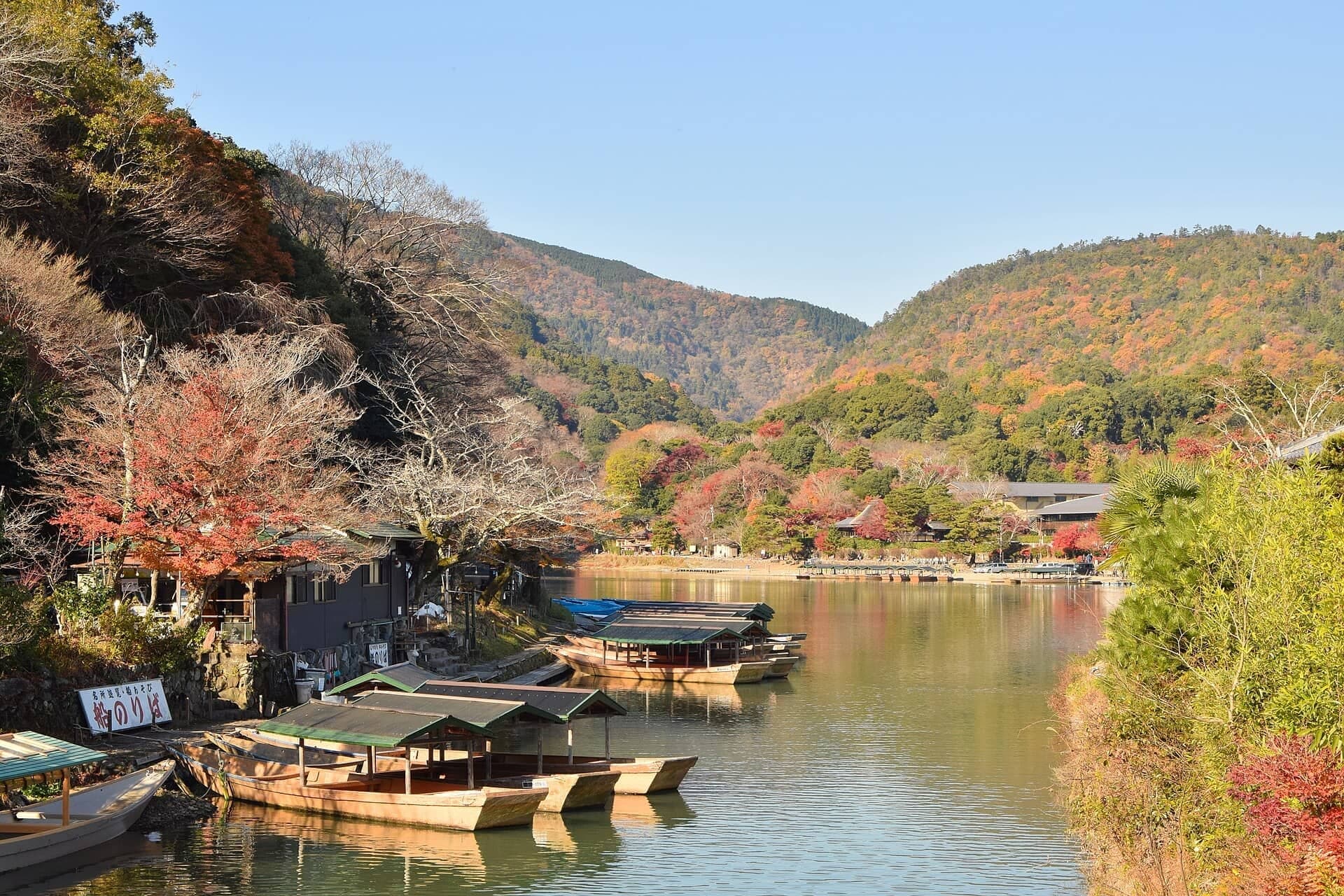
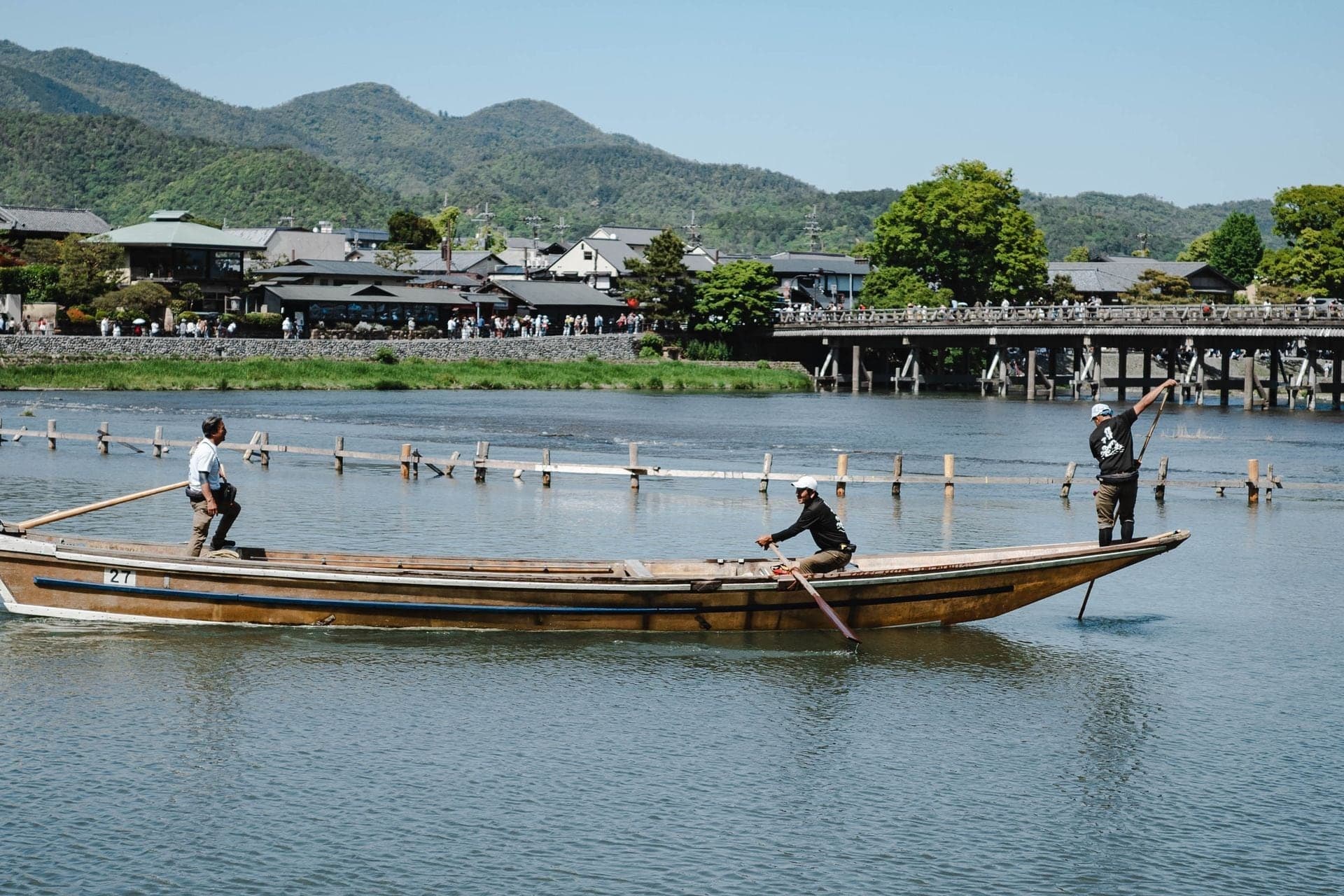
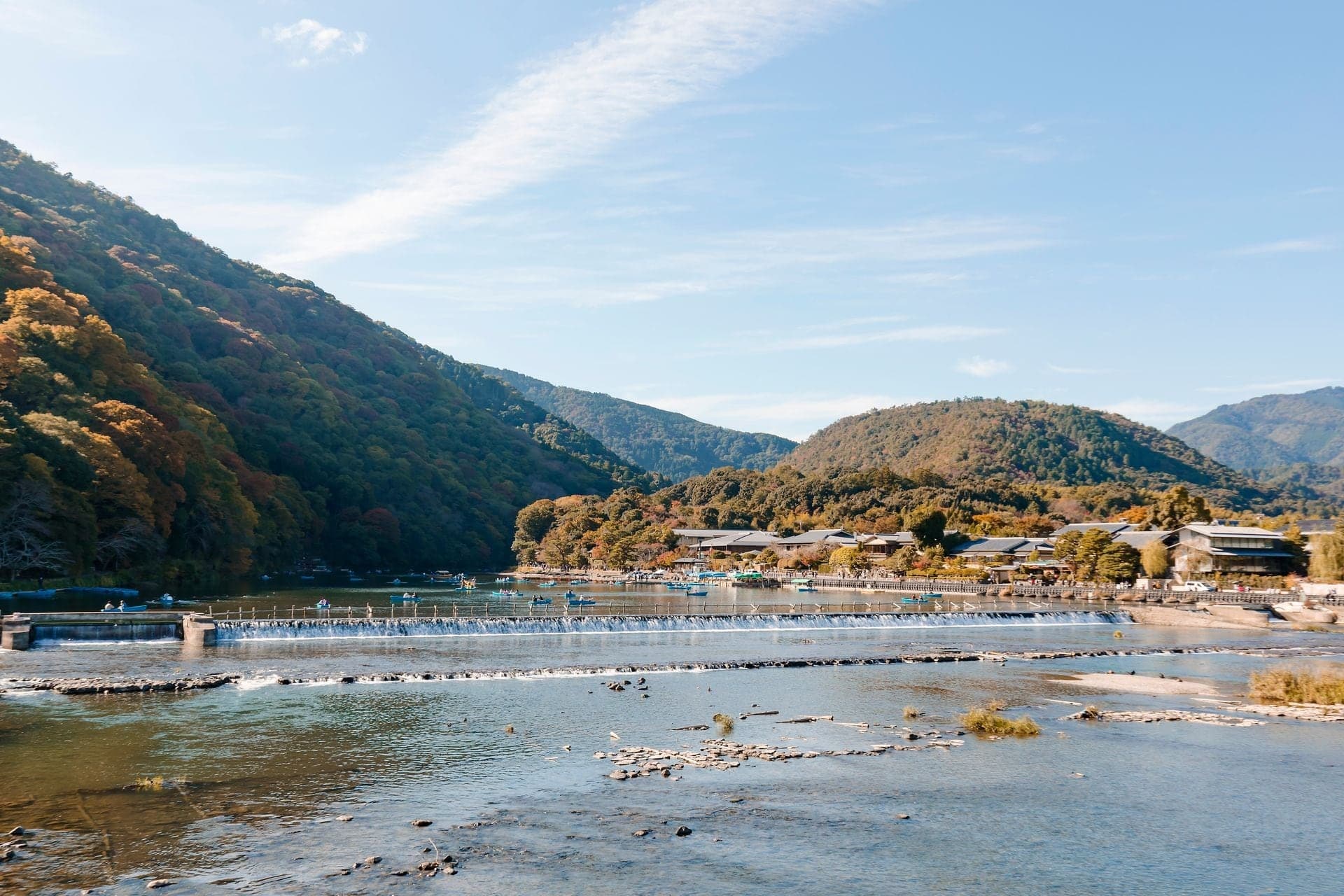
Hozu River Boat Landing: Where the Boats Come In
The landing where Hozu river boats end their trip down the gorge. Boatmen once hauled them back upstream on ropes.
- 8
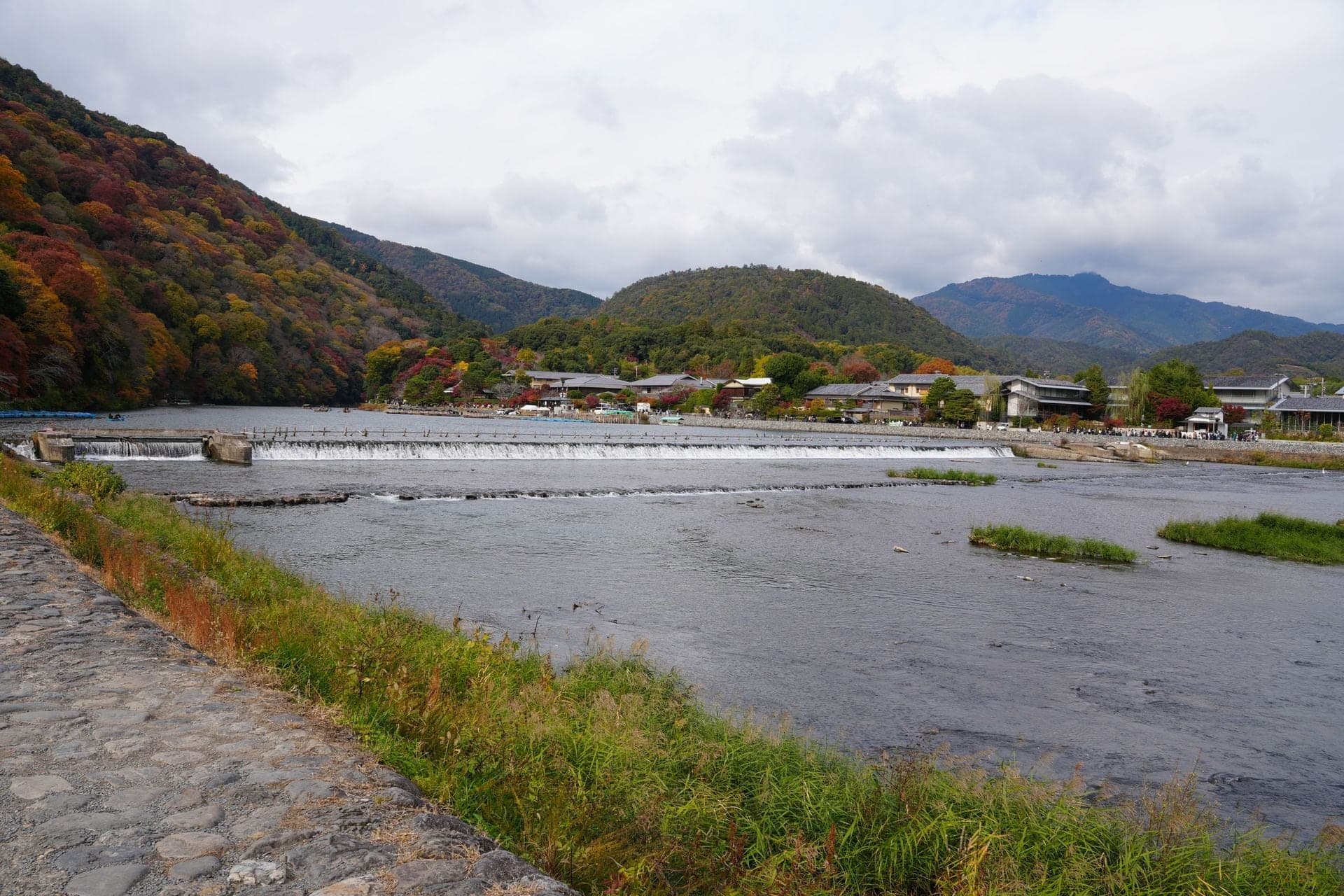
Oi River Promenade: One River, Three Names
A riverside promenade facing a national scenic forest. Ahead, a low weir crosses the river below the bridge.
- 9
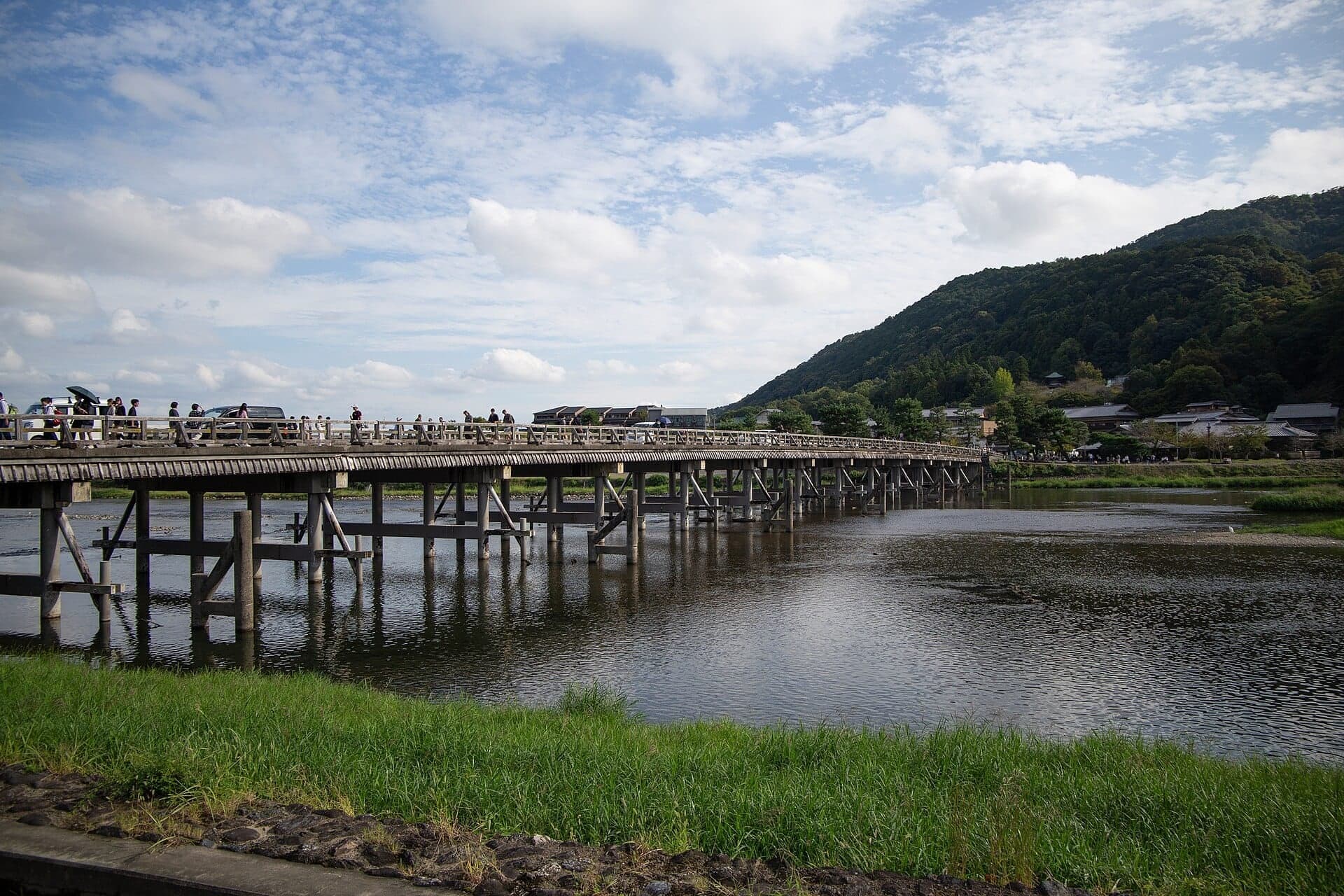
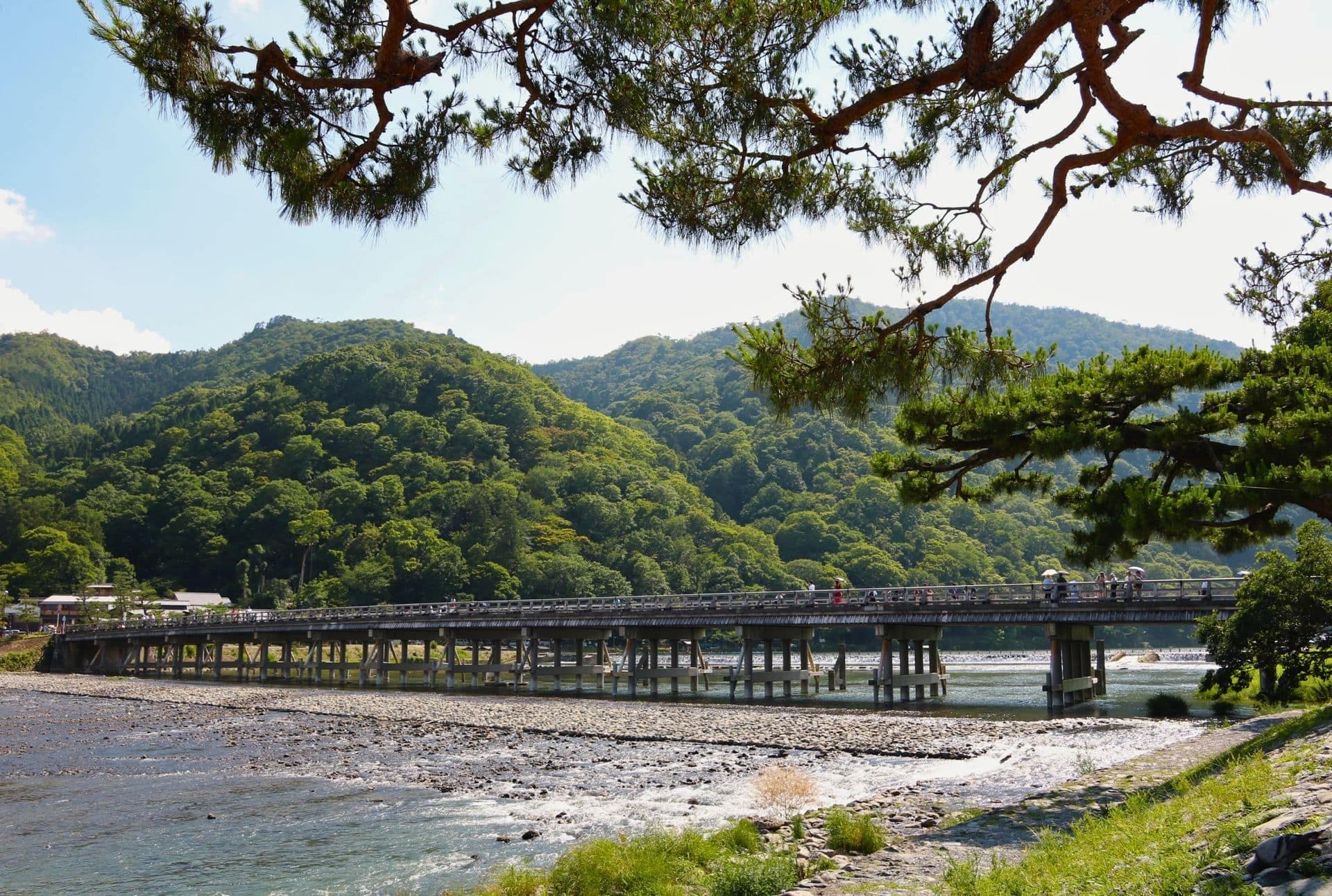
Togetsukyo Bridge: Cypress Rails on Concrete
A concrete bridge of 1934 dressed in cypress rails, under the forested mountain. The walk ends here.
Details
Best Time to Visit
Early morning, on a dry day. Kyoto's tourist association says the bamboo grove is always crowded and recommends going early. This is a daylight walk: Kameyama Park has no lighting at night. Tenryu-ji's garden opens at 8:30 (at 7:30 from 14 to 30 November 2026), and the first Hozu boats leave Kameoka at 9:00 (10:00 in winter) and take about 100 minutes to reach Arashiyama. Spring blossom and autumn leaves are the seasons the 1927 designation names, and the busiest. Checked 16 October 2026.
Pro Tips
- •Getting to the start: the walk begins inside Randen (Keifuku) Arashiyama Station, so the Randen tram drops you straight into the Kimono Forest. The walk ends at the north end of Togetsukyo Bridge, a few minutes' walk from the station along the main street.
- •Kimono Forest (stop 1): free, and lit from inside after dark. The station square's shops open 10:00 to 18:00 (second floor 11:00 to 18:00), and there is a paid footbath. Checked 16 October 2026.
- •Tenryu-ji (stop 2): garden 500 JPY, halls 300 JPY more, the Cloud Dragon ceiling a separate 500 JPY; 8:30 to 17:00, last entry 16:50. The halls close on 29 and 30 October 2026. The temple's north gate opens onto the bamboo path, so with a garden ticket you can leave the garden straight into the grove. Free zazen meditation on the second Sunday of each month at 9:00. Checked 16 October 2026.
- •Nonomiya Shrine (stop 3): free. In 2026 the Saigu procession, about a hundred people in costume re-enacting the princess's journey, is on Sunday 18 October: expect crowds and closures on the lane that day. Checked 16 October 2026.
- •Okochi Sanso (near stop 5): 1,000 JPY including matcha and a sweet, 9:00 to 17:00, last entry 16:30. Checked 16 October 2026.
- •Step-free: the climb to the Kameyama Park lookout (stop 6) is a ramp-like track, but there is no step-free way down from it to the river. To avoid the steps, skip stop 6: from the top of the bamboo grove (stop 5), go back down the bamboo path and the main street to the river.
- •Hozu river boats (stop 7): you cannot board at Arashiyama; every boat leaves from Kameoka, upriver, where same-day tickets are sold. In 2026 regular boats run hourly from 9:00 between 10 March and 13 December, with winter boats from mid-December; no boats from 29 December to 4 January. Adults 5,400 JPY. Children under 80 cm tall cannot board. From the landing, the boat company says JR Saga-Arashiyama Station is 15 to 20 minutes on foot. Checked 16 October 2026.
- •Crowds on the bridge: Kyoto's tourist association runs a live camera on the north side of Togetsukyo, on kyoto.travel. Checked 16 October 2026.
Safety & Precautions
- •Between stops 1 and 2 the route crosses Arashiyama's main street (Nagatsuji-dori) once, at the zebra crossing in front of the station. There are no traffic lights, and buses and cars use this street, so cross with care.
- •Between stops 2 and 3 the route follows the main street, where pavements are narrow and crowds are heavy. Keep to the pavement and let people pass.
- •The Nonomiya lane and the bamboo path (stops 3 to 5) have no pavement and are shared with rickshaws and the odd local car: keep to the edge. Please do not touch, lean on or carve the bamboo.
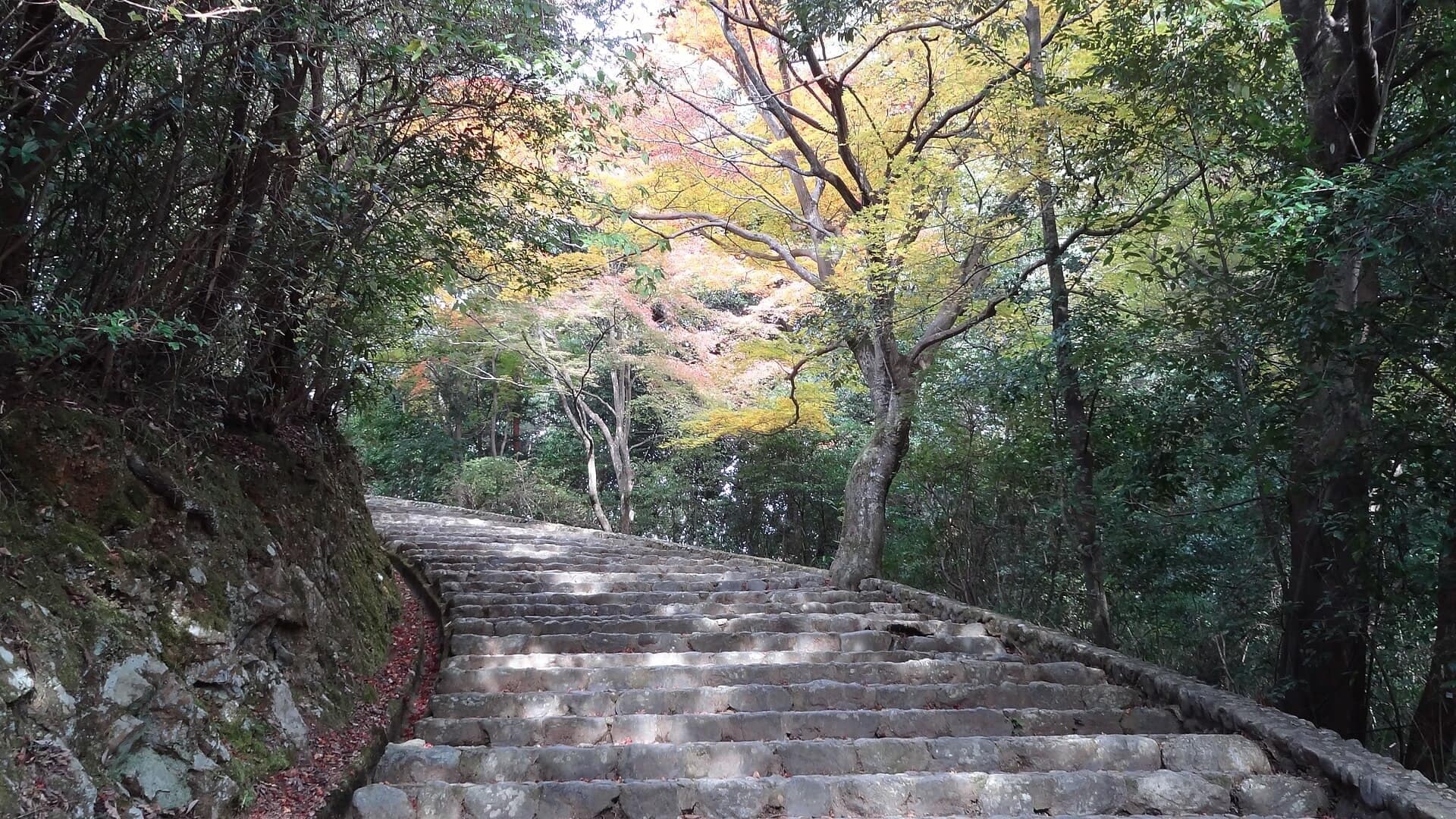
- •Between stops 5 and 6 the route climbs a steady gravel track, with no steps, into Kameyama Park. Between stops 6 and 7 it comes down two long flights of stone steps with no handrail, slippery when wet: take them slowly. The park has no lighting at night, so do this walk in daylight.
- •At the boat landing (stop 7), keep back from the water's edge and out of the boatmen's way.
- •In heavy rain or a typhoon, stay away from the riverbank: the river has flooded over the bridge deck, as it did in 2013, and the boats stop in high water.
- •Between stops 8 and 9 the route follows a one-lane riverside road used by cars, taxis and rickshaws: keep to the pavement on the river side as far as the bridge.
- •Togetsukyo Bridge is very crowded at peak times and carries traffic; stay on its sidewalks.
- •Drones are banned across most of Kyoto City. Arashiyama is a district where littering and street smoking can be fined up to 30,000 yen.
- •Tenryu-ji and Nonomiya are places of worship: keep voices low at their gates.
Travel advisory: Exercise Normal Precautions (Level 1).
Gallery
Related Reading
Go deeper on what you'll see, hear, and walk through.
Read the walk
The full story of Arashiyama: Bamboo Grove and Togetsukyo Bridge, in words. Prefer to listen? Play it narrated, from home or on location.
Introduction
Kyoto, Japan's capital for more than a thousand years, kept some of its most famous views here in Arashiyama, on its western edge. For well over a thousand years people have come here simply to look: at a river coming out of the mountains, a forested slope, cherry blossom in spring and maple leaves in autumn. This walk asks one question at every stop. Who arranged this view, and how?
Three people will help answer it. Muso Soseki, the first abbot of Tenryu-ji, who laid out its garden to take in the mountains beyond its walls. Okochi Denjiro, a film actor who spent thirty years building a garden of his own at the top of the bamboo. And Suminokura Ryoi, the merchant who cleared the river gorge so that boats could reach Kyoto.
The walk is nine stops over about two point three kilometers, about a mile and a half, and takes about seventy-five minutes. It passes a temple gate, a small shrine and the bamboo grove, then climbs a short, steady track into Kameyama Park for a view over the gorge, and comes down long flights of stone steps to the river. It is a daylight walk, because the park has no lights. It begins here in the Kimono Forest, at Randen Arashiyama Station, and ends on Togetsukyo Bridge, a few minutes' walk from where you started.
1. Kimono Forest: A Grove Made of Cloth
Welcome to Arashiyama, and to the Kimono Forest. You are among the rows of tall poles that line the walkway through Randen Arashiyama Station.
There are six hundred poles, and each one is wrapped in a length of Kyoto yuzen, the city's dyed kimono fabric. Look closely at one pattern, and then at the next. The railway company that owns the station says the poles are set out to look like a grove, and that is the whole idea: a forest made of cloth, at the gateway to a district famous for its real woods.
The Kimono Forest opened in the summer of twenty thirteen. An interior designer laid it out for the railway, and the fabric was made by a Kyoto dye works. After dark, the poles are lit from inside.
Find the small pond at the end of the grove. The station calls it the Pond of the Dragon and presents it as the station's guardian. It is named for the dragon of the temple across the road, Tenryu-ji, whose name means the temple of the heavenly dragon.
Keep this place in mind as the walk goes on. It is the most openly designed view in Arashiyama, built little more than a decade ago to be walked through and looked at. Every stop after it is a view that someone arranged too, only longer ago and more quietly: a garden that borrows a mountain, a grove that is fenced and tended, a hill that the official record names as the place to stand and look.
Even the name Arashiyama comes with a story. The station's own account says it comes from the wind that blows down off Mount Atago and scatters the cherry blossoms and the maple leaves.
Follow the route out to the main street and across it at the zebra crossing. There are no lights there, so cross with care.
2. Tenryu-ji Gate: The Garden That Borrows a Mountain
Walk on up the main street and stop on the pavement just short of Tenryu-ji's street gate, where its long, straight approach runs away from the road.
Tenryu-ji's garden and halls are ticketed, and worth it. The details are on this stop's card. From the street you will not see the garden at all, so here is what lies beyond that gate.
The temple says it was founded in thirteen thirty-nine by the shogun Ashikaga Takauji, in memory of the emperor Go-Daigo, who died that year. Its first abbot was Muso Soseki. Two trading ships were sent to China to pay for the building, and the temple was consecrated in thirteen forty-five.
The ground was imperial long before that. The temple tells of a ninth-century temple here, founded by an empress, and of emperors who later kept a villa on the site. In two thousand four, the city's archaeologists dug a site by the river, inside the old villa grounds, and found foundations they read as part of that villa.
Fire is the temple's other history. It lists eight fires, and almost everything standing today dates from eighteen ninety-nine or later. The survivor is the garden. Muso laid it out around a pond nearly seven hundred years ago, and the temple calls it the first place in Japan to be named both a special historic site and a special place of scenic beauty.
Muso's garden is built around a view you cannot see from this pavement: Arashiyama itself, the forested mountain across the river. The temple describes its garden as borrowing that mountain, and the hill of Kameyama beside it, as part of the design. The garden stops at its wall, but its view does not. That is borrowed scenery. You will meet the idea again, and climb that hill later on.
Follow the route on up the main street, toward a small shrine in the bamboo.
3. Nonomiya Shrine: The Torii With Its Bark On
Walk on along the lane and stop at the small shrine with the dark, rough wooden gate. This is Nonomiya Shrine, and it is free to visit.
Look at the gate, the torii, before anything else. It is sawtooth oak, with the bark left on. The shrine says this is the oldest style of torii in Japan, and that the rite of an emperor's accession is enclosed the same way: a torii of black wood and a low fence of brushwood. Find that fence beside the gate. It is made of spicebush brushwood.
So what was this threshold for? For about six hundred and sixty years, by the shrine's account, an unmarried princess of the imperial family was sent to serve at Ise on the emperor's behalf, for a whole reign. She was called the Saio, and before she left the capital she purified herself at a place like this one, behind a black wooden torii and a brushwood fence. A new site was chosen for every reign. The shrine says this one was first used in the early Heian period, more than a thousand years ago, for Princess Hitoko, a daughter of the emperor Saga. Tradition counts sixty-four princesses in all. The custom ended in the wars of Go-Daigo's time, the emperor Tenryu-ji was built to remember.
The shrine also says this sacred place, with its black wooden torii and its fence, is beautifully described in the Sakaki chapter of the Tale of Genji.
Today people come here to pray for a good match, for children and for a safe birth, and to stroke the turtle stone, which the shrine says grants a wish within a year. The shrine asks one thing of visitors: a bow at the torii, going in and coming out.
Follow the route on along the lane, into the bamboo.
4. Bamboo Grove: A Forest That Is Kept
Walk on along the bamboo path and stop where the stalks close in on both sides. This is the path that draws the crowds, and it is worth knowing that it is looked after, stalk by stalk. The whole area is a protected historic landscape under Japan's law for preserving its ancient…
Full narration for this stop unlocks with the tour.
5. Top of the Bamboo Grove: An Actor's Garden
Walk on up to the bend at the top of the bamboo, and stop there, out of the way of the people coming up behind you. Close to this bend is the way in to Okochi Sanso, the hillside villa and garden of a film actor. It is ticketed, and the ticket includes a bowl of green tea and a…
Full narration for this stop unlocks with the tour.
6. Kameyama Park Viewpoint: Above the Hozu Gorge
Climb on to the lookout at the top of the park, and stop at the deck where the view opens over the gorge. This hill is Kameyama, at the foot of Mount Ogura. It is part of Arashiyama Park, run by Kyoto Prefecture, which calls this side of the hill an excellent lookout over the…
Full narration for this stop unlocks with the tour.
7. Hozu River Boat Landing: Where the Boats Come In
Walk on along the riverside path and stop just short of the landing, where the long river boats come in. If a boat is coming in, watch the boatmen bring it to the bank. This is the end of the Hozu river trip, about sixteen kilometers down through the gorge from Kameoka. You…
Full narration for this stop unlocks with the tour.
8. Oi River Promenade: One River, Three Names
Walk on along the riverside promenade, and stop where you can look across the water at the wooded mountain. That mountain is Arashiyama, and it is not wild either. Most of the forest you can see upstream of the bridge is a national scenic forest of about sixty hectares, run by…
Full narration for this stop unlocks with the tour.
9. Togetsukyo Bridge: Cypress Rails on Concrete
Walk on to Togetsukyo Bridge, step onto its upstream pavement, and stop a few paces out by the parapet, where the bridge runs on ahead of you across the river toward the mountain. This is where the walk ends. Look along it. It looks like an old wooden bridge, long and low on…
Full narration for this stop unlocks with the tour.
- Kyoto train station Arashiyama (Keifuku), with train, Kimono forest around, and Arashiyama mountain on the background — Petr Vodička, CC BY-SA 4.0 · source
- Tenryū-ji in Ukyō-ku, Kyoto, Kyoto prefecture, Japan — 663highland, CC BY 2.5 · source
- 20160402_Arashiyama_1859 — Ray Swi-hymn from Sijhih-Taipei, Taiwan, CC BY-SA 2.0 · source
- image montrant une photographie de torii prise au sanctuaire Nonomiya-jinja (Ukyō-ku Kyoto) — Hyppolyte de Saint-Rambert, CC BY 4.0 · source
- Sagano Bamboo forest — dconvertini, CC BY-SA 2.0 · source
- Arashiyama 2012-11-21 — KimonBerlin, CC BY-SA 2.0 · source
- 京都 — 优, CC BY 3.0 · source
- Arashiyama park — Raita Futo from Tokyo, Japan, CC BY 2.0 · source
- Togetsukyō Bridge Kyoto — Ian G Shingler, CC BY-SA 4.0 · source
Images may be cropped or resized. Other photos via Unsplash and Pexels.