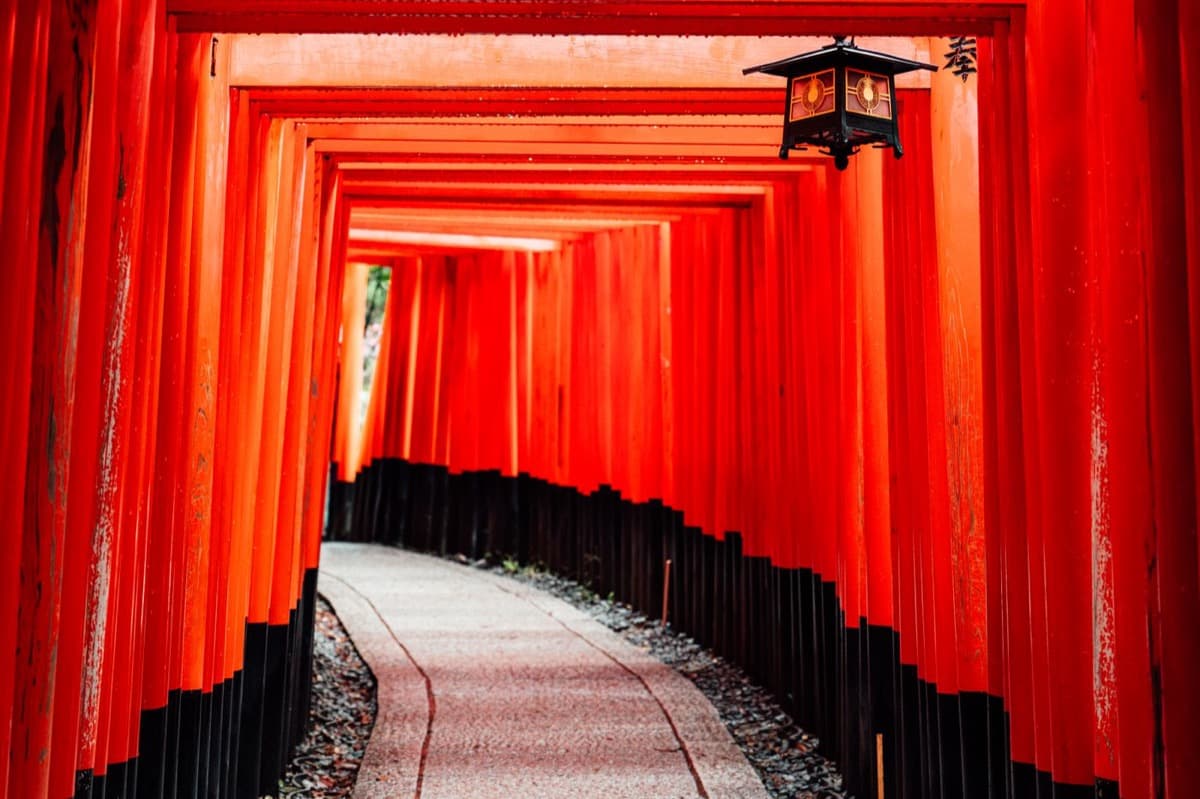
The vermilion tunnel of Fushimi Inari looks like pure beauty, but every one of its roughly ten thousand gates is a receipt. This climb reads the mountain as what it really is: a physical ledger of prayers to a god of rice and money.
Start · Romon Gate: A Warlord's Receipt
DirectionsStops
- 1
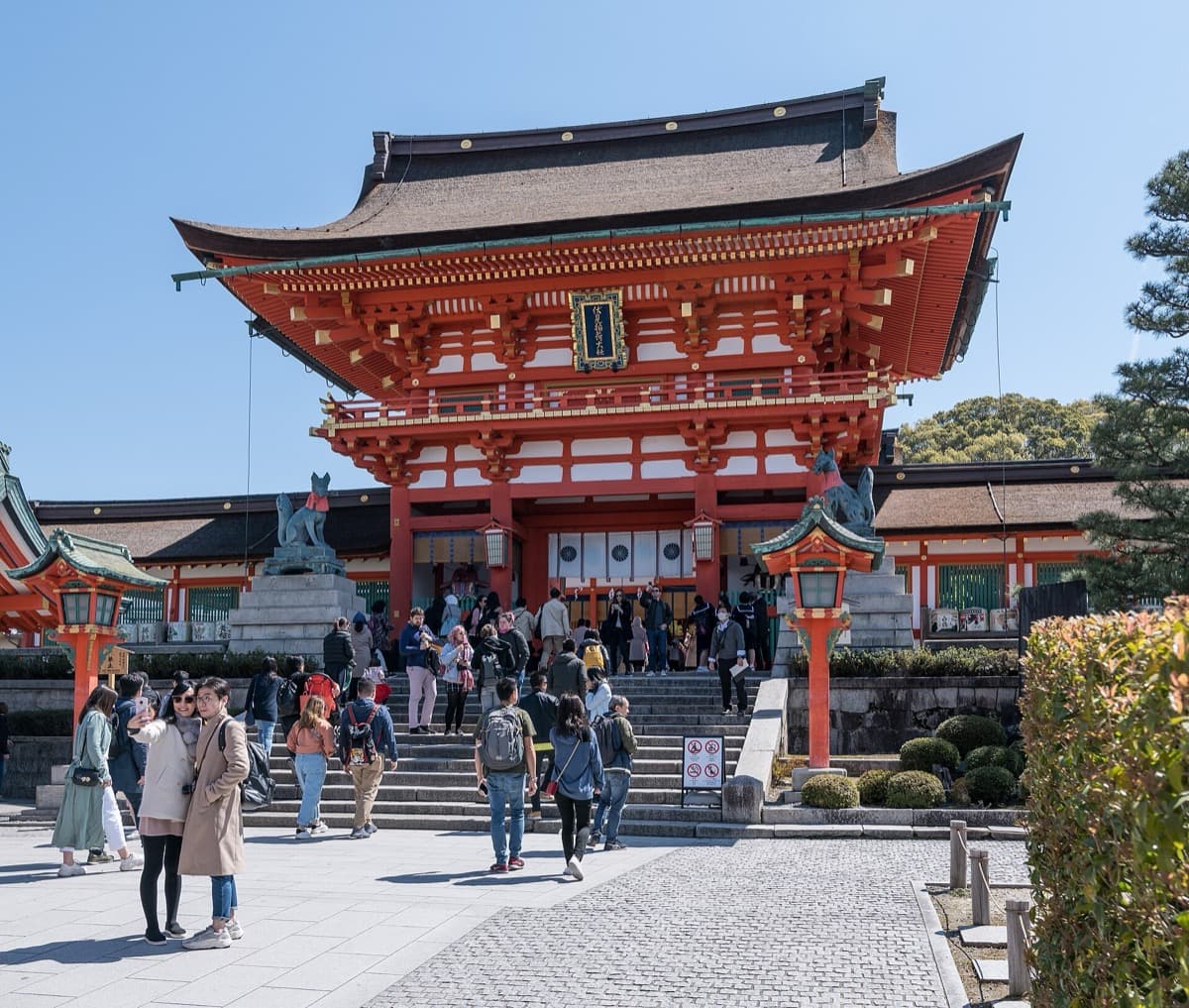
Romon Gate: A Warlord's Receipt
The towering vermilion entrance gate, given by Japan's most powerful warlord as payment on a prayer for his dying mother.
- 2
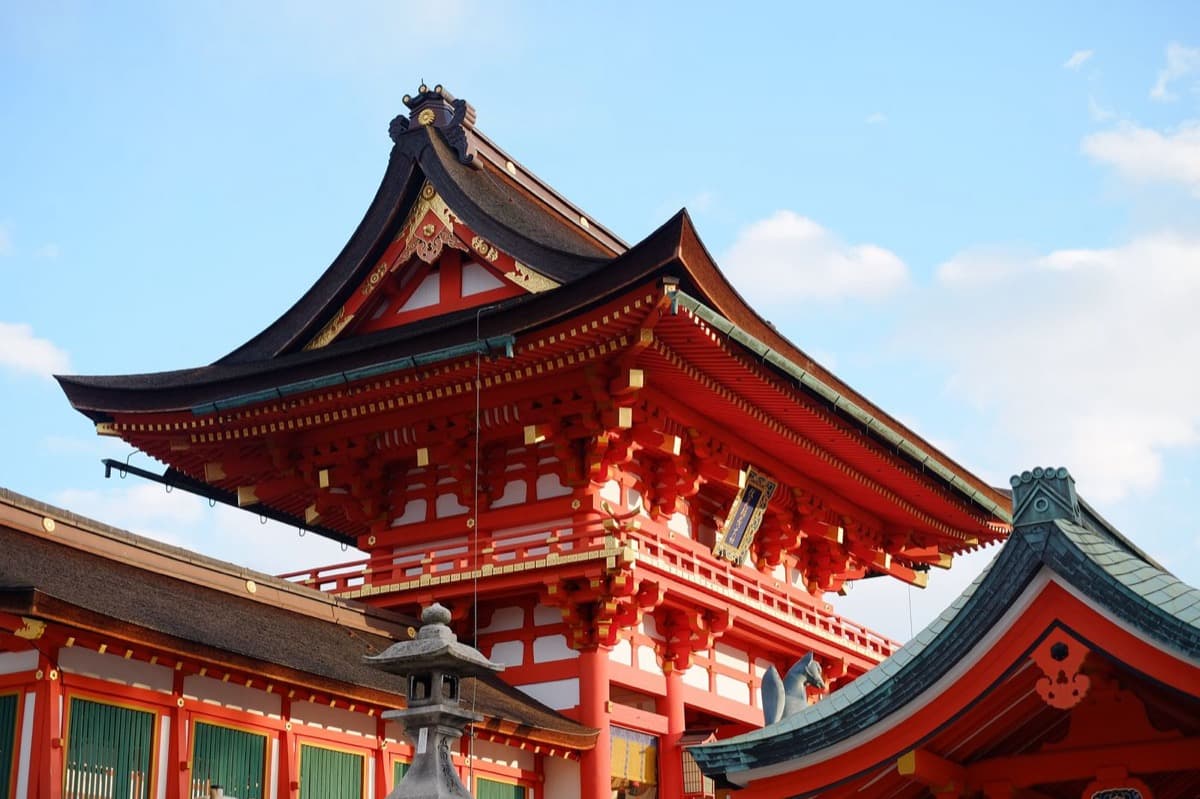
The Main Hall: Rice, Then Money
The main shrine is where a god of rice quietly became a god of business. It was rebuilt after war and fire.
- 3
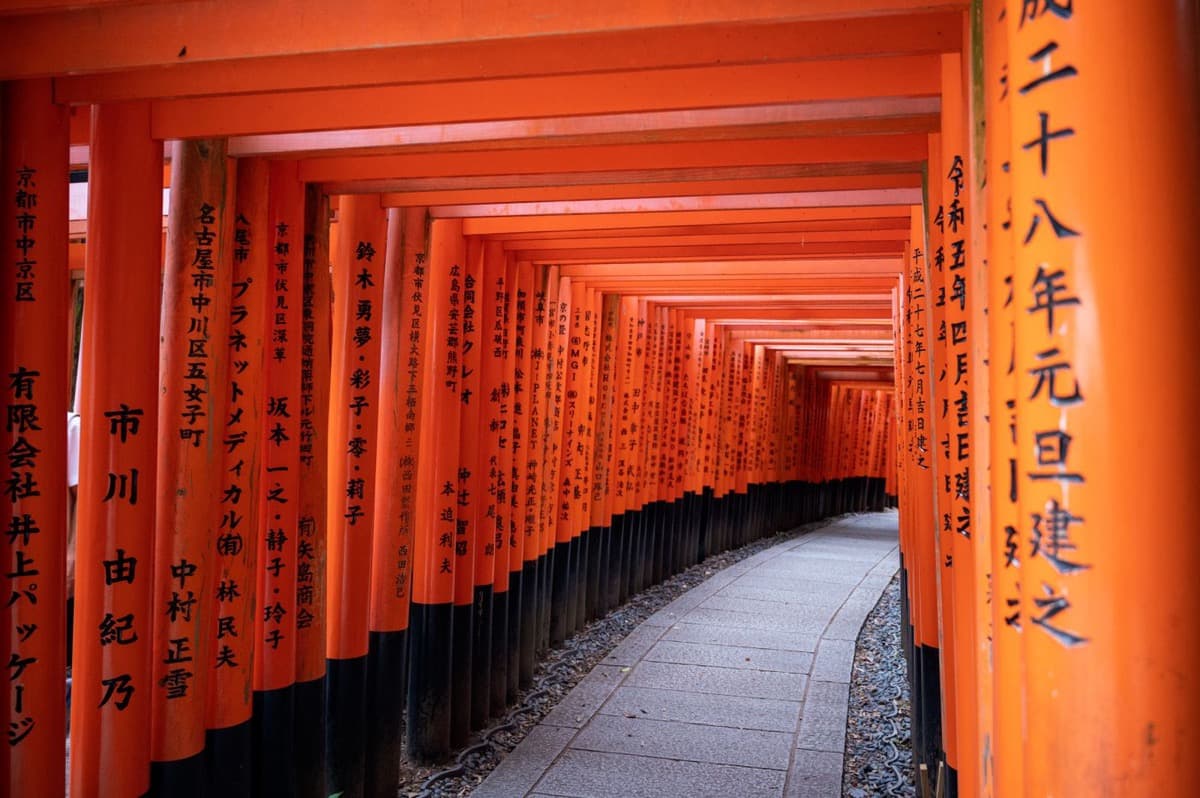
Senbon Torii: Reading the Back of the Gates
The famous tunnel of a thousand gates, revealed as a ledger with every donor's name and date on the hidden reverse.
- 4
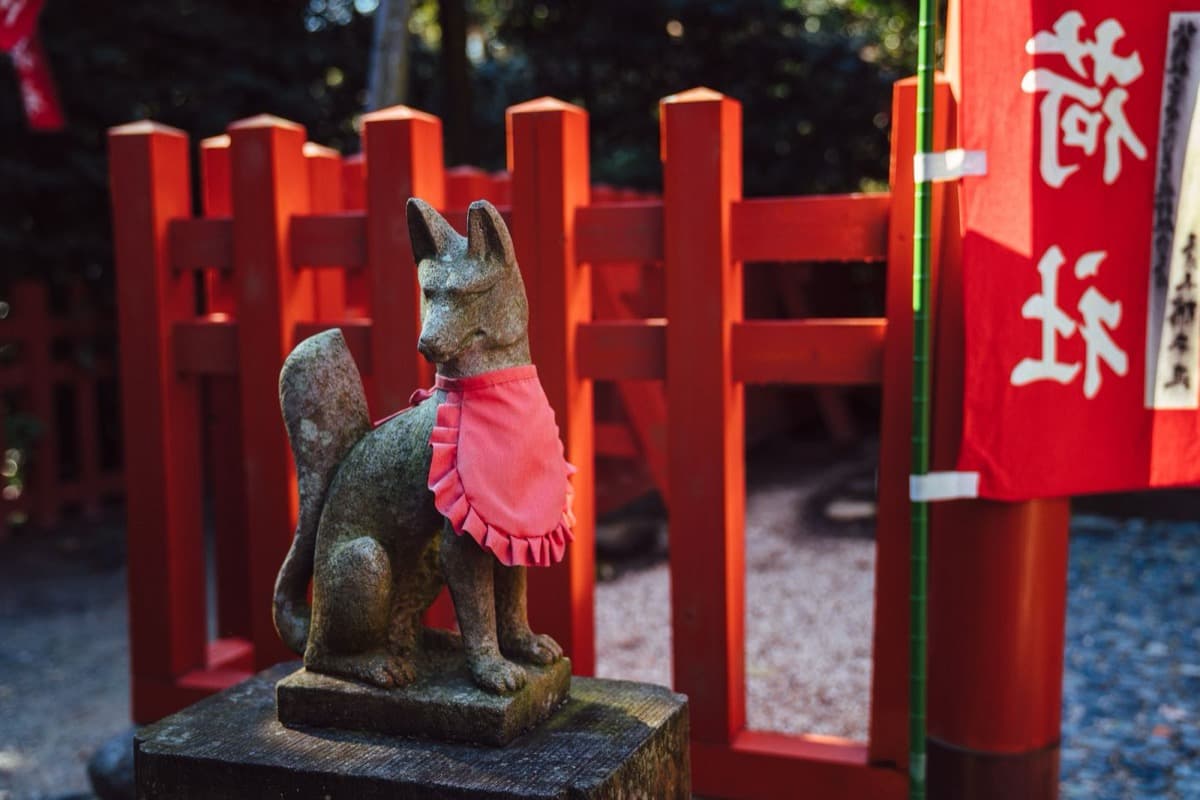
Okusha Hohaisho: Weigh Your Wish
The rear worship hall where you lift a stone with your bare hands to learn whether your wish will come true.
- 5
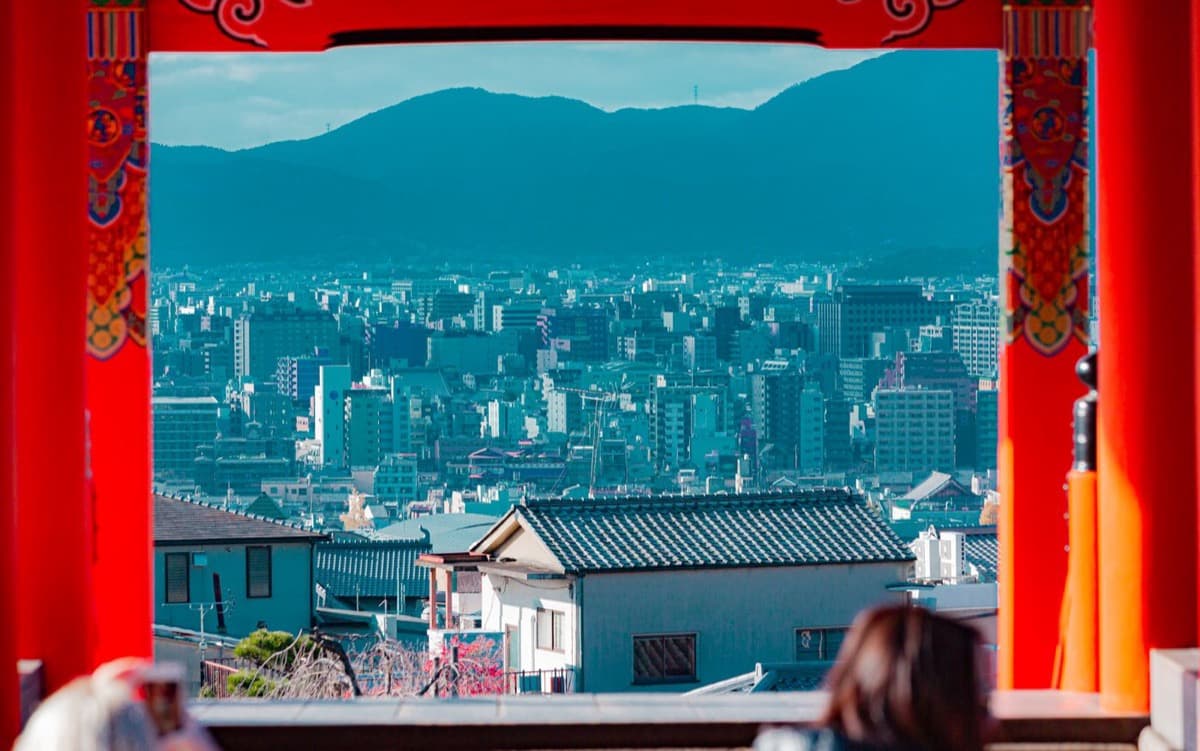
Yotsutsuji: The Crossroads Where Most Turn Back
The halfway crossroads with the best city view of the climb, where the trail loops and most visitors head home.
- 6
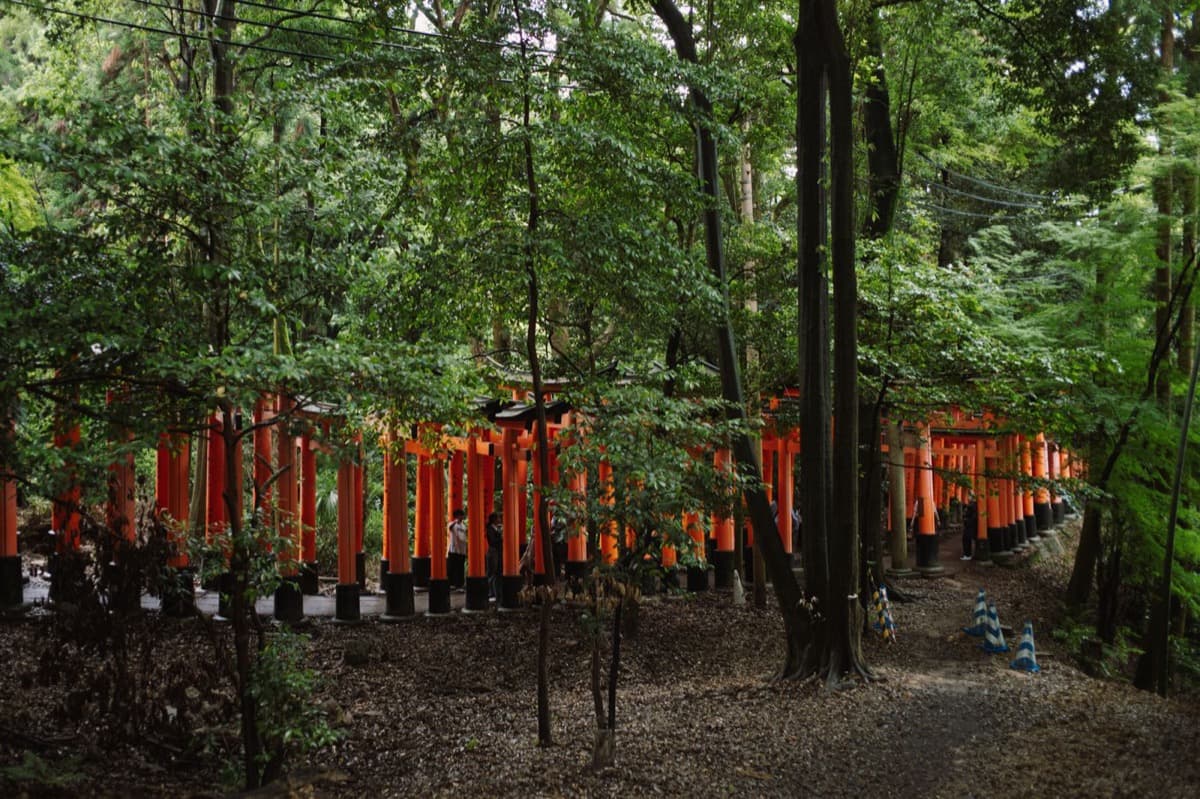
Ichinomine: The Top of the Ledger
The forested summit of Mount Inari, the highest of three peaks, where the gates and crowds finally thin into silence.
Details
Best Time to Visit
Early morning, ideally before eight, or in the evening after the day crowds thin. The shrine has no gates to close and is open all day and night, so a dawn or dusk climb gives you the tunnel nearly to yourself and cooler air for the ascent. Autumn brings comfortable walking weather, while summer climbs are best done at first light to beat Kyoto's heat and humidity.
Pro Tips
- •Wear real walking shoes, not sandals. This is a mountain climb of about four kilometers over uneven stone steps, not a flat stroll through a garden.
- •Carry water, especially from late spring through early autumn. There are vending machines partway up, but they thin out and cost more the higher you go.
- •Photograph the tunnel near the bottom in early morning, then turn around and look back down the path to read the black donor names and dates lacquered on the reverse of each gate.
- •Decide your turnaround point at Yotsutsuji, the halfway crossroads. It has the best city view of the whole climb, so even a shorter walk feels complete if you stop there.
- •Bring cash or a charged IC transit card for the train, snacks, and any small charms. Smaller shrine stalls and vending machines are not reliably set up for foreign cards.
- •Budget the timing honestly: the full summit loop runs roughly two hours round trip, so start with enough daylight or enough energy left if you intend to reach Ichinomine.
Safety & Precautions
- •The upper trail is a genuine mountain path with steep stone steps and tree roots. Watch your footing, particularly after rain when stone gets slick.
- •Kyoto summers are hot and very humid. Pace yourself, rest at the crossroads, and turn back if you feel overheated rather than pushing for the summit.
- •This is an active place of worship, not a theme park. Keep your voice down near the halls, do not block the narrow gate rows for long photo sessions, and follow any posted requests.
- •The summit is forested with no city view, and light fades fast under the trees. If you climb late in the day, carry a phone light and give yourself time to descend safely before dark.
Travel advisory: Exercise Normal Precautions (Level 1).
Gallery
Related Reading
Go deeper on what you'll see, hear, and walk through.
Overview
Best Self-Guided Walking Tours in Kyoto (2026)
3 min
Overview
Kyoto Travel Guide: How Many Days, Getting Around, When to Go (2026)
4 min
Overview
One Day in Kyoto: A Walkable South-East Itinerary (2026)
5 min
Thematic
Best Culture Walking Tours in Kyoto (2026)
2 min
Deep dive
Senbon Torii: Why Ten Thousand Gates Climb the Mountain at Fushimi Inari
5 min
Deep dive
The Romon Gate at Fushimi Inari: A Warlord's Receipt for a Prayer
6 min
Read the walk
The full story of Fushimi Inari: Ten Thousand Gates, in words. Prefer to listen? Play it narrated, from home or on location.
Introduction
Most people come to Fushimi Inari for one image: an endless tunnel of vermilion gates glowing on a hillside. It is one of the most photographed places in Japan, and the pictures do not lie. What they leave out is the accounting. Almost every one of the roughly ten thousand gates on this mountain was paid for. Each was donated by a company, a shop, or a family, and on the back of each, in black lacquer, you will find the donor's name and the date they gave it. The beauty is real. It is also a byproduct. What you are walking through is a database of gratitude, gate after gate, a receipt for a prayer someone believed was answered. The deity here, Inari, began as the kami of rice and farming. Rice was wealth, so over the centuries merchants came to worship Inari as the patron of commerce, and a farming god quietly became a money god. Once that happened, people paid for outcomes and marked the transaction in vermilion for all to see. This walk, in Kyoto, Japan, is a climb, and it moves in one direction: up. Go at your own pace, stop where you want, and turn back whenever you like. There is no entrance fee, and the shrine is open all day and all night. Over six stops and about two hours you will climb roughly four kilometres, from a great tower gate a warlord bought for his sick mother to the quiet summit where the gates thin into forest. When you arrive at the Romon Gate, begin with stop one.
1. Romon Gate: A Warlord's Receipt
You are standing at the foot of the shrine, and above you rises a two-story vermilion tower gate, the Romon. It is one of the oldest and largest gates of its kind in Kyoto, and it is here because of a deal. According to the shrine's own records, it was donated in fifteen eighty-nine by Toyotomi Hideyoshi, the warlord who had unified Japan and was, at that moment, the most powerful man in the country. His mother, known as Omandokoro, had fallen ill. So Hideyoshi did what farmers and merchants had long done at this mountain. He prayed to Inari, and he made an offer. His written prayer reportedly asked the god for three more years of his mother's life, or two, or at the very least thirty more days, in exchange for an offering of ten thousand koku of rice. A koku was a measure of rice, roughly a year's worth for one person, so ten thousand koku was a fortune. His mother recovered. And Hideyoshi paid. He funded this gate as the fulfillment of that vow. Centuries later, during repairs, workers found a text dated fifteen eighty-nine that confirmed the whole account. Stand here and take in what that means. The richest, most powerful man in Japan treated a rice god like a lender. He named a price, asked for an outcome, got it, and settled the account by building something enormous and permanent, with the transaction essentially written into it. Everything above you on this mountain runs on the same logic, just at a smaller scale. Ten thousand gates. Ten thousand prayers. Ten thousand people who wanted something and were willing to pay for it. Hideyoshi simply had the means to make his receipt this tall.
2. The Main Hall: Rice, Then Money
You are now before the Honden, the main hall, where the Inari deities are enshrined. It looks settled and permanent, but the building you see is a survivor. The shrine dates its founding all the way back to the year seven hundred and eleven, when, according to its own history, the deity Inari took up residence on this mountain. That makes this one of the truly ancient sacred sites of Japan. But ancient things burn. During the Onin War, a conflict that gutted much of Kyoto, the shrine's buildings on and below the mountain were destroyed by fire in the attack of fourteen sixty-eight. What stands here was rebuilt in fourteen ninety-nine, and five centuries later, in nineteen ninety-nine, the shrine held a ceremony marking that rebuilding's five hundredth anniversary. Now here is the pivot that explains this whole mountain. Inari began as the kami of rice and agriculture. A farming god. But think about what rice was in old Japan. Rice was food, rice was tax, rice was salary, rice was wealth itself. Hideyoshi paid his vow in rice for a reason. So as centuries passed, the people who prayed here changed. Farmers still came, but so did merchants, and shopkeepers, and eventually entire companies, all worshipping Inari as the patron of commerce and prosperity. The god of the harvest became the god of the ledger. That transformation is the reason for everything above you. Once a rice god had become a business god, paying for a gate to secure success or to say thank you for success made perfect sense. The Inari worshipped here is honored as three deities, enshrined across the mountain's three peaks. Keep that number in mind as you climb, because you are about to walk up through the physical proof of what happens when a farming god learns the language of money.
3. Senbon Torii: Reading the Back of the Gates
This is the image you came for. Behind the main shrine, the path splits into two dense parallel rows of vermilion gates, climbing the ridge so tightly packed that they form a glowing tunnel. It is called Senbon Torii, which means thousand torii. Roughly eight hundred gates line…
Full narration for this stop unlocks with the tour.
4. Okusha Hohaisho: Weigh Your Wish
Where the twin rows of gates finally end, you arrive at the Okusha Hohaisho, the rear worship hall. After the mass scale of the tunnel, all those corporate names and dated receipts, this spot makes the transaction personal again. Behind the hall stand a pair of stone lanterns,…
Full narration for this stop unlocks with the tour.
5. Yotsutsuji: The Crossroads Where Most Turn Back
You have climbed for a while now, maybe thirty to forty-five minutes of steady steps, and you have reached Yotsutsuji, a name that means four crossroads. This is the four-way junction that sits roughly halfway up Mount Inari, and it is a genuine decision point. Turn and look…
Full narration for this stop unlocks with the tour.
6. Ichinomine: The Top of the Ledger
You kept going. Past the crossroads, up through the looping trail where the gates spread apart and the forest presses in, you have reached Ichinomine, the first peak. The shrine's own maps mark this as the mountain's highest point. It is the summit of Mount Inari, which rises…
Full narration for this stop unlocks with the tour.