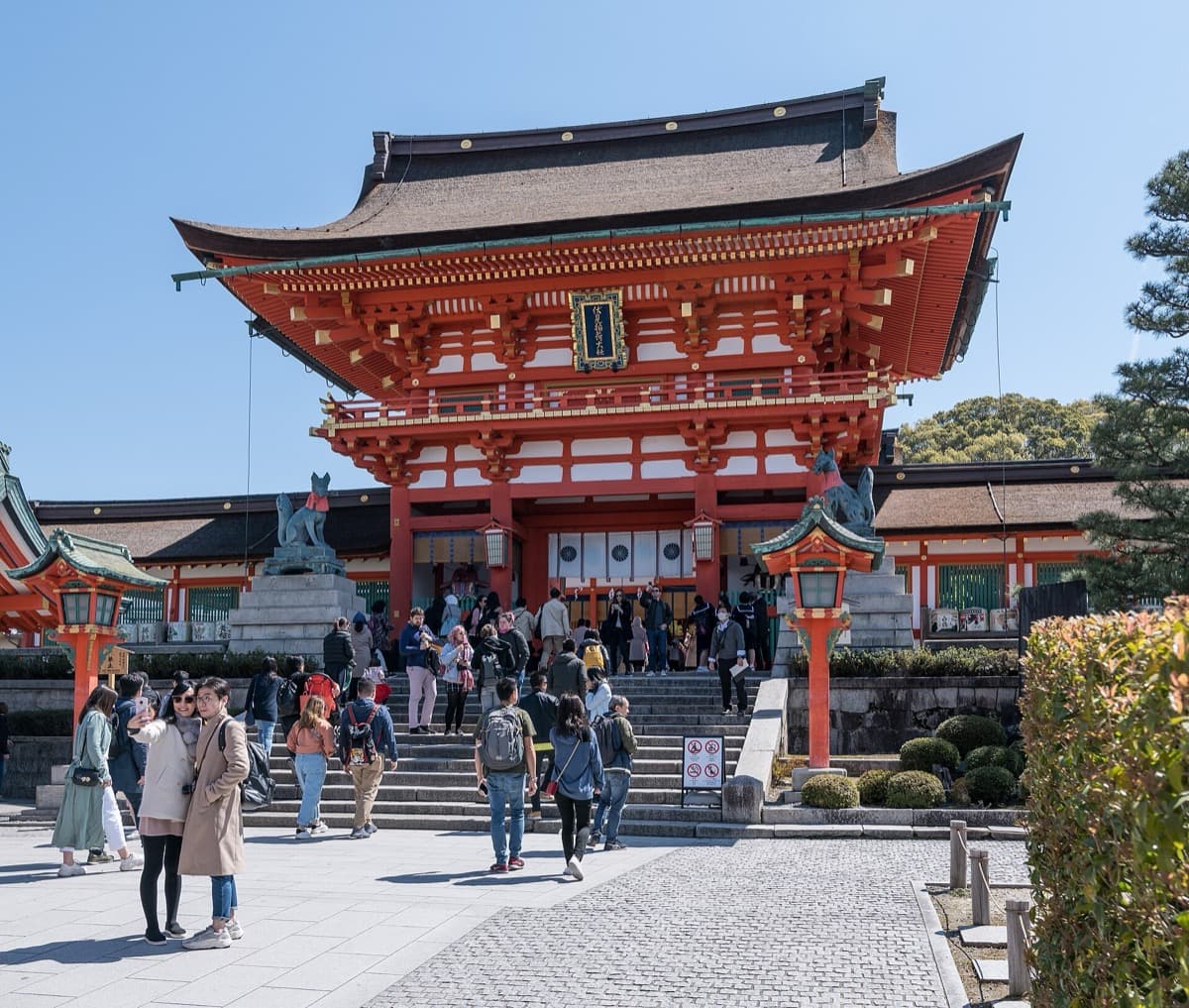
The two-story vermilion tower gate that greets you at the foot of Fushimi Inari is a receipt. In 1589, Toyotomi Hideyoshi, the warlord who had unified Japan and was then the most powerful man in the country, paid for it to settle a bargain he made with a rice god over the life of his sick mother. Most visitors read the gate as an entrance, a beautiful threshold before the famous tunnel of torii above. It is better understood as the first and loudest line in a ledger of paid prayers that runs all the way up the mountain. Hideyoshi named a price, asked for an outcome, got it, and built something enormous and permanent to mark that the account was closed.
A Bargain Struck With a God of Rice
The story survives in the shrine's own records, and it is unusually specific for a legend. Hideyoshi's mother, known as Ōmandokoro, had fallen ill. So Hideyoshi did what farmers and merchants had done at this mountain for centuries. He prayed to Inari, the deity enshrined here, and he made an offer. According to the shrine, his written pledge promised the god an offering of ten thousand koku of rice if his mother recovered.
That number is worth pausing on. A koku was a standard measure, defined as roughly the amount of rice needed to feed one person for a year. Ten thousand koku was therefore not an abstract sum. It was the same threshold that separated a minor lord from a daimyō, a genuine fortune even for a man who controlled the country. Hideyoshi was not lighting incense and hoping. He was writing a contract, with a condition and a price attached, the way a debtor sets terms.
His mother recovered. And Hideyoshi paid. According to the shrine, he funded the Romon gate in 1589 as the fulfillment of that vow. Some accounts date the prayer and the start of construction to 1588, with the gate finished the following year, which is why you will see the earlier date in a few sources. The shrine's official history fixes the donation itself at 1589.
The Text Found Inside the Gate
Hear a stop from this walk
Senbon Torii: Reading the Back of the Gates
For a long time this account sat where most shrine legends sit, in the gray zone between history and pious embellishment. There was little to separate a good story from the record. Then the gate itself supplied the proof.
When the Romon was dismantled for repair, workers found a text written in sumi ink dated to 1589, the year of the donation. That inscription, the shrine says, confirmed that Hideyoshi's pledge was real. This is the part that turns the gate from a nice tale into something more interesting. The transaction was not just remembered. It was documented, and the documentation was hidden inside the very object the money paid for. The gate is not merely a monument to a prayer. It is a monument with the paperwork sealed inside it.
Why a Warlord Prayed to a Rice God
To understand why the most powerful man in Japan treated a deity like a lender, you have to understand who Inari was. Inari began as the kami of rice and agriculture, a farming god, and the shrine dates the deity's arrival on this mountain to the year 711. But think about what rice was in old Japan. Rice was food, but it was also tax, salary, and stored wealth. Domains were measured in koku. Samurai were paid in koku. Rice was, in a real sense, the currency.
So over the centuries the people who prayed here changed. Farmers still came, but so did merchants, shopkeepers, and eventually whole companies, all worshipping Inari as a patron of commerce and prosperity. A god of the harvest quietly became a god of the ledger. Hideyoshi's decision to pledge his offering in rice was not a quaint gesture. It was the natural language of a mountain where prosperity and prayer had already merged. He simply did it at a scale no one else could match.
The Tallest Receipt on the Mountain
Stand at the Romon and look up, and the logic of everything above you comes into focus. The gate is designated an Important Cultural Property of Japan and is described by the shrine as the largest romon gate in Kyoto. It marks the boundary between the ordinary world and the sacred precinct, a threshold Hideyoshi paid handsomely to raise.
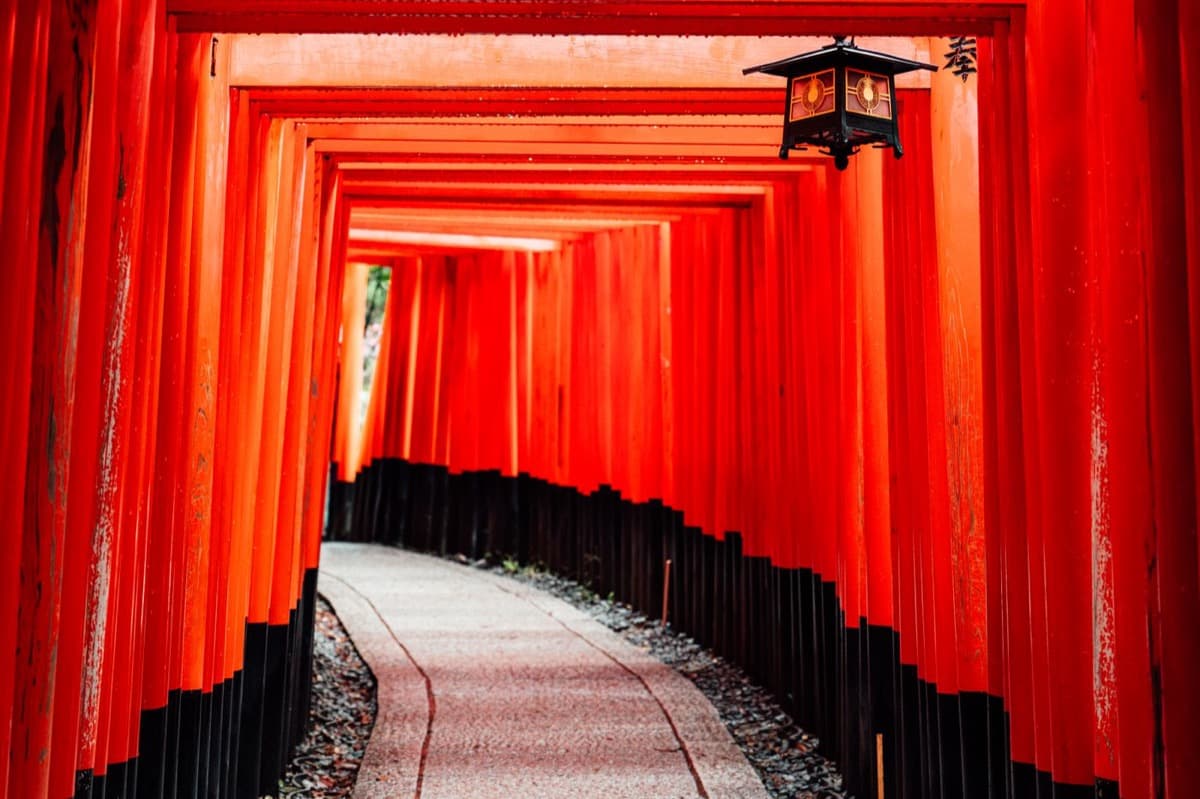
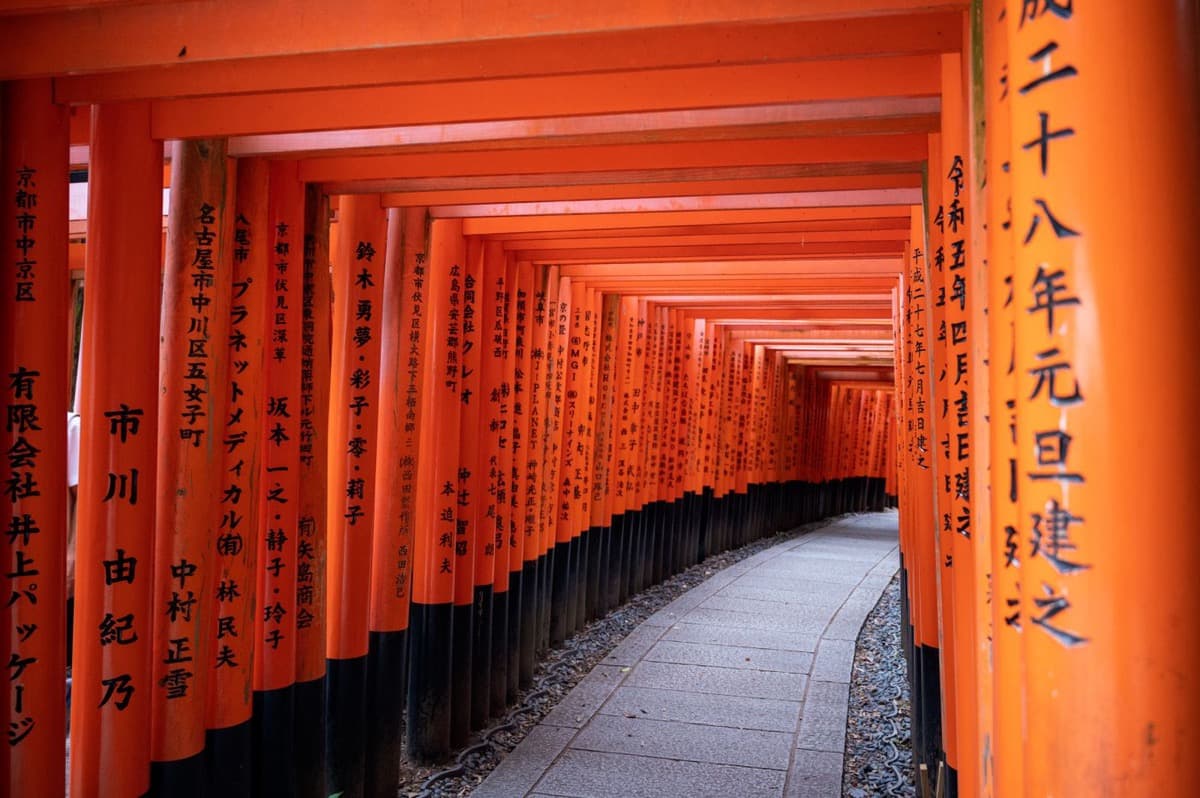
Everything higher on the mountain runs on the same logic, just smaller. The famous Senbon Torii, the dense tunnel of vermilion gates, is made of individual donations, each one paid for by a company or a family, each one carrying a name and a date lacquered in black on the reverse. Roughly eight hundred gates line the main rows, and across the whole mountain the count of gates is said to reach around ten thousand. Every one is a receipt for a prayer someone believed was answered or hoped soon would be. Hideyoshi's gate is not a different kind of thing from those smaller torii. It is the same kind of thing, built by a man who could afford to make his receipt this tall.
That reframing changes how the climb feels. The tunnel of gates is genuinely beautiful, and the pictures do not lie. But the beauty is a byproduct of accounting. What looks like pure spectacle is really a database of gratitude, gate after gate, and the Romon is where the first entry was posted. When you walk beneath it, you are not passing through decoration. You are crossing into a mountain of paid promises, entering under the one a warlord bought to save his mother.
The shrine has no entrance fee and never closes, so you can read this ledger at dawn with the gates nearly to yourself. Start at the Romon, look up at what ten thousand koku bought, and then climb into the rest of the account. The full self-guided walk up Mount Inari begins right here at the gate, and you can trace the whole story bottom to top on the tour in Kyoto.
Sources
- Romon, Fushimi Inari Taisha official site: the shrine's own account of the 1589 donation, the vow over Hideyoshi's mother, the ten thousand koku offering conditioned on her recovery, and the sumi-ink text found during repair.
- Fushimi Inari-taisha, Wikipedia: founding in 711, Mount Inari at 233 meters, Inari as the kami of rice and patron of merchants, the two-story entry gate attributed to Hideyoshi, the roughly eight hundred main-path gates, and the ten thousand total.
- Fushimi Inari Taisha Romon (Important Cultural Property), fudousin.com: the Romon's Important Cultural Property designation, its standing as the largest romon gate in Kyoto, and the Hideyoshi construction dates.
- Koku, Wikipedia: the koku as roughly a year's rice for one person, and ten thousand koku as the daimyō threshold.
Ready to experience it?
Fushimi Inari: Ten Thousand Gates
120 min · 4 km · hard
More from Kyoto
Explore more at your own pace.
Kyoto Travel Guide: How Many Days, Getting Around, When to Go (2026)
One Day in Kyoto: A Walkable South-East Itinerary (2026)
What to Eat in Kyoto: A Food Guide (2026)
Kiyomizu-dera's Wooden Stage: The Icon of Ancient Kyoto That Was Rebuilt in 1633
Senbon Torii: Why Ten Thousand Gates Climb the Mountain at Fushimi Inari