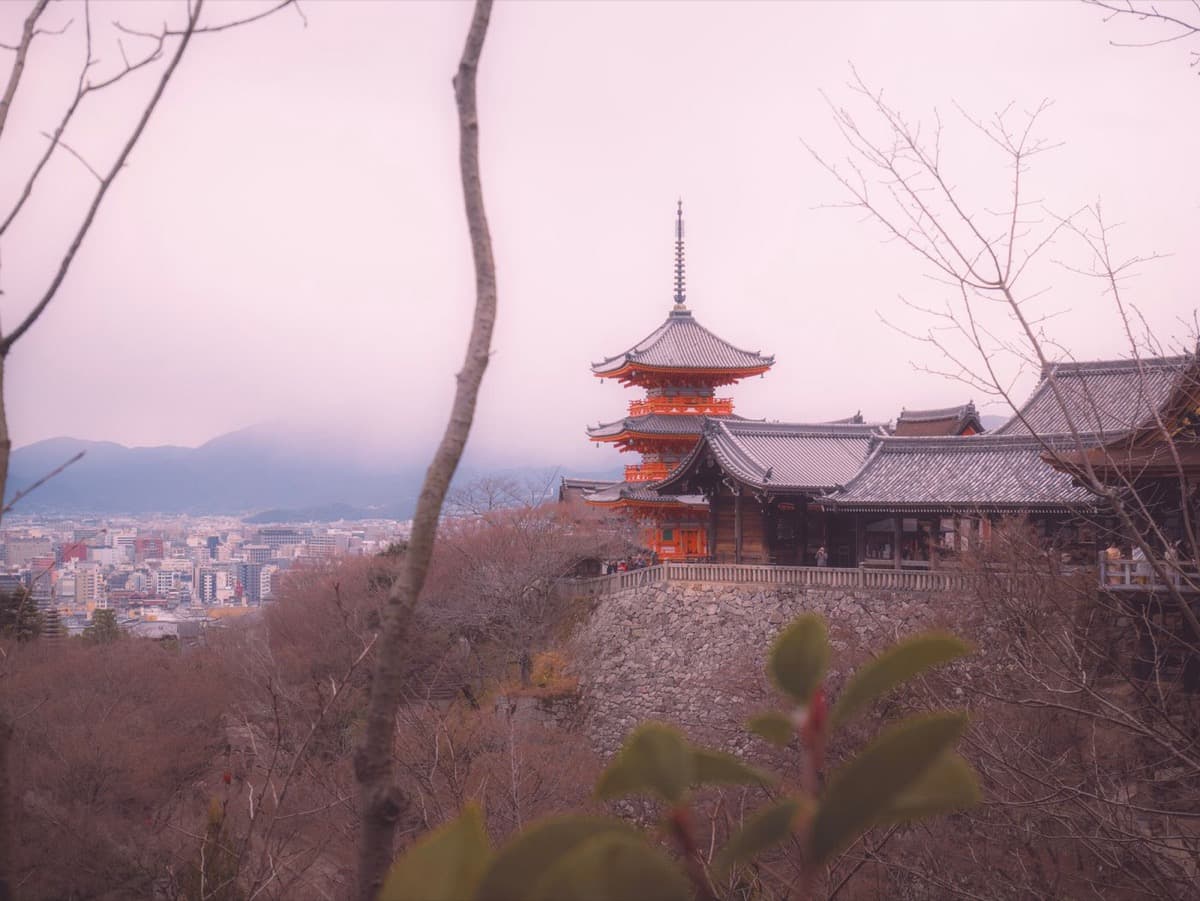
The wooden stage at Kiyomizu-dera is the image people carry home from Kyoto, and it defines what ancient Japan is supposed to look like. It is also not what it appears to be. The platform you stand on is not an untouched survivor of a thousand years. It is a seventeenth-century reconstruction, rebuilt in 1633 after a fire destroyed the hall before it, cantilevered out over the Otowa valley on 139 wooden pillars locked together with crossbeams and not a single nail. The temple is genuinely old. The famous stage is not the same thing as the temple, and telling the two apart changes how you see the whole hillside.
An old temple, a younger stage
Kiyomizu-dera dates its founding to the year 778, and in that sense it truly is an anchor of the eastern hills, a fixed point for well over a thousand years. Its early patronage is traditionally linked to the warrior-official Sakanoue no Tamuramaro, who lived from 758 to 811. But a founding date is not a construction date. The main hall you walk onto, the one with the projecting stage, was rebuilt in 1633, after a fire in 1629 took the earlier building. The reconstruction was helped along by a donation from Tokugawa Iemitsu, the third Tokugawa shogun.
So the very first thing most visitors photograph in Kyoto, the picture that stands in for antiquity itself, is a rebuild from the Edo period. That is not a disappointment once you understand it. It is the more interesting truth. What looks like accidental survival is really continuity as an act of will, one generation after another choosing to raise the past back up rather than let it stay gone.
How it grips the slope
Hear a stop from this walk
Yasaka Shrine: Engineered Against Plague
Look closely at how the stage is made, because the engineering is the point. It is built in the kakezukuri style, a technique for extending a structure outward over a slope when there is no flat ground to build on. Instead of digging into the hillside, the builders reached out over it, resting the platform on a lattice of tall wooden columns. There are 139 of these pillars, joined with horizontal beams into a self-supporting frame that uses no nails at all. The whole assembly relies on precise joinery and compression, the timbers holding one another in place.
The stage stands about 13 meters above the hillside below. That is roughly the height of a four-story building, projecting into open air over the treetops. The same structural idea, building outward on stilts to grip a mountainside, appears at other temples across Japan, but nowhere is it as famous or as photographed as here. When you understand that the platform is held up by wood alone, arranged so that the load holds itself together, the sense of fragility you feel standing on it becomes something closer to respect for the craft.
The gamble that entered the language
In the Edo period, people took the height of the stage literally. A belief spread that if you jumped from the platform and survived the fall, your wish would be granted. This was not a rumor with no paper trail. Temple records document 234 leaps from the stage between 1694 and 1864, and roughly 85 percent of the jumpers survived, cushioned by the thickly forested slope below that broke many of the falls.
That gamble left a permanent mark on the Japanese language. To this day, the phrase kiyomizu no butai kara tobioriru, to jump off the stage at Kiyomizu, means to take a bold and irreversible plunge: to finally buy the house, quit the safe job, or say the thing you have been holding back. The idiom outlived the practice. When someone uses it now, they are invoking a specific wooden platform on a specific hillside, most of them never realizing the numbers behind the expression are real and were written down.
Water, a wish, and World Heritage
Below the main hall, three thin channels of the Otowa waterfall fall into a pond. The temple takes its name from this water: Kiyomizu means pure water. Visitors line up to drink from one of the three streams using long-handled cups, each channel associated with a different blessing, taking a sip for a wish of their own. It is a quieter ritual than the old leap from the stage, and it has outlasted it by centuries.
Kiyomizu-dera was inscribed on the UNESCO World Heritage list in 1994 as part of the Historic Monuments of Ancient Kyoto, grouped under reference number 688. The listing recognizes not a single frozen object but a living site that has been maintained, repaired, and rebuilt across generations. That is the honest shape of its history. The stage that reads as the oldest thing in Kyoto is one of the more rebuilt, and it endures precisely because people kept choosing to rebuild it.
Why the rest of the walk reads differently
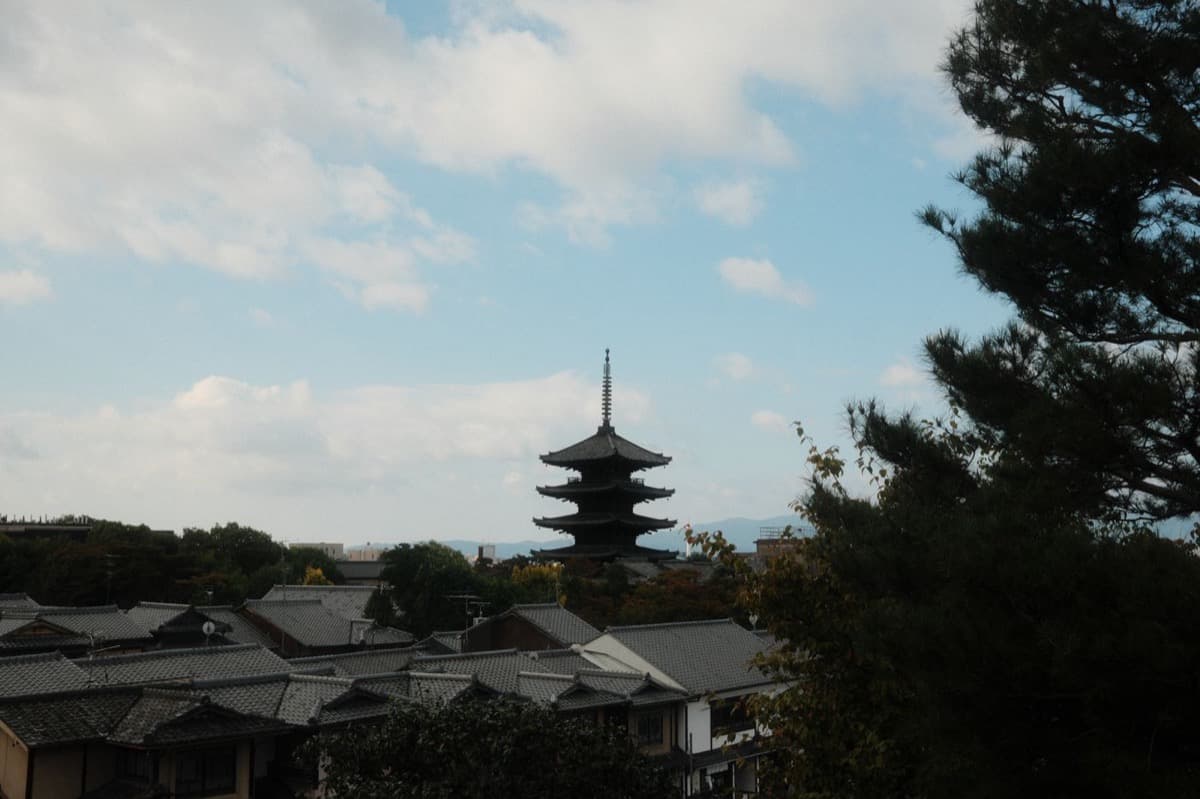
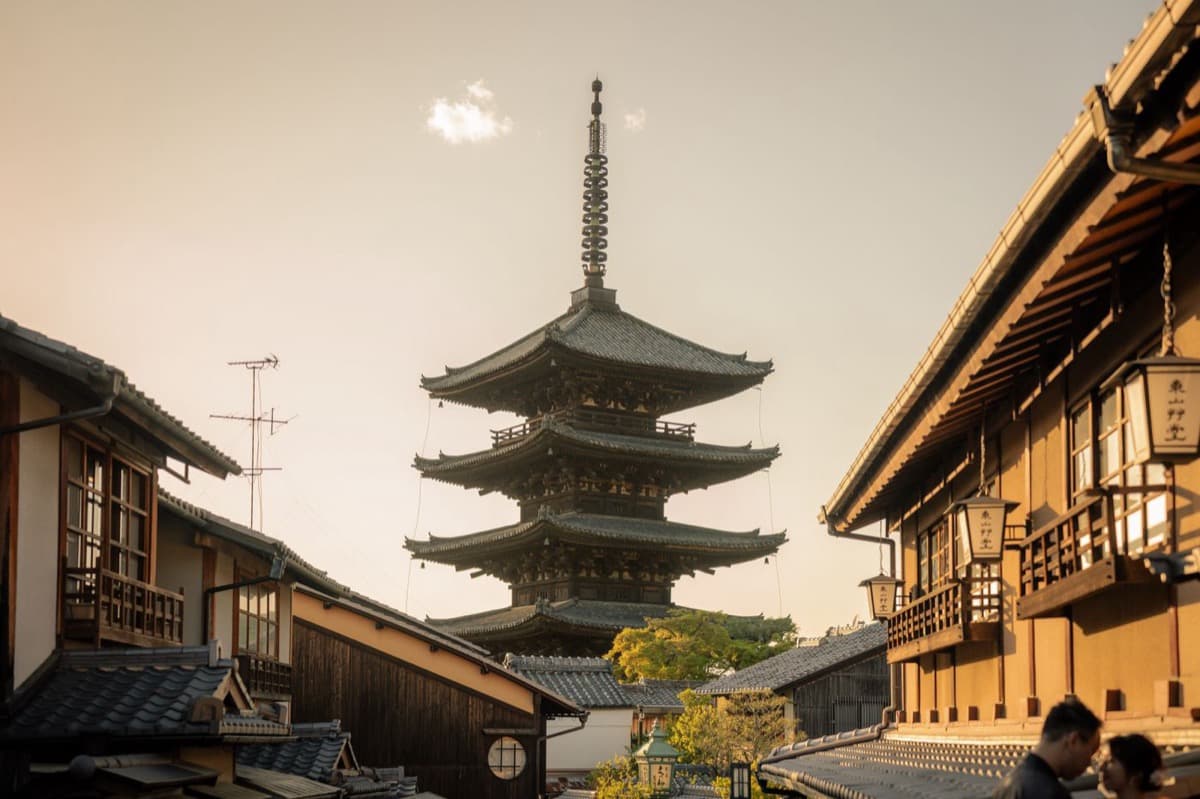
Once you know the stage is a reconstruction, the rest of Higashiyama starts to give up the same secret. The stepped lanes of Sannenzaka and Ninenzaka look untouched because a 1976 national preservation law made them stay that way, burying the power lines and regulating the shopfronts. The Yasaka Pagoda nearby is the last tower of a vanished temple, rebuilt in 1440 after fire took the versions before it. Even the stone alley of Ishibei-koji, the most ancient-feeling corner of all, was largely laid out in the early twentieth century, designed from the start to look centuries older.
Kiyomizu-dera is the doorway into that pattern, which is why the walk begins here. Stand on the stage, feel how permanent it seems, then carry the small correction downhill with you: what looks most timeless was the most deliberately made. To trace the full arc from this stage down through the engineered lanes to Yasaka Shrine, the Higashiyama walking tour starts at these steps. You can explore more of the city at /japan/kyoto.
Sources
- Kiyomizu-dera, Wikipedia: founding date of 778, the 1633 reconstruction after the 1629 fire, the kakezukuri structure and 139 pillars, and the documented 234 jumps at roughly 85 percent survival between 1694 and 1864.
- Historic Monuments of Ancient Kyoto, UNESCO World Heritage List (ref 688): the 1994 inscription that includes Kiyomizu-dera.
- Old Japanese stories: the Kiyomizu-dera proverb, Muza-chan: the idiom "to jump off the stage at Kiyomizu" and its modern meaning of taking a daring plunge.
- Kiyomizu-dera Temple, Japan Guide: the Otowa waterfall's three channels, the pure-water naming, and visitor context for the main hall.
Ready to experience it?
Higashiyama: The Engineered Hillside
90 min · 2.5 km · moderate
More from Kyoto
Explore more at your own pace.
Kyoto Travel Guide: How Many Days, Getting Around, When to Go (2026)
One Day in Kyoto: A Walkable South-East Itinerary (2026)

What to Eat in Kyoto: A Food Guide (2026)
Senbon Torii: Why Ten Thousand Gates Climb the Mountain at Fushimi Inari
The Romon Gate at Fushimi Inari: A Warlord's Receipt for a Prayer