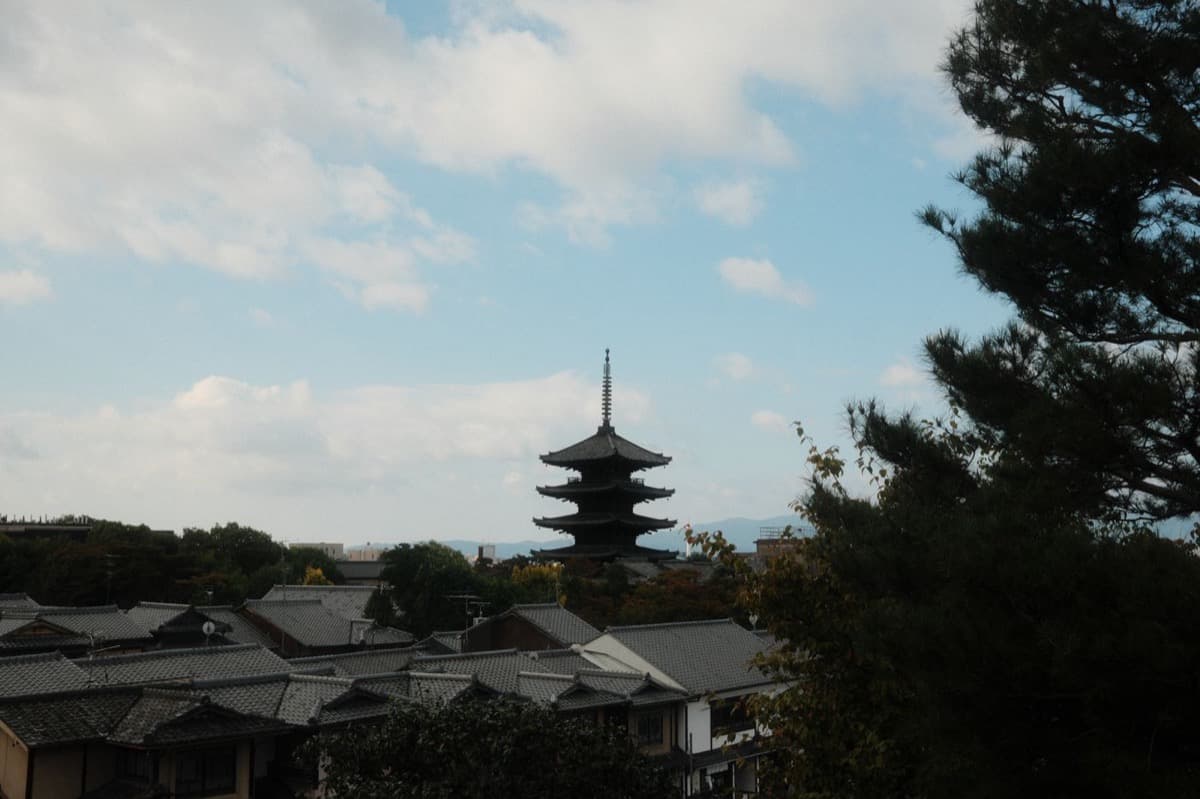
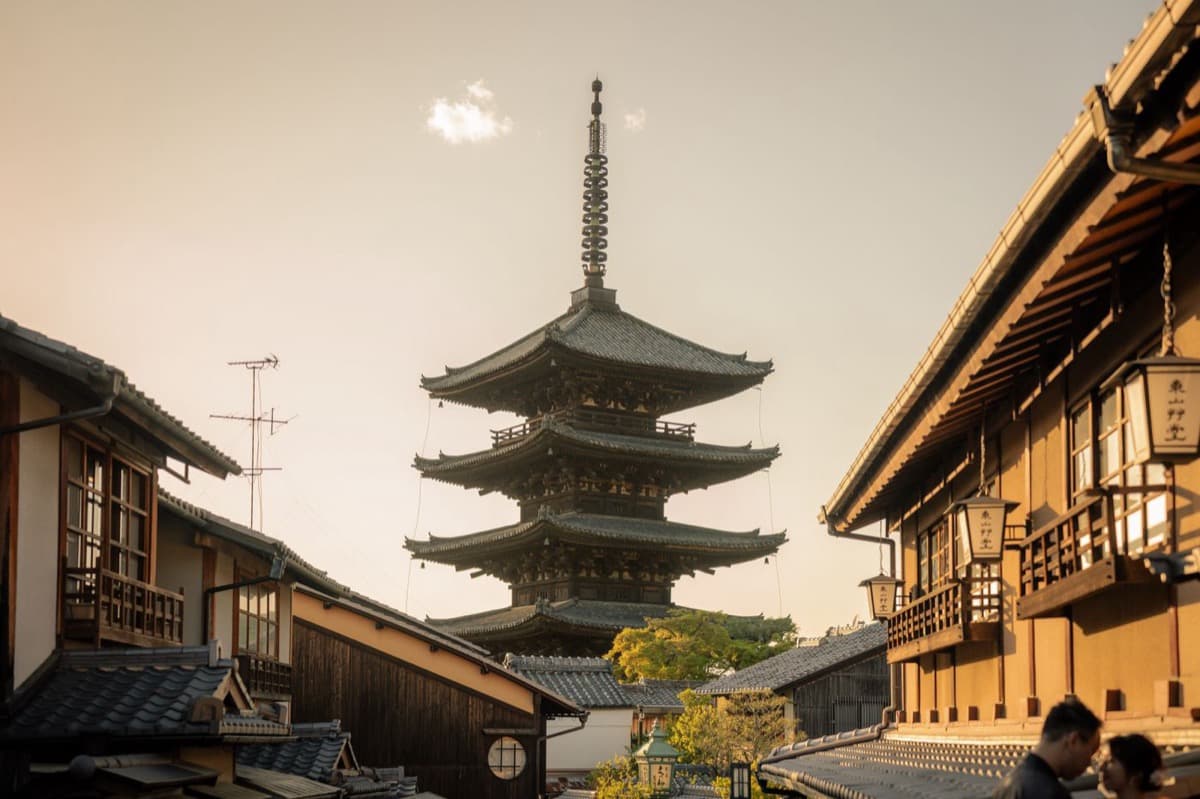
The pagoda that rises over the old lanes of Higashiyama is, for most visitors, the perfect Kyoto photograph: a five-storey wooden tower framed at the end of a sloping cobbled street, with everyone crowding to catch it. That is a shame, because the Yasaka Pagoda is far more than a backdrop. It is the last surviving structure of a temple founded in the sixth century, the sole remnant of a lost complex, rebuilt in its current form by a shogun in 1440. Read it as an ancient survivor rather than scenery, and it opens a window onto the deep time lying beneath Higashiyama's carefully preserved streets.
The last piece of a vanished temple
The pagoda belongs to a temple called Hokan-ji, and it is nearly all that remains of it. By tradition, the temple was founded in the sixth century, associated in legend with Prince Shotoku, the semi-legendary statesman who championed Buddhism in Japan's earliest Buddhist age, said to have raised it after a vision of the bodhisattva Kannon. Whatever the exact origin, the temple was one of the oldest in the area, and over the centuries almost all of it disappeared. What survived is the pagoda, standing alone where a full temple complex once spread. When you look at it, you are looking at the single enduring fragment of a sixth-century foundation, a tower that outlived everything built around it.
Destroyed, and rebuilt by a shogun
Hear a stop from this walk
Yasaka Shrine: Engineered Against Plague
The pagoda's survival was hard-won. Like so much of wooden Kyoto, it was destroyed and rebuilt several times, undone repeatedly by fire and lightning across the centuries. The structure standing today dates from 1440, when it was reconstructed during the Muromachi period under the shogun Ashikaga Yoshinori. That fifteenth-century rebuilding is the pagoda visitors see now, with its gracefully sloping tiled roofs stacked five deep. So the tower is at once very old in lineage and precisely dated in fabric: a sixth-century foundation carried forward through a fifteenth-century rebuild, a pattern that runs through all of Kyoto's oldest sites. Roamer's companion piece on Kiyomizu-dera, the great stage temple nearby, tells the same story of a famous structure repeatedly burned and rebuilt.
The tower that frames the district
The Yasaka Pagoda's role in Higashiyama is architectural in a second sense: it organizes the whole view. The old preserved lanes of the district, above all the famous sloping streets of Sannenzaka and Ninenzaka, are arranged so that the pagoda appears at their end, closing the view like a full stop. That is why the image is so beloved and so photographed. But the composition is not accidental scenery. It is the result of a genuinely ancient tower standing amid genuinely old lanes, streets that are, as Roamer's Higashiyama: The Engineered Hillside tour explains, legally protected to keep their old appearance. The pagoda is the anchor that makes the whole preserved hillside read as a single historic picture. Reach it early or late, and you can catch the tower with the lanes quiet, the way they were meant to be seen.
Reading it in place
Resist the urge to treat the Yasaka Pagoda only as a photo stop. Stand at its base and take in that this five-storey tower is the last survivor of a sixth-century temple, rebuilt in 1440 by a shogun. Then walk the sloping lanes of Sannenzaka and Ninenzaka and notice how they are composed to frame it. Early morning is the single best time: the light is soft, the crowds are thin, and the pagoda stands over empty old streets, which is when Higashiyama is at its most timeless.
The pagoda is a stop on Roamer's Higashiyama: The Engineered Hillside. To plan a day, see one day in Kyoto, and for the full set of routes, browse Kyoto walking tours.
Sources
- Wikipedia, Yasaka Pagoda: the pagoda as the last remaining structure of the sixth-century Hokan-ji temple complex, the traditional founding associated with Prince Shotoku, the repeated destruction by fire and lightning and reconstruction up to 1440, and the current pagoda rebuilt in 1440 during the Muromachi period under the shogun Ashikaga Yoshinori, in Higashiyama-ku, Kyoto.
- Roamer tour transcript, Higashiyama: The Engineered Hillside (kyoto-higashiyama), fact-audited: the Yasaka Pagoda and the legally preserved lanes of Sannenzaka and Ninenzaka.
Ready to experience it?
Higashiyama: The Engineered Hillside
90 min · 2.5 km · moderate
More from Kyoto
Explore more at your own pace.
Kyoto Travel Guide: How Many Days, Getting Around, When to Go (2026)
One Day in Kyoto: A Walkable South-East Itinerary (2026)

What to Eat in Kyoto: A Food Guide (2026)
Kiyomizu-dera's Wooden Stage: The Icon of Ancient Kyoto That Was Rebuilt in 1633
Senbon Torii: Why Ten Thousand Gates Climb the Mountain at Fushimi Inari