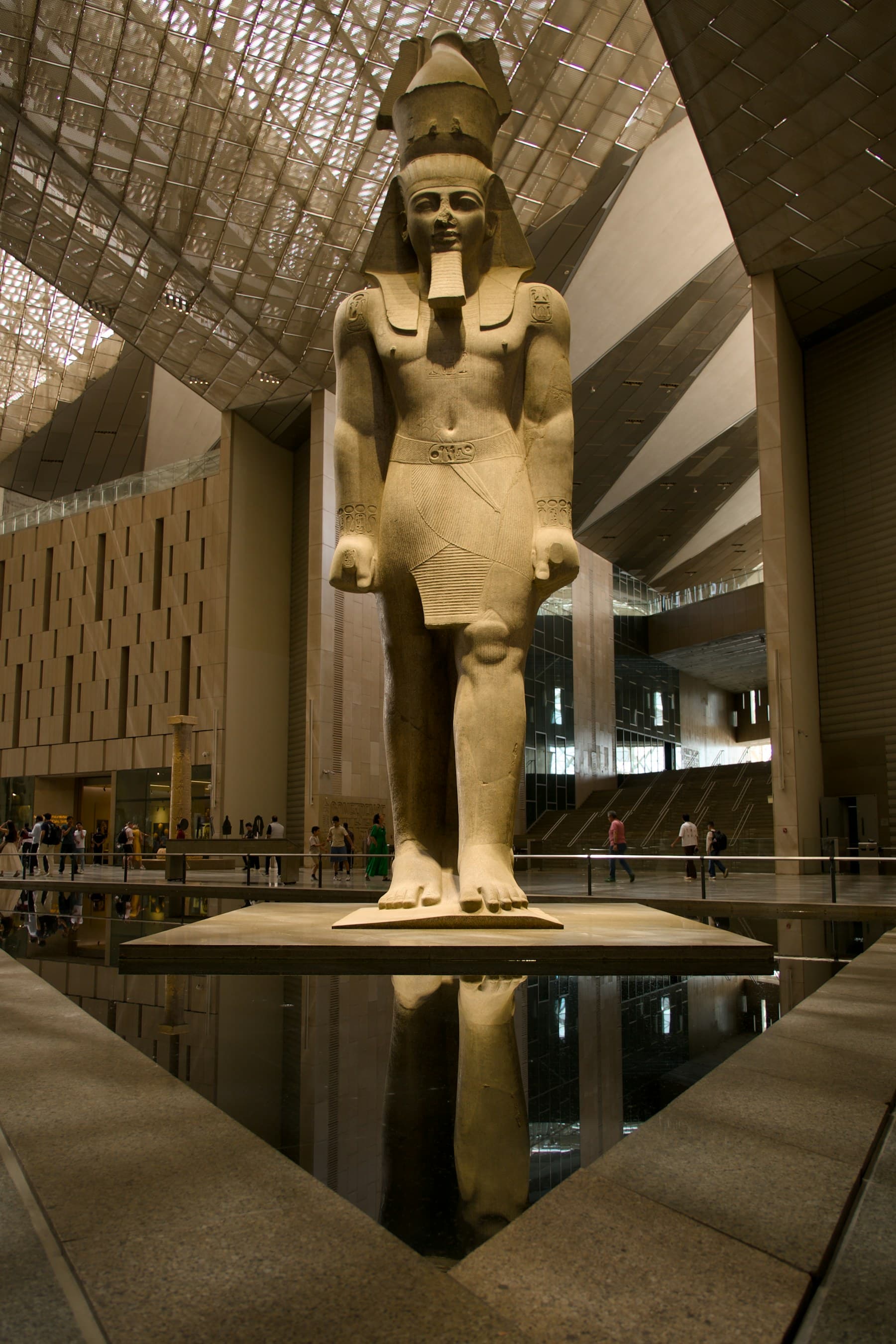
Plan about two hours for the highlights of the Grand Egyptian Museum, and three to four for a comfortable visit, plus 20 to 30 minutes for Khufu's Boats Museum. Start with the colossal Ramesses II in the Grand Hall, climb the Grand Stairs to the window onto the pyramids, see Queen Hetepheres' furniture and Mesehti's model soldiers in the Main Galleries, then walk the Tutankhamun Galleries to the gold mask.
The Grand Egyptian Museum stands at Giza, where the Nile valley meets the desert plateau, about two kilometres from the pyramids. After years of delays and trial openings, the full museum opened on 1 November 2025. It is big enough that nobody sees all of it in one visit. How long does it take? Plan about two hours for the highlights and three to four hours for a comfortable visit, plus 20 to 30 minutes for Khufu's boats.
A museum built as a climb
The site drops about 50 metres from the edge of the desert plateau down to the valley floor. The architects, heneghan peng of Dublin, who won an international competition in 2003 against more than 1,500 entries, put the entrance at the bottom and the galleries at the top. The climb between them is the museum's timeline. They kept one rule: the building may sit between the valley and the plateau, but it never rises above the plateau. The pyramids stay on top.
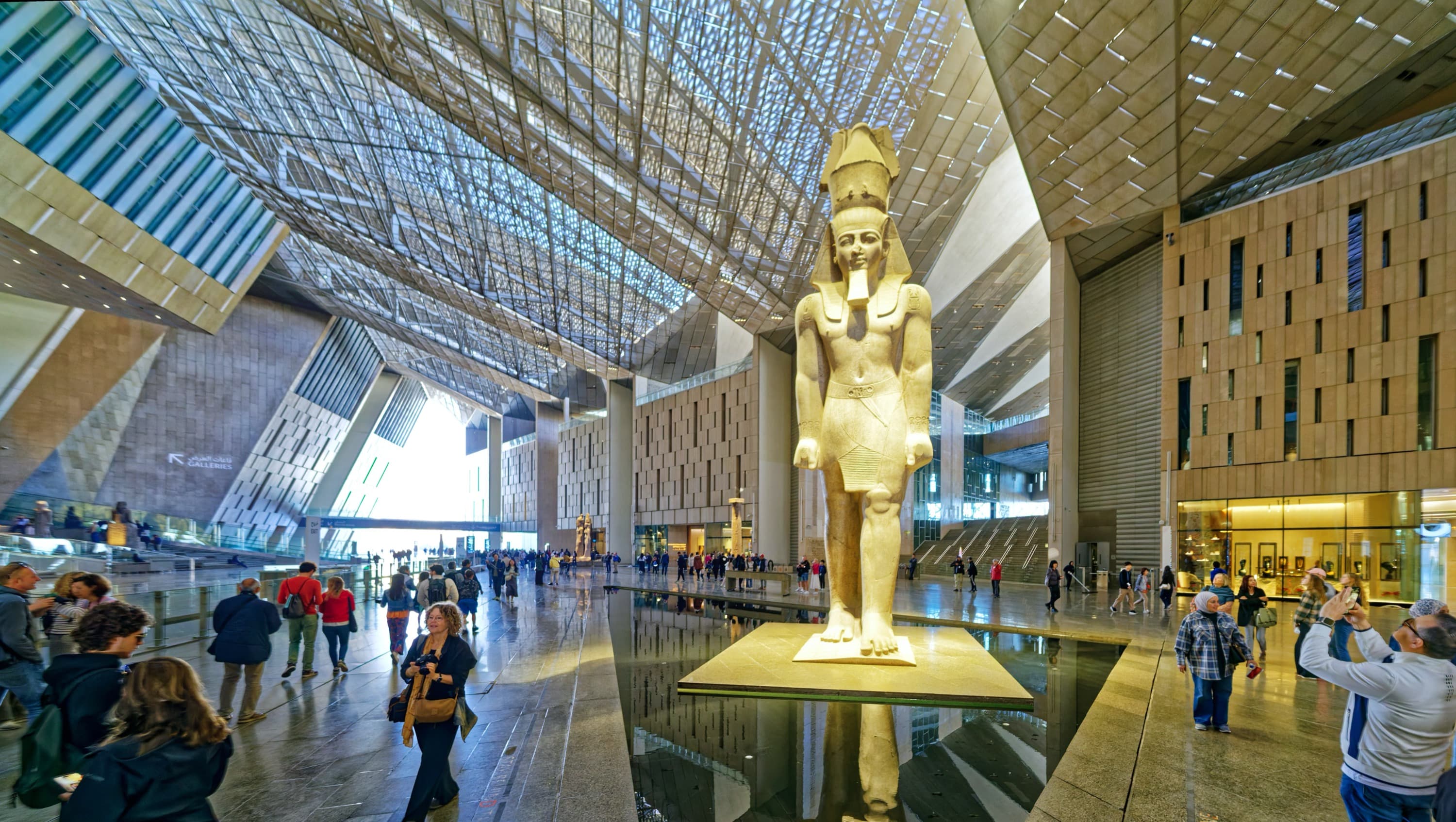
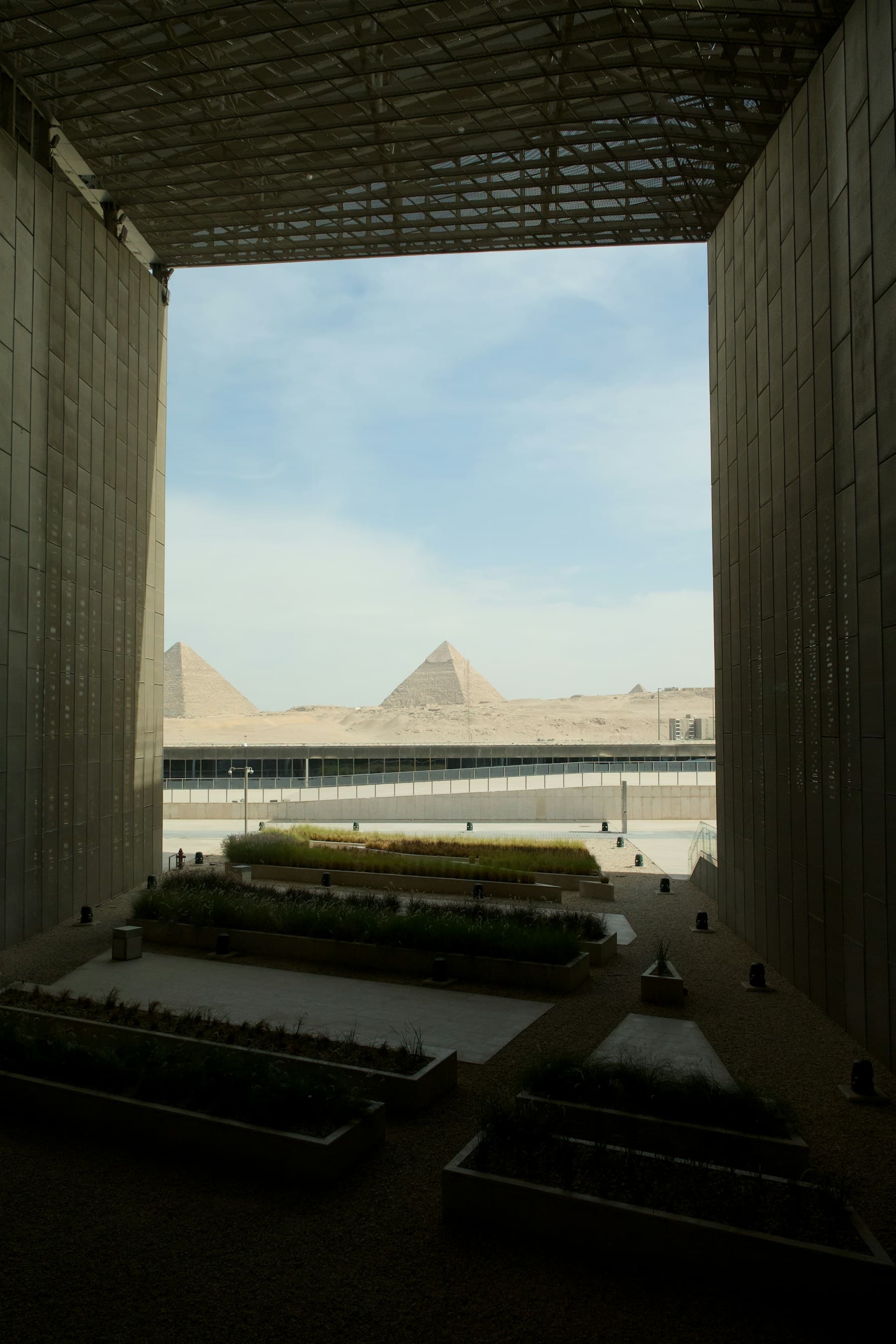
So a visit has a shape. You come in at the bottom, beside an obelisk. You cross the Grand Hall, climb the Grand Stairs past about sixty great statues and monuments, and arrive at a window onto the pyramids. At the top, the museum splits in two: the Main Galleries on one side and the Tutankhamun Galleries on the other. Khufu's boats are in a separate building behind it all.
How the museum is laid out
Hear a stop from this walk
The Great Sphinx: The Guardian Facing the Sunrise
- The Hanging Obelisk. In the forecourt, a granite obelisk of Ramesses II from Tanis stands raised on four legs. Step underneath and look up: his names are carved on the underside of the base, a face no ancient visitor ever saw.
- The Grand Hall. The entrance hall, dominated by the colossal Ramesses II, about 11 metres of red granite. Around him stand his son Merenptah's victory column and a Ptolemaic king and queen raised from the sea off Alexandria. To one side runs the shopping wing, with cafes, shops and another Ramesses II at its far end.
- The Grand Stairs. A staircase of kings about six storeys high, arranged in four themes from bottom to top: the Royal Image, Divine Houses, Kings and Gods, and the Journey to Eternity. A moving walkway runs beside the stairs, and there is a lift.
- The window. At the top, a full-height wall of glass frames the three pyramids of Giza.
- The Main Galleries. Twelve galleries laid out as a grid. The three columns are themes: Society, Kingship and Beliefs. The four rows are eras, from Egypt's deepest past through the Middle Kingdom and the New Kingdom to the Roman period. The numbers zigzag, so you cross the first row through 01, 02 and 03, then turn back through the next. Stairs lead down to small side rooms on the Valley of the Kings, the tomb builders' village of Deir el-Medina and the sunken cities of Abu Qir Bay.
- The Tutankhamun Galleries. Two long parallel halls, each about 180 metres long, holding almost everything from his tomb together. A black band on the floor, the Curatorial Path, carries every object, and a band of light on the ceiling, the Path of the Sun, runs above it. The first hall is about his life and death; the second holds the shrines, the coffins and the gold mask.
- Khufu's Boats Museum. A separate building behind the main museum, on the far side from the entrance. Khufu's cedar boat stands whole inside, and his second boat is being rebuilt in front of visitors.
The must-see pieces, area by area
The Grand Hall. Walk all the way round Ramesses II. He was found at Memphis in 1820 lying in six pieces, stood for half a century in front of Cairo's main railway station, and in January 2018 was the first great piece to enter this hall, while the building was still being finished. Then look for the two pink granite Ptolemaic giants, worn smooth by centuries under the sea at Thonis-Heracleion.
The Grand Stairs. In the first theme, the Royal Image, find Hatshepsut as king, in the headcloth, beard and kilt of a male ruler. Higher up, the tip of her obelisk from Karnak, where her kneeling figure was later cut out of the scene and replaced by two altars. Then a sphinx of Amenemhat III that carries the names of at least four rulers, and Ramesses II standing between the gods Ptah and Sekhmet, three figures cut from one block of red granite.
The Main Galleries. In Gallery 02, the gold-cased furniture of Queen Hetepheres, Khufu's mother: a bed canopy, a bed, an armchair and a carrying chair, found in a hidden shaft at Giza in 1925. Her sarcophagus was empty when it was opened, and her mummy has never been found. In the Middle Kingdom galleries, find the wooden soldiers of Mesehti, a governor of Asyut: two companies of forty, one of Egyptian spearmen and one of Nubian archers. In the New Kingdom galleries, look for a red granite head of Ramesses II with a crown of horns, feathers and a sun disc.
The Tutankhamun Galleries. The first hall opens with his golden throne, where the king and his wife Ankhesenamun sit under the rays of the sun disc. Then come his chariots, a cup shaped like an open lotus, and the two life-size guardian statues that stood at the sealed door of his burial chamber. In the second hall, the four gilded shrines that once nested one inside another are opened out so you can walk through them, followed by the coffins, including the innermost one of solid gold, about 110 kilograms. The mask comes last, in a space of its own.
Khufu's Boats Museum. The first boat, more than 40 metres of cedar held together with rope, was found in 1954 in a sealed pit beside the Great Pyramid, taken apart into 1,224 pieces. In August 2021 it travelled here in one piece and entered its hall through the roof. Next to it, restorers are rebuilding the second boat on a steel frame, a job its head of restoration expects to take about four years.
What to see in two hours
This plan follows the climb and saves the mask for last.
- The Hanging Obelisk (5 minutes). Step underneath and find the names on the base.
- The Grand Hall (15 minutes). Ramesses II, Merenptah's column and the Ptolemaic pair.
- The Grand Stairs (20 minutes). Stop at Hatshepsut and at the Ptah, Ramesses and Sekhmet group on the way up.
- The window (5 minutes). Find all three pyramids.
- The Main Galleries (25 minutes). Hetepheres in Gallery 02, Mesehti's soldiers, and the colossal head of Ramesses.
- The Tutankhamun Galleries (45 minutes). The throne, the chariots, the guardians, the gold coffin, and the mask.
The order that works, and the queue at the mask
There is no single marked route through the museum, and reviewers have found it easy to miss a gallery. Two orders work well.
- Follow the climb. Grand Hall, Grand Stairs, the window, then the Main Galleries before Tutankhamun. The archaeologist Martin Odler, reviewing the museum, suggests starting in the Main Galleries rather than going straight to Tutankhamun, and this order gives the Tutankhamun halls context.
- Tutankhamun first. Some visitors book the earliest entry window and go straight to the Tutankhamun Galleries before they fill, then do the Grand Stairs and the Main Galleries afterwards.
The mask is the bottleneck. It has its own room at the end of the second Tutankhamun hall, and there is usually a queue to stand in front of it for a moment, or you can look from outside the rope. If the room is packed when you reach it, carry on through the rest of the hall and come back at the end. When you do get to the glass, walk around to the back if the case lets you: a spell from the Book of the Dead runs across it, and most photographs never show that side.
Practical tips
- Hours. At the time of writing the galleries open daily from 9:00 to 18:00, and until 21:00 on Wednesdays and Saturdays. Last entry is one hour before closing, and hours change during Ramadan. Check the museum's website before you go.
- Tickets. Sold online only, for a timed entry window, on the museum's website and in some Egyptian mobile operator apps. The window sets when you go in, not when you must leave. The standard ticket covers the Grand Hall, the Grand Stairs, the Main Galleries, the Tutankhamun Galleries and Khufu's Boats Museum.
- Bring headphones. The museum's gallery rules restrict playing audio aloud, so any guide on your phone needs headphones.
- Save things before you arrive. Phone signal inside is not guaranteed. Download your ticket, and anything you plan to read or listen to, before you get there.
- Photos. Personal photos are allowed, without flash. In the Tutankhamun Galleries, only mobile phones are allowed for photos.
- Watch the floor in the Grand Hall. The shallow reflecting pools can look like floor, and visitors have stepped in.
- Bags. Anything larger than 40 by 40 centimetres goes to the free lockers.
- Do not forget the boats. Khufu's Boats Museum is included in the ticket but is a separate building, and it is often skipped. The museum's own guided tours leave it out.
Combining the museum with the pyramids
The museum and the Giza plateau are about two kilometres apart, and they make a natural pair: the window at the top of the Grand Stairs looks straight at the pyramids, and Khufu's boats were buried at the foot of his. The plateau needs its own ticket. A common plan is the pyramids at opening and the museum in the afternoon, or the reverse. One travel writer who did both in a day logged about ten hours on foot and recommends two days, so pace yourself.
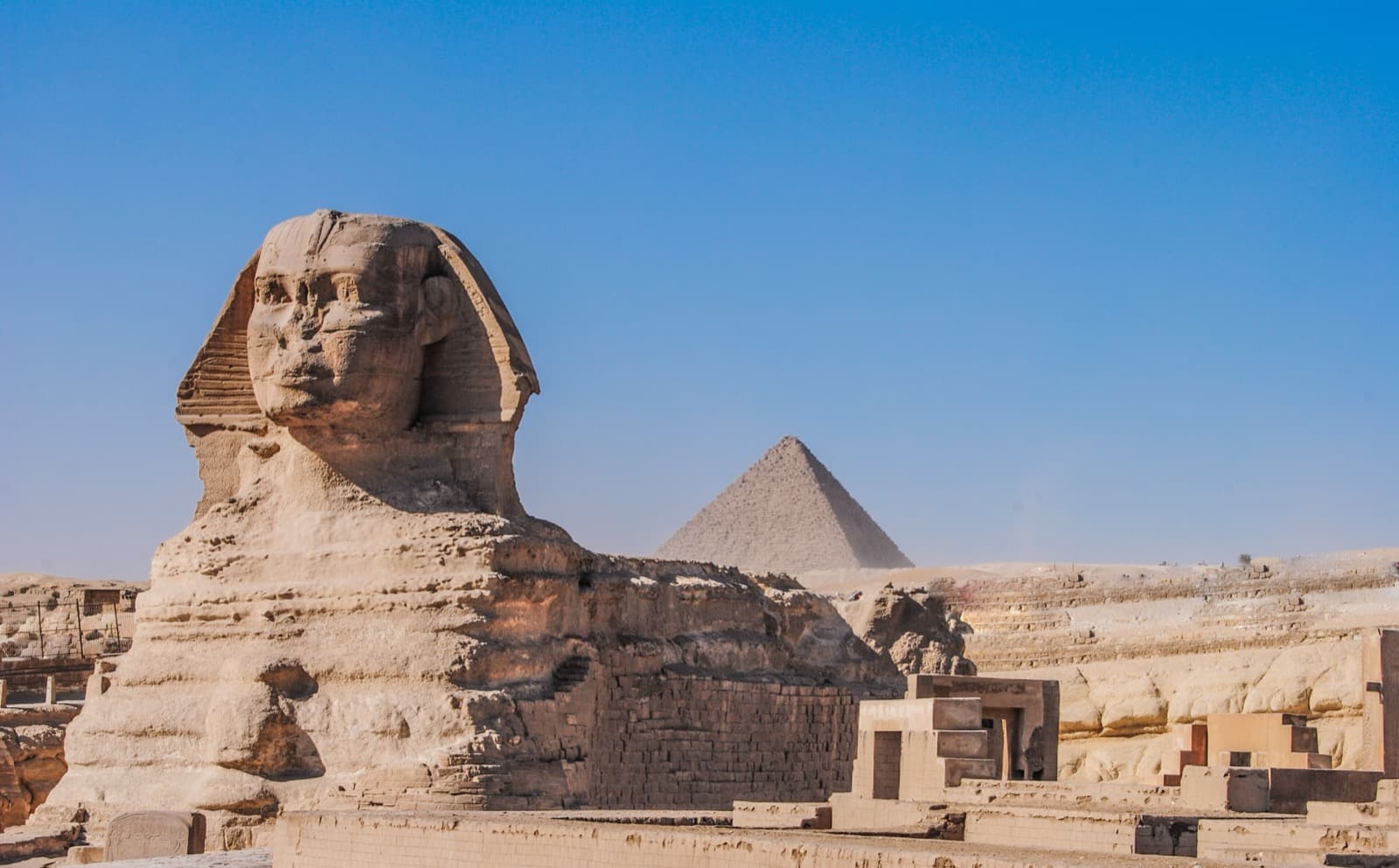
On the plateau, Roamer's Giza walk reads the pyramids and the Sphinx as one planned cemetery; the Great Pyramid of Khufu is a good primer. Back in the city, the walk along al-Muizz Street and the Coptic Cairo walk cover the medieval and Christian cities that grew up long after the pharaohs.
How this fits the Roamer guide
Roamer has an independent audio guide to the Grand Egyptian Museum, not affiliated with the museum. It works room by room: open the area you are standing in and play its story, find a piece by the number on its label, or follow one of five short routes, from "The Grand Egyptian Museum in Two Hours" and "A Staircase of Kings" to "Tutankhamun, Room by Room" and "Khufu, from Pyramid to Boat". It works offline once saved to your phone. You can find it here: the Grand Egyptian Museum guide.
Cover photo: Aleksei Filimonov, via Unsplash.
Frequently asked questions
- How long do you need at the Grand Egyptian Museum?
- Two hours covers the highlights if you keep moving: the Grand Hall, the Grand Stairs, a few Main Galleries and the Tutankhamun Galleries. Three to four hours is comfortable. Khufu's Boats Museum, a separate building behind the main one, adds 20 to 30 minutes.
- Is Tutankhamun's gold mask at the Grand Egyptian Museum?
- Yes. The gold mask has a space of its own at the end of the Tutankhamun Galleries, and it usually has its own queue. It left the Egyptian Museum on Tahrir Square, which still keeps other famous pieces such as the Tanis royal treasure.
- What are the opening hours of the Grand Egyptian Museum?
- At the time of writing the galleries open daily from 9:00 to 18:00, and until 21:00 on Wednesdays and Saturdays, with last entry one hour before closing. Hours change during Ramadan, so check the museum's own website before you go.
- Do you need to buy Grand Egyptian Museum tickets in advance?
- Yes. Tickets are sold online only, for a timed entry window, on the museum's website and in some Egyptian mobile operator apps. The window sets when you enter, not when you leave. Khufu's Boats Museum is included in the standard ticket.
- Can you see the pyramids from the Grand Egyptian Museum?
- Yes. At the top of the Grand Stairs a full-height wall of glass frames the pyramids of Giza, about two kilometres away. The architects designed the climb up the stairs to end at that view.
- Can you visit the pyramids and the Grand Egyptian Museum on the same day?
- You can, since they are about two kilometres apart, but it is a long day on your feet and the Giza plateau needs its own ticket. Many visitors do the pyramids early and the museum in the afternoon, and some travellers recommend splitting them across two days.
Ready to experience it?
Giza: The Pyramids and the Sphinx
150 min · 5 km · moderate
More from Cairo
Explore more at your own pace.
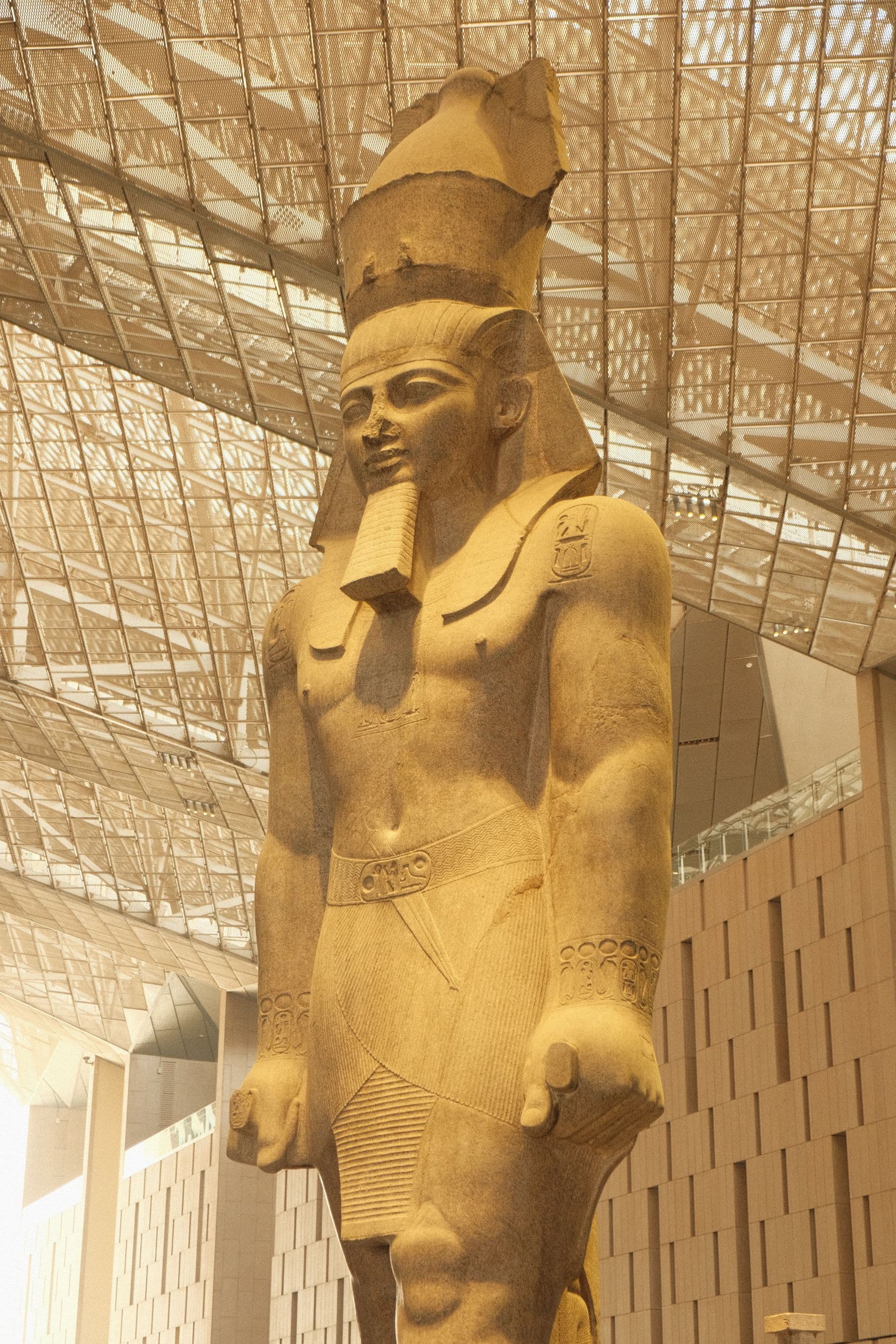
The Colossal Ramesses II at the Grand Egyptian Museum: From Memphis to Ramses Square to Giza
The Grand Staircase at the Grand Egyptian Museum: Six Storeys of Kings
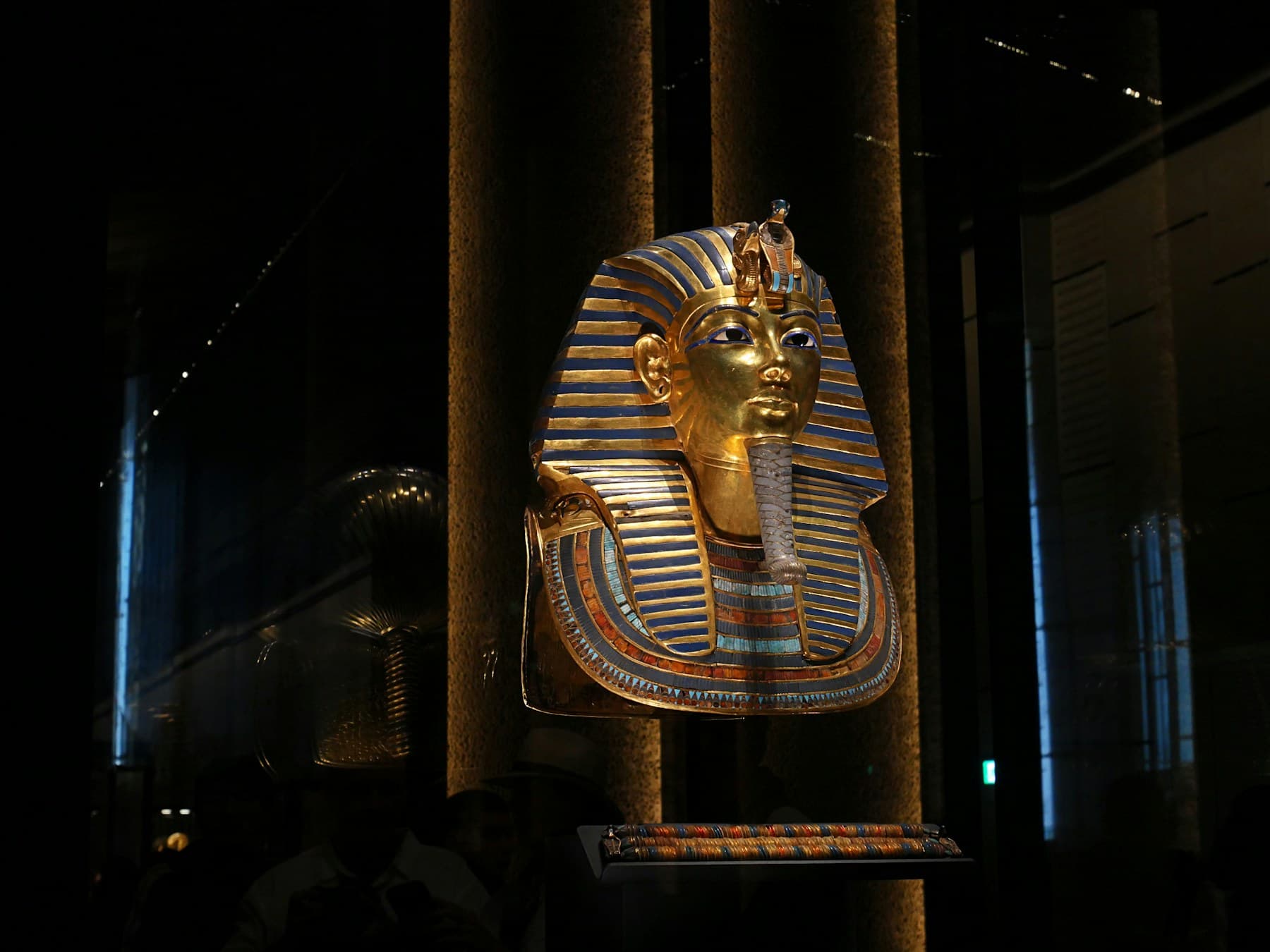
Tutankhamun's Gold Mask at the Grand Egyptian Museum: What to Look For

Al-Muizz Street: Reading a Thousand Years of Cairo on One Pavement
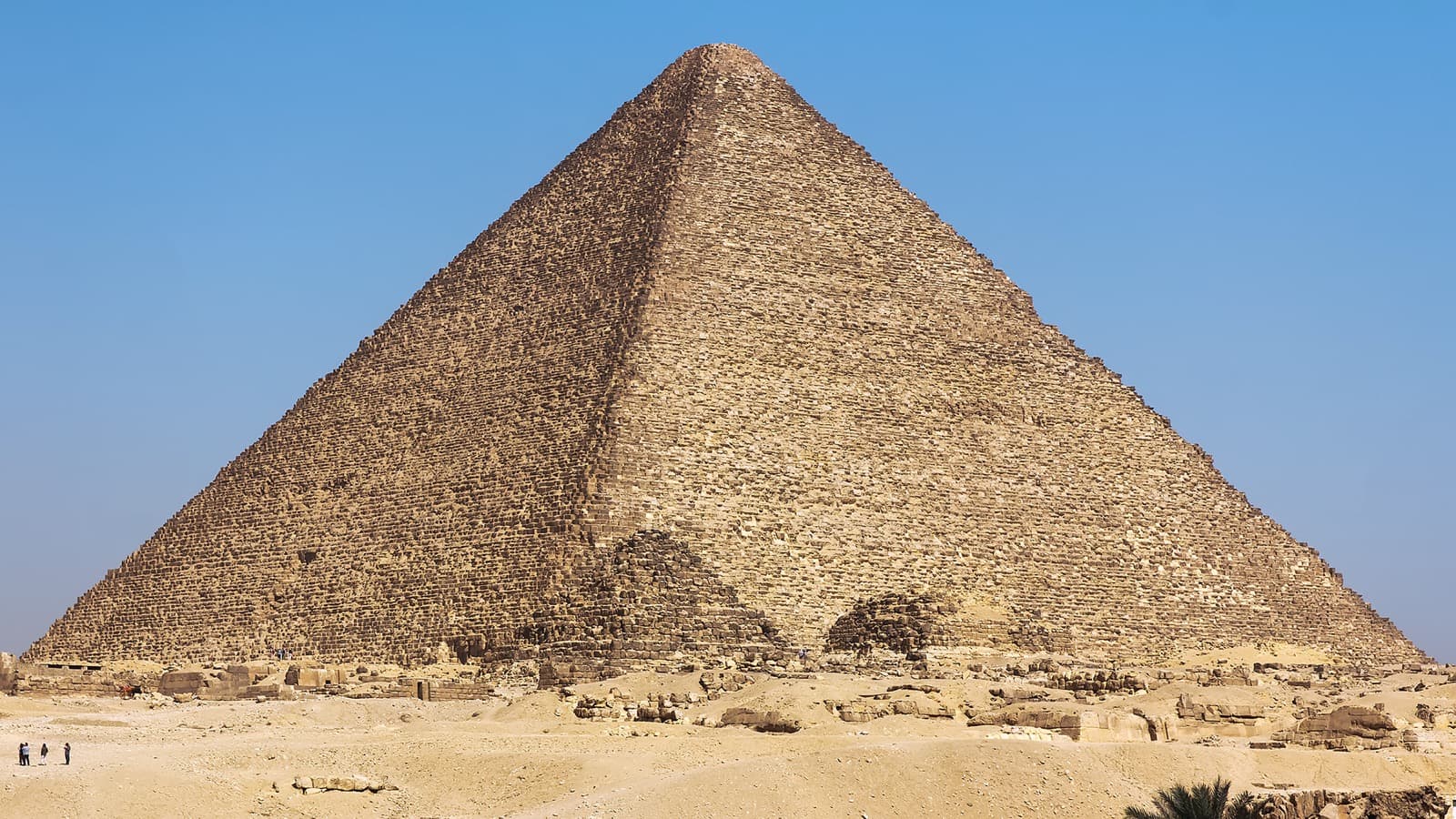
The Great Pyramid of Khufu: How to Read the Whole Giza Plateau