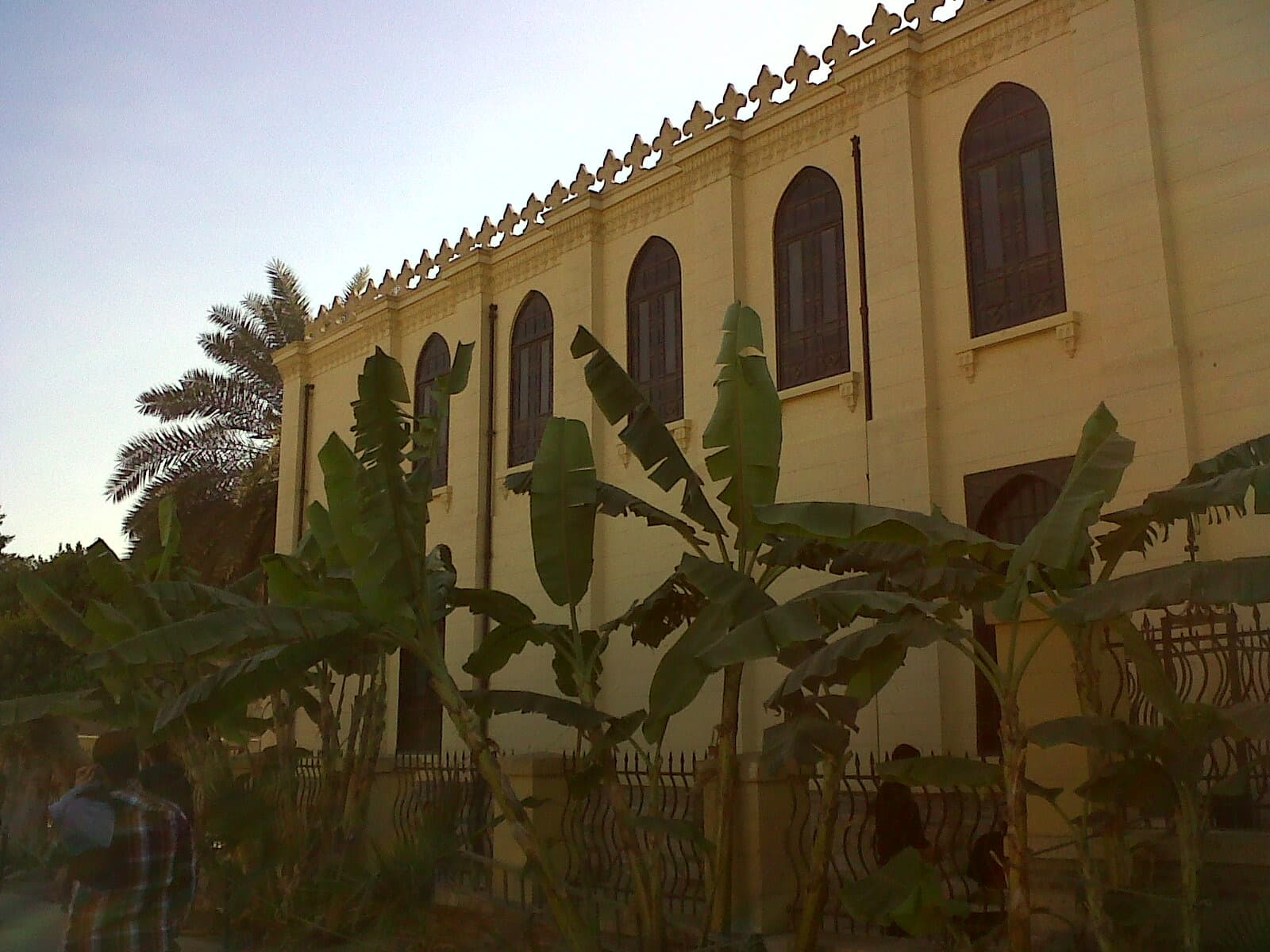
Inside a former church building in Old Cairo, wedged between Coptic churches and the towers of a Roman fort, the Ben Ezra Synagogue holds the memory of Egypt's oldest Jewish community and the single greatest document find in the study of medieval life. This is the oldest synagogue in Cairo, and for roughly a thousand years its congregation quietly filled a storeroom in the back wall with worn-out paper. That storeroom, the geniza, turned out to hold about four hundred thousand manuscript fragments. When scholars finally opened it and read it, the ordinary shopping lists, marriage contracts, and business letters inside reshaped what the modern world knew about the medieval Mediterranean. Standing in front of this small building, that is the one thing to understand: the plainness is the point. The extraordinary thing here was hidden in the walls.
A synagogue inside a church
Ben Ezra sits in the very center of Coptic Cairo, the compact quarter that grew inside and around the Roman fortress of Babylon on the Nile. Its exact founding date is unknown. Documents connected to the site predate the year 882 A.D. and are probably older still, which places the Jewish community here among the ancient roots of the city. The building you see today is not that ancient structure. It was completely rebuilt in the early 1890s, with further work in the early twentieth century, so what stands now is a careful nineteenth-century reconstruction wrapped around a much older story.
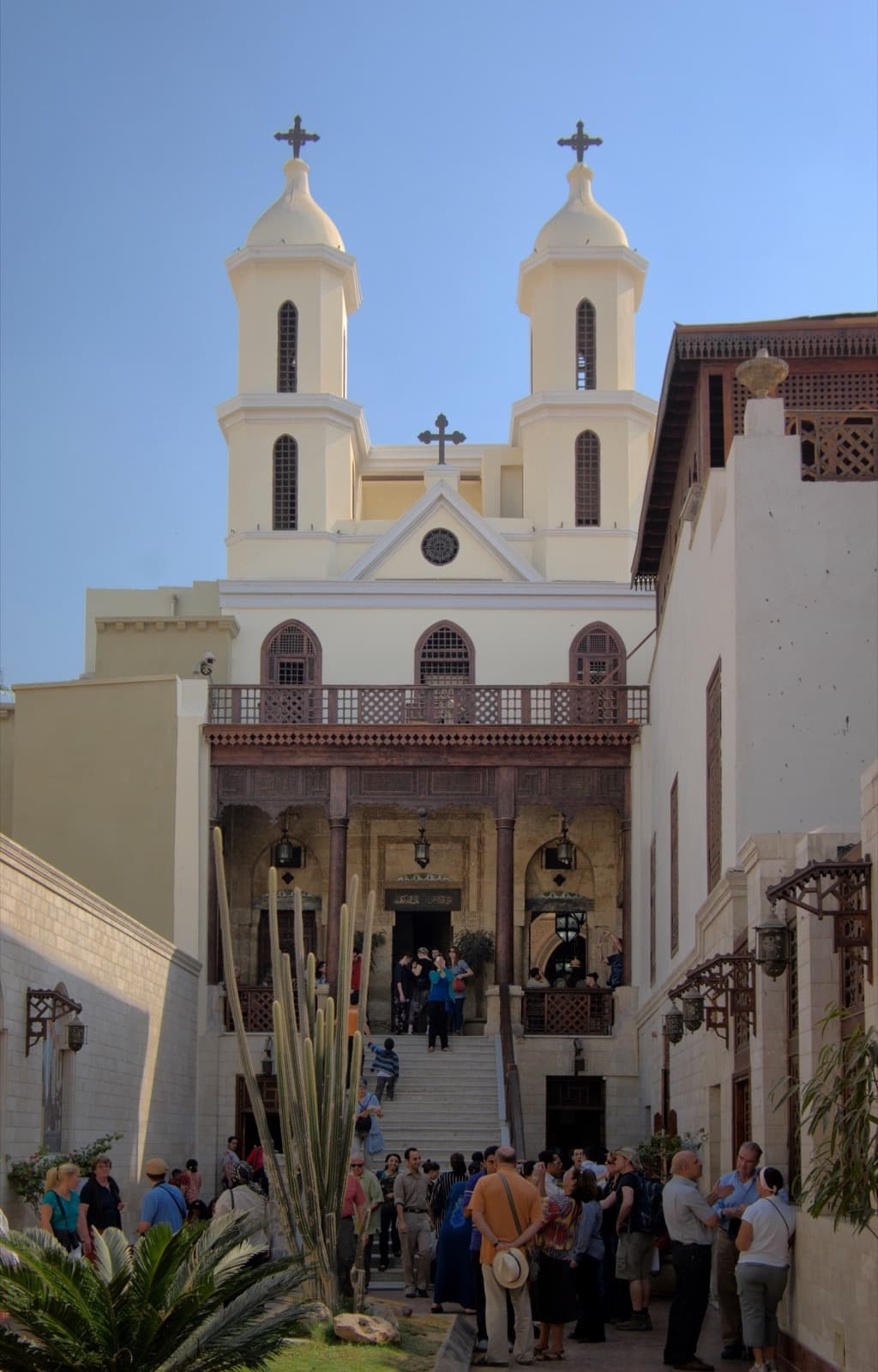
The detail that surprises most visitors is where they are standing. This synagogue occupies a former church building. According to tradition tied to the year 882, the Coptic Orthodox Church sold a church and its grounds to the Jewish community, though modern scholars debate exactly how the site changed hands. Faiths in Old Cairo did not sit in separate zones. They pressed up against each other, sometimes literally reusing each other's walls. Within a few hundred meters you can walk from the Hanging Church suspended over a Roman gate, past the crypt at Abu Serga, to this synagogue, and on to the first mosque in Africa. Ben Ezra is the third faith in that sequence, and its presence in the middle of a Christian quarter is a small monument to how tangled and close these communities once were.
The greatest document find
Hear a stop from this walk
The Mosque of Amr ibn al-As: Where Islamic Cairo Began
Every synagogue keeps a geniza, a storeroom where documents bearing the name of God are set aside rather than destroyed, out of reverence. Most geniza contents are eventually buried. At Ben Ezra, for reasons of neglect and dry Egyptian air, they were not. Over roughly the eleventh century through the late nineteenth, the community kept piling worn paper into the storeroom, and it simply accumulated. By the time scholars grasped what was there, the pile held around four hundred thousand fragments.
What makes the Cairo Geniza matter is not that it held sacred texts, though it did. It is that Jewish tradition treated almost any Hebrew-lettered paper as too holy to throw away, so the community deposited everything: court records, love letters, children's writing exercises, a merchant's account of a shipwreck, prescriptions, and contracts. The result is an unedited archive of daily life across the Mediterranean, in Hebrew, Aramaic, Judeo-Arabic, and more. It documents Jewish, Muslim, and Christian lives together, because these people all traded, borrowed, married, and argued with one another. Cambridge University Library, which now holds the largest share, calls the collection an unparalleled resource for the economic and social history of the Mediterranean and Near East in the Middle Ages, and it reshaped what scholars could know about that world.
There is a human figure at the center of this. The philosopher and physician Moses Maimonides, one of the towering minds of medieval Judaism, settled in Fustat, walking distance from this synagogue, in 1168. He became the leader of Egyptian Jewry in 1171 and worshipped here until his death in 1204. Among the geniza fragments are documents in his own hand, drafts and notes that survived precisely because no one threw them out. To stand in Ben Ezra is to stand where he stood.
How the manuscripts left Cairo
The removal of the geniza is a story in itself. In 1896 two sisters from Cambridge, Agnes Lewis and Margaret Gibson, returned from Egypt with fragments and brought them to a scholar named Solomon Schechter. Schechter recognized what they were and traveled to Cairo. He carried the largest portion of the storeroom back to Cambridge University Library, nearly one hundred ninety-three thousand fragments, where the material became the Taylor-Schechter Collection. The timing matched the building's rebuilding in the 1890s, when the old storeroom was disturbed and its contents finally became reachable. Other collectors took portions too, so today the Cairo Geniza is scattered across libraries worldwide, its reassembly an ongoing scholarly project more than a century on.
It is worth being honest about what is verified and what is beloved tradition. Local folklore marks this site as the place where the infant Moses, the biblical prophet, was found among the reeds, and a Well of Moses stands in the courtyard. That is a cherished folk memory, not documented history, and it is best held as exactly that: a story the community told itself, layered onto a spot that already carried the weight of centuries.
Standing in front of it
Ben Ezra is a working piece of heritage, not a spectacle. Admission is usually included in the combined Old Cairo ticket, donations are welcome, and photography inside can be restricted or carry a small charge, so look for signage and ask quietly before raising a camera. The interior is modest by the standards of grand European synagogues, and that restraint is the correct frame for it. Nothing about the room announces that it once held the most important cache of medieval documents on earth. That contrast, between the quiet space and the enormity of what left it, is the whole experience.
The best time to come is early morning, soon after the quarter opens, when the churches and the synagogue are calm before tour groups arrive. Autumn through spring is far more comfortable than Cairo's summer heat. Dress modestly, since almost every neighboring stop is an active place of worship, and carry small cash in Egyptian pounds for donations and tickets.
Ben Ezra makes most sense as one stop in the larger walk it belongs to, where a Roman fort shelters three faiths in a few hundred meters. To reach it in that context, and to move at your own pace with no group and no schedule, walk the Coptic Cairo tour on Roamer, which places the synagogue between the ancient Coptic churches and the first mosque in Egypt. For more routes through the city, see our guide to Cairo walking tours.
Sources
- Ben Ezra Synagogue, Wikipedia: founding history, the early 1890s rebuilding, the former-church tradition, and Maimonides worshipping here.
- What Is the Cairo Geniza?, Princeton Geniza Lab: the nature and scale of the geniza as a source for medieval life.
- Cairo Geniza, Wikipedia: the roughly four hundred thousand fragments, the Taylor-Schechter figure of nearly 193,000, and their dispersal to libraries including Cambridge.
- Taylor-Schechter Genizah Research Unit, Cambridge University Library: the collection as a resource for the economic and social history of the medieval Mediterranean and Near East, and Maimonides autograph fragments.
- 18 Facts About the Cairo Geniza, Chabad.org: Maimonides settling in Fustat in 1168 and his autograph fragments among the finds.
Ready to experience it?
Coptic Cairo: The Old Christian Quarter Inside a Roman Fort
120 min · 2.7 km · easy
More from Cairo
Explore more at your own pace.
Grand Egyptian Museum: What to See, From the Grand Hall to Tutankhamun
The Colossal Ramesses II at the Grand Egyptian Museum: From Memphis to Ramses Square to Giza
The Grand Staircase at the Grand Egyptian Museum: Six Storeys of Kings
Tutankhamun's Gold Mask at the Grand Egyptian Museum: What to Look For
Al-Muizz Street: Reading a Thousand Years of Cairo on One Pavement