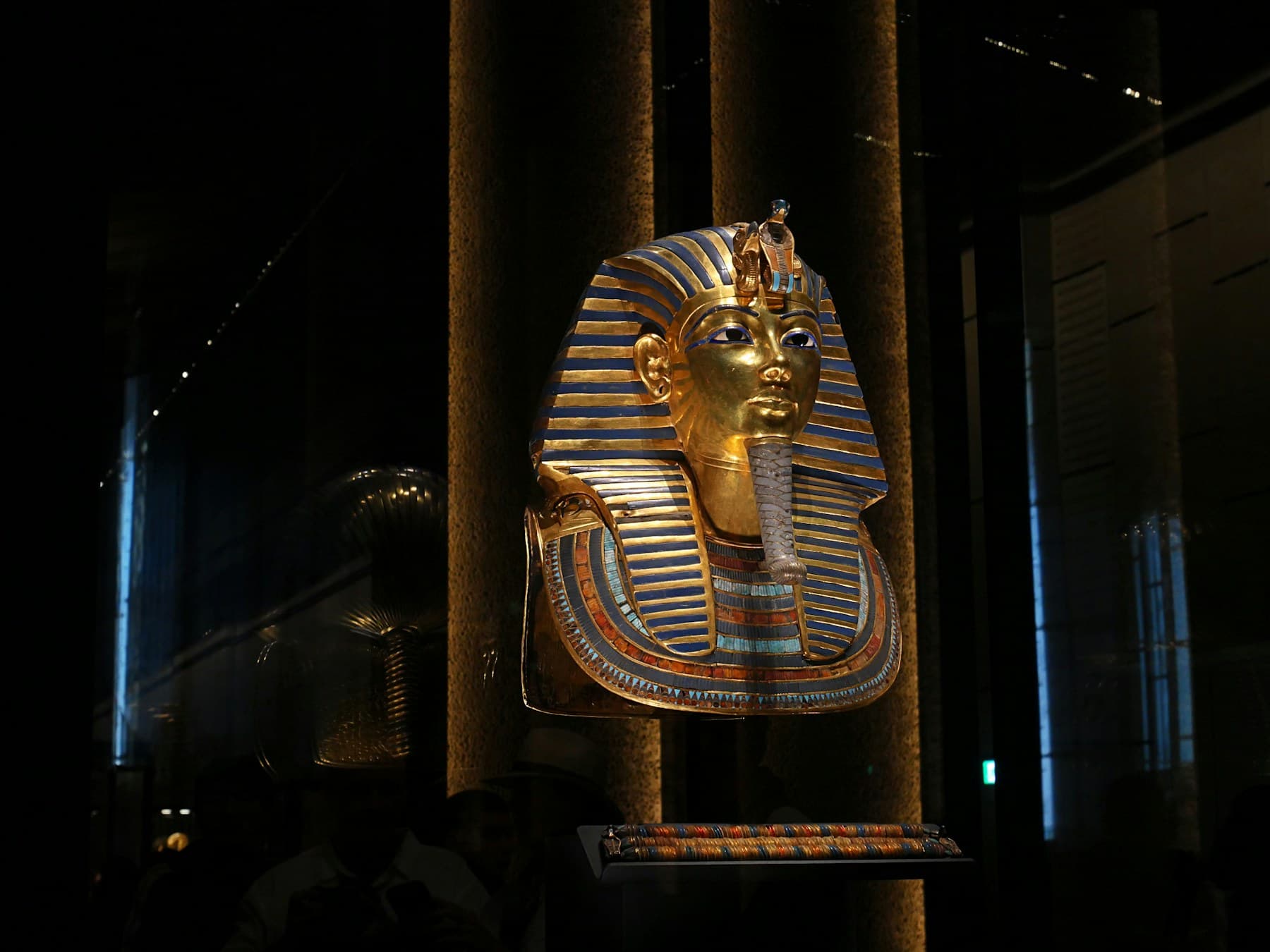
Tutankhamun's gold mask is on display at the Grand Egyptian Museum in Giza, in a space of its own at the end of the second Tutankhamun hall. It is 54 cm tall and weighs about 10.23 kg, made from two layers of mainly 23 karat gold. Howard Carter's team found it over the head and shoulders of the king's mummy on 28 October 1925. A spell from the Book of the Dead is written across its back.
Tutankhamun's gold mask is the most famous object in Egypt, and since the Grand Egyptian Museum opened it has lived at Giza, in a room built around it alone. Most people see it for a few seconds at the front of a queue. It rewards a slower look, starting with the face and ending, if the case lets you, at the back.
Where to find it
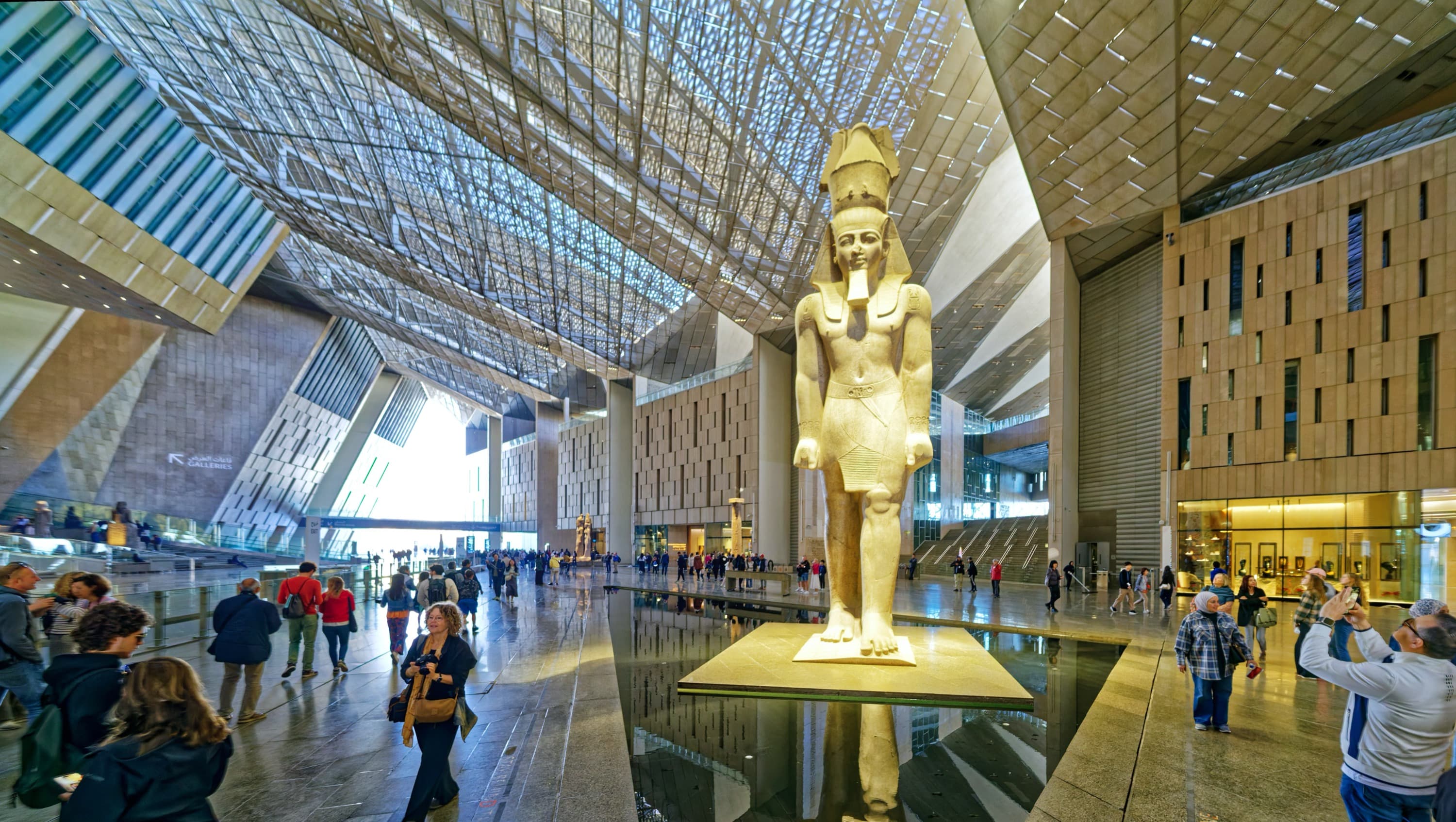
The mask is the grand finale of the Tutankhamun Galleries, two long parallel halls at the top of the Grand Stairs. The first hall is about the king's life and funeral. The second follows his burial inward, layer by layer: four gilded shrines that once nested one inside another, then the coffins, including the innermost one of solid gold. The mask comes after the gold coffin, in a space of its own.
Expect a crowd. There is usually a queue to stand for a moment right in front of it, or you can stay outside the rope and look from there. If the room is packed when you arrive, carry on through the rest of the hall and come back at the end. One change from its old home: at the Egyptian Museum on Tahrir Square, visitors were not allowed to photograph the mask. At Giza you can, but in the Tutankhamun Galleries only with a mobile phone, and never with flash.
The night the lid came off
Hear a stop from this walk
The Great Sphinx: The Guardian Facing the Sunrise
On 28 October 1925, Howard Carter's team lifted the lid of the solid gold coffin. Inside lay the wrapped mummy of the king, with this mask over his head and shoulders. It was the first time anyone had seen it in about 3,250 years. In his diary Carter called its expression sad but tranquil, and noted that its features matched the king's statues and coffins.
Carter gave every object in the tomb a number before it was moved. The mask is 256a. A dagger found in the king's wrappings is 256k: both share the number 256, because both were found on the body. In December 1925 the mask left the tomb for the Egyptian Museum in Cairo, about 635 kilometres away. In the Grand Egyptian Museum's own catalogue it is now GEM 8.
The king himself never made the journey. His body still lies in his tomb in the Valley of the Kings, so the room with the mask is the closest the museum brings you to him.
What it is made of
Start with the face: young, smooth and calm. The mask is 54 centimetres tall and weighs about 10.23 kilograms, made from two layers of gold between 1.5 and 3 millimetres thick. A 2007 study found it is mainly 23 karat gold, with a thin surface of a lighter alloy on the face and neck than on the rest.
Now the details, one at a time.
- The eyes. White quartz, with pupils of black obsidian.
- The eyebrows and eye lines. Blue lapis lazuli.
- The headcloth. The blue stripes are glass, set into the gold.
- The brow. A vulture and a cobra, the protectors of Upper and Lower Egypt.
- The ears. Pierced for earrings. Carter recorded that the lobes of the king's own ears were pierced too, and a pair of his gold earrings is in the galleries.
The beard that broke off
Look at the long plaited beard. It had already come away from the mask by the time it was found, and was fixed back on in 1944. In 2014 it broke off again during cleaning and was glued back badly. A German and Egyptian team then reattached it with beeswax.
The spell on the back
If you can, walk round to the back. Most photographs never show this side, and it is where the mask does its real work.
Ten vertical lines and two horizontal lines of hieroglyphs run down the back and across the shoulders. They are a version of spell 151 of the Book of the Dead, which first appeared on masks in the Middle Kingdom, about 500 years before Tutankhamun. The spell hands each part of the face to a god. The forehead is Anubis. The right eye is the night boat of the sun, the left eye the day boat. The eyebrows belong to the company of nine gods. Other lines give the nape of the neck to Horus and the locks of hair to Ptah-Sokar.
So the face on the front is not only a portrait. It is a set of divine guardians, each one keeping a feature safe so that the king could see his way into the afterlife.
What lay beneath it
Look nearby for two more pieces from that same innermost layer of the burial. The first is the royal diadem, a band of solid gold set with red carnelian and blue glass that circled the king's head under the mask. The vulture and cobra made to slot onto its front were not on his brow when Carter's team unwrapped the body. They lay lower down, on his thighs, and nobody knows why.
The second is the dagger numbered 256k, with a gold handle and a grey blade. That grey is iron. A 2016 study found about 11 percent nickel in it, far more than iron smelted from ore before the nineteenth century ever contains, which is why the metal is thought to have come from a meteorite. In Tutankhamun's time, that plain grey blade may have been rarer than the gold around it.
Quick facts
- Where: the Tutankhamun Galleries, Grand Egyptian Museum, Giza, in a space of its own at the end of the second hall.
- Size: 54 cm tall, about 10.23 kg.
- Material: two layers of mainly 23 karat gold, with quartz, obsidian, lapis lazuli, carnelian, glass and faience.
- Date: about 1323 BC.
- Found: 28 October 1925, over the head and shoulders of the king's mummy.
- On the back: a version of spell 151 of the Book of the Dead.
How this fits the Roamer guide
Roamer's independent audio guide to the Grand Egyptian Museum, not affiliated with the museum, tells the story of the mask, the spell on its back, the diadem and the iron dagger in the mask's own room. It is the last stop on both "Tutankhamun, Room by Room" and "The Grand Egyptian Museum in Two Hours". You can find it in the Grand Egyptian Museum guide. For the rest of the museum, read what to see at the Grand Egyptian Museum.
Cover photo: Suzi Kim, via Unsplash.
Ready to experience it?
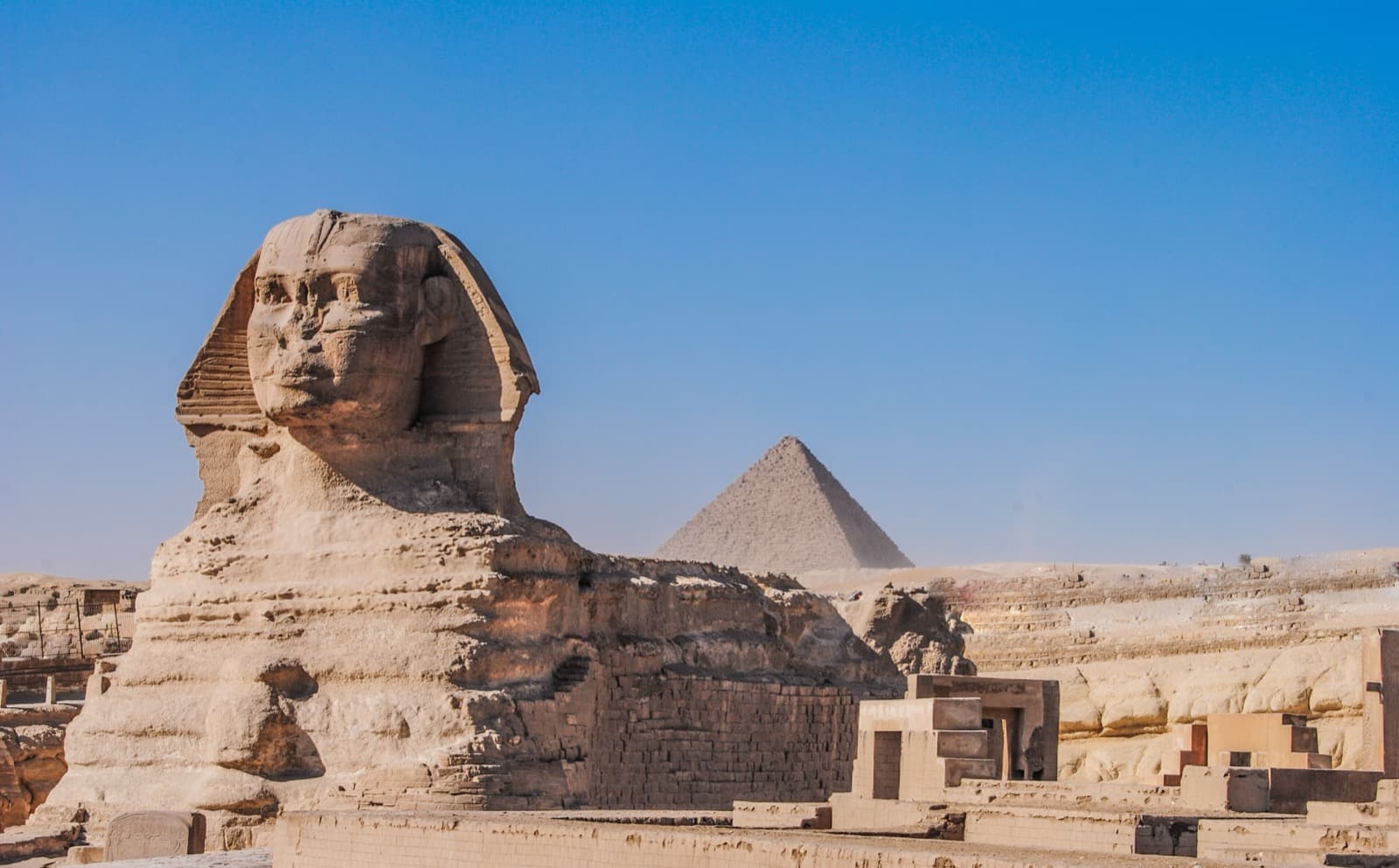
Giza: The Pyramids and the Sphinx
150 min · 5 km · moderate
More from Cairo
Explore more at your own pace.
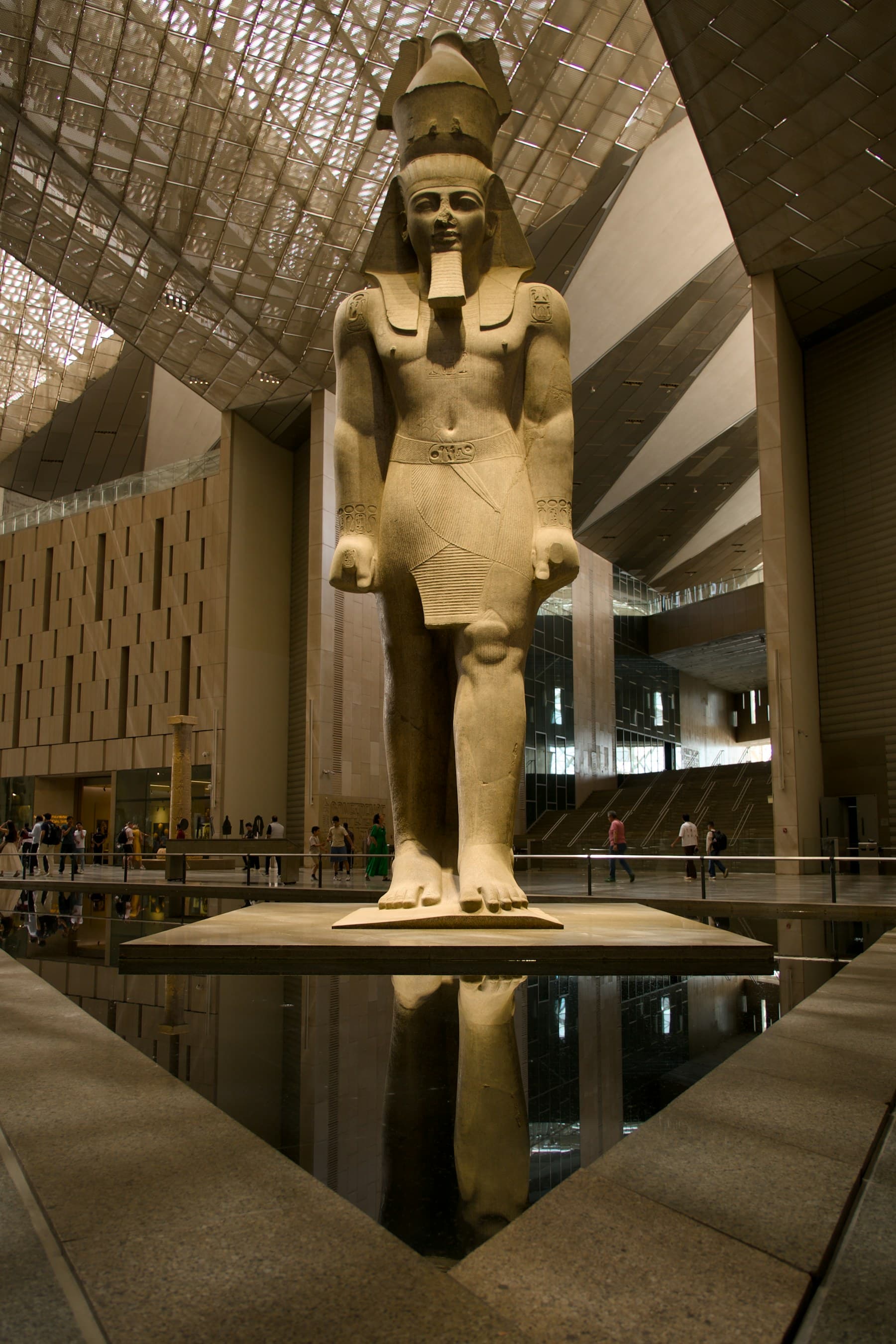
Grand Egyptian Museum: What to See, From the Grand Hall to Tutankhamun
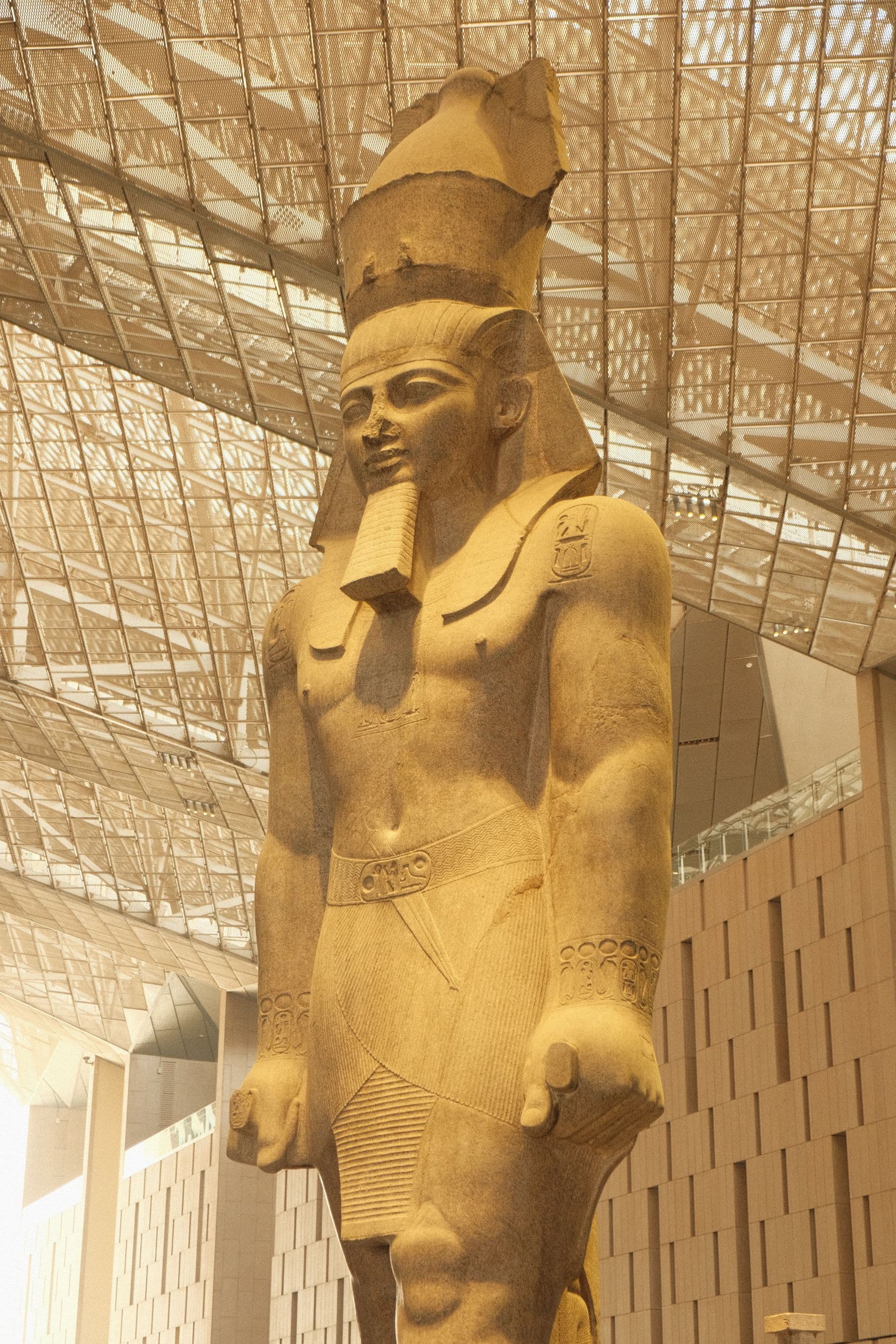
The Colossal Ramesses II at the Grand Egyptian Museum: From Memphis to Ramses Square to Giza
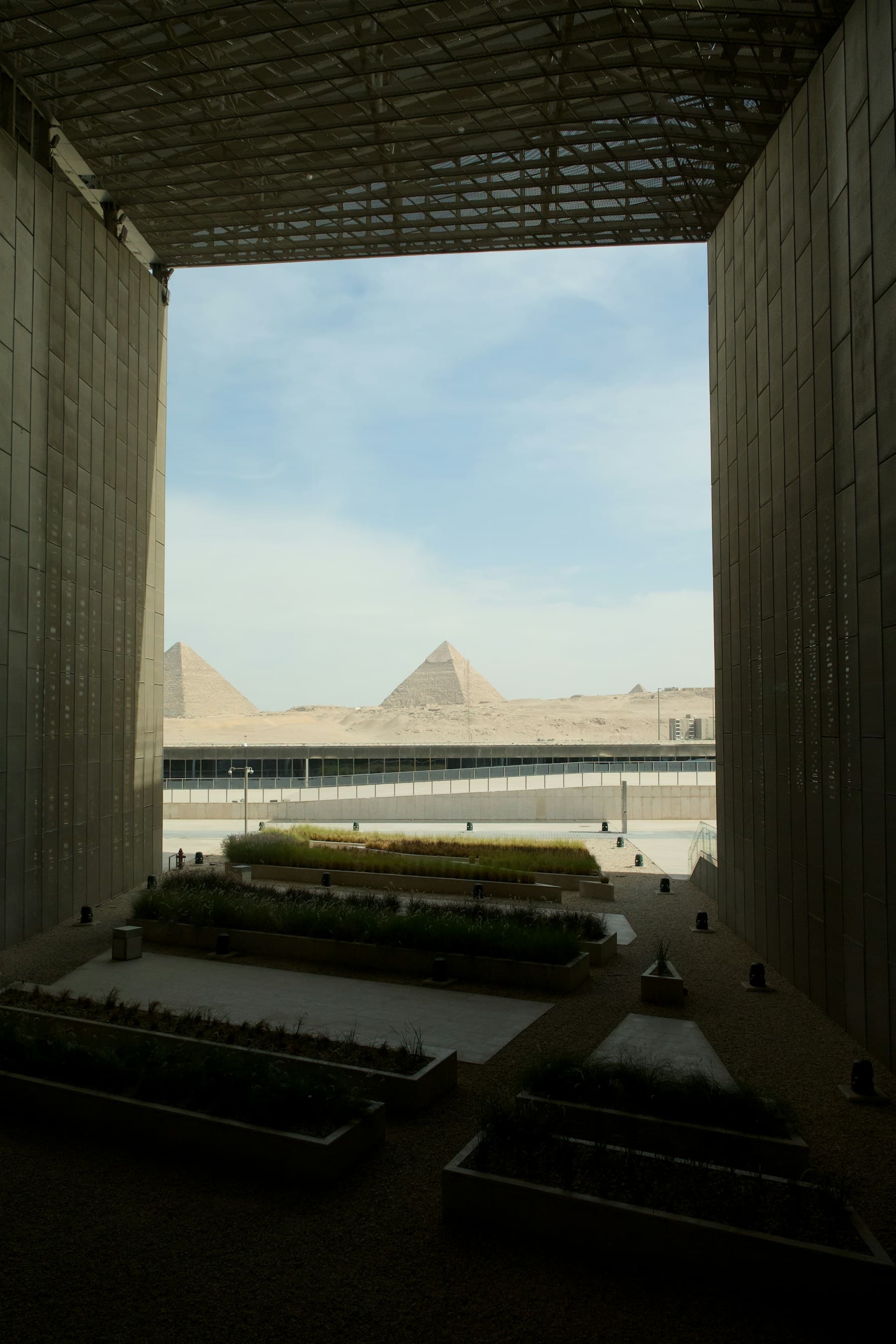
The Grand Staircase at the Grand Egyptian Museum: Six Storeys of Kings

Al-Muizz Street: Reading a Thousand Years of Cairo on One Pavement
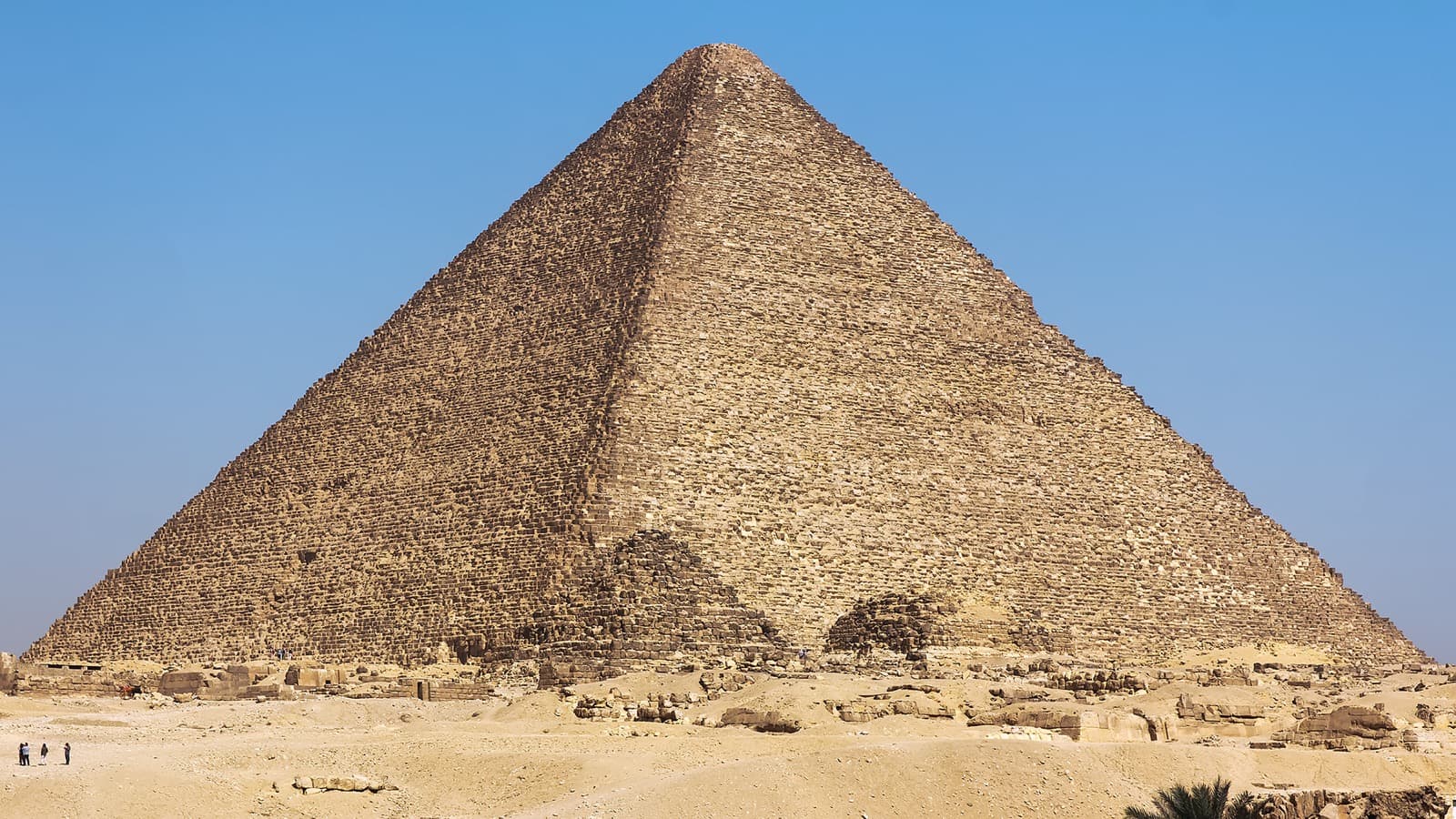
The Great Pyramid of Khufu: How to Read the Whole Giza Plateau