Sacromonte is the hill you walk when you want to know what happened to the losing side. The Alhambra tour shows you what the Nasrids left finished, and the Albaicín tour shows you the everyday medieval city that outlived the surrender of 1492. The Sacromonte tour shows you the human afterlife of that defeat: a hillside east of the Alhambra where two displaced peoples ended up sharing the same soft rock and, out of that, made something new that still plays in the caves at night.
The rock made the homes possible
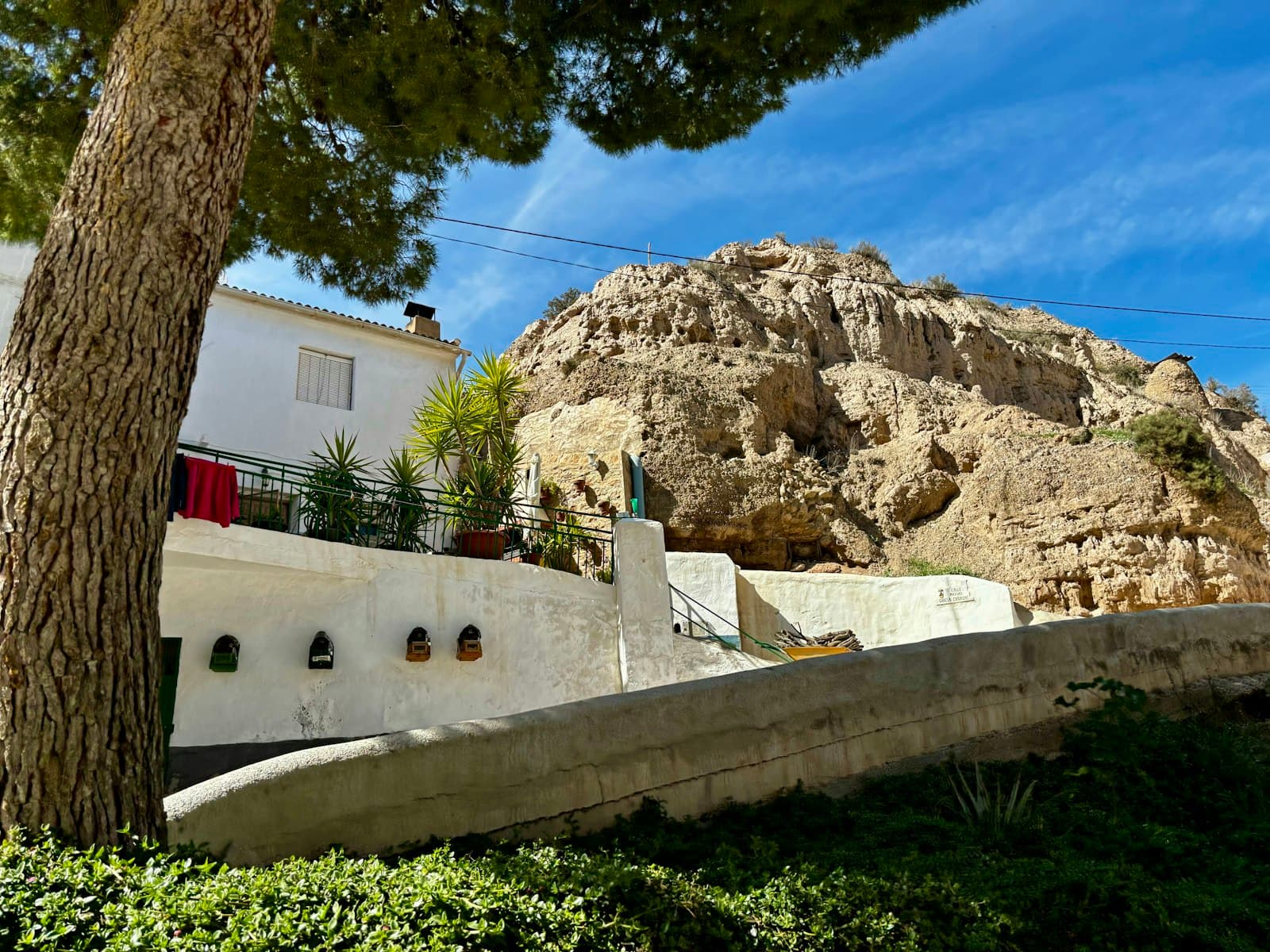
The hill is Miocene conglomerate, a soft compacted sediment that a person can carve into with hand tools. That geology is the precondition for everything. You cannot dig comfortable homes into granite, but you can dig them into this, and people did, cutting cave-houses straight into the slope. The caves stay cool in the Andalusian summer and warm in winter, and they cost nothing but labor. For populations with no capital and no legal place in the city below, a hillside you could carve was the only kind of home available.
The first displaced people: the Moriscos
Hear a stop from this walk
Mirador San Miguel Alto: The Defensive Crown on Yusuf the First's Tower
The story starts with 1492 and the broken promise that followed it, the arc traced in Granada 1492: The Hinge Year. The surrender terms had guaranteed the Muslim population its religion. A royal decree in 1502 revoked that, forcing conversion. The converts, the Moriscos, were pushed increasingly to the margins, and many ended up beyond the old walls, on and around this hill. Then, between 1609 and 1614, the crown expelled the Moriscos from Spain entirely.
But a culture does not fully leave with the people who carried it. What the Moriscos left behind on this slope included a wedding tradition, a specific musical and dance form tied to marriage celebration. The word for it, zambra, is itself Morisco, from the Arabic. It was their form, their occasion, their name.
The second displaced people: the Roma
Into the same hillside, over the sixteenth and seventeenth centuries, came Roma communities, themselves a marginalized and often persecuted people who settled where they were tolerated, which was rarely inside the walls. They occupied the caves the Moriscos had opened, and they absorbed what was left on the hill, including the zambra. Over generations it became a Roma practice: the Moriscos' word and occasion, performed and transformed by their Roma neighbors, folded into the broader flamenco tradition as a distinct wedding-form.
That is the single most important thing to understand before you walk Sacromonte. The living culture of the hill is not one people's inheritance. It is a handoff between two peoples who both ended up here because there was nowhere else to be. The Cueva de la Rocío, a working zambra venue on the tour route, is where that handoff is still audible.
The strange monument on the summit
Above the caves sits one of the oddest structures in Spain, and its story belongs to the same century of desperation. Around 1600, forged lead tablets, the Lead Books of Sacromonte, were "discovered" on the hill. They claimed to be first-century Christian scripture and to link Granada to early Christian martyrs. Scholars now agree they were made by Moriscos, most likely the translators Miguel de Luna and Alonso del Castillo, as an argument that Christianity and the Morisco world shared a common root, at exactly the moment that world was being erased.
Archbishop Pedro de Castro believed them, and founded the Abadía del Sacromonte over the caves on the strength of them in the years after 1609. Rome eventually condemned the whole affair as heretical forgery in 1682. But the abbey stayed. So the hill's crown is a real monument built on a fake scripture written by a doomed people trying to argue their way back into belonging. It is the after-image of the whole story, in a single building.
Reading the hill in order
The tour walks up the corridor, the Camino del Sacromonte, from the Casa del Chapiz at the edge of the walled city to the highest tower on the old Nasrid wall. That climb is the argument made physical: you start at the hinge where the Albaicín ends, move up through the caves where the two peoples lived and the zambra still plays, pass the abbey the forgery built, and finish at the Mirador San Miguel Alto, on a defensive tower dating to the reign of Yusuf I, looking back down over the whole story.
From that height you can see the Alhambra, the Albaicín, and the caves in one view. The palace is what the kingdom left. The white quarter is the city that survived. And this hill, with its carved homes and its wedding songs, is what the people themselves became. That is why the Sacromonte tour is the one that finishes the trilogy. It is the human ending to an architectural story.
Ready to experience it?
Sacromonte: The Cave-Houses Where Zambra Was Born
100 min · 1.7 km · moderate
More from Granada
Explore more at your own pace.
Granada 1492: The Hinge Year You Are Standing On

Granada's Free Tapas: The Only City in Spain Where the Food Still Comes Free
How to Read the Alhambra: The Seven Elements of a Nasrid Sentence
The Albaicín Is the Real Thing the Barri Gòtic Only Imitates
El Bañuelo: The Eleventh-Century Bath That Survived by Hiding in Plain Sight