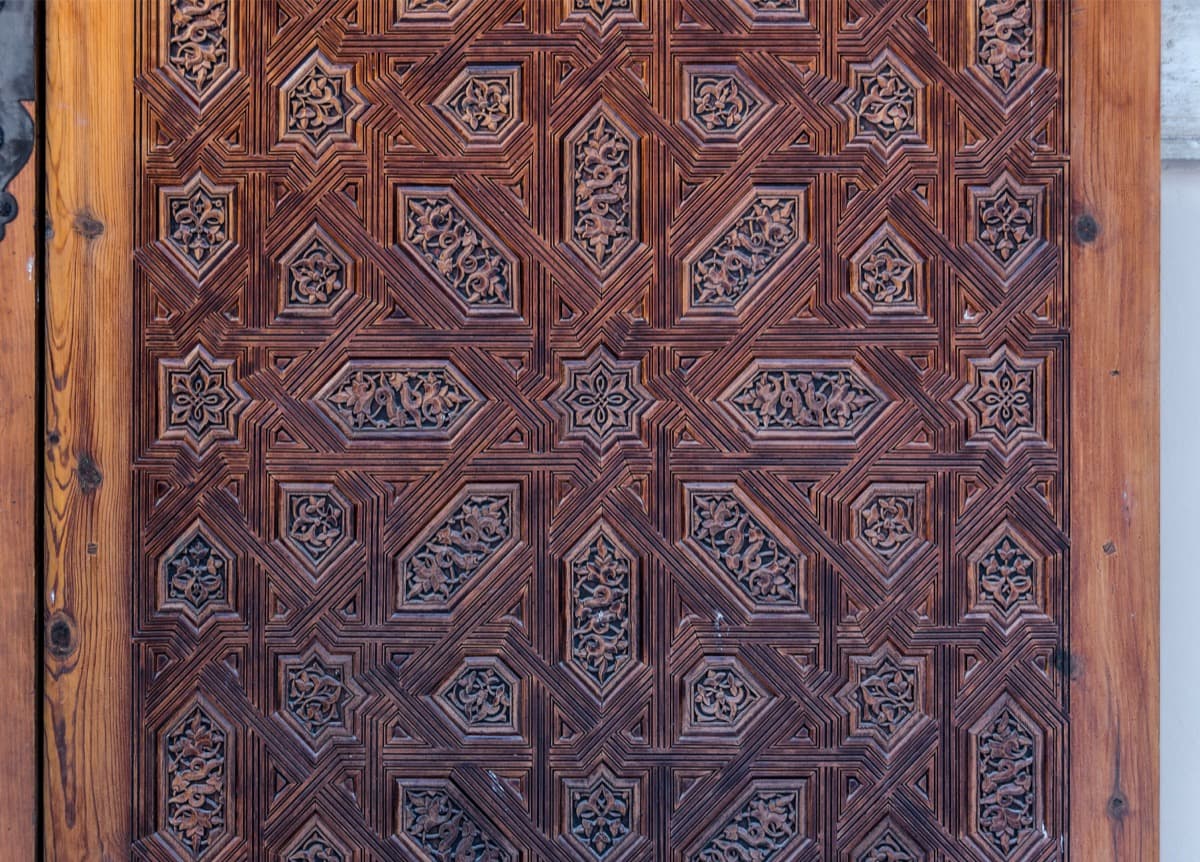
Most visitors walk the Alhambra as a sequence of famous rooms and leave with a camera full of ceilings and no idea what they were looking at. The reading-the-Alhambra tour treats the palace as what it actually is: a single architectural language with a fixed vocabulary, walked in the order that teaches you to read it. Learn the seven words and you can read this building, and every Islamic building built after it. This is the companion to the Nasrid architecture tour, and its job is to give you the grammar before you arrive.
Why the Alhambra can be "read" at all
The Alhambra survives because Granada surrendered by negotiation rather than siege in 1492, so the palace changed hands intact rather than being sacked. That single fact, unpacked in Granada 1492: The Hinge Year, is why it is the most complete surviving Nasrid palace complex in the world. Completeness is what makes it legible. Nothing essential is missing, so the language is all present, in sequence, waiting to be parsed.
And it genuinely is a language with rules. Nasrid builders were not improvising ornament. They were composing with a defined set of elements, each doing a specific job, combined according to consistent logic. The tour isolates seven of them.
The seven elements
Hear a stop from this walk
Generalife (Patio de la Acequia): The Literacy Applied Outward
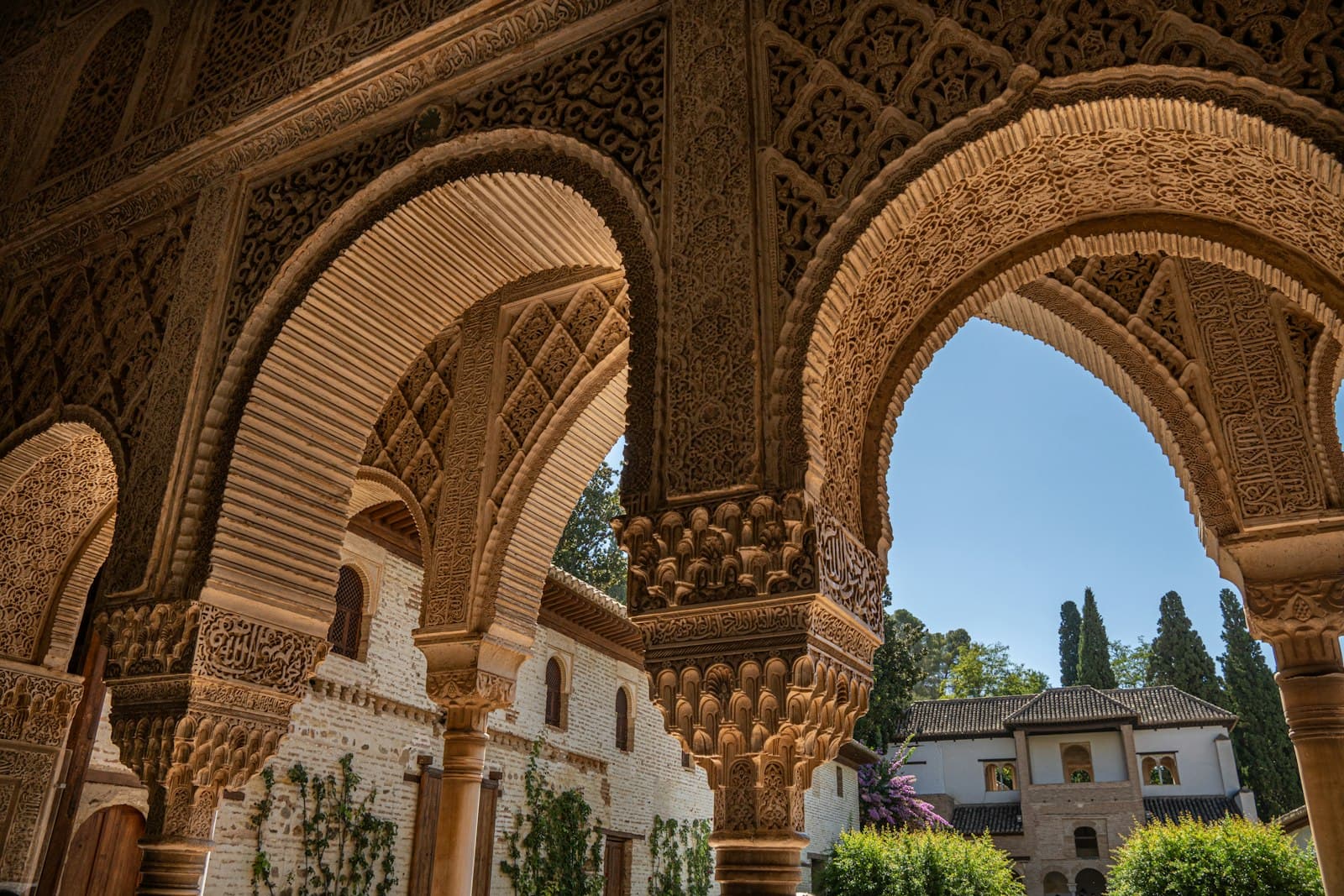
One: the trabeated arch. The palace looks like it is held up by slender columns and delicate arches. It is not. The real structure is post-and-beam, trabeated, hidden behind arches that are frequently decorative rather than load-bearing. The first lesson of the Alhambra is that appearance and structure are deliberately separated. What looks fragile is carrying almost nothing; the wall behind it is doing the work.
Two: ashlar masonry. The Alcazaba, the fortress that opens the tour, is built of heavy dressed stone laid with military seriousness. Setting it first is a teaching choice. It shows you the defensive grammar, blunt and structural, before you enter the palatial grammar, refined and theatrical. The contrast is the point: the same dynasty that built for war also built for poetry, and you should see the war first.
Three: the ceramic dado. Run your eye up any wall. The lower zone is glazed tile, laid in interlocking geometric patterns; the upper zone is carved plaster. This is not arbitrary. Tile is where hands and water reach, so it is durable and washable. Plaster is above, where nothing touches it. The material changes at exactly the height where wear stops. Function chose the boundary.
Four: the stucco frieze. Above the tile, the walls dissolve into carved plaster of astonishing depth, cut in multiple layers so light rakes across it and shadows do half the work. Stucco is light, quick to carve, and easy to repair, which is why an entire palace can be covered in it without the weight of stone carving. It is the Nasrid answer to how you decorate everything without loading the building.
Five: calligraphic epigraphy. The walls are covered in Arabic text. Some of it is religious, some is the dynasty's motto repeated thousands of times, and some, remarkably, is poetry composed by the court poet Ibn Zamrak specifically to be carved into the room it describes. The Comares hall and the Court of the Lions carry verses that speak in the building's own voice. The architecture literally narrates itself. No European building of the period does anything comparable.
Six: the muqarnas vault. The famous "honeycomb" ceilings, thousands of small nested niches building down from the vault like a frozen cascade. Muqarnas is the peak of Nasrid craft, and Muhammad V's builders used it most lavishly in the fourteenth century, the dynasty's artistic high point. The Sala de los Abencerrajes has an eight-pointed star muqarnas dome that is one of the great objects of world architecture. It is structural sleight of hand: a way of transitioning from a square room to a domed ceiling while appearing to defy gravity entirely.
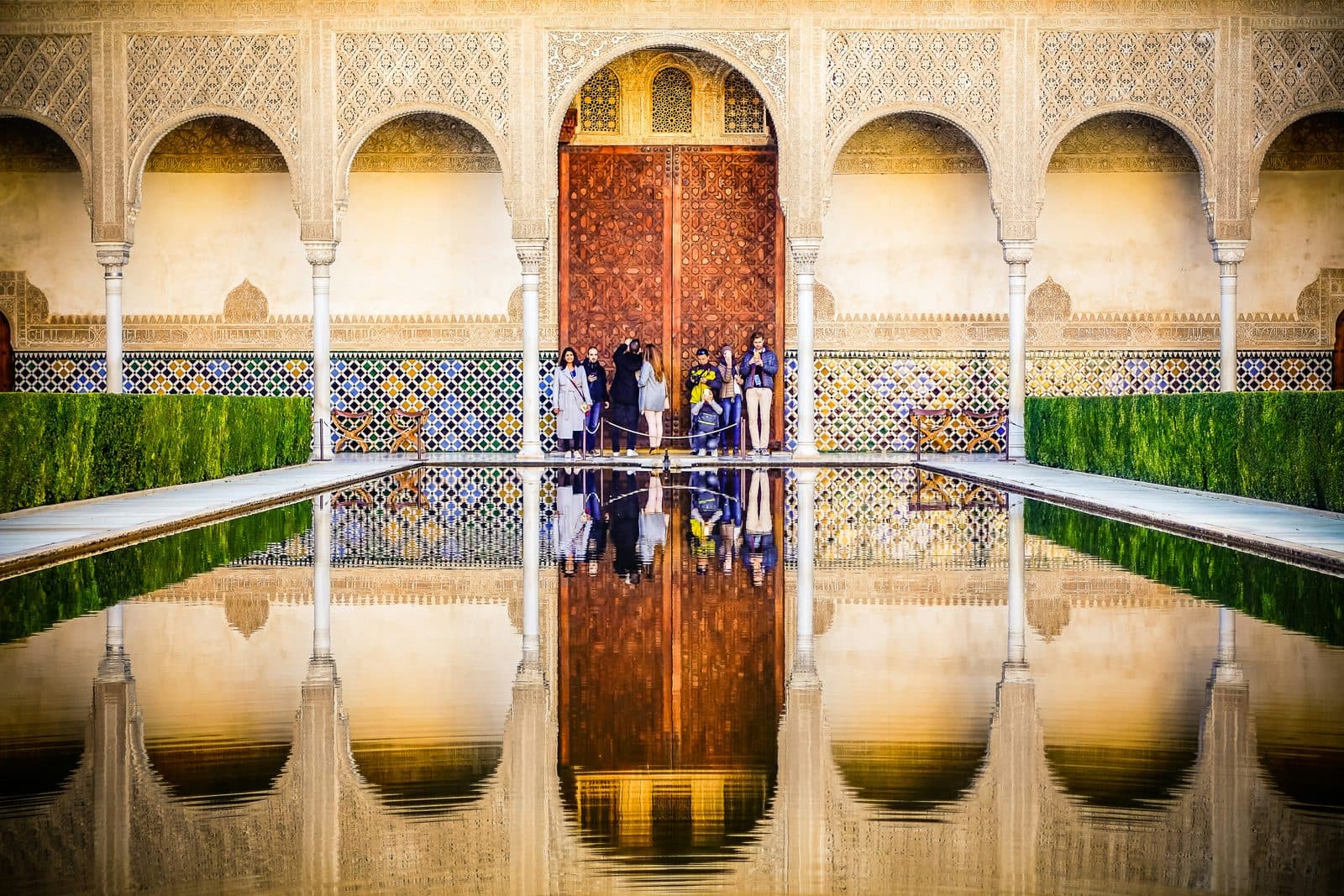
Seven: water as structure. This is the element that separates the Alhambra from every imitation. Water here is not decoration added to architecture; it is architecture. Channels, basins, and the twelve-lion fountain are laid out on the same geometric grid as the walls. The reflecting pool in the Court of the Myrtles doubles the facade above it, so the building is designed to be read together with its own reflection. The Court of the Lions fountain runs on a hydraulic system engineered to keep flowing centuries later. Take the water away and the design collapses into a shell.
The strapwork that ties it together
Underneath all seven elements is one organizing principle: geometric strapwork, the interlacing lines that structure the tile, the stucco, and the ceilings alike. It is the grammar that makes the vocabulary into sentences. Once you can see the strapwork, you stop seeing "decoration" and start seeing a system, which is the whole aim of the walk.
The one deliberate exception
The tour ends by breaking its own rule. The Sala de los Reyes contains figurative paintings, human and animal figures, in a tradition that generally avoids them in religious contexts. It is the exception that proves how consistent everything else is, and the tour saves it for last on purpose. A language is defined as much by its exceptions as its rules.
What you leave with
By the final stop you are not admiring rooms anymore. You are parsing them. You can point at a wall and name why the tile stops where it does, why the arch is a lie, why the poem is where it is, and why the water is not optional. That skill travels. Walk into a mosque in Fez or Isfahan afterward and you will read it too. That is the difference between visiting the Alhambra and understanding it, and it is the entire reason the Nasrid architecture tour is built the way it is.
Ready to experience it?
Reading the Alhambra: A Nasrid Architectural Specimen
105 min · 1.6 km · moderate
More from Granada
Explore more at your own pace.
Granada 1492: The Hinge Year You Are Standing On
Granada's Free Tapas: The Only City in Spain Where the Food Still Comes Free
Sacromonte: Where Two Losing Sides Made a New Culture in the Caves
The Albaicín Is the Real Thing the Barri Gòtic Only Imitates
El Bañuelo: The Eleventh-Century Bath That Survived by Hiding in Plain Sight