On the bank of the Darro, below the Albaicín, a low door opens into a set of vaulted rooms that are roughly a thousand years old. This is El Bañuelo, also called the Baños del Nogal, the oldest surviving Arab bath in Andalusia and one of the best-preserved on the entire Iberian Peninsula. On the Albaicín tour it is the deepest layer you touch, the eleventh-century Zirid foundation the whole hill was built on top of.
How old, and why that number matters
The bath is traditionally dated to the eleventh century, the era of the Zirid rulers of the Granada taifa, which places it well before the Nasrids, before the Alhambra, before almost anything else standing in the city. Medieval Granada had many baths; sources count around twenty-one hammams in the Moorish city. El Bañuelo was the oldest of them, and it is now essentially the only one left in anything like its original state. Nearly all the others were demolished, most of them in the decades after 1492 when the conquered city was being reshaped, the process traced in Granada 1492: The Hinge Year. This one survived.
How it survived when the others did not
Hear a stop from this walk
El Bañuelo: The Zirid Hammam and Torres Balbás's Conservation Method
The reason is almost mundane: it was built over. In the centuries after the baths went out of use, a house was constructed on top of the Bañuelo, and the vaulted bath rooms became, in effect, a basement. Public Moorish baths had a bad reputation in post-conquest Christian Granada and were prime targets for demolition, but a set of vaults buried under a private dwelling was easy to overlook. The bath survived by disappearing. What destroyed the other twenty was visibility. What saved this one was that it had a house sitting on it and nobody bothered.
What you actually walk through
The plan is a direct inheritance from Roman bathing, adapted for Islamic practice, a sequence of rooms rising in temperature. There is an entrance vestibule, then a cold room, then a warm room, then a hot room, corresponding to what a Roman would have called the apodyterium, frigidarium, tepidarium, and caldarium. The heat came from a furnace below and moved through a hypocaust, an under-floor cavity, so the floors of the hot rooms were literally warmed from beneath.
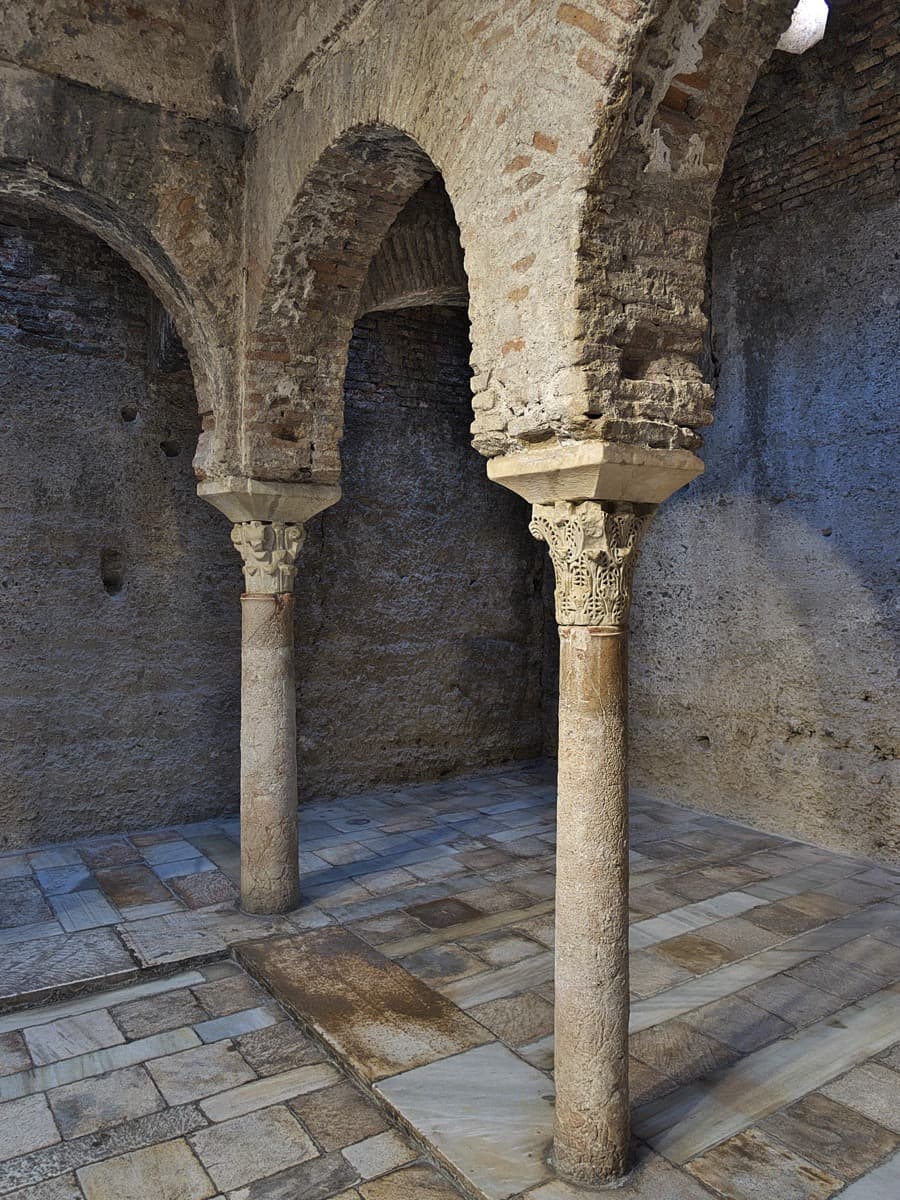
Look up. The vaults are pierced with star-shaped and octagonal skylights. These are not decorative whimsy. They were the light and ventilation system. Steam needed to escape and daylight needed to enter a windowless interior, and the star-holes did both, throwing shafts of light down through the rising steam. The columns holding the vaults are a mix of reused pieces, including capitals salvaged from earlier Roman and Visigothic buildings, spolia, older stone given a new job. The bath is thrifty and engineered at once, which is exactly the character of the Zirid water system that shaped the whole neighborhood.
The conservation is half the point
El Bañuelo was declared a National Monument in 1918, and its conservation became associated with Leopoldo Torres Balbás, the architect-conservator who worked across Granada's Moorish heritage between 1923 and 1936 and pioneered scientific restoration in Spain. His method is the reason the bath reads as genuine today. Rather than "improving" the ruin with invented detail to make it prettier, the honest approach here stabilized the real structure and left the salvaged columns and worn surfaces visible as what they are.
That discipline is exactly the argument at the heart of the Albaicín companion: Granada's medieval quarter is authentic in a way that reconstructed districts elsewhere are not. El Bañuelo is the proof object. A thousand-year-old bath, conserved without fakery, sitting quietly under the neighborhood that grew up over it. You are not looking at a reproduction of an eleventh-century bath. You are standing in one.
Why this small door is worth stopping at
It would be easy to walk past. There is no grand facade, no queue, no spectacle, just a modest entrance on the river. But this is the oldest thing on the tour and one of the oldest surviving Islamic structures of its kind in Spain, and it survived precisely because it was humble enough to be buried and forgotten. The Albaicín tour walks you here on purpose, near the bottom of the hill and the bottom of the chronology, so that you meet the foundation before you climb through everything that was built on it.
Ready to experience it?
Albaicín: 800 Years on a Hillside
105 min · 2.1 km · moderate
More from Granada
Explore more at your own pace.
Granada 1492: The Hinge Year You Are Standing On
Granada's Free Tapas: The Only City in Spain Where the Food Still Comes Free
How to Read the Alhambra: The Seven Elements of a Nasrid Sentence
Sacromonte: Where Two Losing Sides Made a New Culture in the Caves
The Albaicín Is the Real Thing the Barri Gòtic Only Imitates