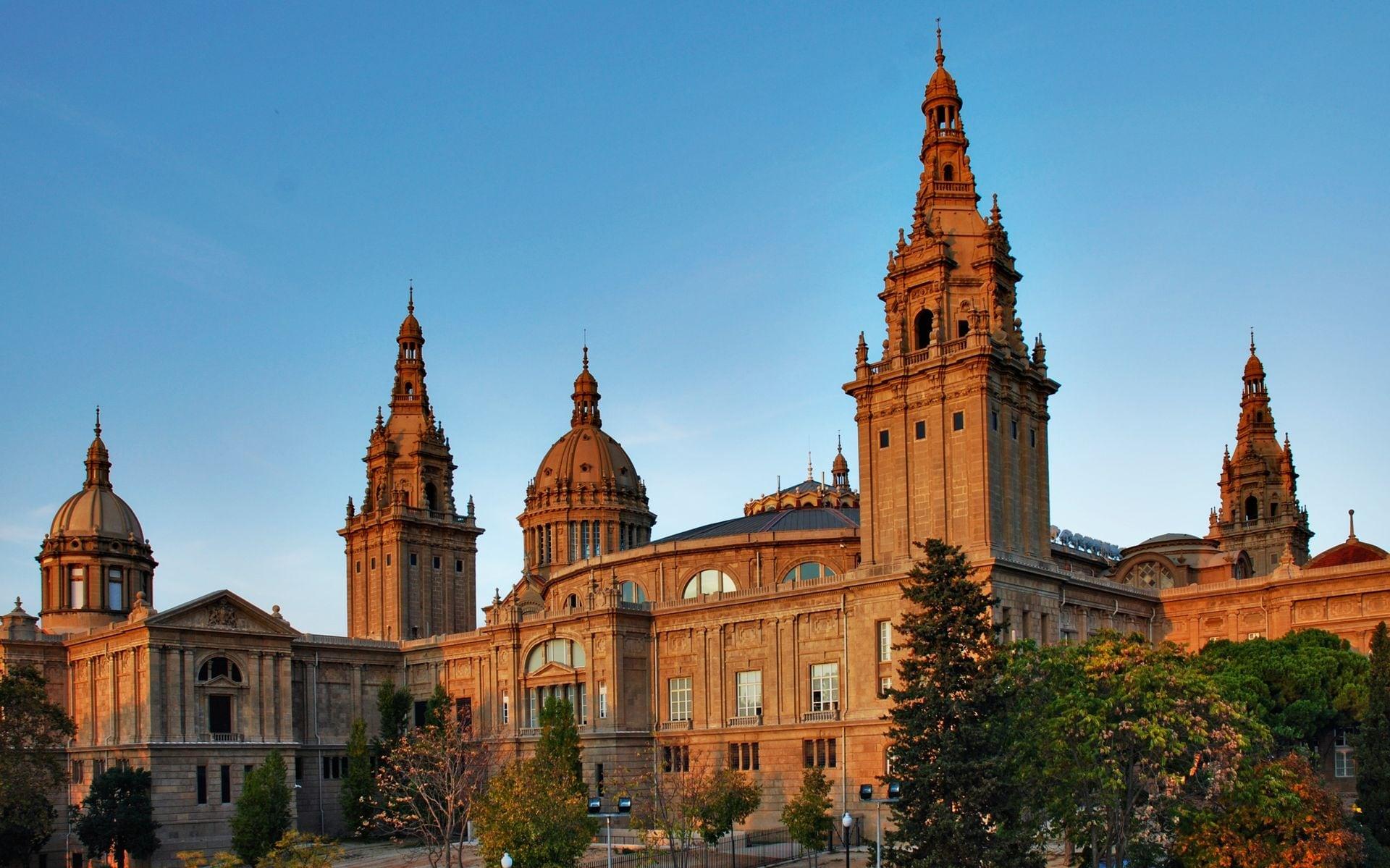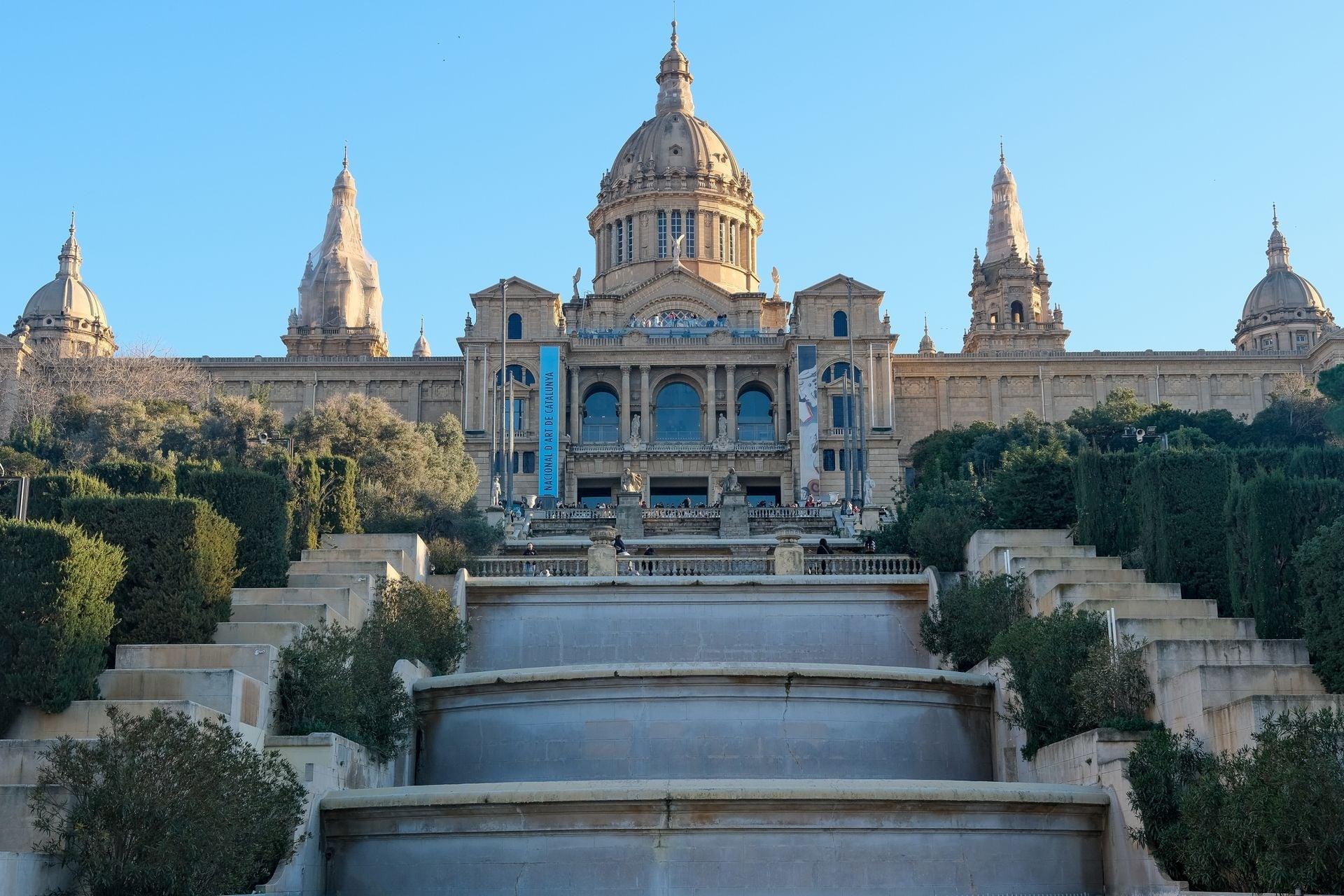
The 1929 International Exposition built Montjuïc's north face as a stage set: one straight axis of gate, avenue, fountain, water stair and palace, and then terraced gardens and a quarry theatre for the same fair. Walk it from the bottom to the top and you watch a world's fair stage a city, and you can count what Barcelona kept, what it rebuilt and what it put back. Most visitors meet this hillside in pieces, a fountain show one night, a museum another day. Read as one line, it makes sense all at once.
The set seen from the back of the hall
Stand between the two brick towers on Plaça d'Espanya and turn to face the hill. Everything the fair wanted you to see is in that one look: the avenue, a great basin, a staircase of water and a domed palace closing the view. The towers themselves are a costume. Each is about forty-seven metres tall and modelled on the bell tower of Saint Mark's in Venice, with a base of cut stone, a shaft of bare brick, an open gallery of columns and a copper roof. That is the dress of a real campanile on a gate with no bells to ring.
The man who planned this axis was Josep Puig i Cadafalch. His two palaces flanking the foot of the water stair, built between 1920 and 1922, were the first fair buildings to go up, and they held a furniture and decoration show in 1923 that Catalonia's heritage inventory calls a rehearsal for the big event. Then politics intervened. Under the dictatorship of Primo de Rivera he was sidelined, another architect directed the works, and the fountains and cascades were finished without him.
A machine dressed as scenery
Hear a stop from this walk
Greek Theatre: A Stage Cut From a Quarry
The Magic Fountain is where the stage set becomes a machine. Carles Buïgas presented his project in June 1928, and the city's own history of the fountain records that more than three thousand workers built it in less than a year. Three basins step down the slope. Colour comes from below, through drums of tinted glass turning under skylights, and the lamps behind them are LED now. The small jets down the middle of the avenue and the four cascades up the hill run on the same system from one control room, so on a show night the whole axis moves together like stage lighting.
The cascades have had their own interruptions. Two stopped in the 1970s, and the city brought them back in stages, with all four running again by the Olympic year and their water and lights renewed between 2014 and 2016. Look at the two old palaces as you climb past: their fronts step inward up the slope, narrowing the space to mark where the great stair begins. Wings at the sides, a space that tightens, a palace for a backdrop. It is theatre carried out in stone.
What came down and what came back
Two stops on this walk tell the same story twice. Just off the axis, a low podium of pale stone marks the Barcelona Pavilion, designed by Ludwig Mies van der Rohe and Lilly Reich as Germany's national pavilion. The Fundació Mies van der Rohe records that it was dismantled in 1930, rebuilt from 1983 and reopened on its original site in 1986, in the same four stones: Roman travertine, green Alpine marble, ancient green marble from Greece and golden onyx from the Atlas.
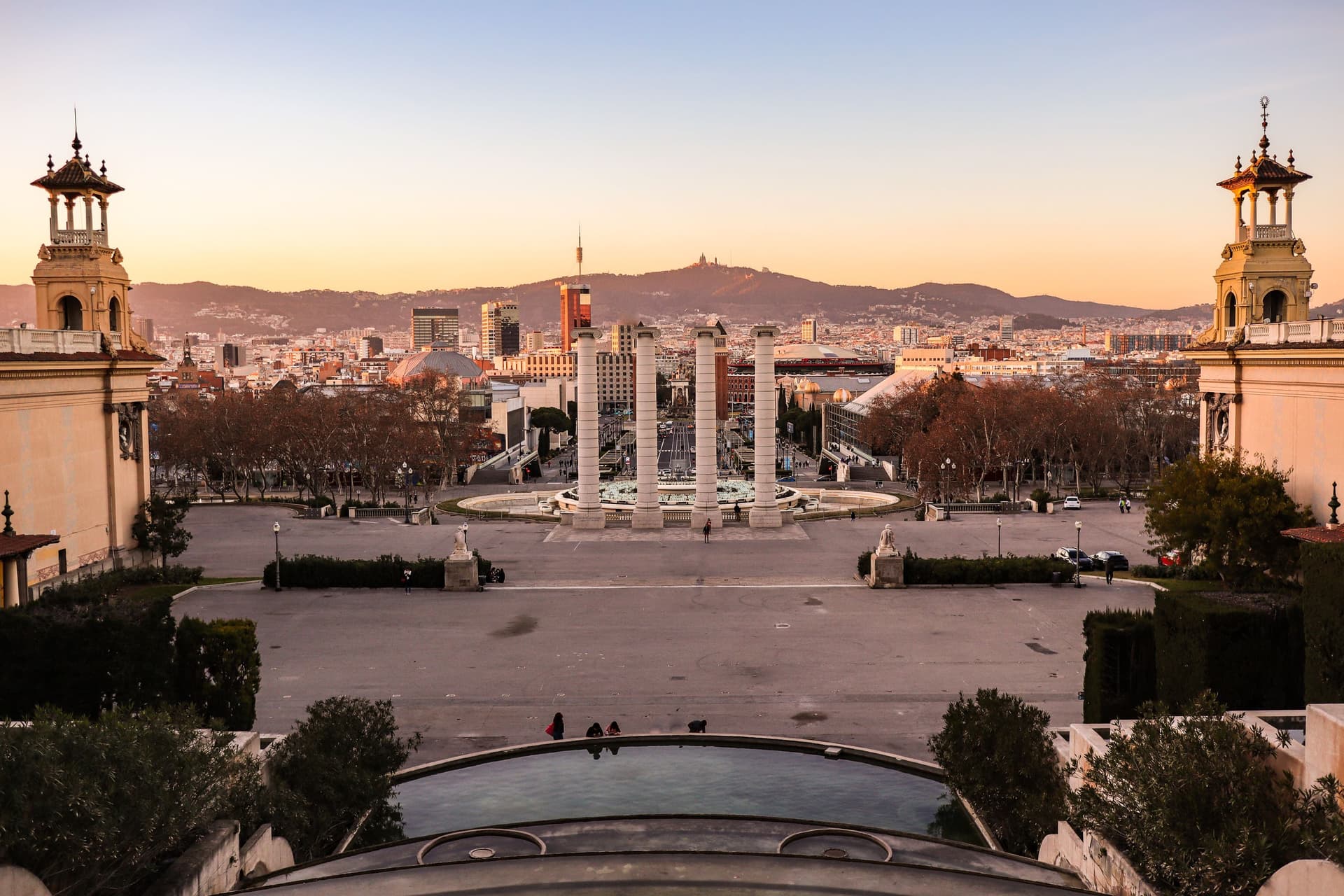
A few steps away stand four tall columns. Puig i Cadafalch raised them in 1919 on the spot the Magic Fountain now occupies, and they are widely read as the four red stripes of the Catalan flag. The dictatorship pulled them down in 1928, and the city rebuilt them in 2010, a few metres from where they first stood. The fountain filled the hole the columns left, and now both share the slope. Montjuïc is a hill of things taken down and put back.
The top of the stair, then off the set
The Palau Nacional closes the view. It was built for the fair, finished in 1929, and since 1934 has held Catalonia's art collections; the terrace in front is free. Turn round at the balustrade and the whole line you walked lies below you, straight down to the twin towers. That was the point of the design: a palace to end the axis and a balcony to look back down it.
From here the walk steps off the stage into the gardens the fair also made. In the Laribal gardens, laid out by the French landscape designer Jean-Claude Nicolas Forestier, water pours from a stone cat's head at the Font del Gat. Below, the Fundació Joan Miró catches daylight in curved skylights, a 1970s building set into fair ground, lit from above where the fountain is lit from below. The walk ends in the Greek Theatre, cut into an old quarry for 1929 by the same architect who drew the gate towers. The fair's front door and its theatre are by one hand.
Walking it yourself
This hillside rewards doing it at your own pace. You can linger on the terrace, take the escalators or the stairs beside them, and skip any stop that does not hold you, with no group to keep up with. The whole line, from the towers at stop 1 to the theatre at stop 11, is Montjuïc and the Magic Fountain: A World's Fair Stage, about 2 kilometres over eleven stops in around 75 minutes, and every stop works from outside, with the pavilion and both museums optional. For the rest of the city, browse Barcelona walking tours or the Barcelona city page.
Sources
- Fundació Mies van der Rohe, "The Pavilion": https://miesbcn.com/the-pavilion/ . Designers, 1929 construction, dismantling in 1930, rebuilding from 1983 and reopening in 1986, and the four stones.
- Ajuntament de Barcelona, "Història" of the Font Màgica: https://barcelona.cat/ca/que-pots-fer-a-bcn/font-magica/historia . Buïgas's project, more than three thousand workers in under a year, the Four Columns demolished in 1928 and rebuilt in 2010 a few metres away, and the cascade restorations.
- VilaWeb, 27 June 2008: https://www.vilaweb.cat/noticia/2912647/20080627/lajuntament-barcelona-restituira-quatre-columnes-puig-cadafalch-montjuic.html . The city council vote to restore the columns raised in 1919 and demolished in 1928.
- The tour's own audited research (Roamer Montjuïc rebuild, October 2026): Generalitat heritage inventory cards for the towers, cascades and palaces, MNAC building history, and the city's garden pages.
Ready to experience it?
Montjuïc and the Magic Fountain: A World's Fair Stage
75 min · 2 km · moderate
More from Barcelona
Explore more at your own pace.
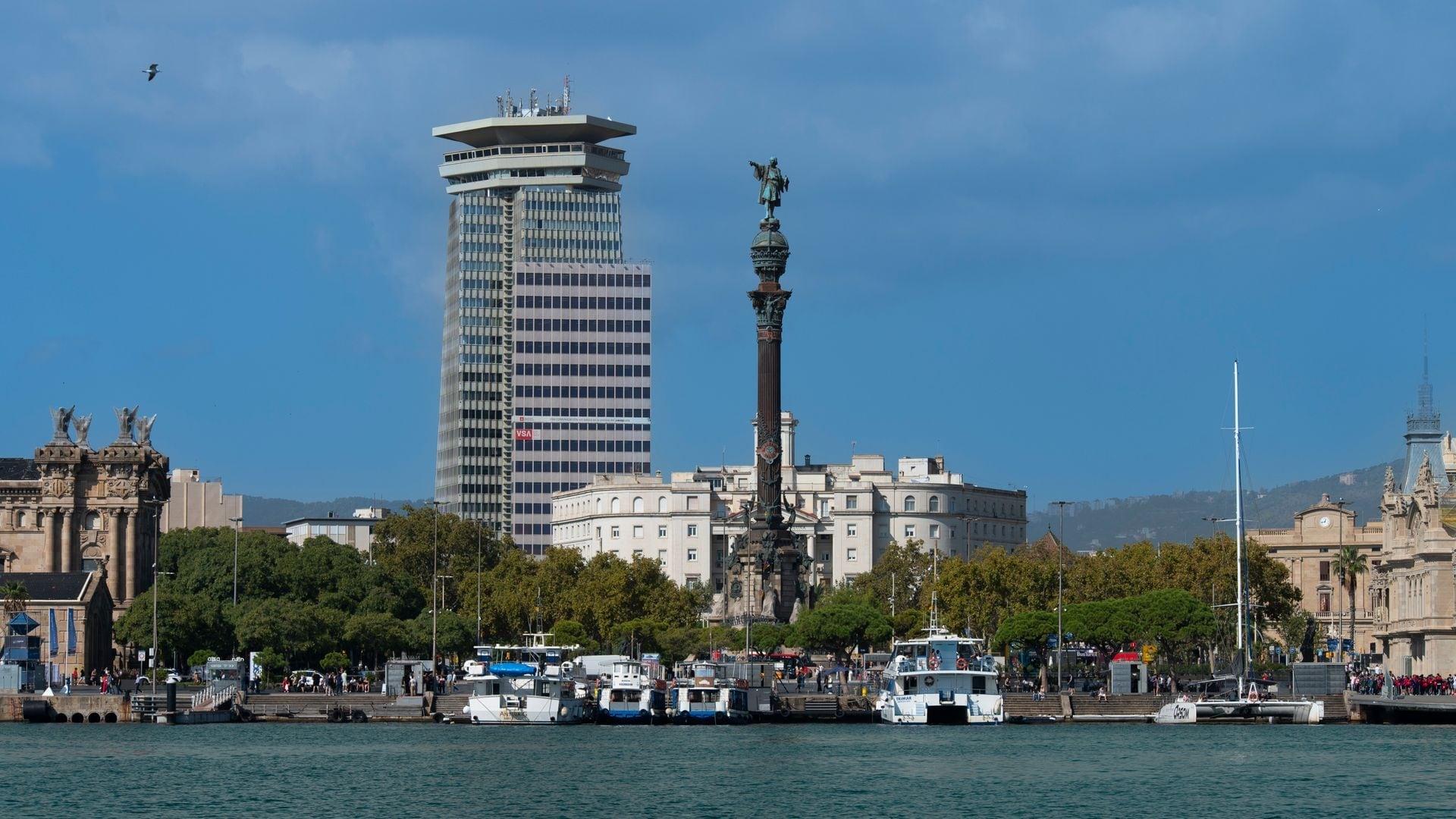
Barceloneta and Port Vell: Walking the City's Moving Edge of the Sea
Ciutadella Park: A Fortress Turned Inside Out Into a Science Garden
El Born: The Sea Quarter That Paid for Its Landmarks and Lost Its Streets
Gràcia to Park Güell: How a Town of Private Developments Ended in Gaudí's Failed Estate
Sagrada Família and Sant Pau: Reading a Basilica One Side at a Time, Then Walking to the Hospital