Every stop on this walk stands on the old, moving edge of the sea: a shipyard the storms damaged in 1302, a harbour front of monuments and merchants, warehouses on the Fishermen's Beach, a soldier-planned town on silted sand, and a beach the city only won back from 1995. Barcelona's waterfront is not a fixed line. The sea and the city have been trading it back and forth for seven hundred years, and once you know that, every building along it tells you where the water used to be.
A navy yard on the beach
Begin at the Drassanes Reials, the Royal Shipyards: a row of stone gables, each the end of a long arched hall big enough to build a war galley indoors. The yard goes back to the thirteenth century, and in 1378 the king, the city and Catalonia's government agreed to build it properly together. The Maritime Museum inside calls it the largest and most complete medieval shipyard to survive anywhere. When it was built the beach reached the far end of the halls, and documents from 1302, 1313 and 1320 record storms damaging its sea front. Along it runs the only stretch of the medieval walls kept when the rest came down from 1854.
Iron columns and merchants' arcades
Hear a stop from this walk
L'Estel Ferit: The Wounded Star
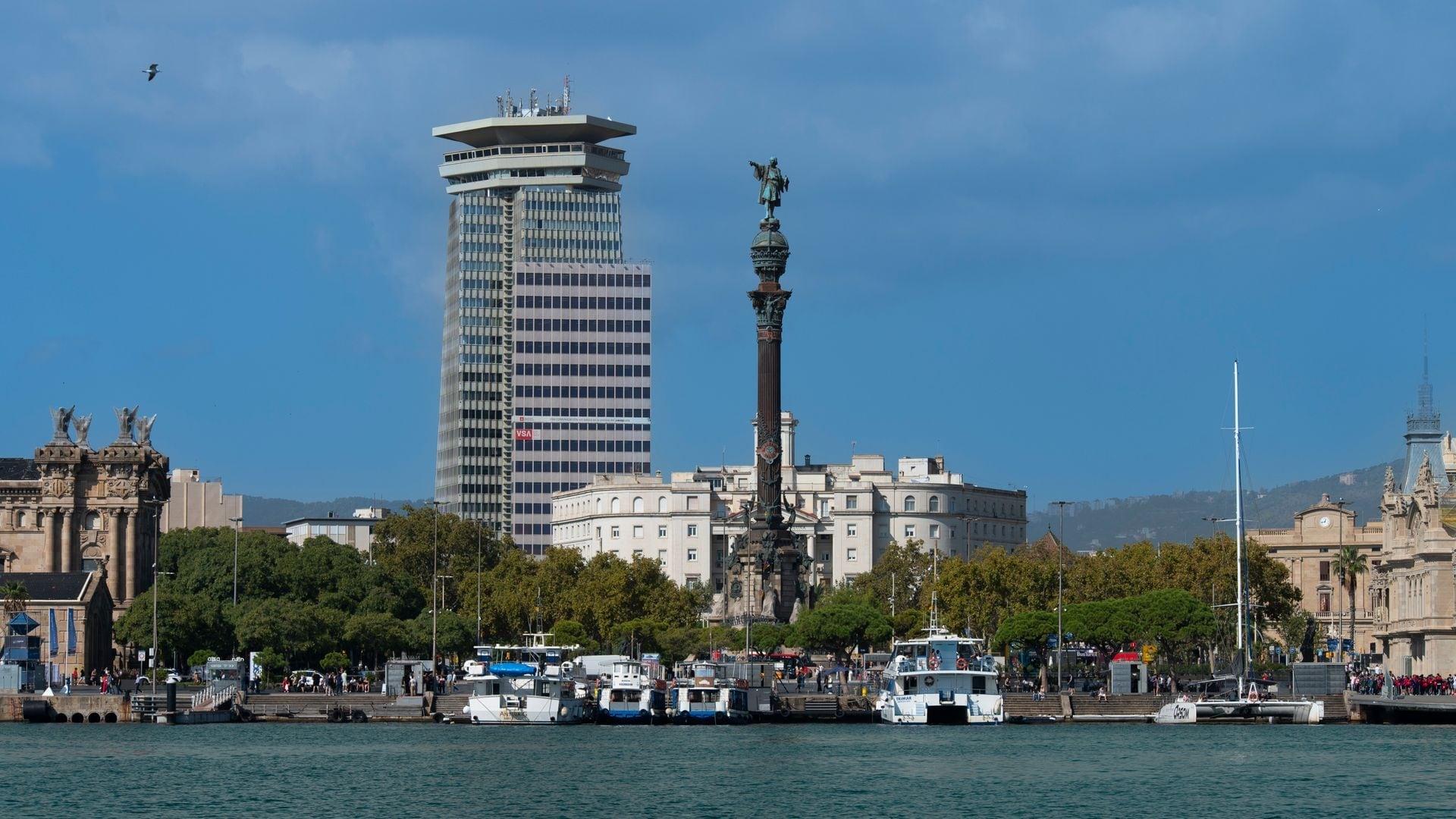
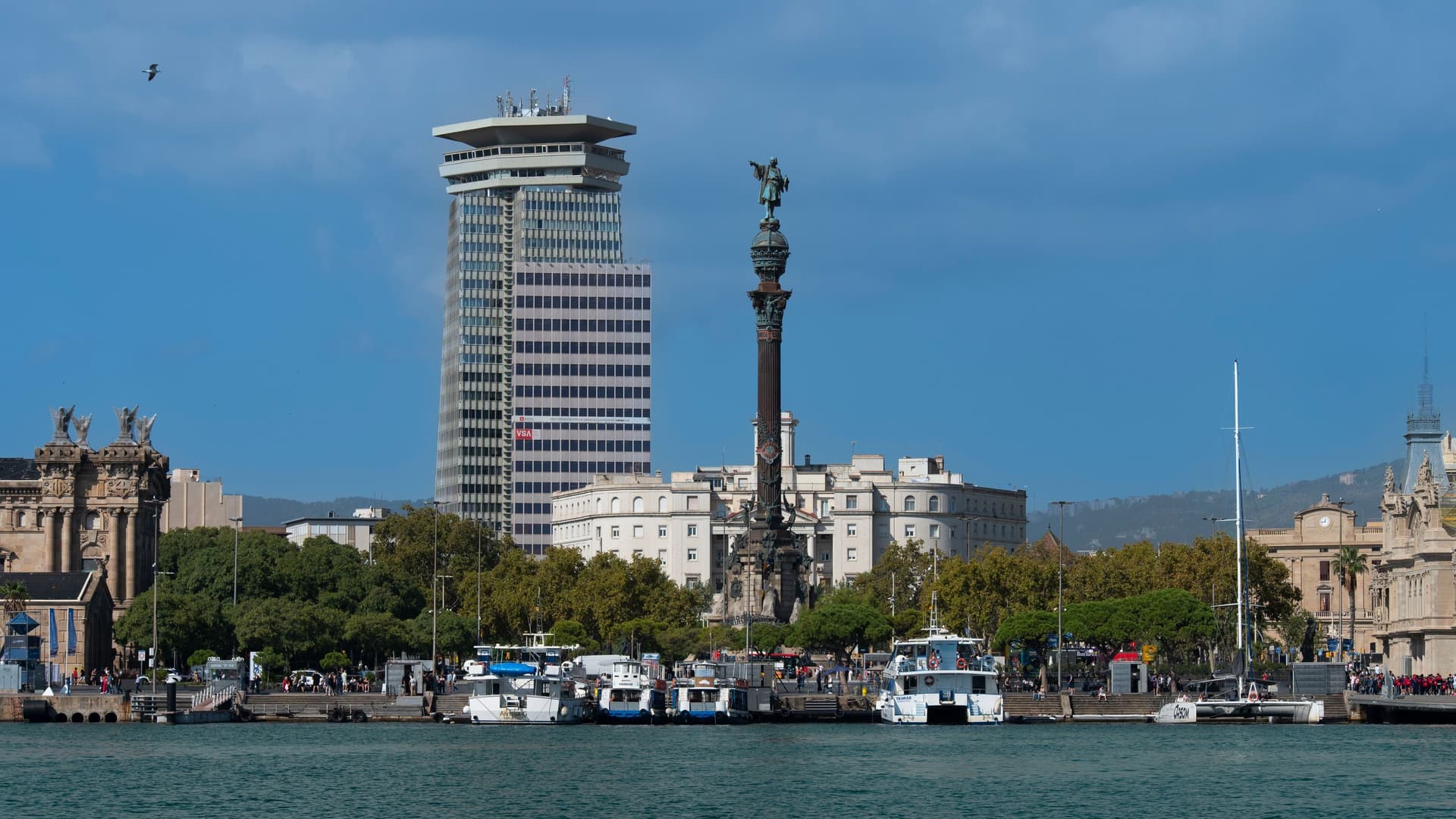
The harbour front is where the industrial city showed off. The Columbus Monument, unveiled for the Universal Exposition of 1888, is nearly sixty metres of iron and bronze cast in Barcelona, with a lift inside to a small gallery under the statue's feet. A historian of the city's monuments notes it was hailed as the tallest column in the world built entirely of metal. Around the corner in Plaça del Duc de Medinaceli stands its little ancestor: an iron column of 1851, the first large ornamental cast-iron piece put up in the city. Same idea, thirty-seven years apart.
Further on, the merchants. The Llotja de Mar, the sea exchange, wears a classical coat from the 1770s over a Gothic trading hall of the late fourteenth century. Facing it, the Porxos d'en Xifré of the 1830s were, the city's catalogue says, the first buildings in Barcelona put up as rented flats and the first with drinking-water tanks on the roof. Look up at the medallions: Columbus is there, half a century before his column.
Between them, two newer pieces show the harbour turning from workplace to promenade before the 1992 Olympics: Roy Lichtenstein's Barcelona Head, unveiled that April, its printed dots laid in trencadís broken tile, and the remade Moll de la Fusta, the old timber wharf.
Warehouses on the Fishermen's Beach
Palau de Mar was never a palace. It began as the General Trade Warehouses, designed in 1881 on models from the docks of London and Liverpool and built from 1885 on what had been the Fishermen's Beach, one more stretch of shore turned into port. The Port of Barcelona calls it the only building left of the old industrial port, and a citizens' campaign in 1989 stopped its demolition. Its long, plain brick walls were made for storing goods, not for show.
A town drawn by a soldier
Cross into the Barceloneta and the ground itself is young. The harbour's breakwater trapped sand until, by the 1700s, it was solid enough to build on. In 1753 the captain general began a new district here to house the port's workers, laid out by the military engineer Juan Martín Cermeño like a barracks: long straight streets of identical small houses. The first houses were allowed only one floor above the ground, so the cannon of the Ciutadella fortress could fire over their roofs. On Carrer de Sant Carles, the little house of 1761 is the last original building with fronts on three streets, and the city now runs it as a small museum. Compare it with the stacked floors around Sant Miquel del Port, the district church begun three months after the first stone.
The market down the street keeps its 1880s iron frame under a two-tone zinc roof of the 2000s carrying solar panels, and some corner stones still carry the old block numbers of the 1753 plan.
The beach handed back
The walk ends on the sand at Rebecca Horn's L'Estel Ferit, the Wounded Star, four steel boxes stacked out of line in July 1992 as a homage to the bathhouses and beach restaurants that stood here for most of the twentieth century. Rebuilding of this beach began in 1995, after a coastal law of 1988 let the state, the city and the port clear the shore. The new sand was so much higher that the sculpture sank into it and had to be lifted onto a base. The sea that battered the shipyard is now the city's front garden.
Walking it yourself
The route is flat and step-free, so it suits a slow pace with stops for shade, the market and the water. It is eleven stops over just under 3 kilometres in about 90 minutes, from stop 1 at the shipyards to stop 11 on the beach, on Barceloneta Beach and Port Vell: Walking on the Sea. Skip the stops that do not interest you and linger at the ones that do. More ideas are on the Barcelona city page and in Barcelona walking tours.
Sources
- Spain.info (Turespaña), Monumento a Colón: https://www.spain.info/es/lugares-interes/monumento-a-colon-barcelona/ . The column designed by Gaietà Buïgas for the 1888 Universal Exposition, its height and the lift to the viewing gallery.
- Ajuntament de Barcelona, Setmanes d'Arquitectura, Casa de la Barceloneta 1761: https://barcelona.cat/setmanesarquitectura/en/venues/casa-de-la-barceloneta-1761 . The house at Carrer de Sant Carles 6, its original proportions and status as the last original building with a three-street front.
- The tour's audited research (Roamer Barceloneta and Port Vell rebuild, October 2026): the Maritime Museum's history of the Drassanes, the city's public art catalogue, the Port of Barcelona on Palau de Mar, and the Museum of the History of Catalonia on the 1753 plan.
Ready to experience it?
Barceloneta Beach and Port Vell: Walking on the Sea
90 min · 2.9 km · easy
More from Barcelona
Explore more at your own pace.
Ciutadella Park: A Fortress Turned Inside Out Into a Science Garden
El Born: The Sea Quarter That Paid for Its Landmarks and Lost Its Streets
Gràcia to Park Güell: How a Town of Private Developments Ended in Gaudí's Failed Estate
Montjuïc's World's Fair Stage: Reading the 1929 Axis From Gate to Palace
Sagrada Família and Sant Pau: Reading a Basilica One Side at a Time, Then Walking to the Hospital