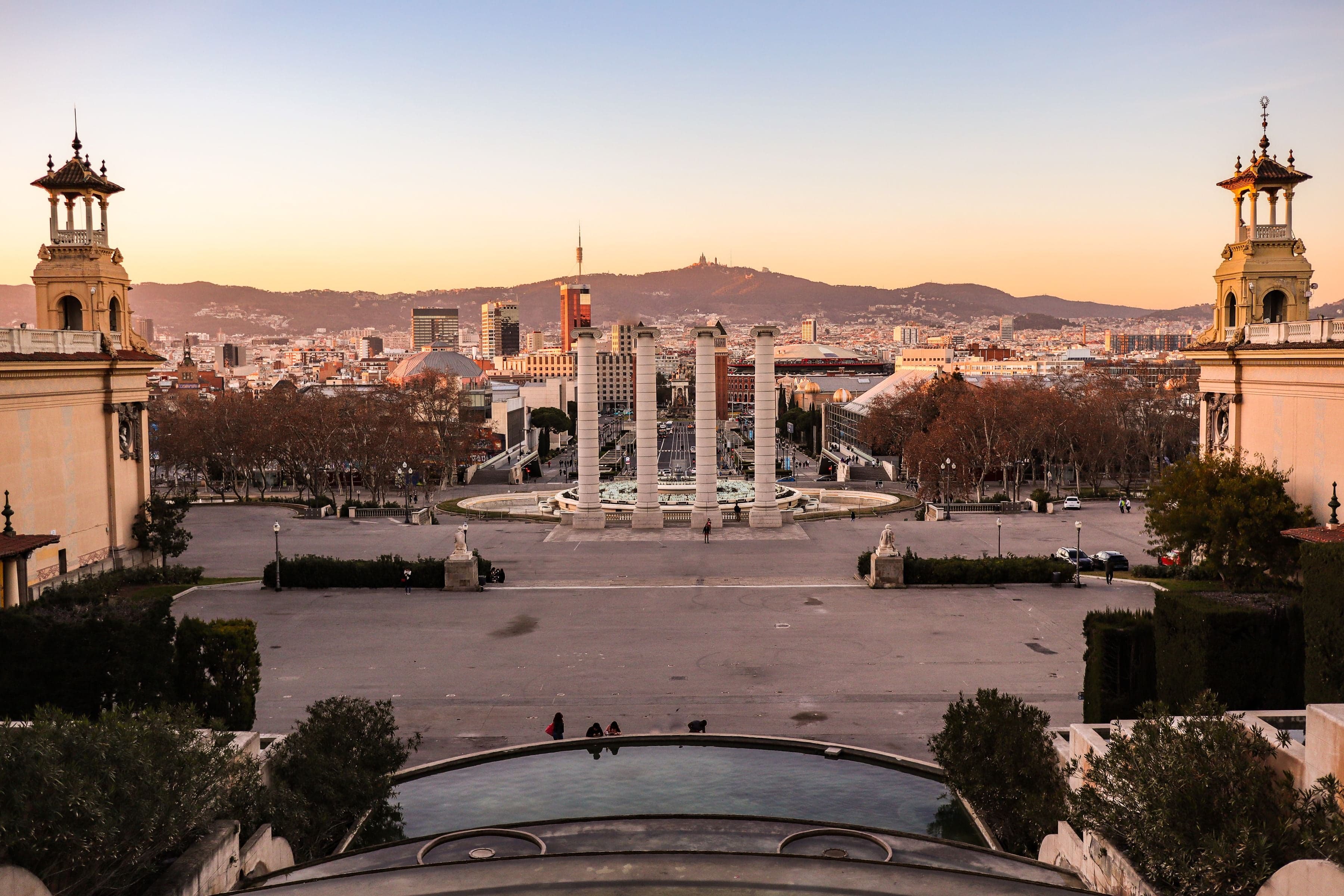
Walk the 1929 World's Fair axis from Plaça d'Espanya's towers past the Magic Fountain, CaixaForum and the Barcelona Pavilion, climb the cascades to the Palau Nacional terrace, then cross Montjuïc's gardens to the Greek Theatre.
Start · Plaça d'Espanya: The Fair's Front Door
DirectionsStops
- 1
Plaça d'Espanya: The Fair's Front Door
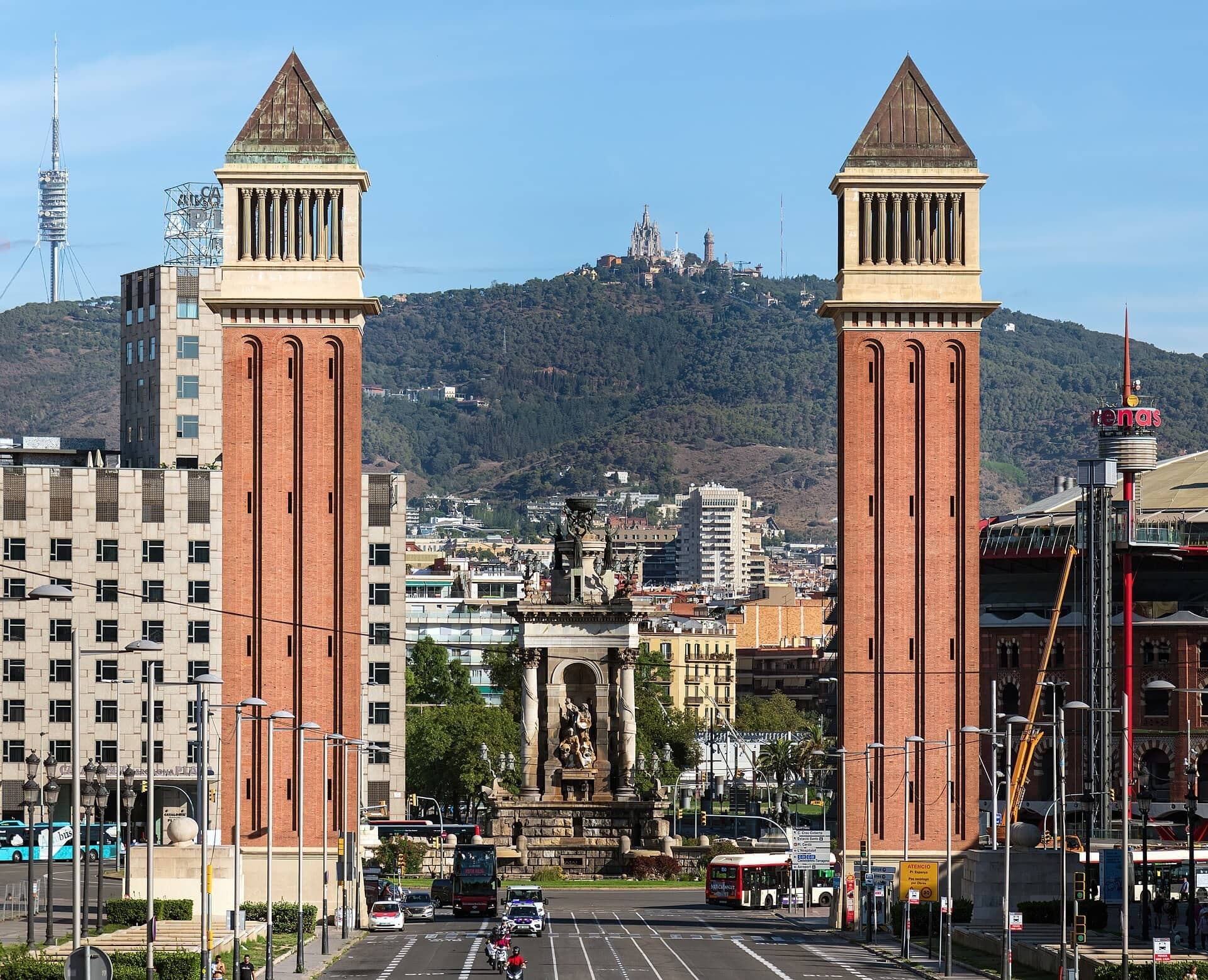
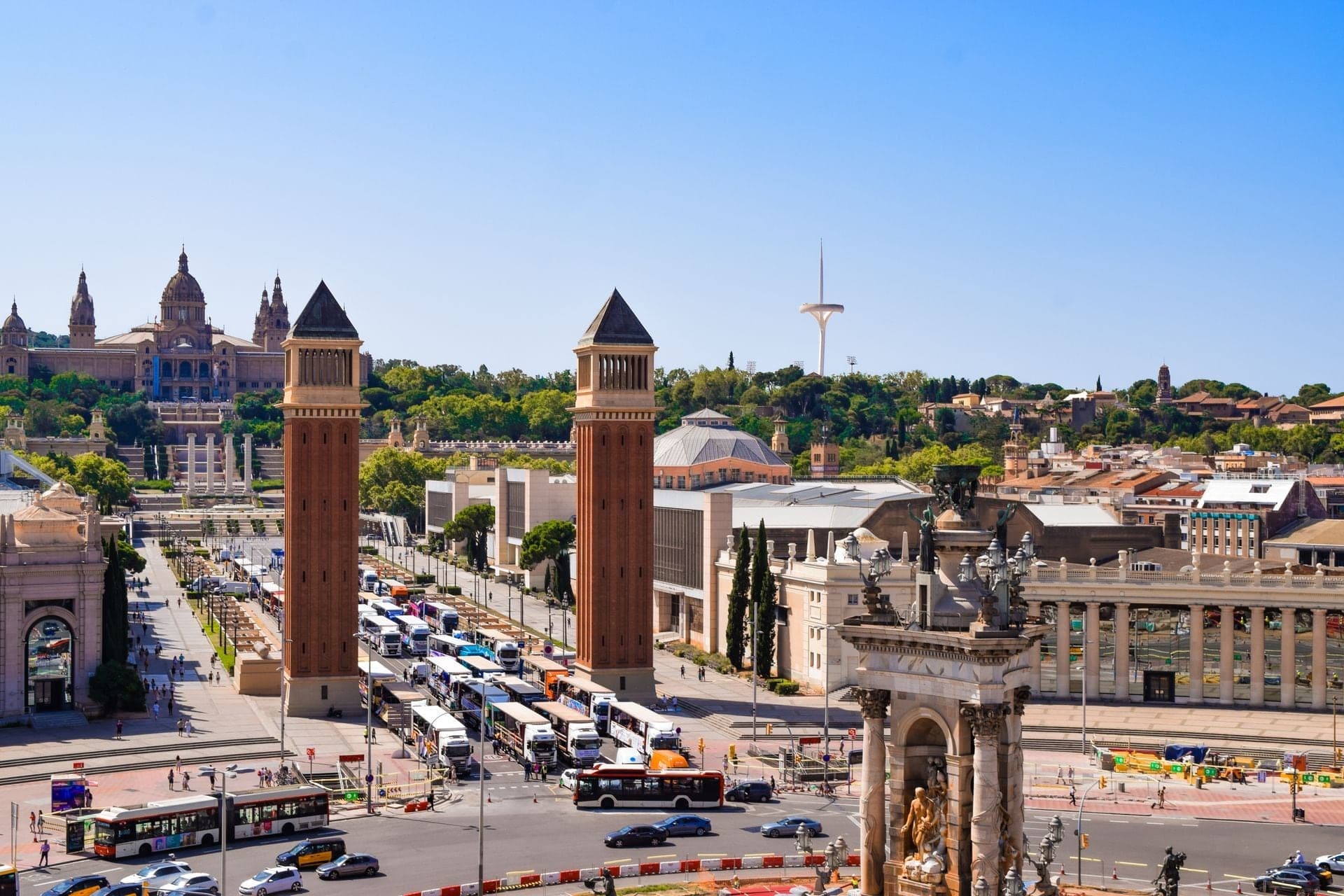
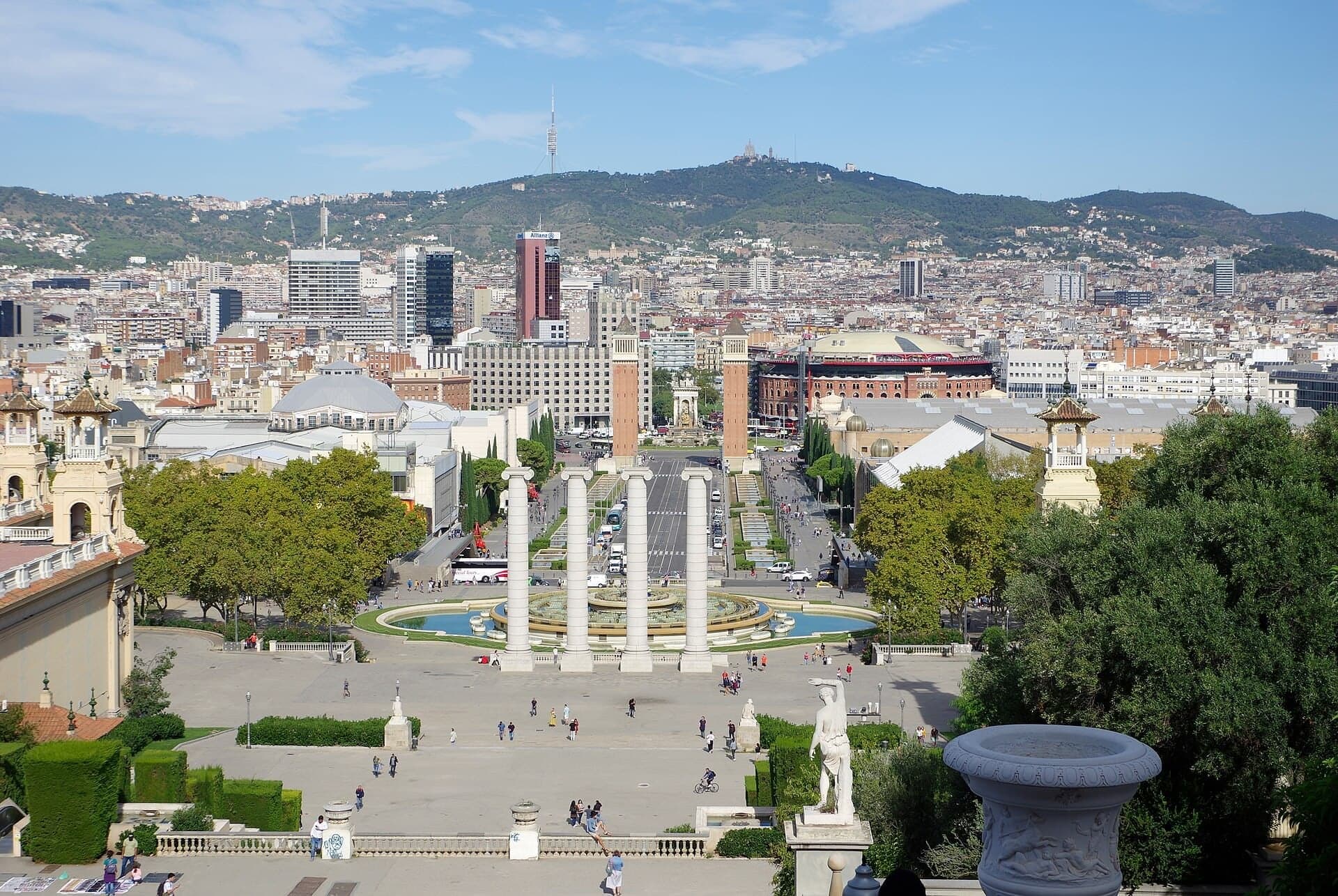
Two brick towers modeled on Venice frame the fair's front gate. Turn round and the whole axis climbs to the palace on the hill.
- 2
Avinguda de la Reina Maria Cristina: A Runway of Light
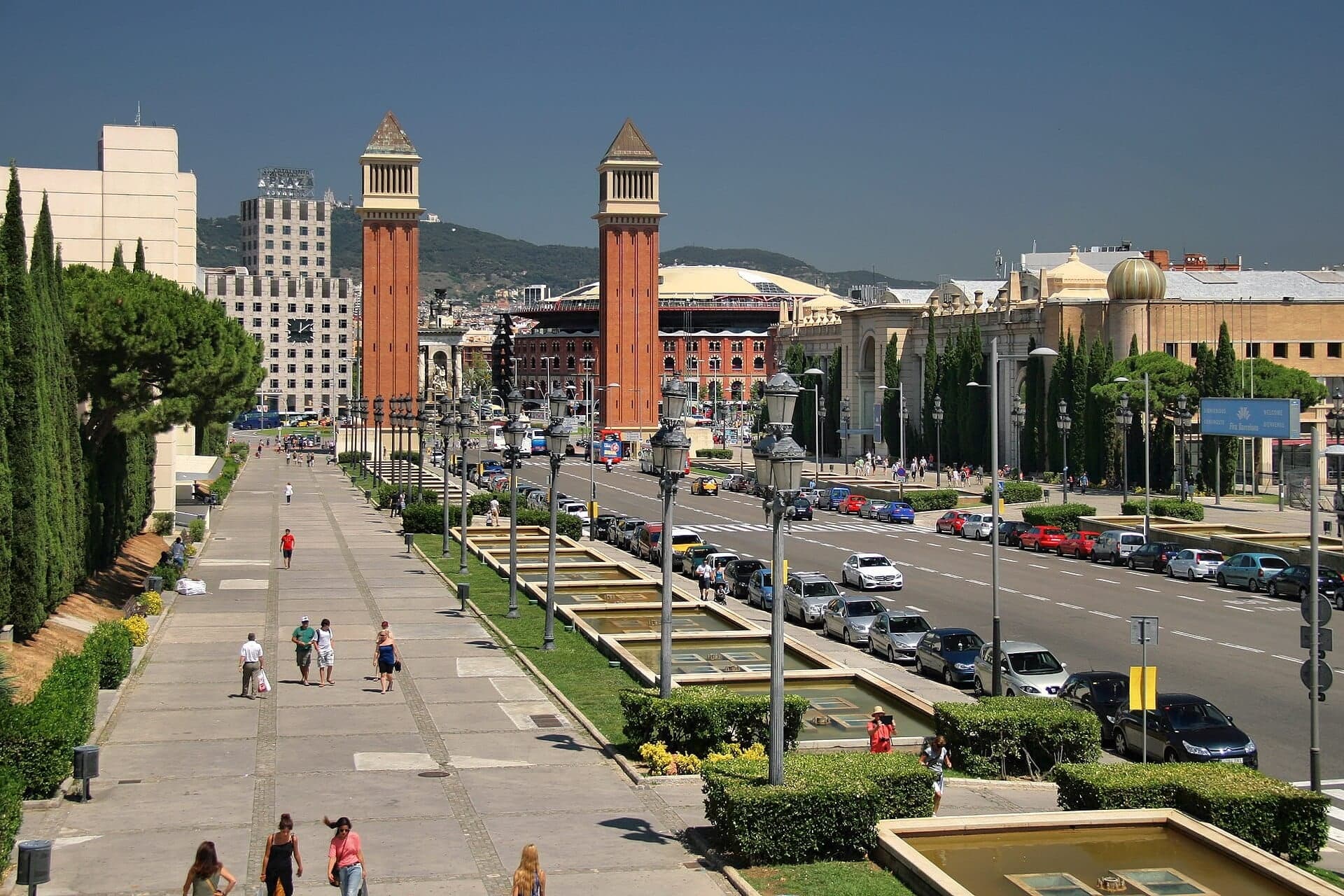
The fair's avenue runs between halls the trade fair still uses, with a line of lit jets wired to the Magic Fountain ahead.
- 3
Magic Fountain: A Machine of Light and Water
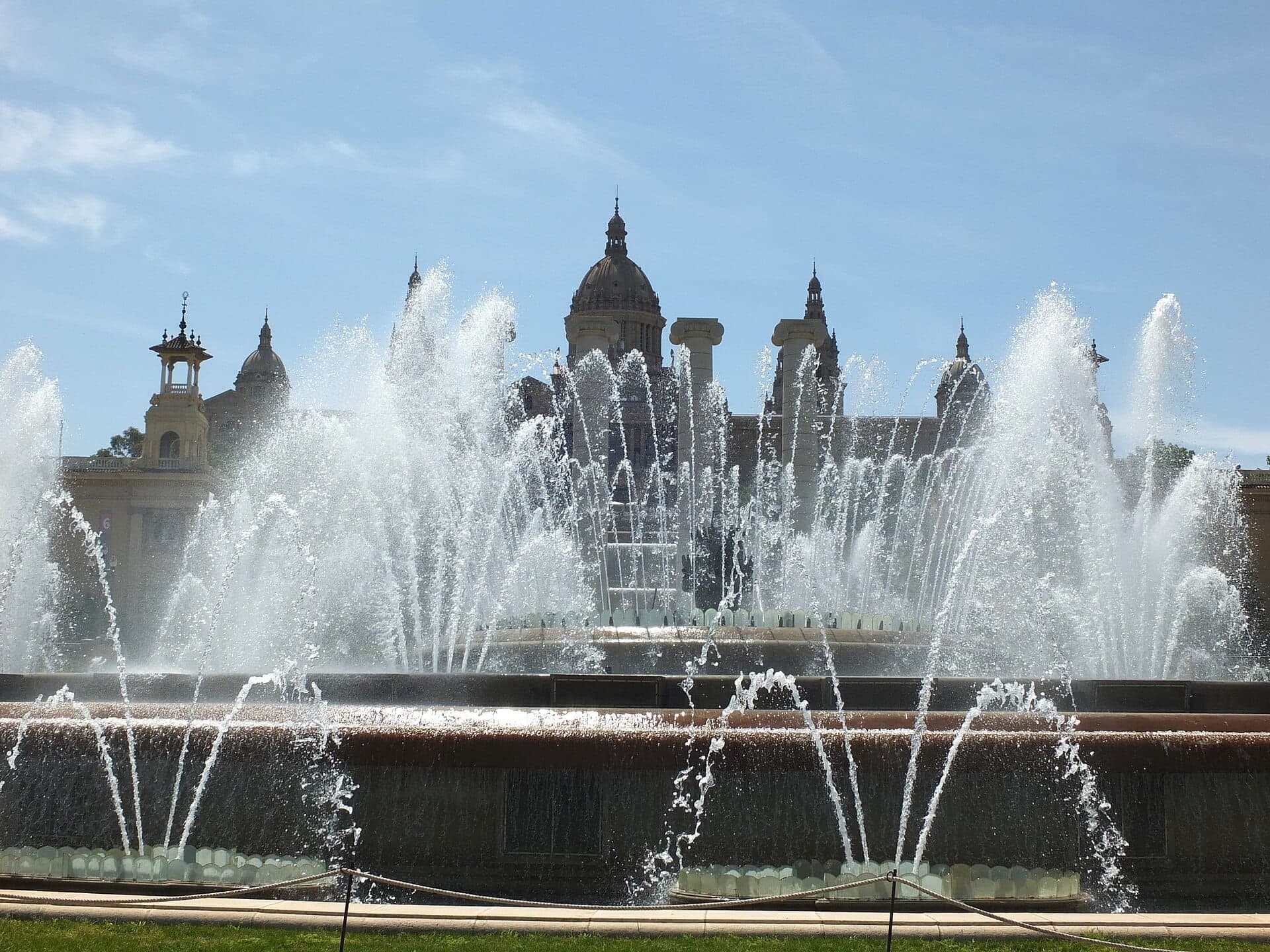
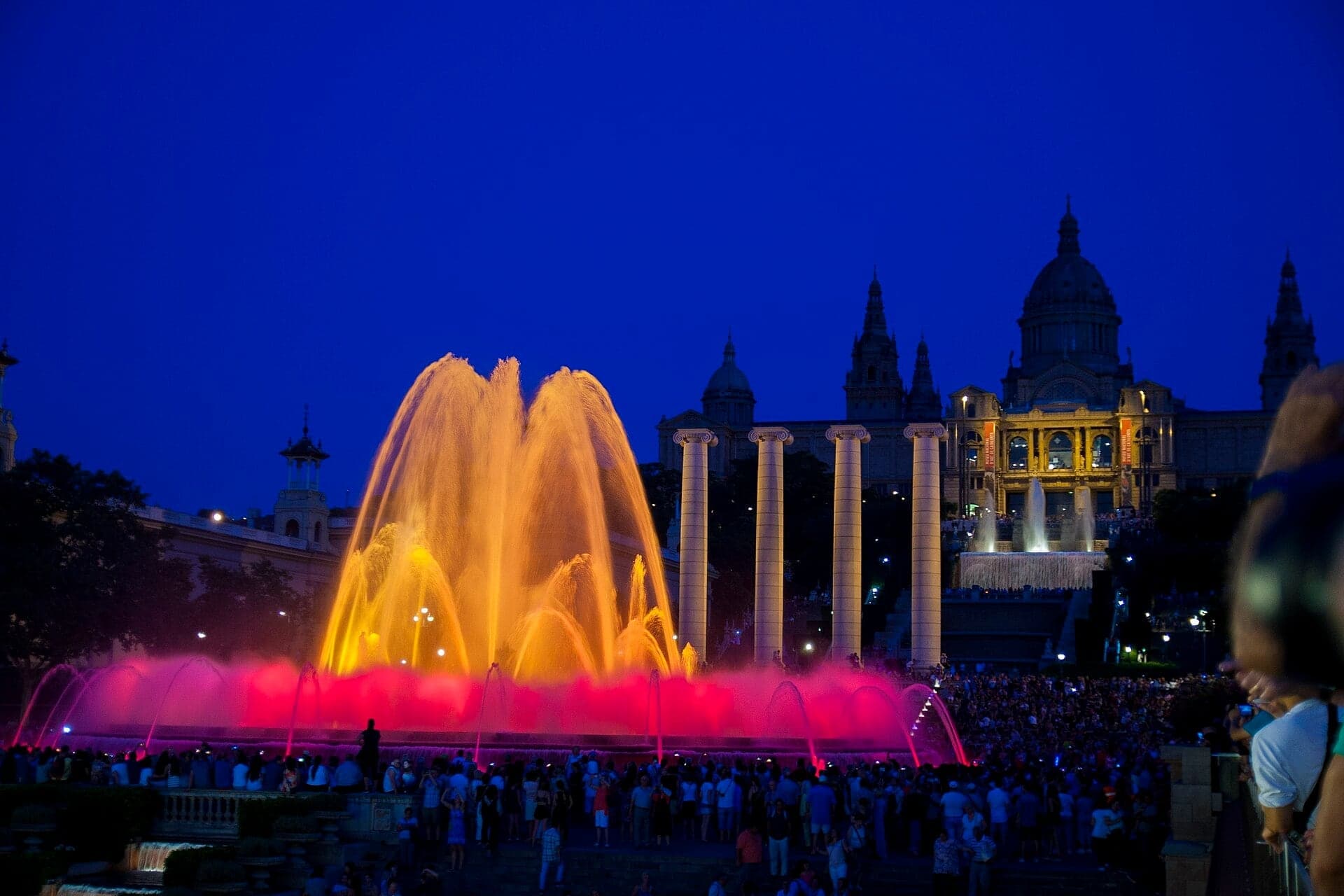
Carles Buïgas built this fountain of light and water for 1929. Turning drums of colored glass still make its color, on show evenings.
- 4
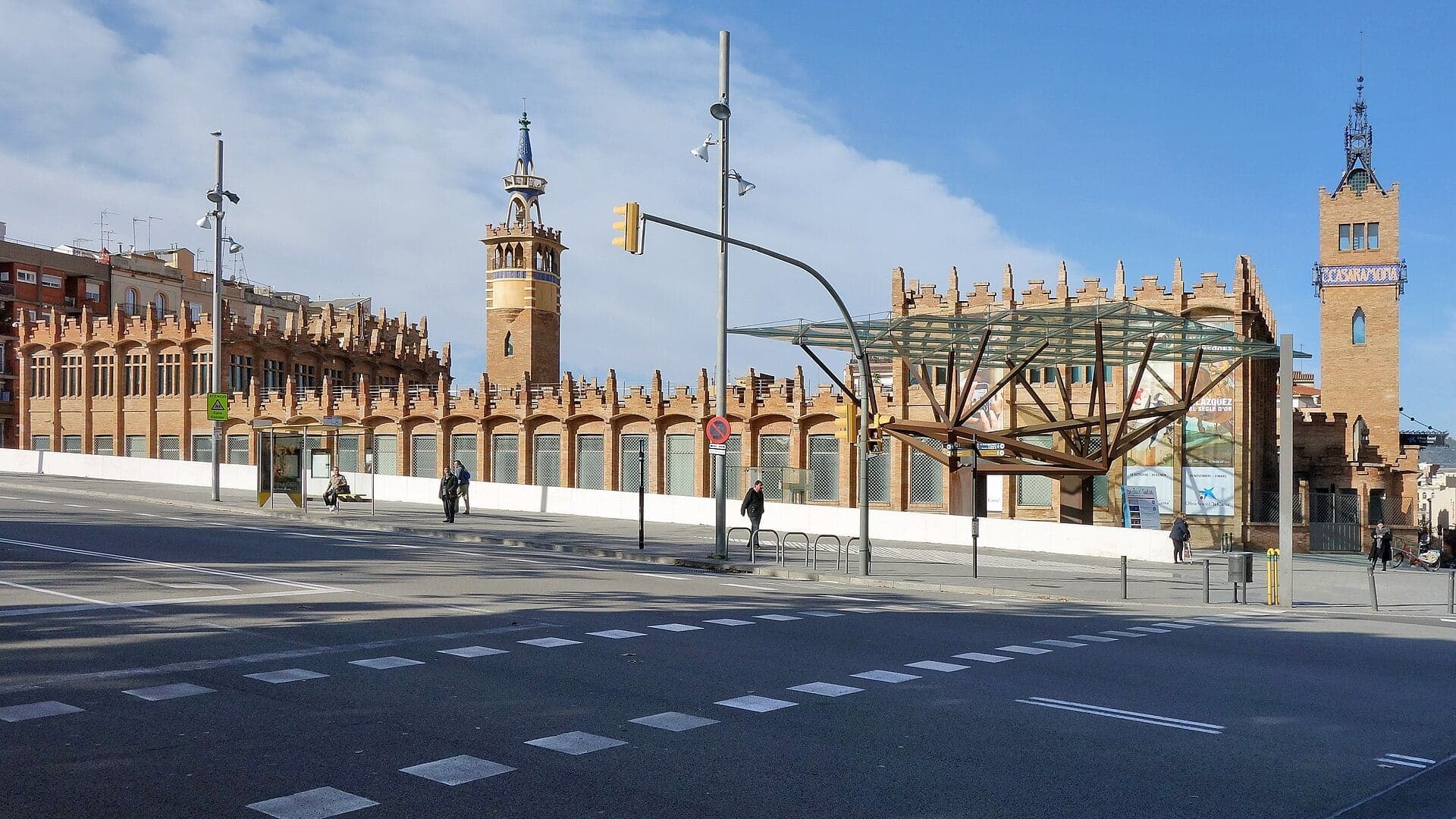
CaixaForum: A Factory Built Against Fire
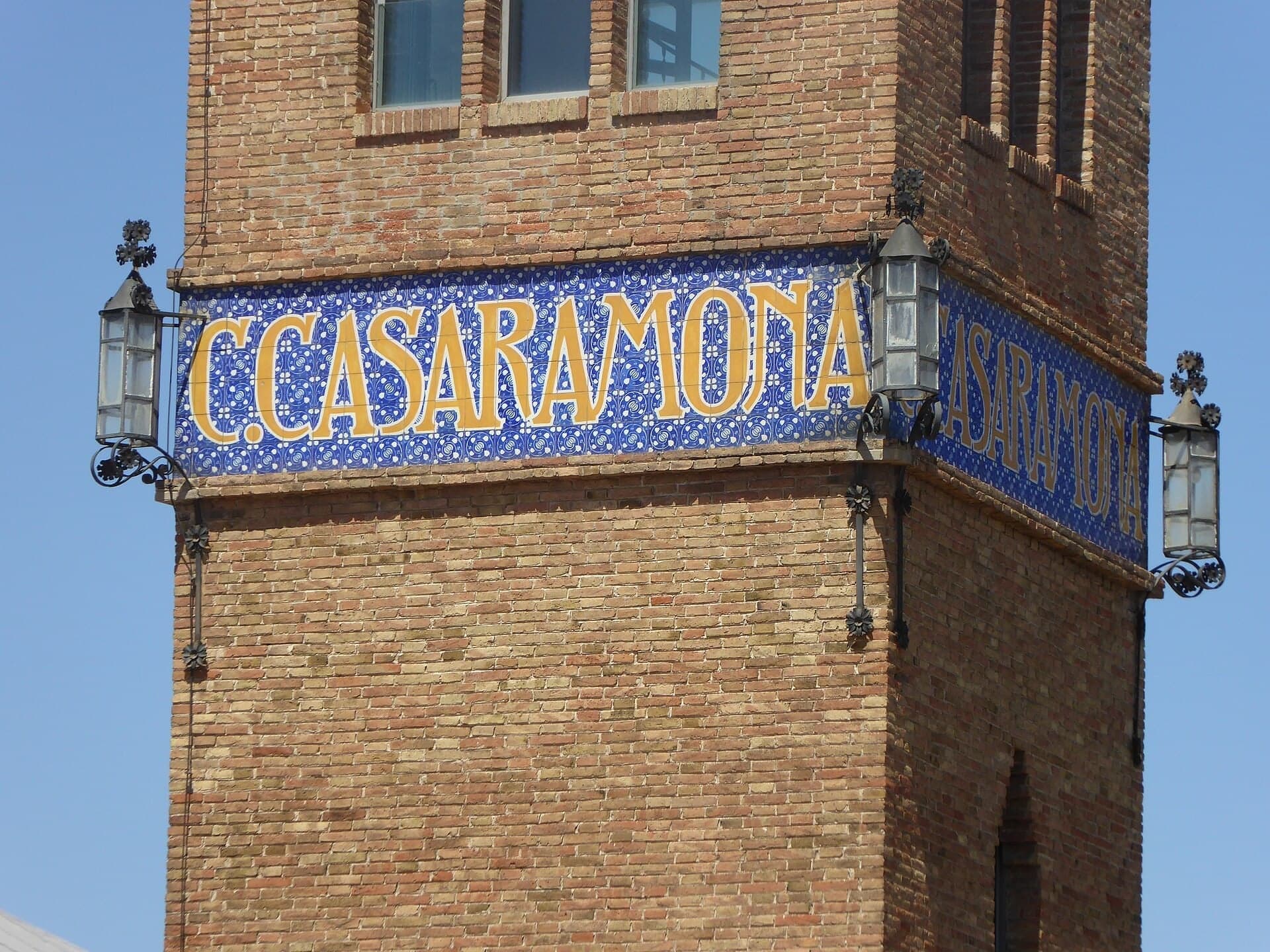
Puig i Cadafalch built this textile mill as a castle against fire. Its towers hid water tanks, and today it is CaixaForum.
- 5
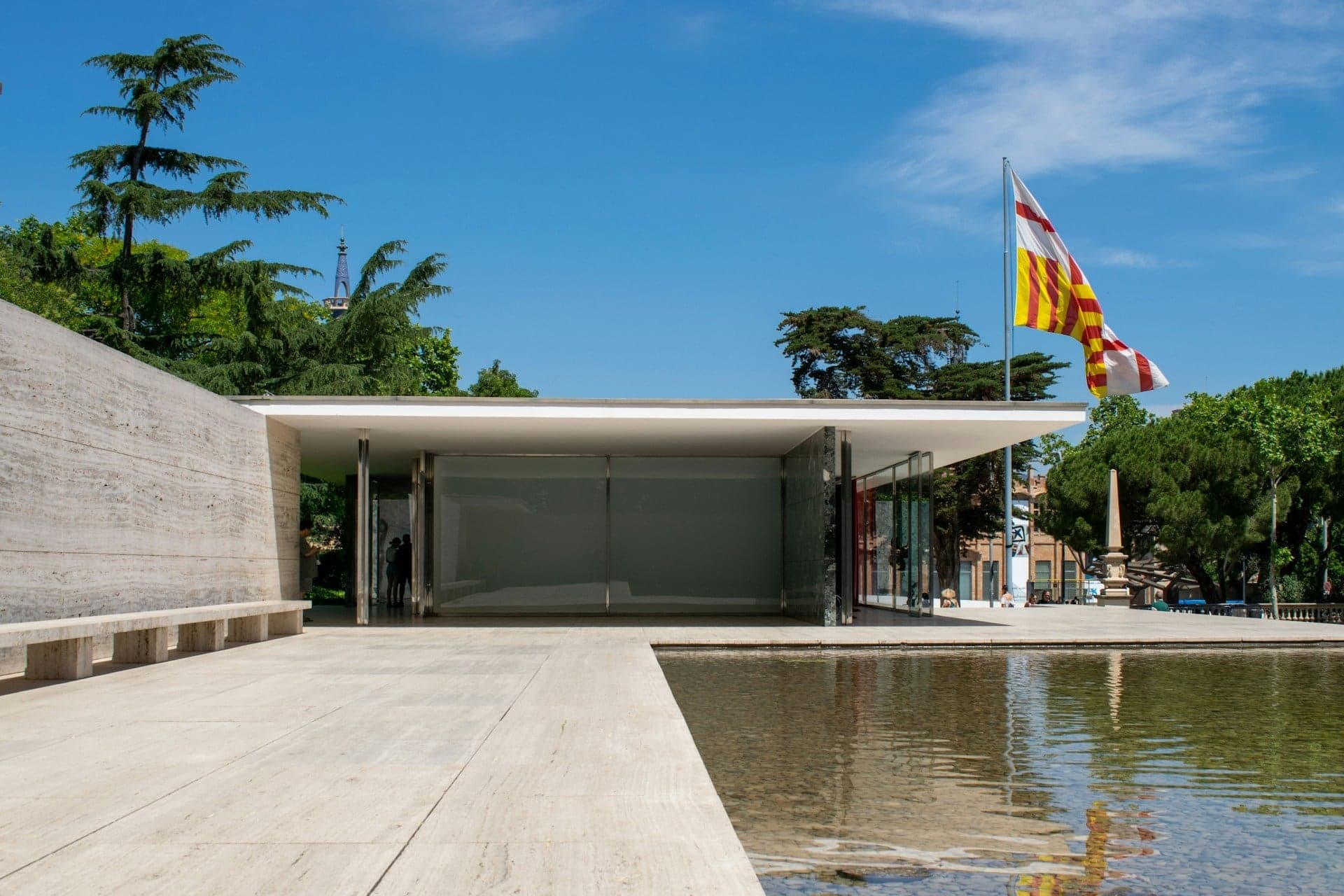
Barcelona Pavilion: Taken Down and Rebuilt
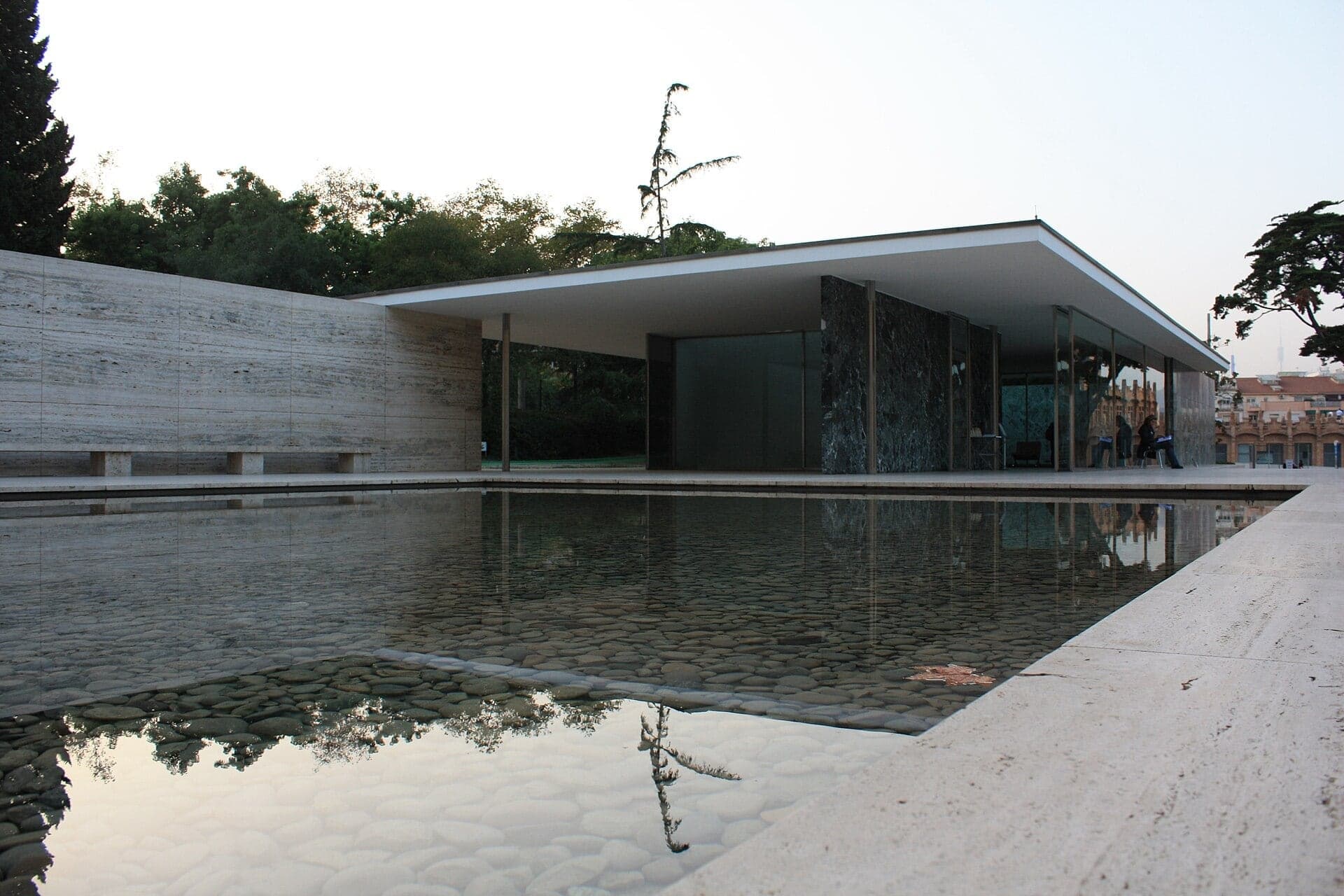
Mies van der Rohe and Lilly Reich's German pavilion of 1929, made of glass, steel and four kinds of stone. It was rebuilt here in the 1980s.
- 6
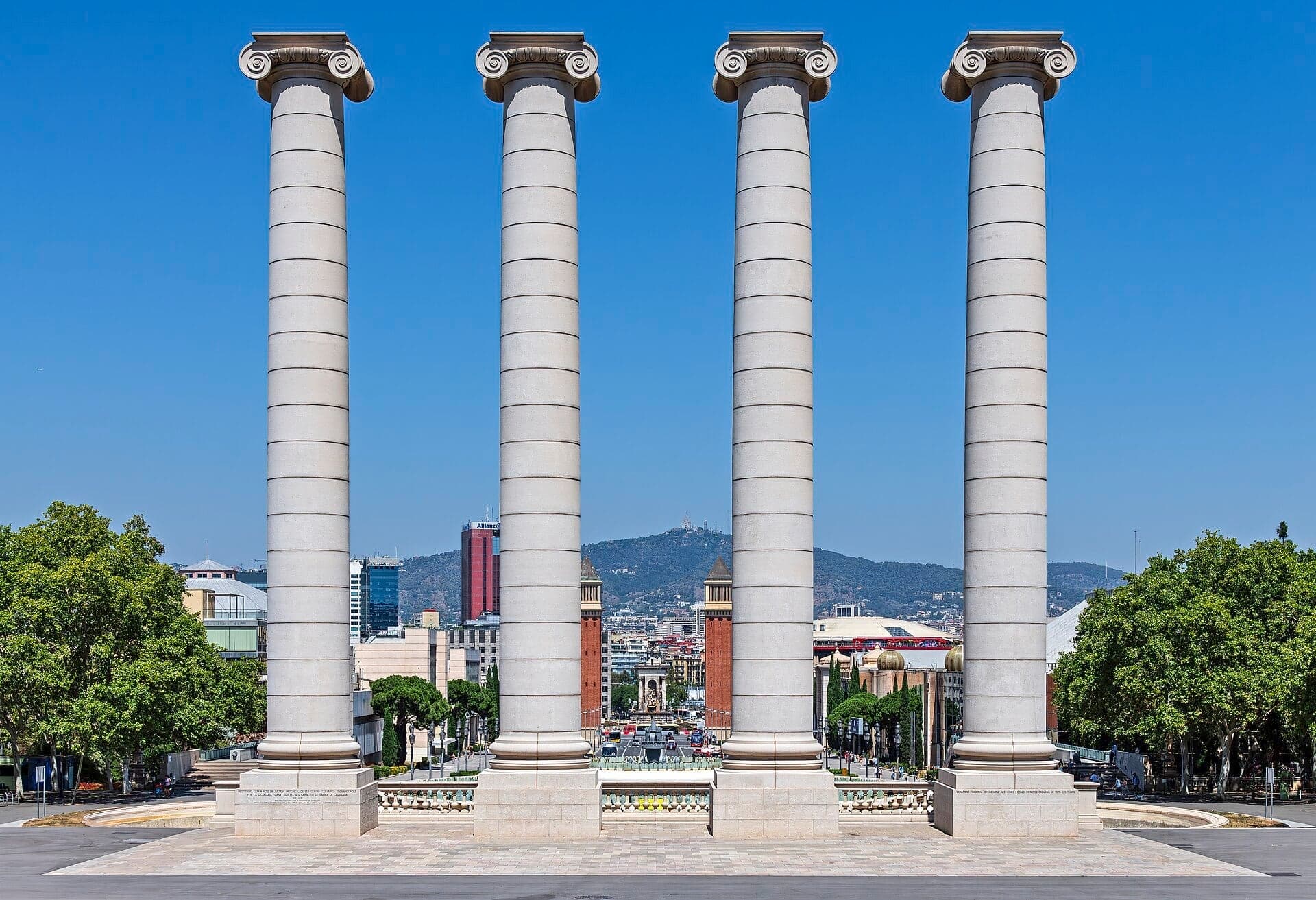
Four Columns: Removed and Put Back
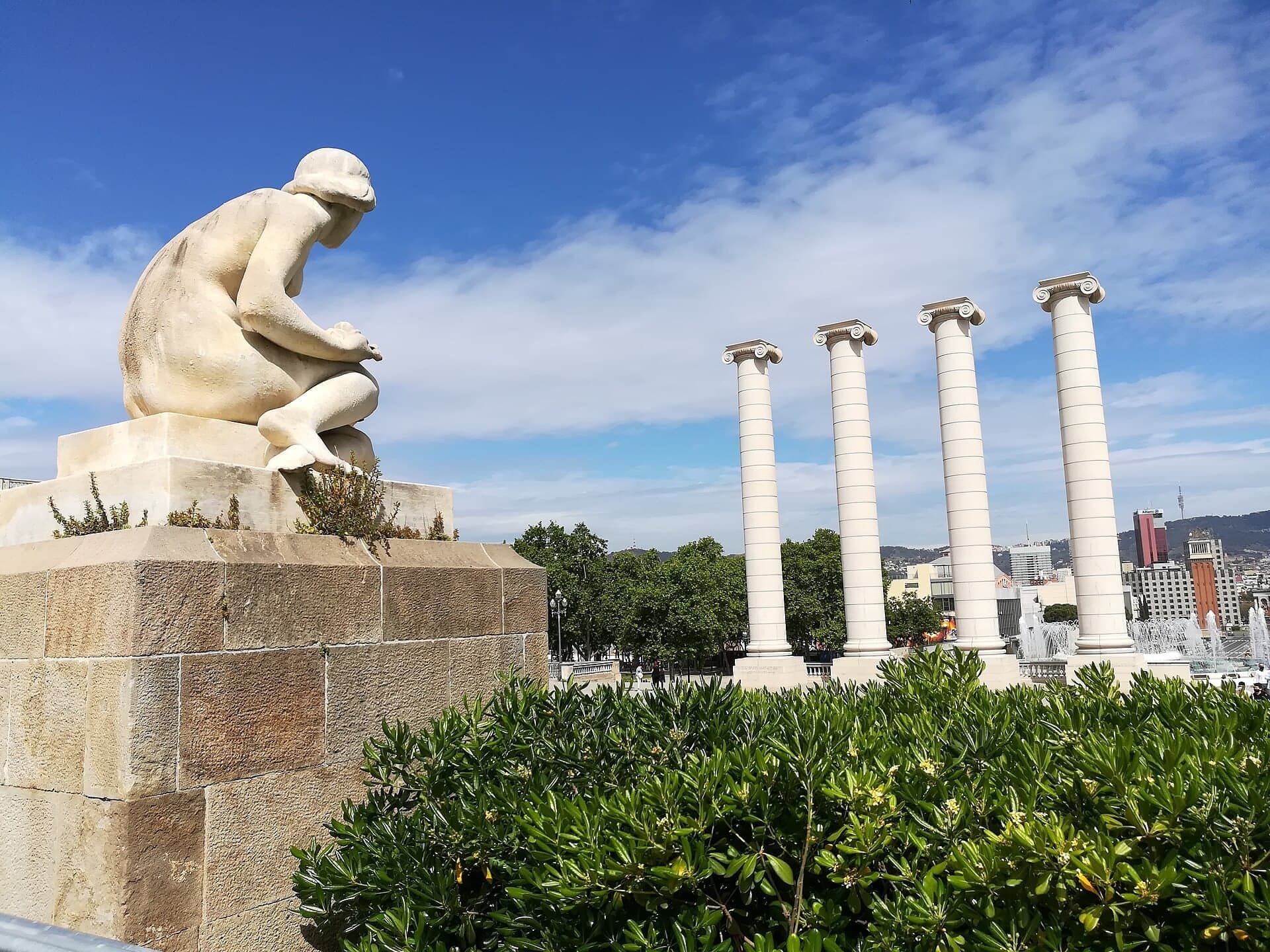
Four columns pulled down in 1928 were rebuilt in 2010. Puig i Cadafalch first raised them in 1919, where the fountain now plays.
- 7
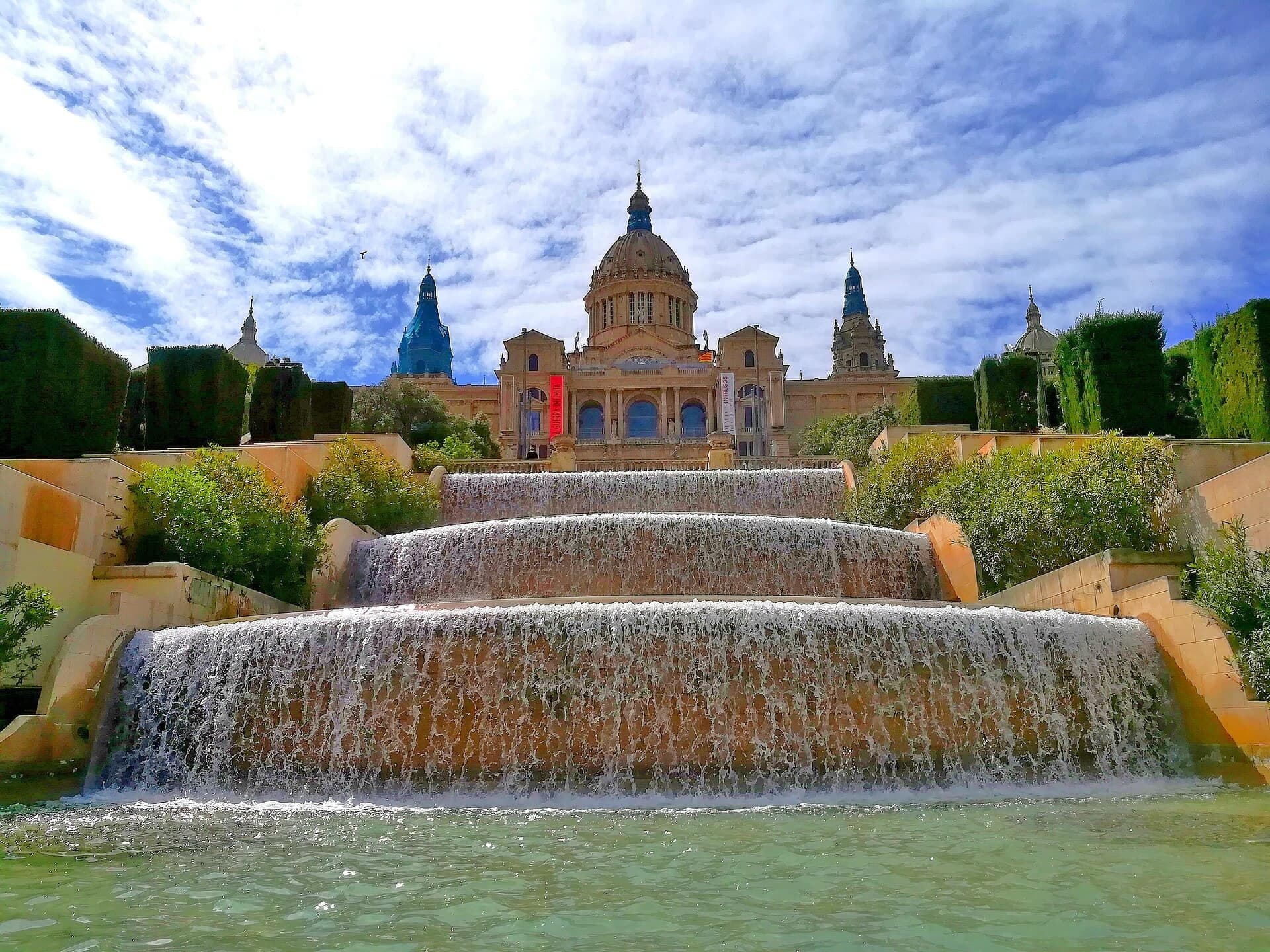
Cascades: A Staircase of Water
The water stair of the 1929 fair climbs to the Palau Nacional. Statues and palaces frame it, and stairs and escalators run beside it.
- 8
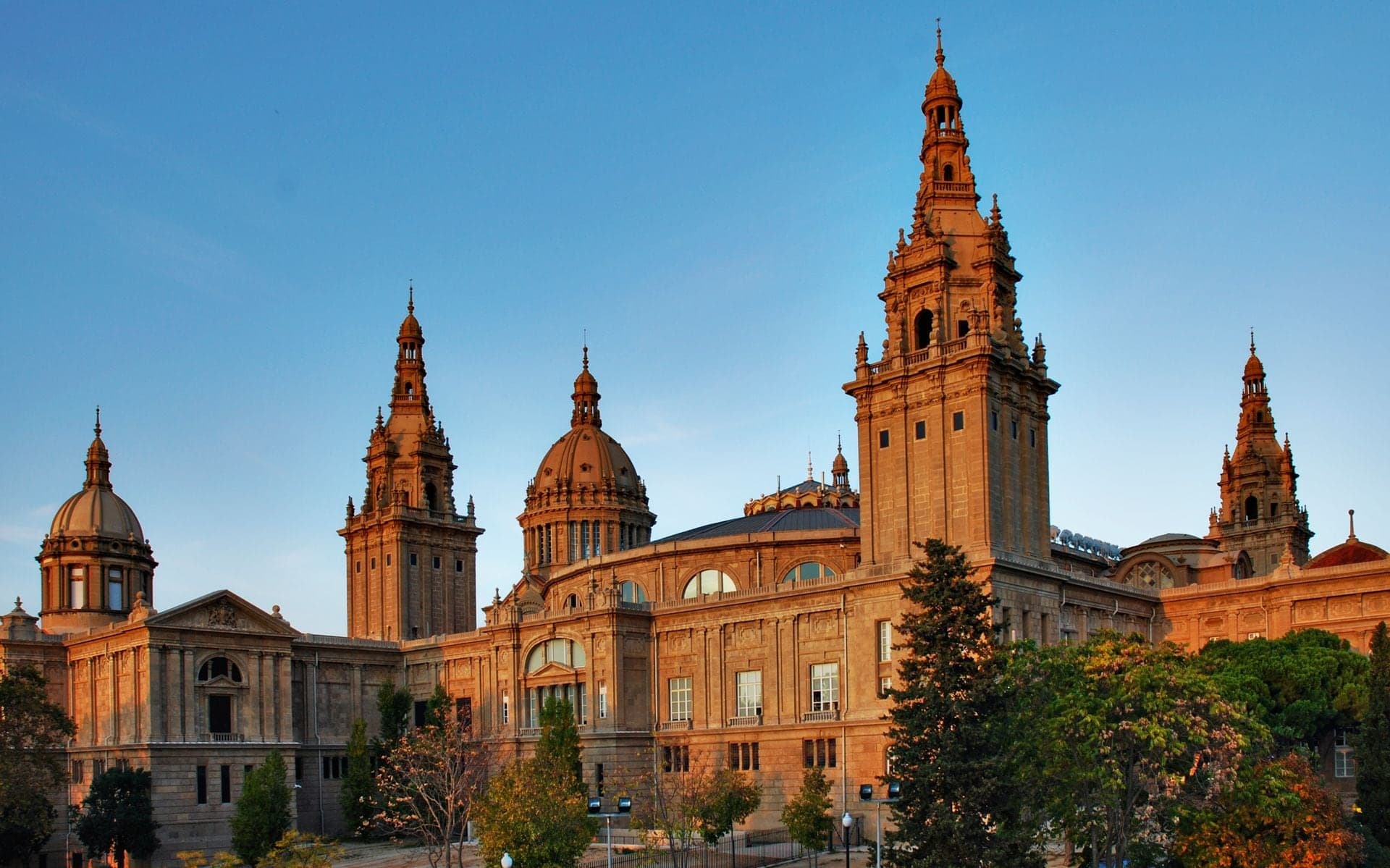
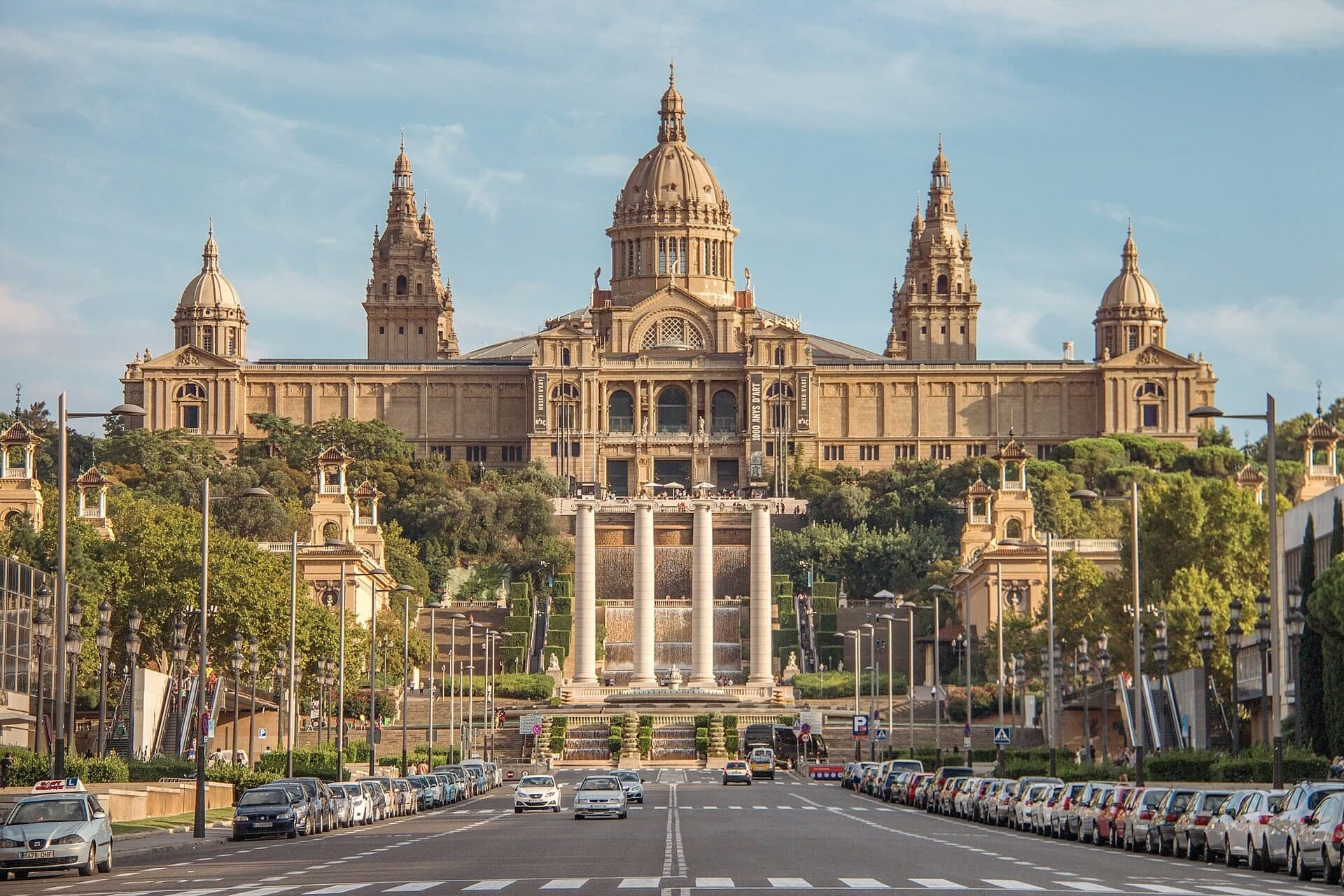
Palau Nacional Terrace: The Whole Stage Below
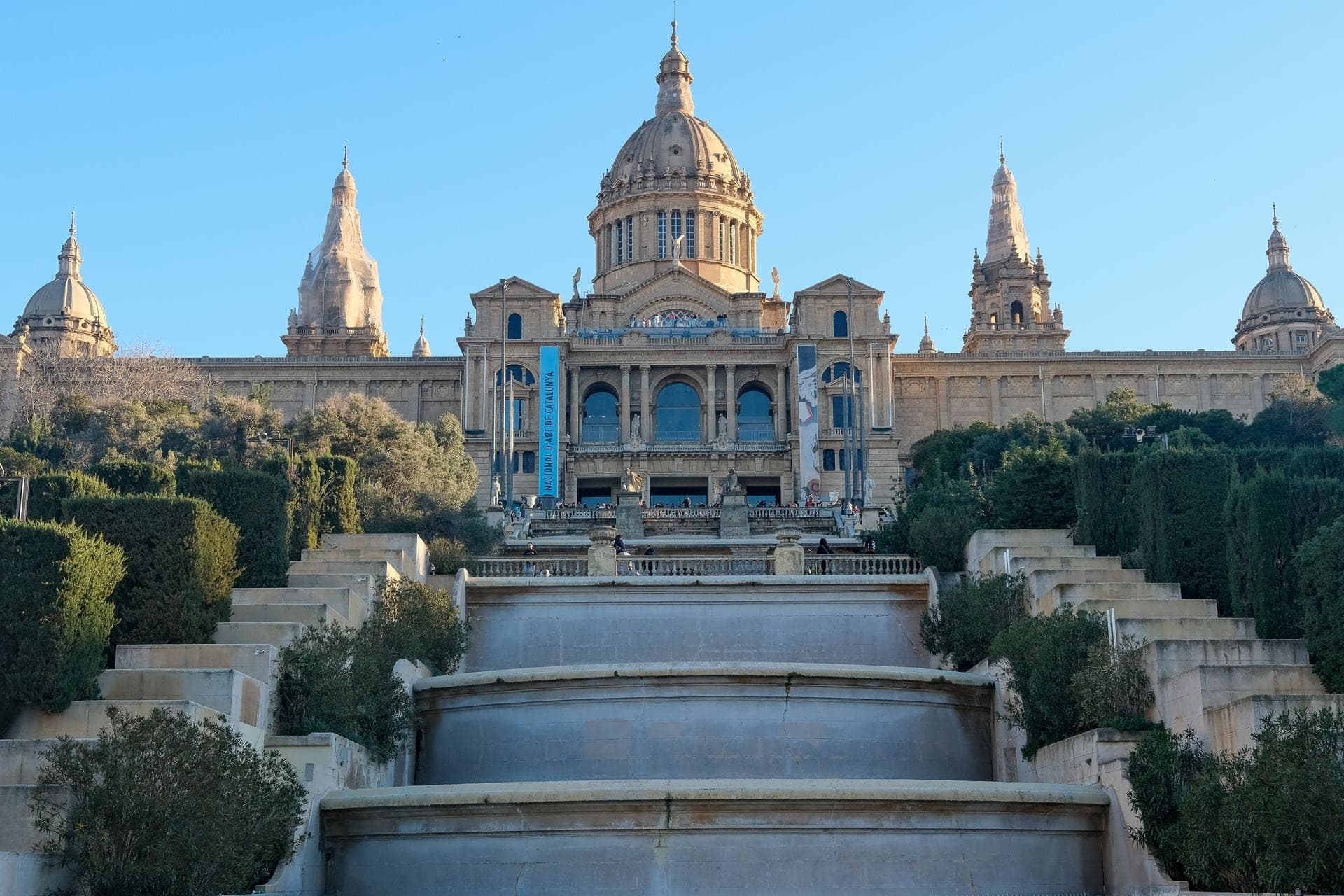
The fair's palace is now Catalonia's national art museum, with a free terrace that looks back down the entire axis.
- 9
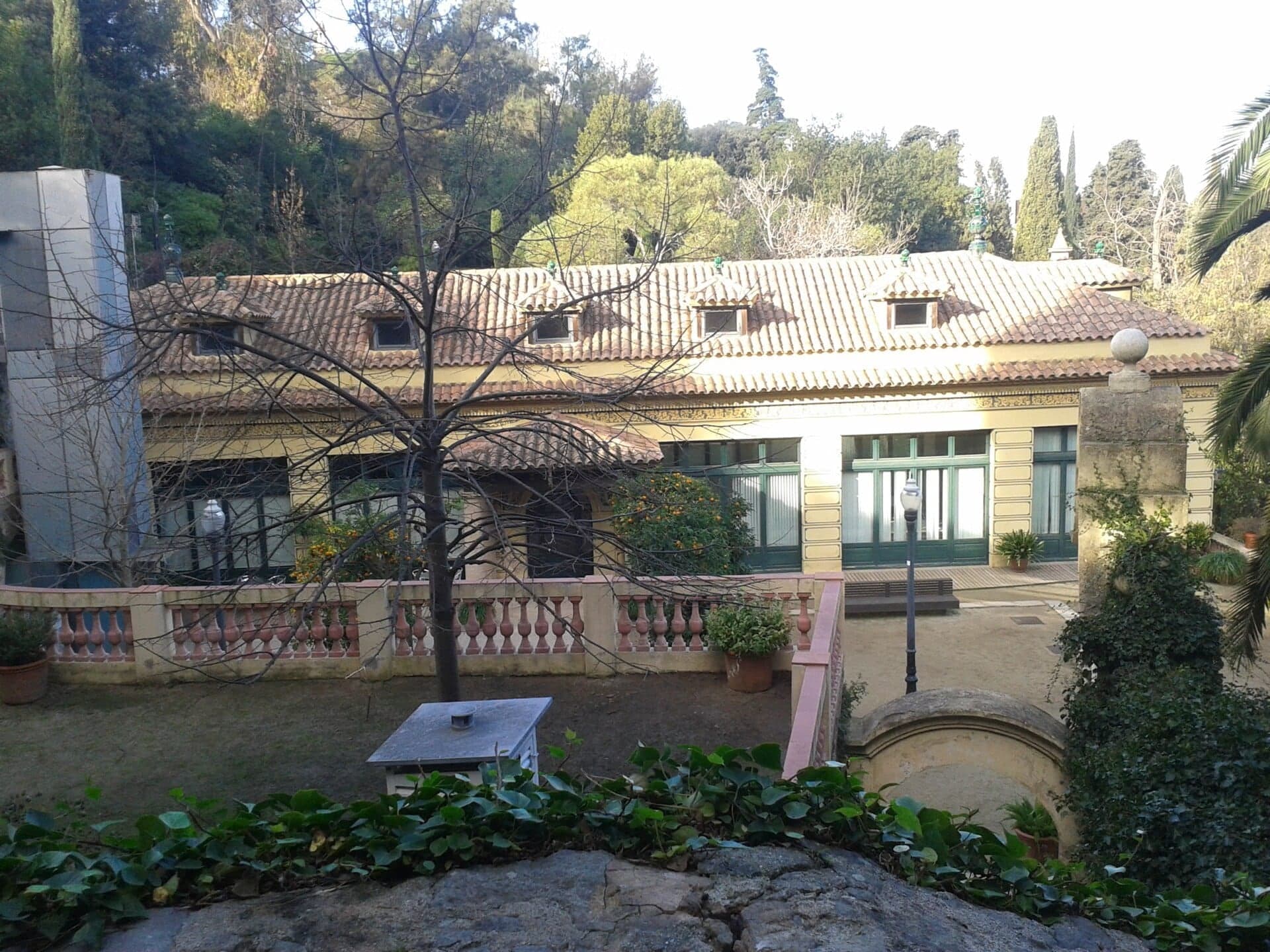
Font del Gat: The Cat's Spring
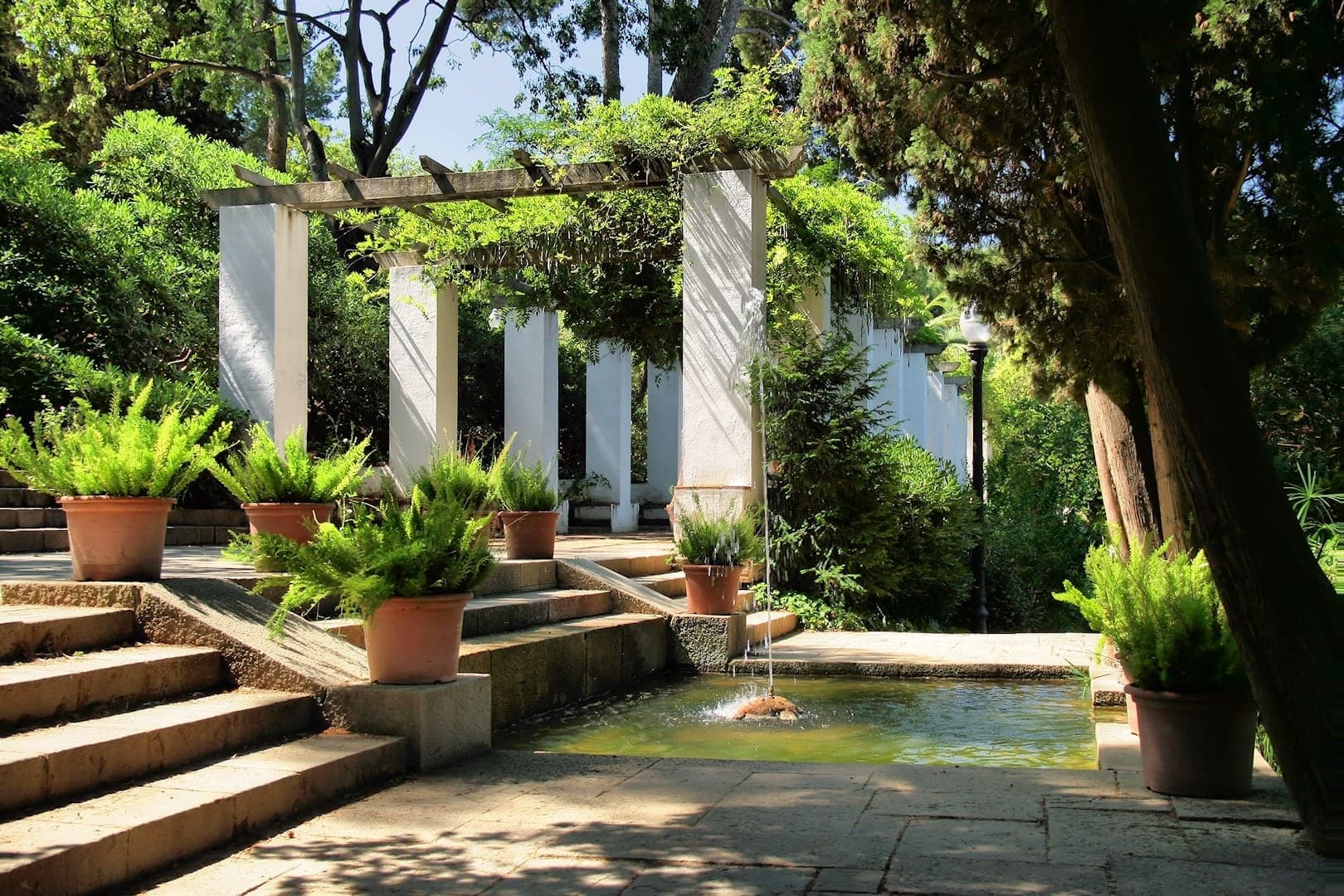
An old picnic spring in the Laribal gardens, with water pouring from a stone cat's head carved in 1918.
- 10
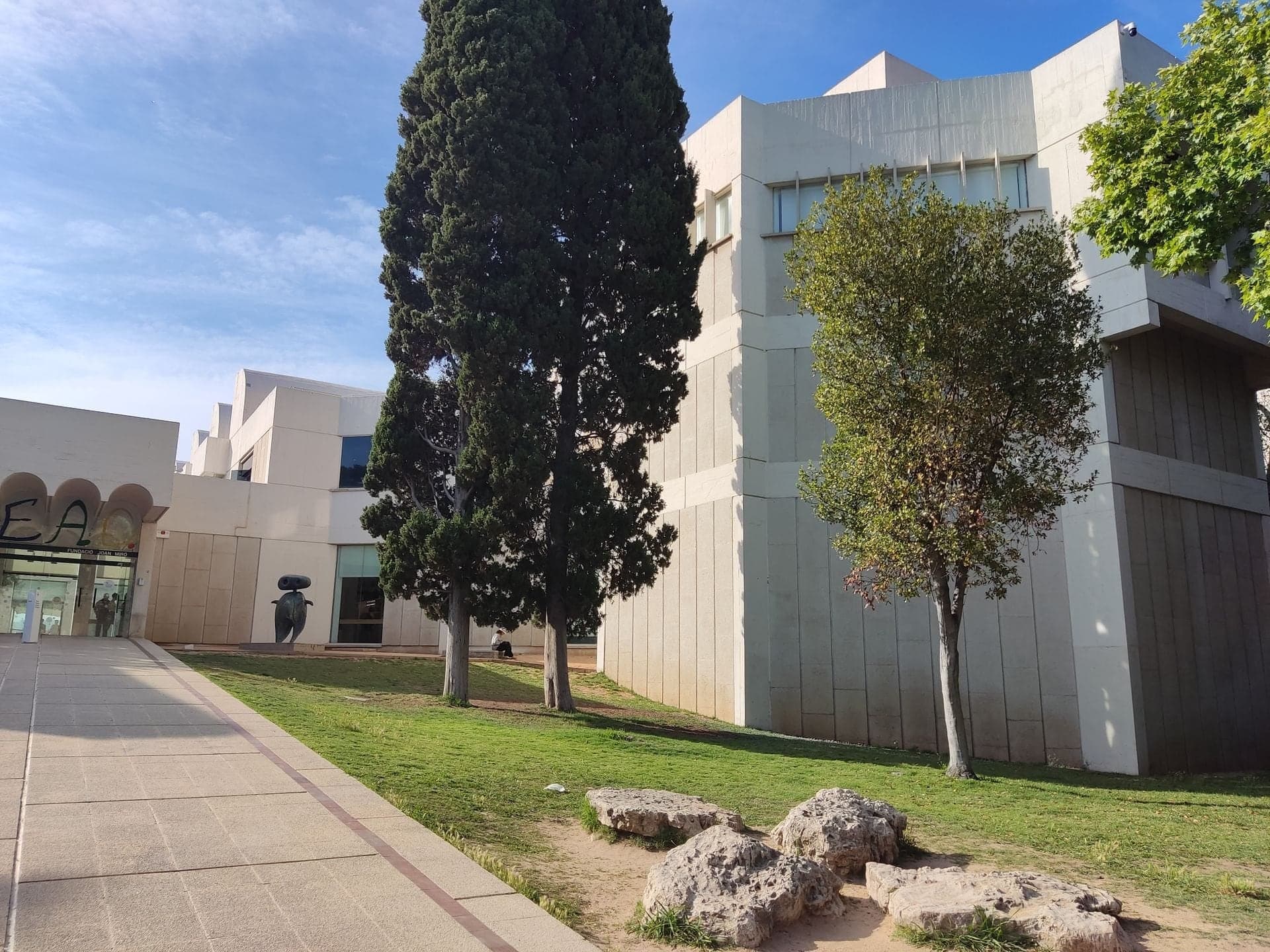
Fundació Joan Miró: Lit From Above
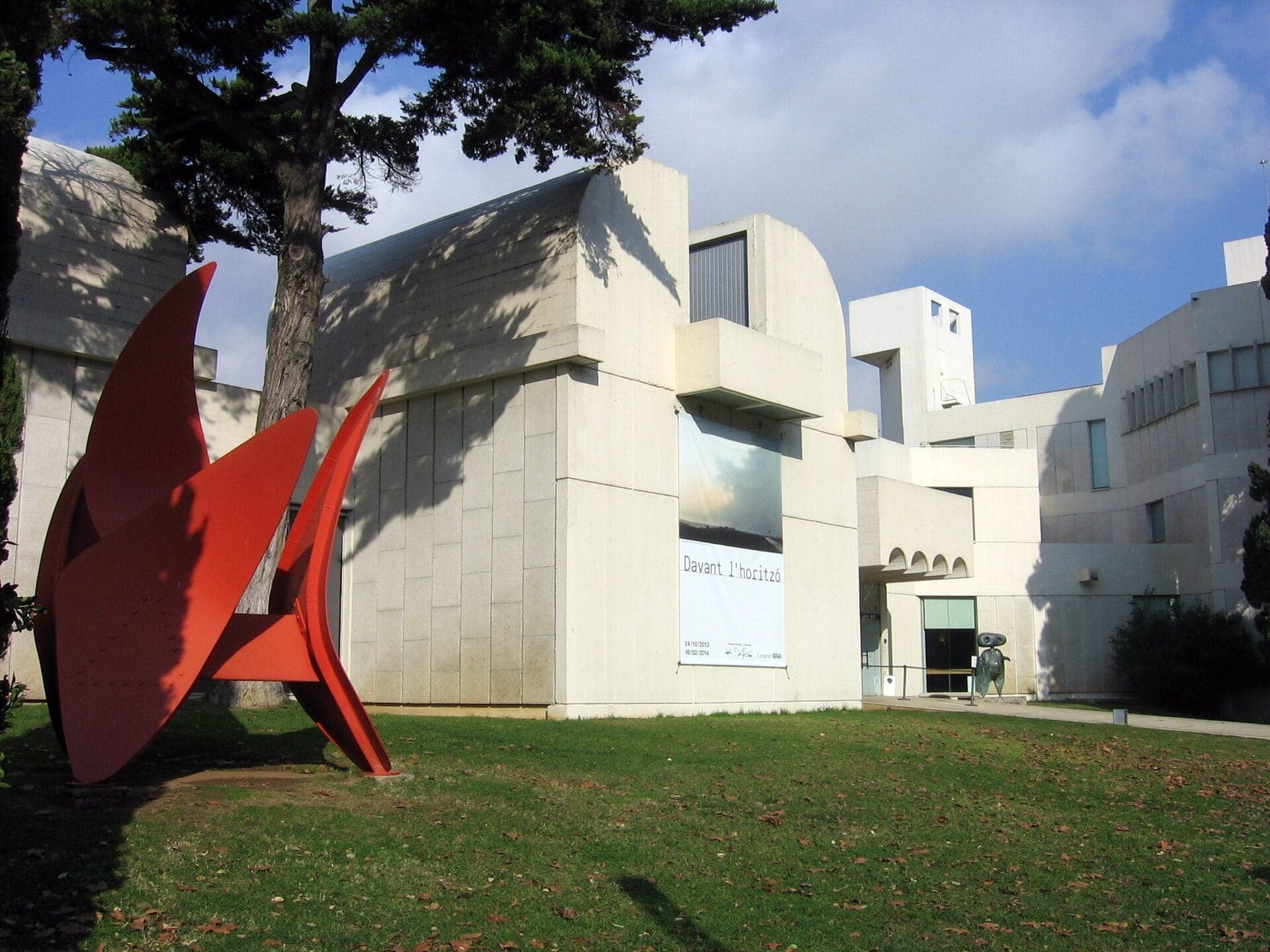
The white museum of the painter Joan Miró, opened in 1975, whose curved roof lanterns bounce daylight down without shadows.
- 11
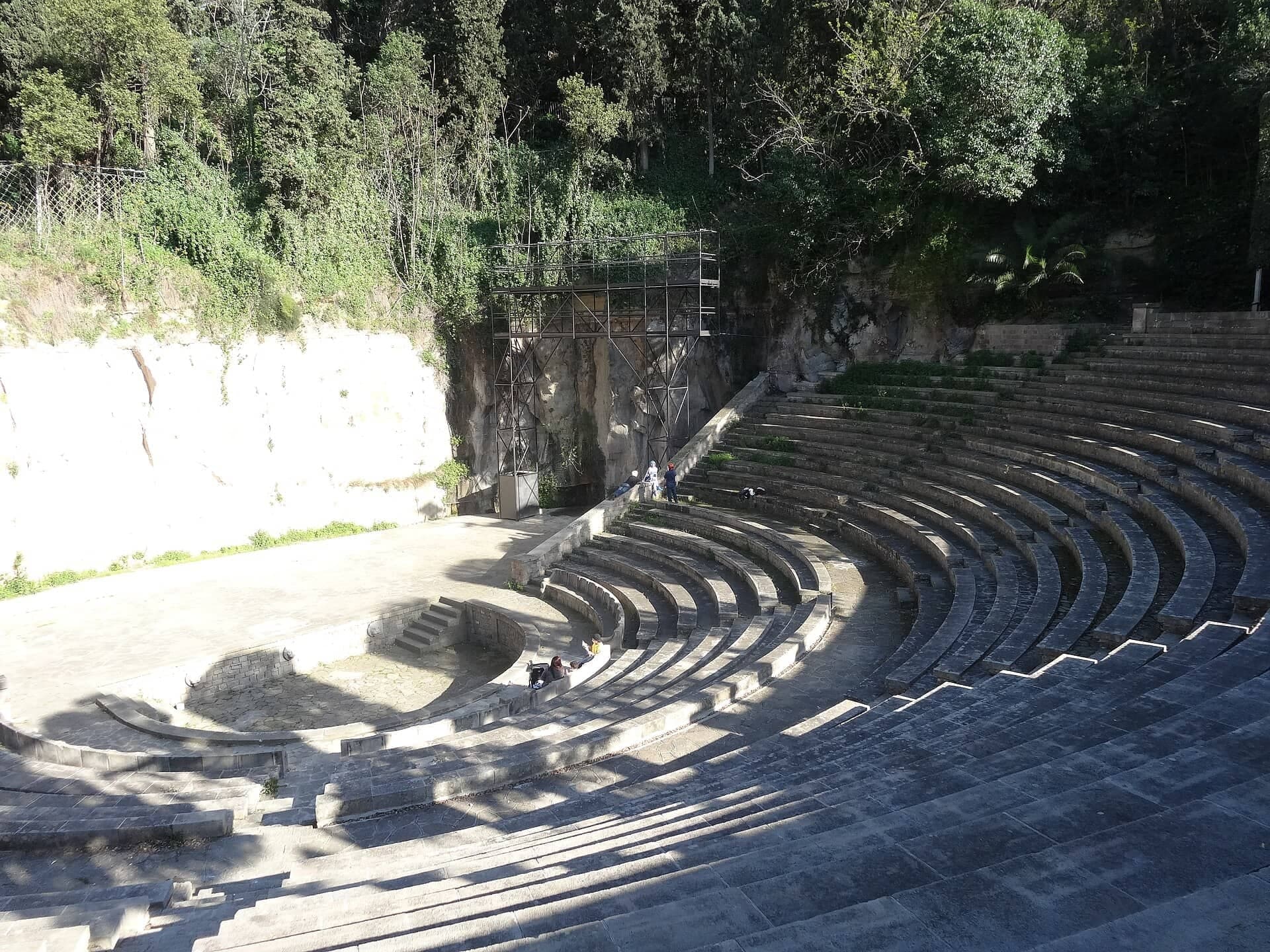
Greek Theatre: A Stage Cut From a Quarry
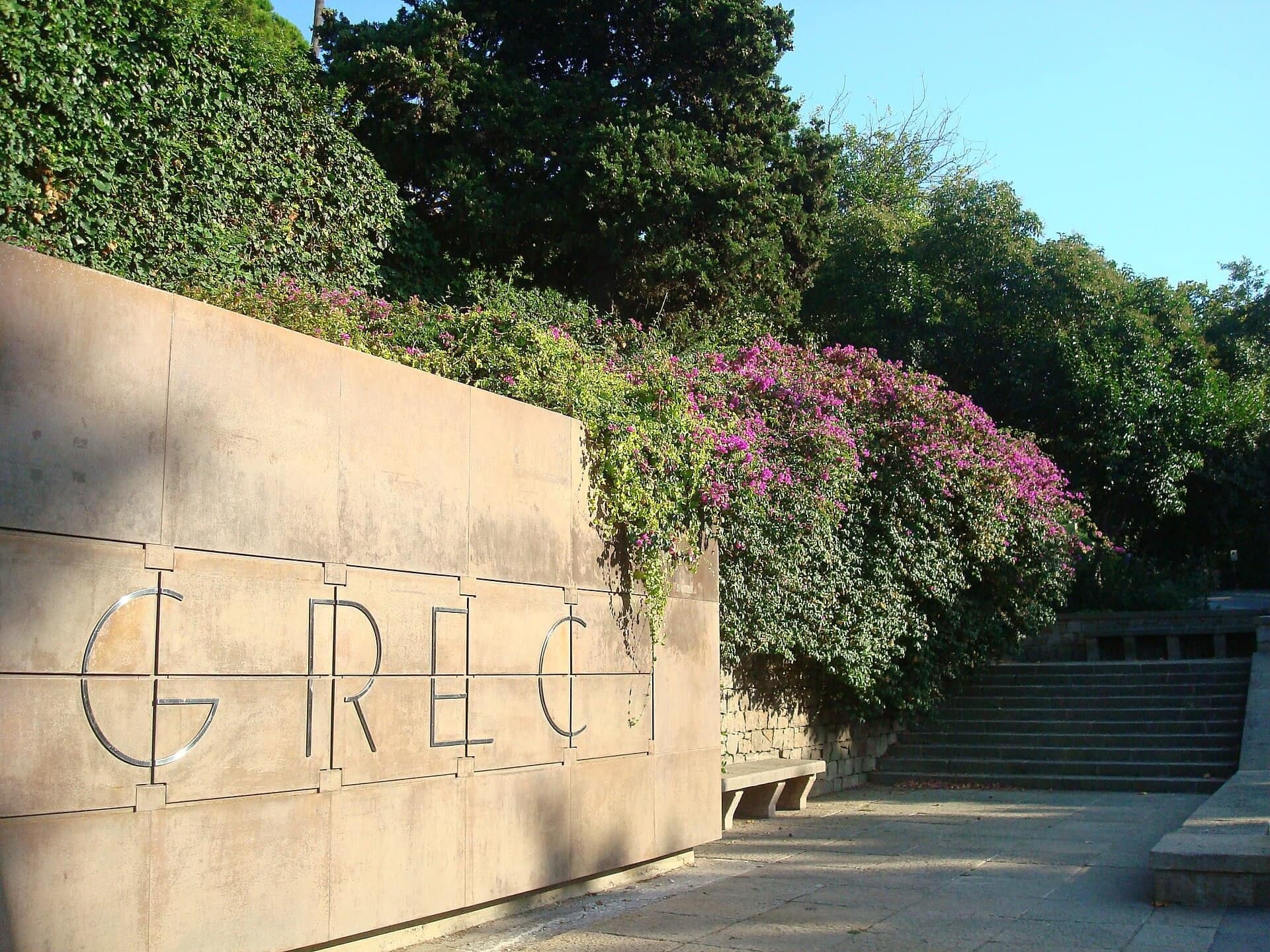
An open-air theater of 1929 cut into an old quarry, below the terraced rose garden that ends the walk.
Details
Best Time to Visit
Afternoon into early evening, starting early enough to finish in the gardens before dusk. Laribal and the Teatre Grec gardens are open 08:00 to 21:00 until 31 October and 08:00 to 19:00 from 1 November to 31 March, but they close earlier when it gets dark: start at least two and a half hours before sunset (sunset at the Palau Nacional about 19:17 on 12 October; after the clock change on 25 October about 17:56, so start by about 15:30). The axis (stops 1 to 8) has no shade: in hot weather avoid midday. Magic Fountain shows in October 2026: Thursday, Friday and Saturday, 21:00 to 22:00, with music-and-colour shows starting at 21:00 and 21:30; none are scheduled in November 2026 on the city's calendar. To combine, walk in the afternoon and come back down to the fountain after dark. Checked 12 October 2026.
Pro Tips
- •Getting to the start: Metro Espanya, lines L1 (red) and L3 (green), and FGC Espanya. The Barcelona Bus Turístic red route stops at Plaça d'Espanya. From the station, cross Plaça d'Espanya at the signalled crossings at the head of Avinguda de la Reina Maria Cristina onto its central walk, between the two towers. Checked 12 October 2026.
- •On some fair and congress days the avenue's access from Plaça d'Espanya is closed. The Mies van der Rohe Foundation says the easiest way in is then by Carrer de Lleida; join the walk at the Magic Fountain (stop 3) and listen to stops 1 and 2 from there. Checked 12 October 2026 at miesbcn.com.
- •Magic Fountain shows are free. October 2026: Thursday, Friday and Saturday, 21:00 to 22:00, shows starting at 21:00 and 21:30. The city's calendar lists no shows in November 2026. Check the official calendar at barcelona.cat (Font Màgica) before you go. Checked 12 October 2026.
- •Escalators: the city has been replacing all of Montjuïc park's escalators in phases, keeping one set working; any flight may be stopped. There are stairs beside every escalator on the cascades. Checked 12 October 2026.
- •Barcelona Pavilion (stop 5): 9 EUR, reduced 5 EUR, under-16s free, free on the first Sunday of the month; closed all day on 16 and 22 October 2026 and on short hours on several other October days (see the stop's card). Checked 12 October 2026 at miesbcn.com.
- •Palau Nacional (MNAC, stop 8): the terrace is free; a 2 EUR ticket opens the building and the rooftop viewpoint; the museum is free on Saturdays from 15:00 and on the first Sunday of the month; closed on Mondays except public holidays. Checked 12 October 2026 at museunacional.cat.
- •CaixaForum (stop 4) and the Fundació Joan Miró (stop 10): we could not confirm today's hours and prices; check caixaforum.org and fmirobcn.org before you plan a visit.
- •Getting away: the Teatre Grec gardens' main gate is at Passeig de Santa Madrona 38. Walk downhill into Poble-sec for Metro Poble Sec (L3) or Paral·lel (L2, L3); the Montjuïc funicular also runs up the hill from Paral·lel.
- •Step-free: no step-free line has been checked for this walk. From the Barcelona Pavilion (stop 5) on there are steps on most legs, and the Laribal garden stairs (stops 8 to 10) and the Escales del Generalife (stops 10 to 11) are stairs only. Some Laribal paths are earth and gravel, hard going with a stroller.
Safety & Precautions
- •Pickpockets work Plaça d'Espanya, the Magic Fountain on show nights and the Palau Nacional terrace at sunset. Keep bags closed and in front of you.
- •There is no shade on the axis (stops 1 to 8). Carry water and a hat in warm weather.
- •Between stops 3 and 4 the route crosses Avinguda de la Reina Maria Cristina and Avinguda de Francesc Ferrer i Guàrdia at traffic lights. On the climb from stop 7 it crosses Passeig de Jean Forestier, a park road with light traffic and no marked crossing. On the avenue's central walk, just before the Magic Fountain, the route crosses a service road with no marked crossing.
- •Between stops 8 and 9 the route crosses Passeig de Santa Madrona at a zebra crossing on a hairpin bend, with no lights: cars and the 150 bus come round the bend blind. Wait for a clear gap.
- •The Laribal and Teatre Grec gardens (stops 9 to 11) close at dusk. If they are already shut, end the walk at the Palau Nacional terrace (stop 8). No pets are allowed in the Teatre Grec gardens.
- •During the Grec summer festival (about late June to early August) access to the Teatre Grec gardens changes; if they are closed, end the walk at the Fundació Joan Miró (stop 10).
- •The trade fair grounds along the avenue and beside the cascades are being rebuilt in stages for the Exposition's centenary in 2029 (press, March and June 2026): expect hoardings and cranes, and follow any diversion signs.
- •The Font del Gat court (stop 9) is shared with a restaurant: keep to the path and clear of its tables.
Travel advisory: Exercise Increased Caution (Level 2).
Gallery
Related Reading
Go deeper on what you'll see, hear, and walk through.
Read the walk
The full story of Montjuïc and the Magic Fountain: A World's Fair Stage, in words. Prefer to listen? Play it narrated, from home or on location.
Introduction
Barcelona, the capital of Catalonia in Spain, held a world's fair in nineteen twenty-nine, and it built the fair on Montjuïc, the hill at the edge of the old city. Its planners laid out one straight line, like a stage set: a gate of two towers, an avenue, a great fountain, a staircase of water, and a palace on the hill to close the view. This walk climbs that line, then leaves it for the gardens made for the same fair, and ends in the fair's own theater.
Three people come back along the way. Josep Puig i Cadafalch, the architect who planned the axis and was sidelined before it was finished. Carles Buïgas, who designed the Magic Fountain. And Jean-Claude Nicolas Forestier, the French landscape designer behind the gardens.
The Barcelona Pavilion, the national art museum and the Miró museum are ticketed, and every stop works from outside.
The walk is eleven stops over about two kilometers, a mile and a quarter, and takes about an hour and a half. It climbs about thirty-five meters to the palace, mostly up the cascades, by escalator or by the stairs beside them. Then garden stairs climb about thirty meters more before the path comes down again. The gardens close at dusk. It begins on the central walk of the avenue, between the two towers by Espanya Metro station, and ends in the gardens of the Greek Theatre, above the Poble-sec neighborhood.
1. Plaça d'Espanya: The Fair's Front Door
Welcome to Plaça d'Espanya, Spain Square, and to the walk. You are on the central walk of Avinguda de la Reina Maria Cristina, the avenue of the fair. Look back toward the busy square for the two tall towers, one on each side of the avenue. If the plane trees are in leaf, look up past them.
The towers are twins, each about forty-seven meters tall, modeled on the bell tower of Saint Mark's in Venice. They were the fair's front door. An architect won the city's competition for this entrance in nineteen twenty-seven, and the towers went up for the fair of nineteen twenty-nine. Remember that architect: he comes back at the very end.
Read a tower from the ground up. A base of cut stone. A tall shaft of bare brick, with very narrow windows that light a stair inside. Then an open gallery of columns, and a pointed roof of copper. Stone, brick and copper: the dress of a real bell tower, on a gate with no bells to ring.
In the middle of the square, behind them, is a fountain built as a homage to water: a three-sided monument over three basins, one for each of the seas that wash the coasts of Spain, with sculptures of the rivers that flow into them. Beyond it, the round brick building was a bullring, and is now a shopping center.
Now turn around and face up the avenue. That is the whole fair in one look: the avenue, a great fountain, a staircase of water, and a palace on top of the hill, all on one straight line, like a stage seen from the back of the hall. This walk climbs it, step by step.
Follow the route up the central walk of the avenue. Next, a row of small fountains with a secret.
2. Avinguda de la Reina Maria Cristina: A Runway of Light
Walk on along the central walk and stop beside the line of small fountains down the middle of the avenue.
In nineteen twenty-nine this avenue was lined on both sides with columns of light. The line of jets down the middle replaced them, and they are not on their own. These forty-four jets, the four cascades up the hill and the Magic Fountain ahead are one system, run by remote control from a single control room. On a show night the whole axis lights up and moves together, like stage lighting on a set.
The big halls on both sides belong to Barcelona's trade fair, the Fira, which still holds its shows in the buildings of the Exposition.
Now look ahead, past the fountain, to the two large palaces that stand on either side of the staircase of water. They were designed by Josep Puig i Cadafalch with a partner, and built between nineteen twenty and nineteen twenty-two, the first buildings of the fair to go up. In nineteen twenty-three they held an exhibition of furniture and interior decoration, which Catalonia's heritage inventory calls a sort of rehearsal for the big fair.
Remember Puig i Cadafalch. He planned this whole axis, from the towers behind you to the palace on the hill. You will meet his work again and again on this walk, and find out why he was not in charge when it opened.
The line you are walking is the point. Every piece of the fair was placed on it, so that a visitor coming through the towers saw the whole climb ahead.
Follow the route on along the avenue to the edge of the big plaza. Next, the Magic Fountain.
3. Magic Fountain: A Machine of Light and Water
Walk on to the edge of the plaza and stop where the whole basin opens up in front of you. This is the Magic Fountain, the Font Màgica.
It was the idea of Carles Buïgas. He presented his project in June nineteen twenty-eight, with four hundred and sixty plans and seventy large drawings, and some of the fair's commissioners called it madness. More than three thousand workers built it in less than a year, and it first ran in May nineteen twenty-nine.
By day it may be still water, so look at it as a machine. Three basins step down the slope. About two thousand six hundred liters a second can run through them, and the whole fountain holds more than three million liters. The water is groundwater, pumped up and used again.
The color comes from below. Under the water are a hundred and twenty drums of colored glass, turning beneath a hundred and twenty skylights, and Catalonia's heritage inventory says they are still moved by Buïgas's system of nineteen twenty-nine. White, yellow, red, blue and green. The lamps behind the glass are LED today, but the color still passes through the old drums.
It has had a hard century. Buïgas himself restored it in the nineteen-fifties after damage in the Civil War, music was added later, and it has been repaired again since.
On some evenings, the fountain puts on a free show of water, light and music. The city publishes the dates, so check before you plan around it. Show nights are crowded, and crowds bring pickpockets: keep your bag closed and in front of you.
One more thing about this ground. Before the fountain, four tall columns stood here. You will meet them in a few minutes.
Follow the route across the avenue at the lights, and across the next road at the lights too. Next, a factory dressed as a castle.
4. CaixaForum: A Factory Built Against Fire
Walk on along the pavement and stop across the avenue from the red brick building with two towers. This was the Casaramona factory, a textile mill, and today it is CaixaForum, an arts center.
It is older than the fair. Puig i Cadafalch, the architect of the palaces up the hill, built it as a mill making blankets and towels, and it was finished in the early nineteen-tens, after a fire at the owner's old mill, sources say. Fire is the key to the building.
If the trees are in leaf they screen the low front, and the towers show above them. Look at what the castle details are doing. The building is a near-square block of low sheds, mostly one storey, roofed with brick vaults on iron pillars. Between the sheds run internal streets for moving goods, and those streets were also firebreaks: a fire in one shed had a gap to cross. The two towers, which look like a castle's keeps, hid water tanks. The battlements along the top are brick, and the buttresses end in little spires. In a mill full of yarn and cloth, the ornament and the fire plan are one design. The entrance tower still carries the factory's name, in ceramic panels.
The city gave it its annual prize for building in the year it was finished. After the Civil War it became a police barracks, and stayed one until nineteen ninety-two. A savings bank, la Caixa, had bought it in nineteen sixty-three, and opened it as an arts center in two thousand two, with the modern entrance added at the corner.
Keep this brick castle in mind. The next building is its opposite.
Follow the route a short way on to the paved forecourt next door.
5. Barcelona Pavilion: Taken Down and Rebuilt
Walk on to the paved forecourt and stop where a low platform of pale stone runs along it, on your right, across the paving. That is the podium of the Barcelona Pavilion. Inside is ticketed, and worth it if you love buildings; the details are on this stop's card. From here you…
Full narration for this stop unlocks with the tour.
6. Four Columns: Removed and Put Back
Walk on into the plaza and stop near the four tall columns, with the staircase of water rising behind them and the Magic Fountain a little way back down the slope. Puig i Cadafalch put up four columns in nineteen nineteen, on the spot where the Magic Fountain now plays. They…
Full narration for this stop unlocks with the tour.
7. Cascades: A Staircase of Water
Walk on to the wide landing at the foot of the cascades and stop at the edge of the basin, facing up the hill. In front of you, water falls down the middle in steps, with stairways on both sides, balustrades, vases and statues, and the Palau Nacional and its great dome closing…
Full narration for this stop unlocks with the tour.
8. Palau Nacional Terrace: The Whole Stage Below
Walk on to the viewpoint at the top of the stairs and stop at the balustrade, with the palace close by and the city spread below. Look for the two reclining figures, Earth and Water, beside the viewpoint. This is the Palau Nacional, the National Palace, built for the fair, and…
Full narration for this stop unlocks with the tour.
9. Font del Gat: The Cat's Spring
Walk on through the gateway in the stone wall and stop in the small court by the spring. You are in the Jardins de Laribal, the Laribal gardens, and this is the Font del Gat, the cat's fountain. The gardens take their name from the estate of a lawyer and journalist that the…
Full narration for this stop unlocks with the tour.
10. Fundació Joan Miró: Lit From Above
Walk on along the garden path and stop where the white building shows through the trees, across the slope. This is the Fundació Joan Miró, the museum of the painter Joan Miró. It is ticketed, and every word of this stop works from the garden. Look for the curved shapes on its…
Full narration for this stop unlocks with the tour.
11. Greek Theatre: A Stage Cut From a Quarry
Walk on into the rose garden and stop on the path where you can see into the stone bowl of the theater. This is the Greek Theatre, the Teatre Grec, and the end of the walk. It looks ancient, but it was cut into an old quarry for the nineteen twenty-nine fair. It was built on…
Full narration for this stop unlocks with the tour.
- Access towers to the Exhibition site of 1929 (Barcelona), known as the Venetian Towers, historicist work by Ramon Reventós i Farrerons (1927 — Didier Descouens, CC BY-SA 4.0 · source
- Avinguda de la Reina Maria Cristina — Jorge Franganillo, CC BY 3.0 · source
- Palau Nacional, Barcelona, España — Juanedc from Zaragoza, España, CC BY 2.0 · source
- Font màgica de Montjuïc, Barcelona. — Ad Meskens, CC BY-SA 4.0 · source
- Magic Fountain in Barcelona — Artourbcn, CC BY-SA 4.0 · source
- Former textile factory C. Casaramona, Architect Josep Puig i Cadafalch, Barcelona 1913. Today site of the CaixaForum. — 0000ff, CC BY-SA 4.0 · source
- Casaramona, Avinguda de Francesc Ferrer i Guàrdia, Montjuïc, Barcelona, Catalonia, July 2014 — Ardfern, CC BY-SA 3.0 · source
- Vista exterior del Pabellón alamán en Barcelona, España. — marfis75, CC BY-SA 2.0 · source
- stop-6-v1.jpg — Didier Descouens, CC BY-SA 4.0 · source
- Escales, mirador i escultures La Terra, L'Aigua i Dones (Barcelona) — Enric, CC BY-SA 4.0 · source
- Palau Nacional (Barcelona) — Enric, CC BY-SA 4.0 · source
- Barcelona, Spain, View from Mirador Palau Nacional — Berthold Werner, CC BY-SA 4.0 · source
- Font del Gat als Jardins de Laribal, Montjuïc — Jordiferrer, CC BY-SA 3.0 · source
- Jardins de Laribal — Jorge Franganillo, CC BY 3.0 · source
- Fundación Joan Miró. — Canaan, CC BY-SA 4.0 · source
- Teatre Grec, Barcelona (abril 2013) — EliziR, CC BY-SA 3.0 · source
- Ingreso del Teatre Grec en el Montjuic Barcelona, Cataluña, España — Farisori, CC BY-SA 3.0 · source
Images may be cropped or resized. Other photos via Unsplash and Pexels.