Taj Mahal: A Paradise Garden Built to Face the River
70 min · 1.3 km · easy
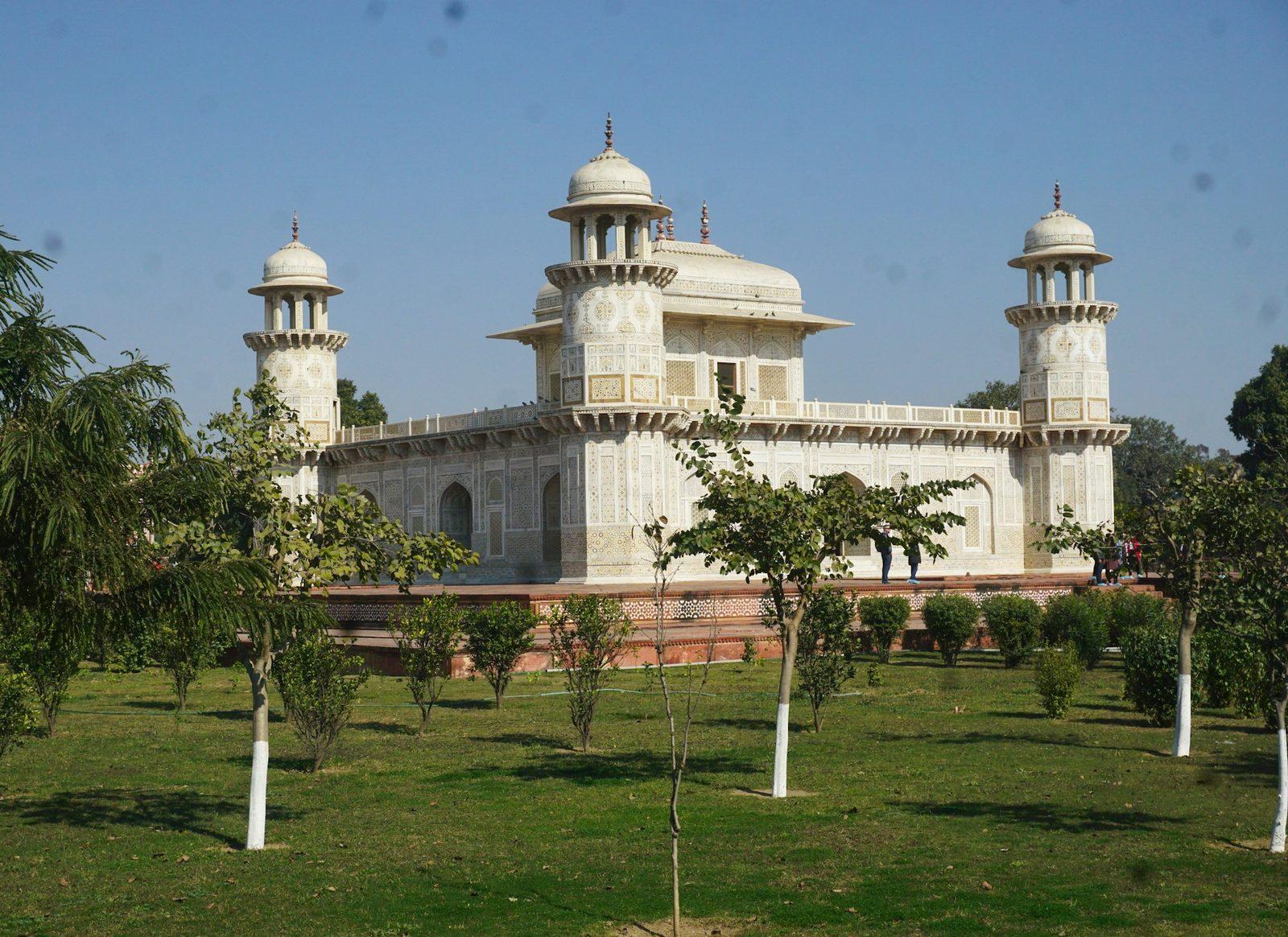
A few years before the Taj Mahal was begun, on the other bank of the Yamuna, a daughter finished a small tomb for her father and dressed its white marble in colored stone. People call it the Baby Taj. It came first. Itimad-ud-Daulah is a daughter's jewel box of inlaid marble for a Persian refugee who ran Jahangir's treasury, finished a few years before his granddaughter's tomb, the Taj, was begun: a step on the way to the famous one, not a copy of it.
A Persian refugee and his family
Itimad-ud-Daulah, "Pillar of the State", was a title. The Archaeological Survey gives it to Mirza Ghiyas Beg, father of Nur Jahan, who rose to be Lord of the Treasury and then wazir, chief minister, under Jahangir. Alexander Waugh's history has him a Persian whose father had served the Safavid court, who fled Persia and entered Akbar's service at Fatehpur Sikri. His wife, Asmat Begum, died in 1621, and he died in 1622, months after her.
His daughter Mehrunnisa married Jahangir in 1611 and was titled Nur Jahan, "Light of the World", in 1616. His granddaughter, the daughter of his son Asaf Khan, was Arjumand Banu Begum, who married Shah Jahan and is remembered as Mumtaz Mahal. Nur Jahan built the tomb from 1622 and, the Survey says, completed it in 1628, nearly seven years after his death. The Taj was begun a few kilometers away about four years later.
A picture, not a mountain
Hear a stop from this walk
East Riverfront: The Moonlight Garden
Walk in by the east gate and the tomb sits low in the center of a fourfold garden, on a platform the Survey measures at 149 feet square, with a round tower at each corner and a square pavilion on top instead of a dome. The historian R. Nath, as Waugh quotes him, saw it "designed as to look like a beautiful picture, rather than a massive tomb." Only the east gate is a real entrance. The west gate is a pavilion on the river, and the north and south gates are false, built for symmetry.
The garden's water is back. The World Monuments Fund and the Survey restored it from 2014, and when it reopened in January 2019 clean water was flowing in the channels again.
The marble that comes before the Taj's
Come close and the white marble is set with hard and semi-precious stone: wine vessels, vases, cypress trees and geometric patterns. You will read that it is the first Mughal tomb in white marble and the first with pietra dura. Be careful with "first". The historian Mehreen Chida-Razvi calls its stone inlay "a forerunner to the delicate pietra dura" of the Taj: a step toward it, not a copy of it. And Salim Chishti's white marble tomb at Fatehpur Sikri, finished in 1580-81, is older.
The central chamber, Chida-Razvi notes, opens only from the south. Inside, Waugh writes, the wife's grave lies at the exact center and the husband's beside her. It is the same arrangement you will see at the Taj, where Mumtaz Mahal lies at the center and Shah Jahan's cenotaph was added beside hers; read the Taj mausoleum piece.
Chini ka Rauza: color of another kind
The walk ends with a short ride. About a kilometer north, on the same bank, stands Chini ka Rauza, the tomb of Afzal Khan Shirazi, poet-scholar and minister to Shah Jahan, who died in Lahore in 1639. It was built in the 1630s and is, by the district's account, the only monument in Agra faced in glazed tile, a Persian technique; chini means glazed ware, not tiles from China. Weather has taken much of the color. It is free.
Before you go
Itimad-ud-Daulah: The Baby Taj That Came First has eleven stops, about an hour: you walk about a kilometer round the garden, then take an auto-rickshaw or taxi about 1.3 km north, roughly five minutes, to Chini ka Rauza. The road between them has no sidewalk, so do not walk it. Both gardens are open every day from sunrise to sunset. Itimad-ud-Daulah's entry is 30 rupees for Indian, SAARC and BIMSTEC citizens and 310 for other foreign visitors (25 and 300 on Fridays), under fifteens free, by the official table checked 22 November 2026; the ticket is not included with the walk. More in Agra monument tickets, hours and closures.
Ready to experience it?
Taj Mahal: A Paradise Garden Built to Face the River
70 min · 1.3 km · easy
More from Agra
Explore more at your own pace.
Agra Monument Tickets, Hours and Closures (Checked November 2026)
Mughal Tombs of Agra: From Akbar's Grave to the Taj Mahal
Akbar's Tomb, Sikandra: The Grave His Son Rebuilt
Fatehpur Sikri: Akbar's Red City and the Names It Borrowed
Musamman Burj, Agra Fort: A Tower of Justice and Confinement