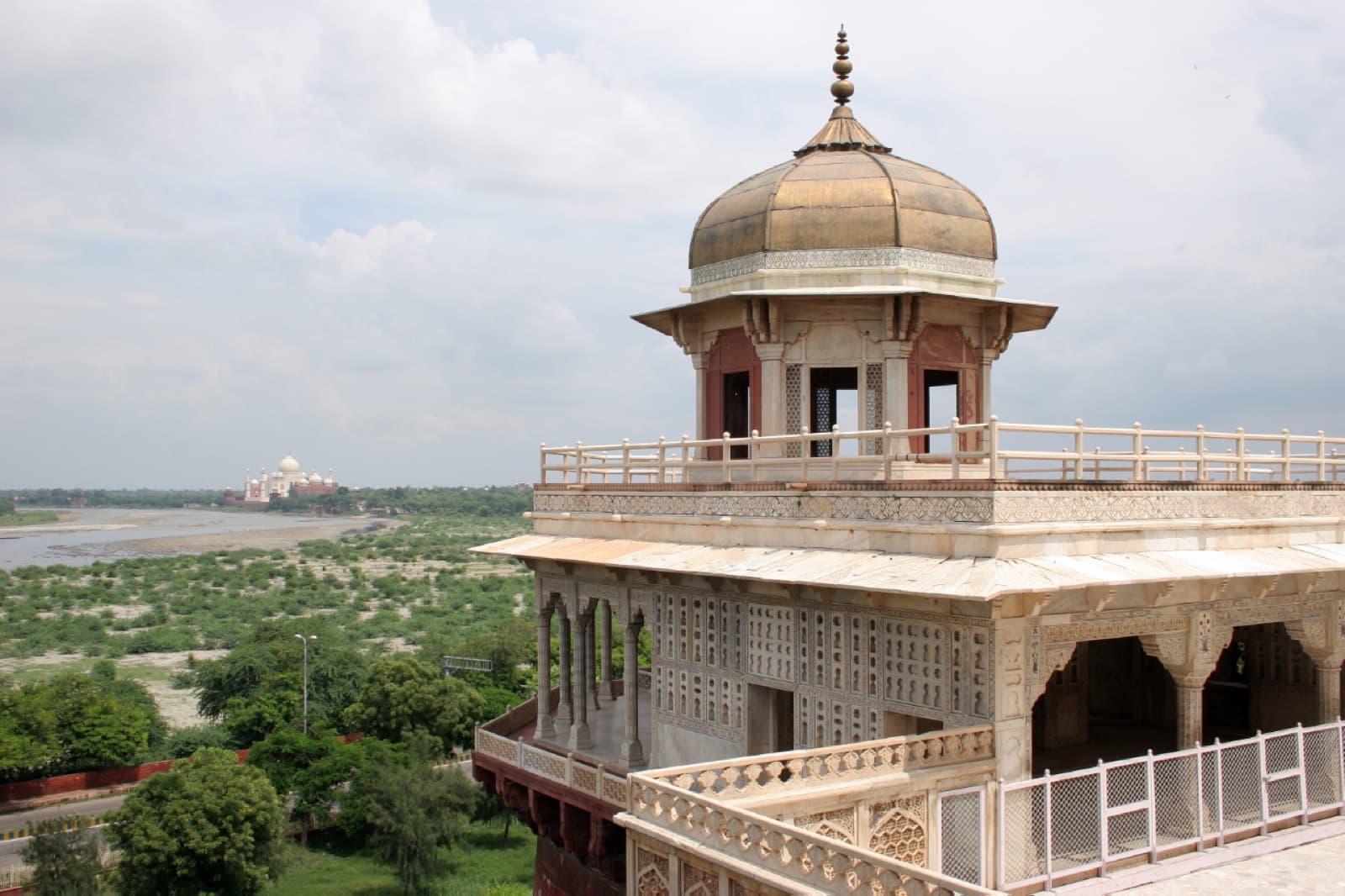
The Musamman Burj is an octagonal white marble tower on the riverfront wall of Agra Fort, and it is where the emperor Shah Jahan spent his final years imprisoned by his own son, Aurangzeb, gazing downstream at the Taj Mahal he had built. That single sentence holds the argument of the whole fort. Agra Fort is the Mughal empire read as one building, and the tower where power turned into captivity is the stop where the argument comes into focus. If you want to understand why this fortress matters, start with the cage at its most beautiful corner and let the rest of the walk lead you to it.
One Building, Three Reigns
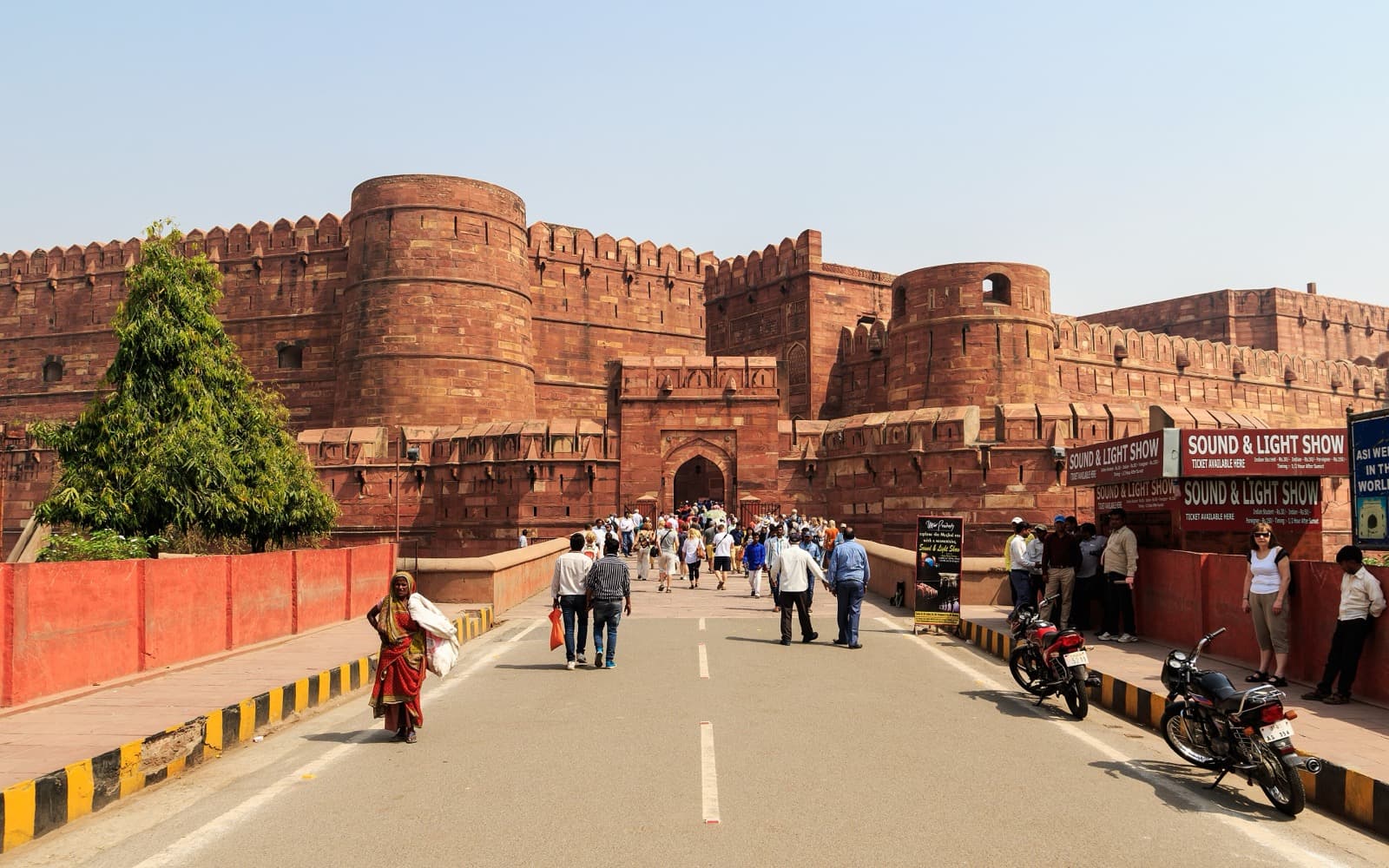
Most great monuments record a single moment. Agra Fort records a family across generations, in stone you can see change colour as you walk. The emperor Akbar rebuilt this fort in red sandstone beginning in 1565, and the work was completed by 1573. According to Britannica, around four thousand builders worked on it daily for some eight years, raising crescent-shaped walls that run about two and a half kilometres and rise roughly twenty-one metres above a moat. UNESCO inscribed the site as a World Heritage Site in 1983.
Akbar's fort was a fortress-city built to keep the world out. His grandson Shah Jahan overwrote much of that red with white marble, trading muscular strength for pierced screens and inlaid flowers. The Musamman Burj is that marble taste at its finest: jali lattices cut fine enough to filter light, ornamental niches, a marble dome, wall inlay in the technique called pietra dura, and a carved fountain set in a surrounding verandah. Shah Jahan built it on the Yamuna riverfront around 1631 to 1640, beside the Diwan-i-Khas, the Hall of Private Audience.
Then the same walls closed around him. In 1658, Aurangzeb seized power and confined his father in these riverfront apartments. Shah Jahan spent about eight years in captivity, from 1658 until his death in 1666, attended by his daughter Jahanara Begum. Tradition holds that from this tower he looked downstream at the Taj Mahal, the tomb he had raised for his wife, Mumtaz Mahal. A fortress built to keep enemies out had become a cage for the emperor who beautified it, jailed within sight of his own masterpiece. Red to white, power to captivity, in one family across three reigns.
Why the Tower Only Makes Sense After the Walk
Hear a stop from this walk
The Nagina Masjid and the Moti Masjid: The Gem and Pearl Mosques Hidden in the Red Fort
You can stand at the Musamman Burj and feel its sadness cold, but the tower means more if you arrive at it the way the tour does, layer by layer. The route through Agra moves inward and forward in time, and each earlier stop plants something that pays off at the tower.
You enter through the Amar Singh Gate, whose passage bends and doubles back deliberately, angled so that neither cavalry nor war elephants could charge straight through. That crooked stone is the fort in its first mood: defensive, sober, red. Shah Jahan renamed the gate; it had been the Akbar Darwaza before him, and even that small act of overwriting foreshadows how one reign paints over another here.
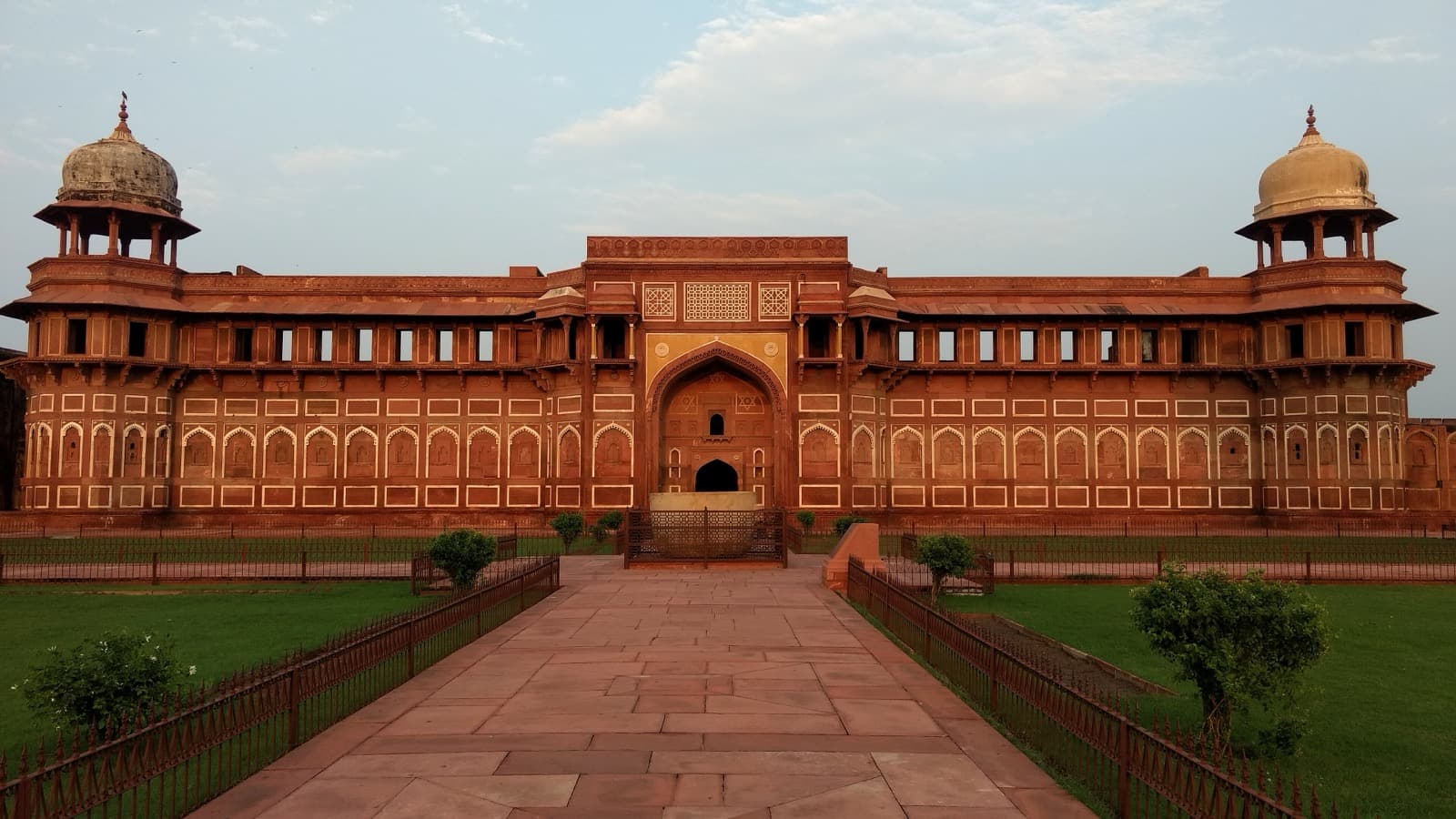
Next comes the Jahangiri Mahal, one of the largest surviving palaces of Akbar's original fort. Its name is a puzzle, because although it carries Jahangir's name, Akbar built it, and Jahangir recorded in his own memoirs that the buildings here were his father's work. Akbar raised it as the zenana, the residence of the royal women, for his Hindu chief queen Mariam-uz-Zamani, popularly remembered as Jodha Bai. Its red sandstone fuses Rajput and Gujarati Hindu forms with Central Asian and Islamic building. This is the deep layer, Akbar's own sixteenth century, robust and grounded.
At the Khas Mahal and the Anguri Bagh the stone changes colour. Shah Jahan's private marble palace looks out over the river to the east and a fourfold Persian garden to the west, the Grape Garden laid out in geometric quarters around a central water tank. Within a single lifetime, grandfather to grandson, the fort's taste has shifted from heavy red strength to fragile white beauty. By the time you reach the Musamman Burj a few paces along the same riverfront, you already understand what that fragile beauty cost the man who commissioned it.
The Diwan-i-Am, the Hall of Public Audience, sharpens the theme once more. It was the first structure Shah Jahan commissioned in the fort after his accession in August 1628, and it became the model for the hall of the same name at the Red Fort in Delhi. Justice was performed here in the open, the emperor visible to every petitioner from a white marble throne alcove. In front of the hall lies the grave of John Colvin, a colonial lieutenant-governor who died during the revolt of 1857 while sheltering in the fort. Two eras rest a few paces apart, the Mughal throne and the British grave, both held by the same red walls.
The Legends the Fort Debunks
Standing at the tower's screen, you may recall two stories tour touts still repeat. Both are legend. The tale that Shah Jahan maimed the Taj's craftsmen so they could never build its equal has no historical evidence; the same artisans went on to build his new city at Delhi. The so-called Black Taj Mahal he supposedly planned as his own tomb is likewise a myth, not fact. A calm, self-guided read of the fort is the antidote to the theatrical version shouted at you by guides working the crowd.
Walk It at Your Own Pace
Agra Fort is one of the most crowded and tout-pressed monuments on earth, thick with guides and hawkers. The self-guided walk is the counter to that pressure: six stops, about ninety minutes, roughly one and a half kilometres, all inside a single site, on your own clock. Go at opening or in the last hours before closing to dodge the worst heat and crowds, and remember that from April to June the exposed sandstone offers little shade. The route ends beyond the tower at the Nagina Masjid and Moti Masjid, the gem and pearl mosques of white marble hidden inside the red walls, where strength and delicacy finally sit together in one building.
The Musamman Burj is the emotional centre, but it is one stop in an argument that only lands if you walk the whole thing. Plan the route with our Agra walking tours guide, then let the fort tell you its story reign by reign, with no group van steering you toward a shop.
Sources
- Agra Fort, Wikipedia. Overview of Akbar's rebuilding, the fort's structures, and its layered construction history.
- Agra Fort, Encyclopaedia Britannica. Details on the crescent walls, builder numbers, and construction timeline used in the tour.
- Musamman Burj (Agra Fort), Wikipedia. Account of the octagonal marble tower and Shah Jahan's imprisonment there.
- Fact-check: Did Shah Jahan chop off the hands of Taj Mahal workers?, The Wire. Debunking of the craftsmen-maiming and Black Taj Mahal legends.
- Agra Fort, Archaeological Survey of India / UNESCO World Heritage listing. Official records of the site's 1983 inscription and the fort's Mughal history.
Ready to experience it?
Agra Fort: The Red Sandstone Seat of Empire
90 min · 1.5 km · moderate
More from Agra
Explore more at your own pace.
Agra Travel Guide: How Many Days, Getting Around, and Safety
One Day in Agra: A Walkable Itinerary from the Taj Mahal to Agra Fort
Agra: The Mughal Zenith Read Across a River
Reading the Taj Mahal as a Tomb: What the Mausoleum Tells You
Jahangiri Mahal: Akbar's Red Palace Where Mughal and Rajput Built as One