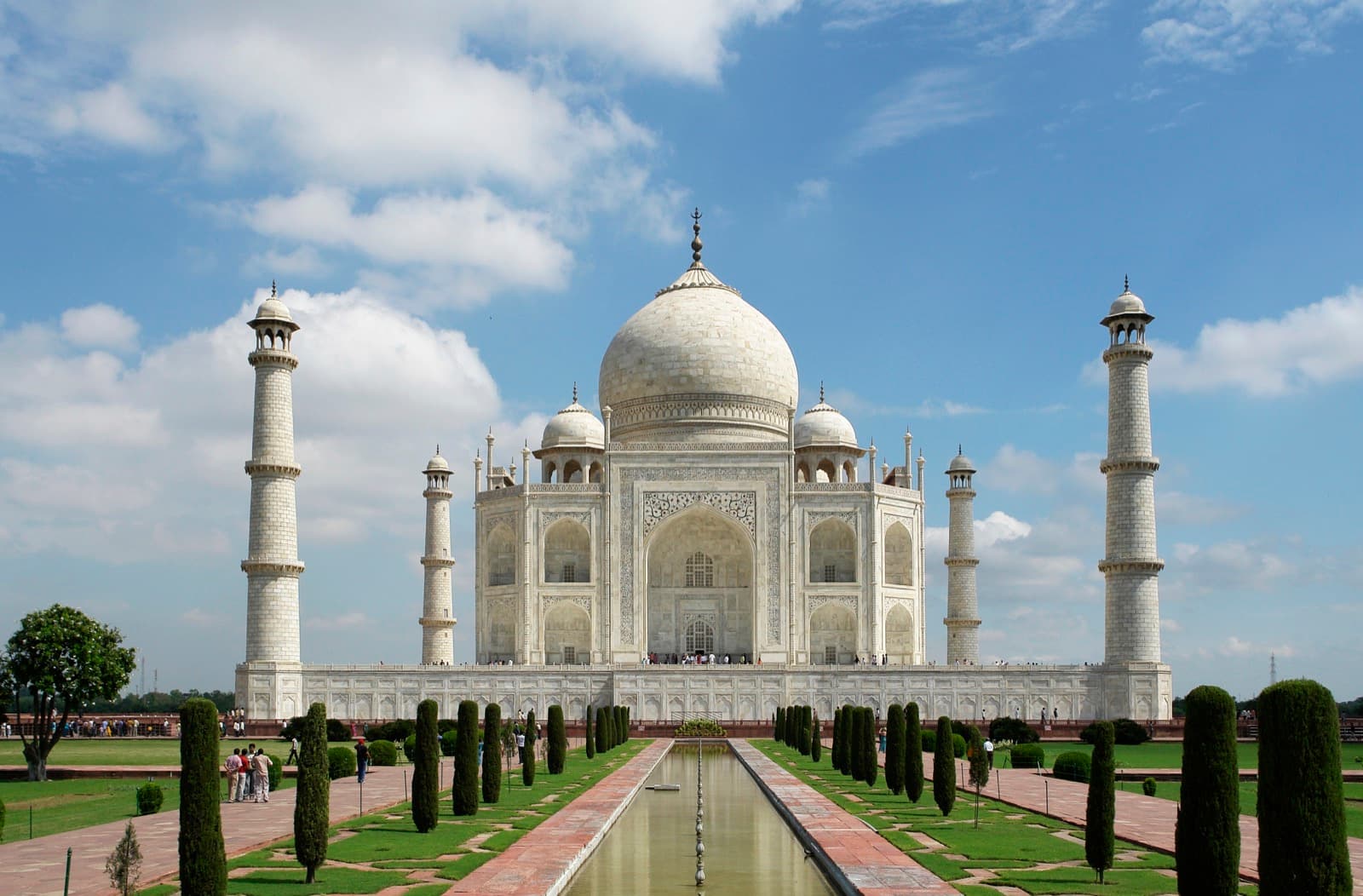
The Taj Mahal is a tomb, not a palace. That single fact, once you hold it, reorganizes everything you thought you knew about the white marble building at the edge of Agra. The emperor Shah Jahan did not raise it to live in or to rule from. He raised it as a grave for his wife Mumtaz Mahal, who died in sixteen thirty-one, and the mausoleum at its center is engineered around that grief. Read the building outward from that point, from the marble tomb rather than from the ticket gate, and the whole complex resolves into one argument about loss, paradise, and near-perfect symmetry. A self-guided walk through Agra is the way to decode it slowly, on your own clock rather than a group's.
The Marble That Flowers with Stone
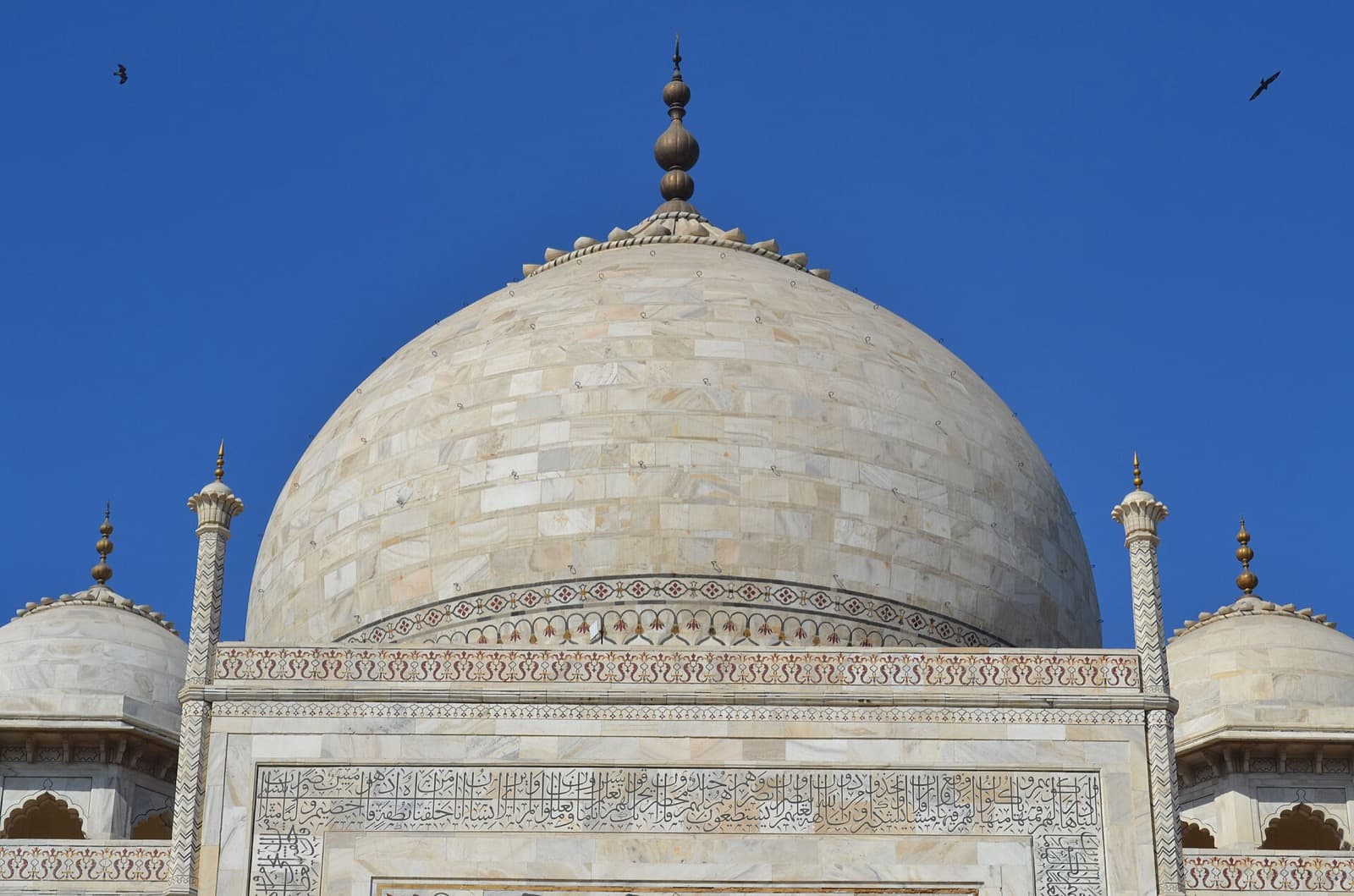
Stand close to the mausoleum and the first thing you notice is that it stops being simply white. The great central double dome rises to about seventy-three metres to the tip of its crowning finial, and from a distance the surface reads as a single pale sheet. Up close, the marble is worked with pietra dura, the inlay of flowers and curling vines cut from semiprecious stone and set flush into the stone so the joints disappear. Twenty-eight kinds of stone are recorded here, among them carnelian, jasper, lapis lazuli, jade, turquoise, and sapphire. The marble seems to flower. Between those inlaid gardens run wide bands of Quranic calligraphy.
This is not decoration applied to a finished shell. It is the tomb making an argument that the grave is a threshold to paradise, and the argument is built into every surface. The chief architect is credited as Ustad Ahmad Lahori, who led a whole board of architects, and the calligraphy belongs to Amanat Khan, the same hand that worked the entrance gate. Construction began in sixteen thirty-two, the mausoleum itself was essentially finished by sixteen forty-eight, and the complete complex covers about seventeen hectares, roughly forty-two acres. It is said to have employed some twenty thousand artisans. UNESCO inscribed the Taj Mahal in nineteen eighty-three, recording it as the jewel of Muslim art in India.
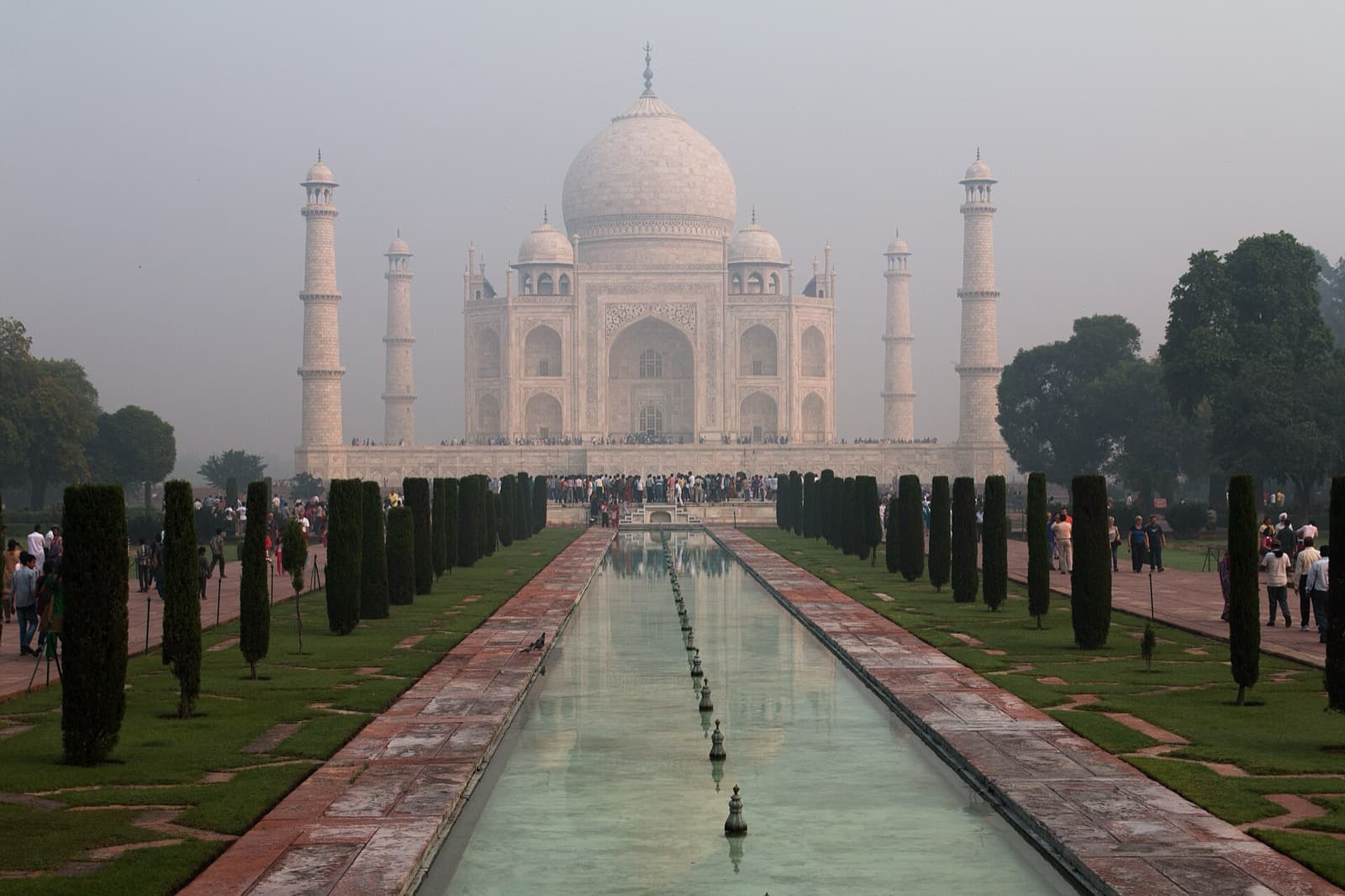
Watch the marble as the light moves and it appears to change color: soft and pearly at dawn, brilliant at midday, warmer toward evening. No two hours look the same, which is one reason a rushed loop cheats you. The mausoleum rewards standing still.
The One Flaw Grief Added
Hear a stop from this walk
The Mosque and the Jawab: A Twin Built Only for Symmetry
Step inside, beneath the dome, and the building's logic sharpens. The chamber holds two cenotaphs, false tombs, ringed by a perforated marble screen cut so fine it looks like frozen lace. The one at the exact center belongs to Mumtaz Mahal. Beside it, larger and set off to the west, is the cenotaph of Shah Jahan himself, placed there after his death in sixteen sixty-six.
That off-center tomb is the single flaw in the entire design. Everything else in the Taj Mahal is balanced with almost unnerving symmetry, one half mirroring the other. The emperor's cenotaph is the one element that breaks it, because the empress was meant to lie alone at the heart of the building and the emperor was added later. Perfection, deliberately imperfected by grief. The real graves are not in this chamber at all. They lie in a plain, undecorated crypt directly below at garden level, closed to visitors, because tradition holds that an actual burial place should not be ornamented.
You will hear a darker story outside from the touts: that Shah Jahan had his artisans' hands cut off so nothing so beautiful could be built again. There is no historical evidence for it. Historians have found nothing to support the tale. Carry it as a legend, a chilling one, but a legend, and notice how a good tour separates the documented from the repeated.
Why the Whole Site Answers the Tomb
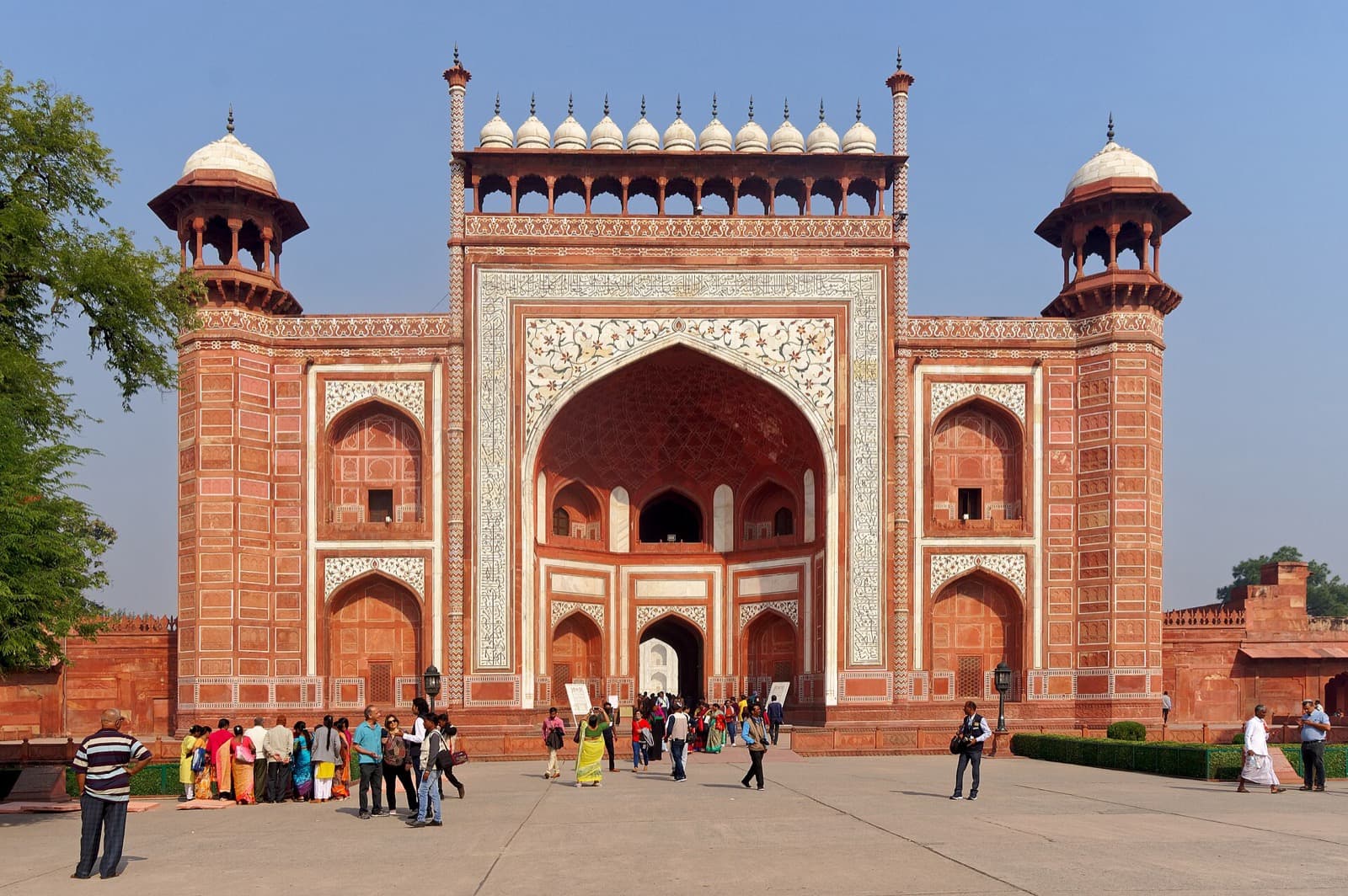
Once the mausoleum is your anchor, the rest of the walk reads as commentary on it. The approach begins at the Great Gate, the Darwaza-i Rauza, a red sandstone arch built deliberately dark so the white tomb appears all at once, like a vision, when you pass through the shadow. The gate's calligraphy carries a genuine optical trick: the letters grow larger toward the top of the arch so that, from the ground, the whole inscription reads as if every letter were the same size.
Beyond it spreads the char bagh, a fourfold Persian paradise garden whose four water channels recall the four rivers described in Islamic tradition. A raised central marble tank feeds the reflecting pool that doubles the dome in still water, the picture the photographers fight over. Flanking the mausoleum stand two identical red sandstone buildings. The western one is a working mosque oriented toward Mecca, which consecrates the ground. The eastern one, the jawab, is its exact mirror down to the stone, and yet it has no mihrab and faces the wrong way, so it can never function as a mosque. The word jawab means the answer. An entire building was raised for no purpose but to answer the mosque and keep the composition symmetrical. That is the paradox of the place at its clearest.
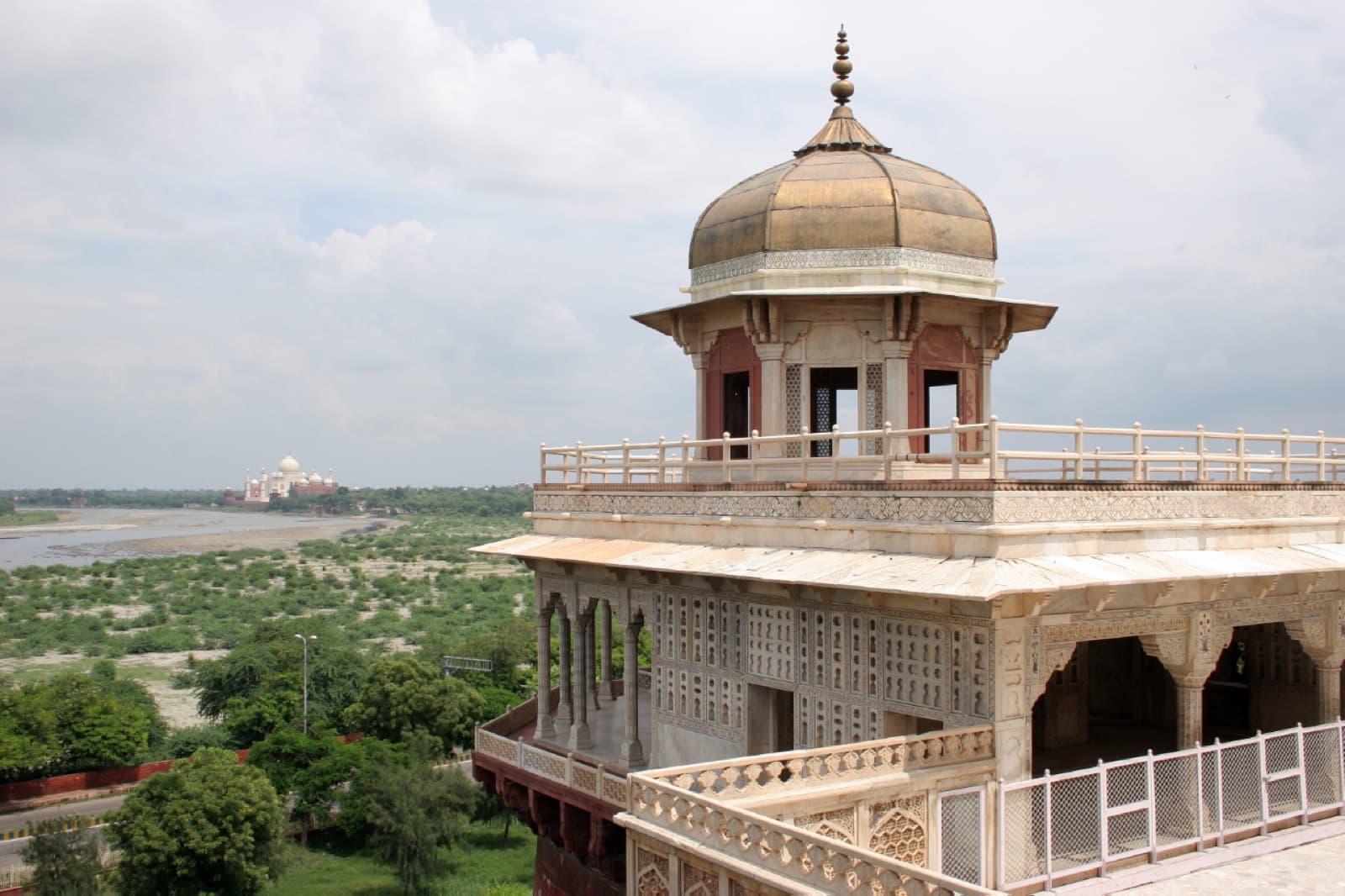
The walk ends on the riverfront terrace above the Yamuna, where most visitors never turn their backs on the tomb to face the water. Turn anyway. About two and a half kilometres upstream sits Agra Fort, where Shah Jahan was confined by his son Aurangzeb around sixteen fifty-eight in the octagonal Musamman Burj, a tower that looks straight across the river at his wife's tomb. Tradition holds he gazed at it until his death in sixteen sixty-six. The river also carries the legend of the Black Taj Mahal, a matching mausoleum in black marble said to be planned for the far bank. Most historians dismiss it as folklore; the supposed black ruins turned out to be discolored white stones. What grief actually made stands. What grief supposedly planned across the river is a story, not a stone.
Walk It at Your Own Pace
This is one of the most tout-heavy and crowded sites on earth, thick with guides, hawkers, and photo-touts. The real gift of moving on your own is that no one hurries you past the calligraphy or steers you toward a shop. You can linger at the marble as long as the light holds. The site is closed on Fridays, so plan another day, and a foreign ticket runs around thirteen hundred rupees, with about two hundred rupees more to step onto the plinth and reach the tomb chamber. If you want more of Agra beyond the tomb, browse the full set of Agra walking tours or start planning from the Agra city page. Read the mausoleum first, and the rest of the walk falls into place.
Sources
- Taj Mahal, Wikipedia: overview of the mausoleum, pietra dura inlay, twenty-eight stones, char bagh garden, and the maimed-artisans and Black Taj myths.
- UNESCO World Heritage Centre, Taj Mahal (List no. 252): the 1983 inscription and the "jewel of Muslim art in India" designation.
- Archaeological Survey of India / tajmahal.gov.in: the calligraphy of Amanat Khan and the function of the jawab as a symmetrical answer to the mosque.
- Shah Jahan, Wikipedia: his deposition by Aurangzeb around 1658, imprisonment in Agra Fort, and death in 1666.
Ready to experience it?
Taj Mahal: An Emperor's Monument to Grief
90 min · 1 km · easy
More from Agra
Explore more at your own pace.
Agra Travel Guide: How Many Days, Getting Around, and Safety
One Day in Agra: A Walkable Itinerary from the Taj Mahal to Agra Fort
Agra: The Mughal Zenith Read Across a River
The Marble Tower Where a Mughal Emperor Was Jailed by His Own Son
Jahangiri Mahal: Akbar's Red Palace Where Mughal and Rajput Built as One