Taj Mahal: An Emperor's Monument to Grief
90 min · 1 km · easy
The Mughal empire raised its greatest works in Agra, and the city holds the summit of that art in two buildings that face each other across the Yamuna river. On the south bank the emperor Shah Jahan built the Taj Mahal in the mid seventeenth century, a white marble tomb for his wife Mumtaz Mahal, set in a fourfold paradise garden and doubled in a reflecting pool. Upstream stands Agra Fort, the red sandstone stronghold the emperor Akbar rebuilt from fifteen sixty-five, whose marble tower became the room where Shah Jahan spent his last years a prisoner, gazing downriver at the tomb he had built. Read the great tomb and the red fort together and you read the whole Mughal century in stone, from power to grief to captivity, at your own pace.
Two buildings, one story, across a river
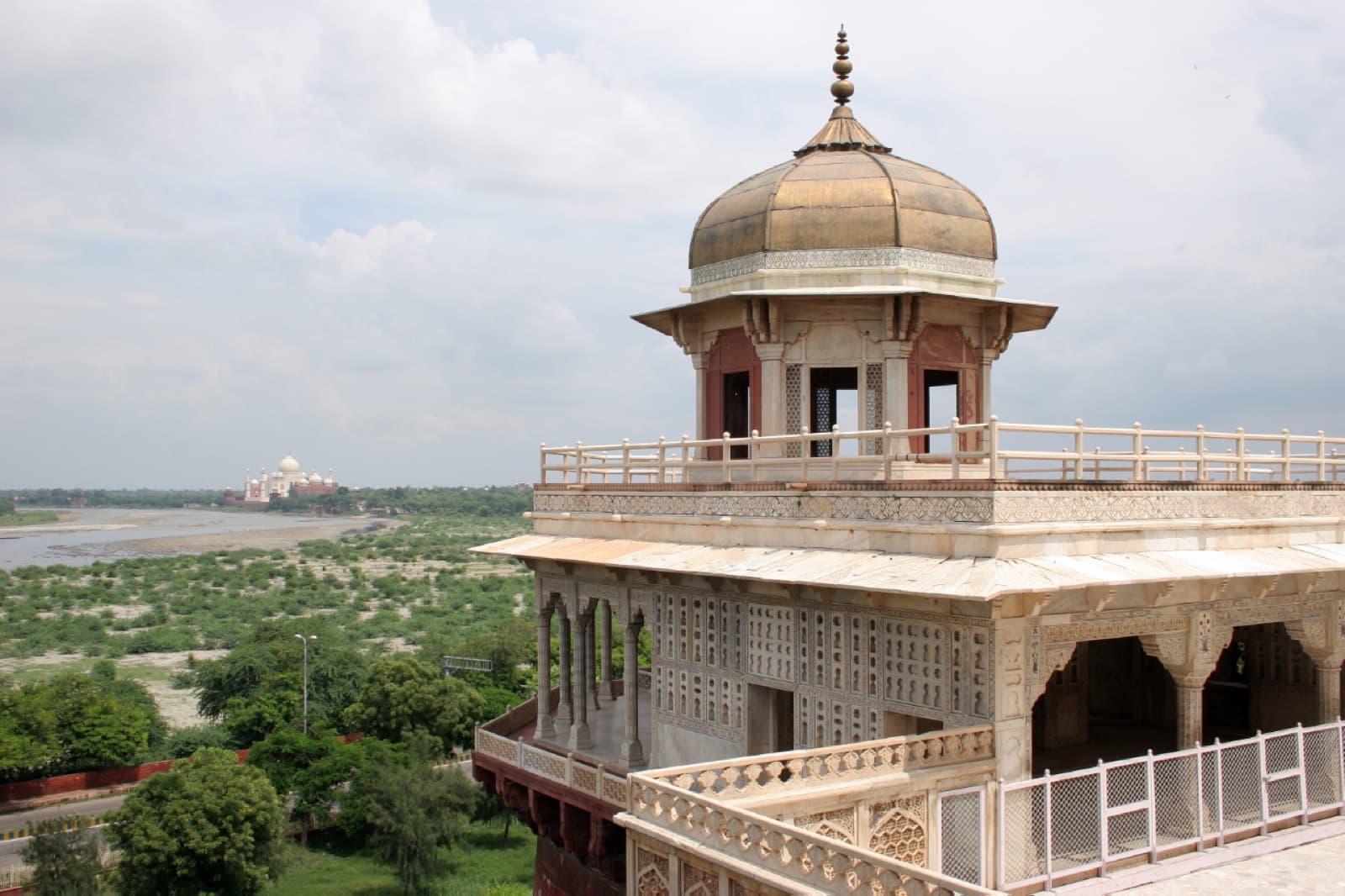
Agra was where the empire performed itself. The two monuments are not separate attractions but two ends of a single arc, and the river carries the connection. From the riverfront terrace of the Taj Mahal you can look upstream about two and a half kilometres to Agra Fort. From the fort's octagonal marble tower, the Musamman Burj, you can look downstream to the tomb. That sightline is the spine of the story. One building is the emperor's monument to loss. The other is the fortress that watched it rise, and then held him while he watched it from a window.
The tomb reads as grief made permanent. Mumtaz Mahal died in sixteen thirty-one, construction began in sixteen thirty-two, and the complex was finished by sixteen fifty-three. Everything about the design serves a single feeling. Walking it slowly, rather than being hurried through in a group, is the only way to feel how deliberately it was built to be experienced in sequence.
The tomb: a machine for revealing paradise
Hear a stop from this walk
The Mosque and the Jawab: A Twin Built Only for Symmetry
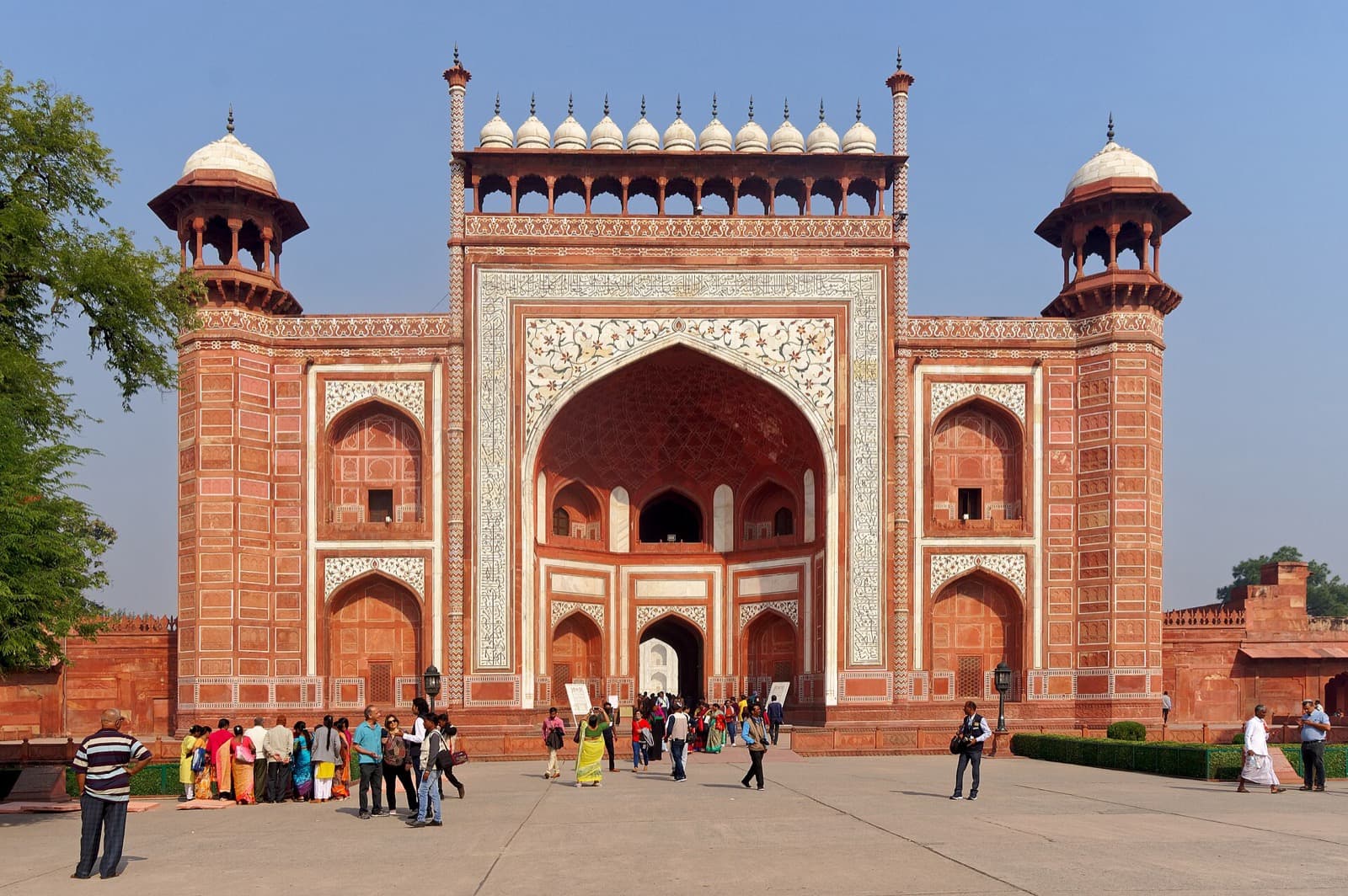
The Taj Mahal walk begins in shadow. The Great Gate, the Darwaza-i Rauza, is built of red sandstone banded with marble and deliberately kept dark, so that when you pass through its arch the white mausoleum appears all at once at the far end of the garden, pale and complete, like a vision arriving. The calligraphy on the gate, carried out under Amanat Khan, born Abdul Haq and given his title by Shah Jahan, hides a piece of engineering: the letters grow larger toward the top of the arch, so that from the ground the whole inscription reads as if every letter were the same size.
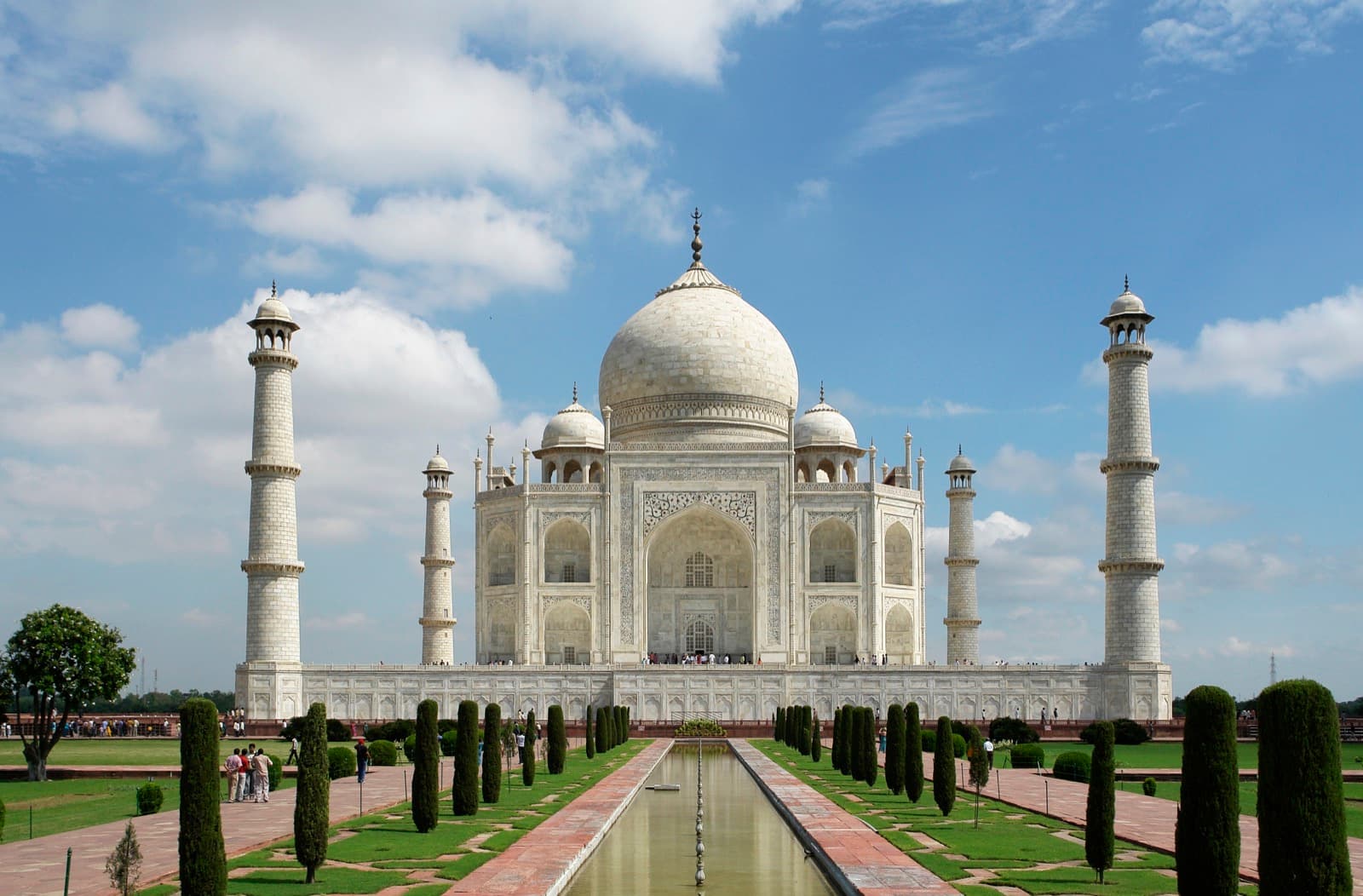
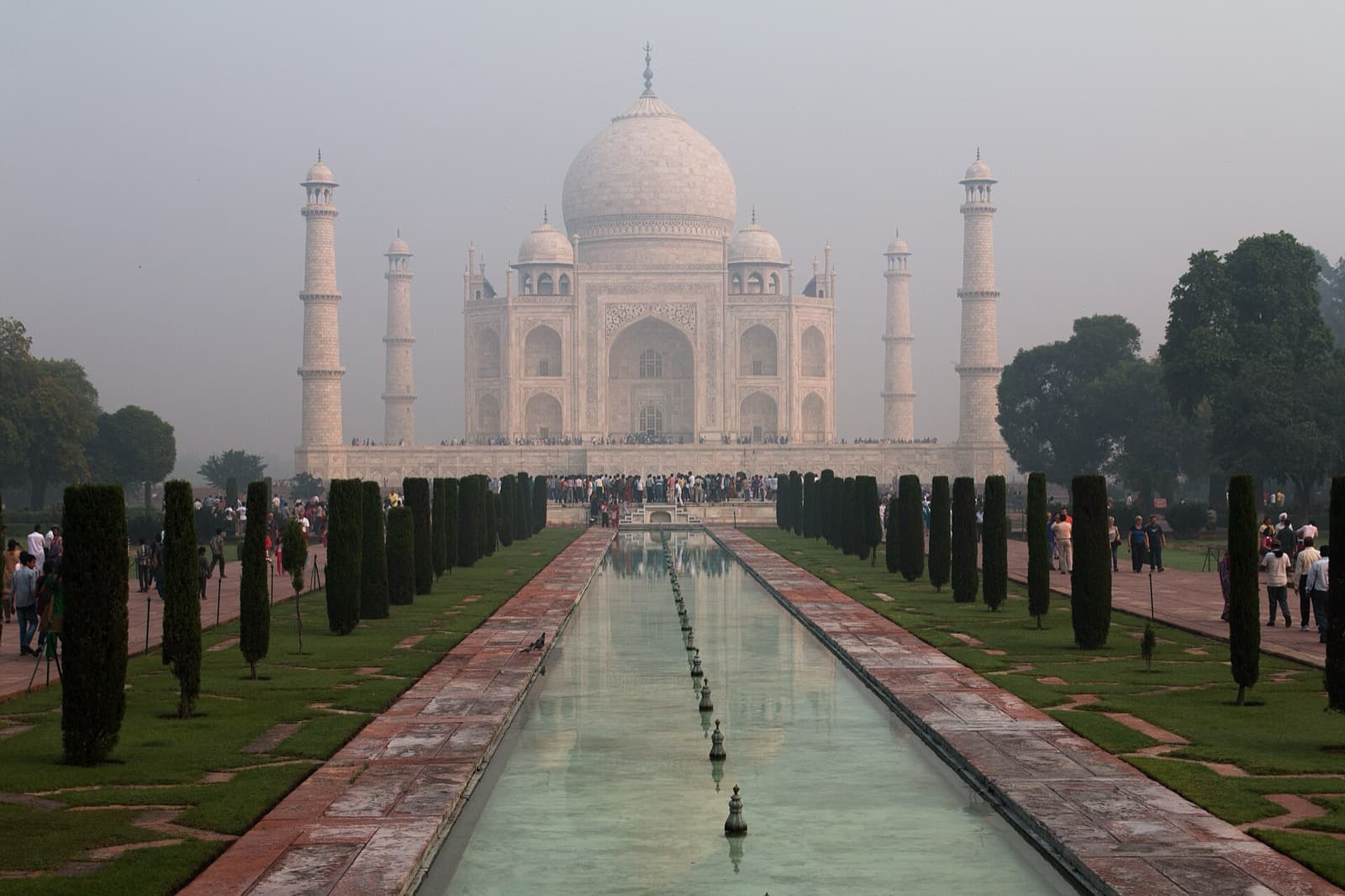
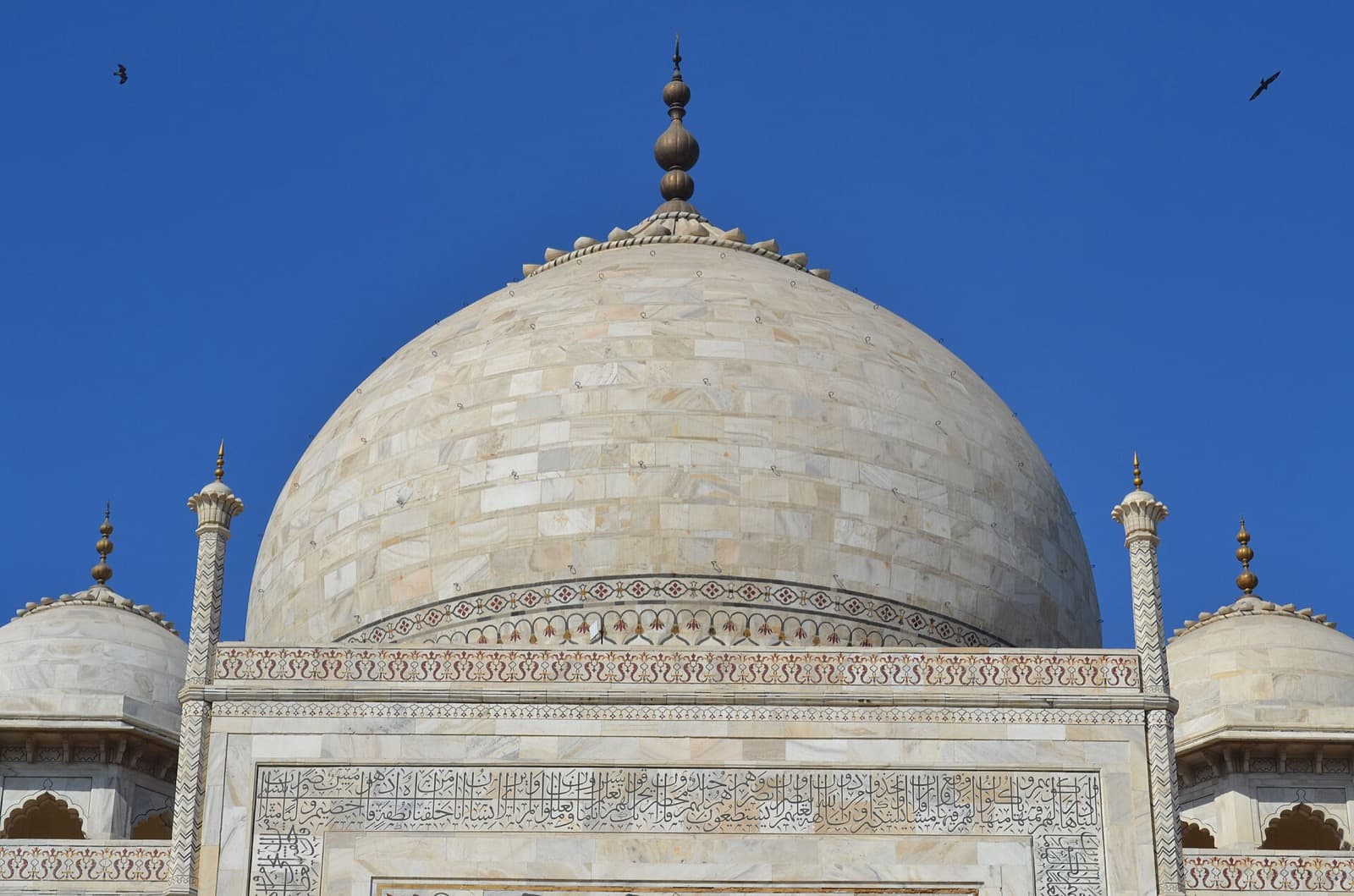
Beyond the gate lies the char bagh, the fourfold Persian garden whose four water channels recall the four rivers of Paradise. At its center a raised marble tank feeds a reflecting channel that runs north to south, and when the water is still the dome and minarets drop straight down into it, doubled. The mausoleum itself rises to about seventy-three metres to the tip of its finial. Come close and the white marble stops being white: its surfaces carry pietra dura inlay, flowers and vines cut from twenty-eight kinds of stone, among them carnelian, jasper, lapis lazuli, jade, turquoise, and sapphire. The chief architect is credited as Ustad Ahmad Lahori, leading a whole board, and the calligraphy again belongs to Amanat Khan. UNESCO inscribed the site in nineteen eighty-three as the jewel of Muslim art in India, a complex of about seventeen hectares said to have employed some twenty thousand artisans.
Inside, the design breaks its own symmetry exactly once. Mumtaz Mahal's cenotaph sits at the precise center of the chamber. Shah Jahan's, added after his death in sixteen sixty-six, sits larger and off to the west, the single asymmetry in an otherwise perfectly balanced building. The empress was meant to lie alone at the heart of it; the emperor was added later. The real graves rest in a plain crypt below at garden level, undecorated because tradition holds a burial place should not be ornamented.
The legends, treated plainly
Agra is one of the most tout-pressed sites on earth, and the crowds carry stories the buildings themselves do not support. Both walks set the legends aside rather than repeating them. The tale that Shah Jahan had his artisans maimed so nothing so beautiful could be built again has no historical evidence; the same craftsmen went on to build his new city at Delhi. The Black Taj Mahal, a supposed mirror tomb in black marble planned for the far bank, is likewise folklore: the ruins said to prove it turned out to be discolored white stones. What stands is what grief actually made. What grief supposedly planned across the river is a story, not a stone.
The fort: the empire read red to white
If the tomb is a single feeling, Agra Fort is the whole dynasty in one enclosure. Akbar rebuilt it in red sandstone from fifteen sixty-five, completed by fifteen seventy-three, its crescent walls running about two and a half kilometres and rising some twenty-one metres above a moat, on a site of roughly thirty-eight hectares, also a World Heritage Site since nineteen eighty-three. The entrance, the Amar Singh Gate, bends and doubles back on itself, a passage cut so that charging cavalry and war elephants could not rush straight through.
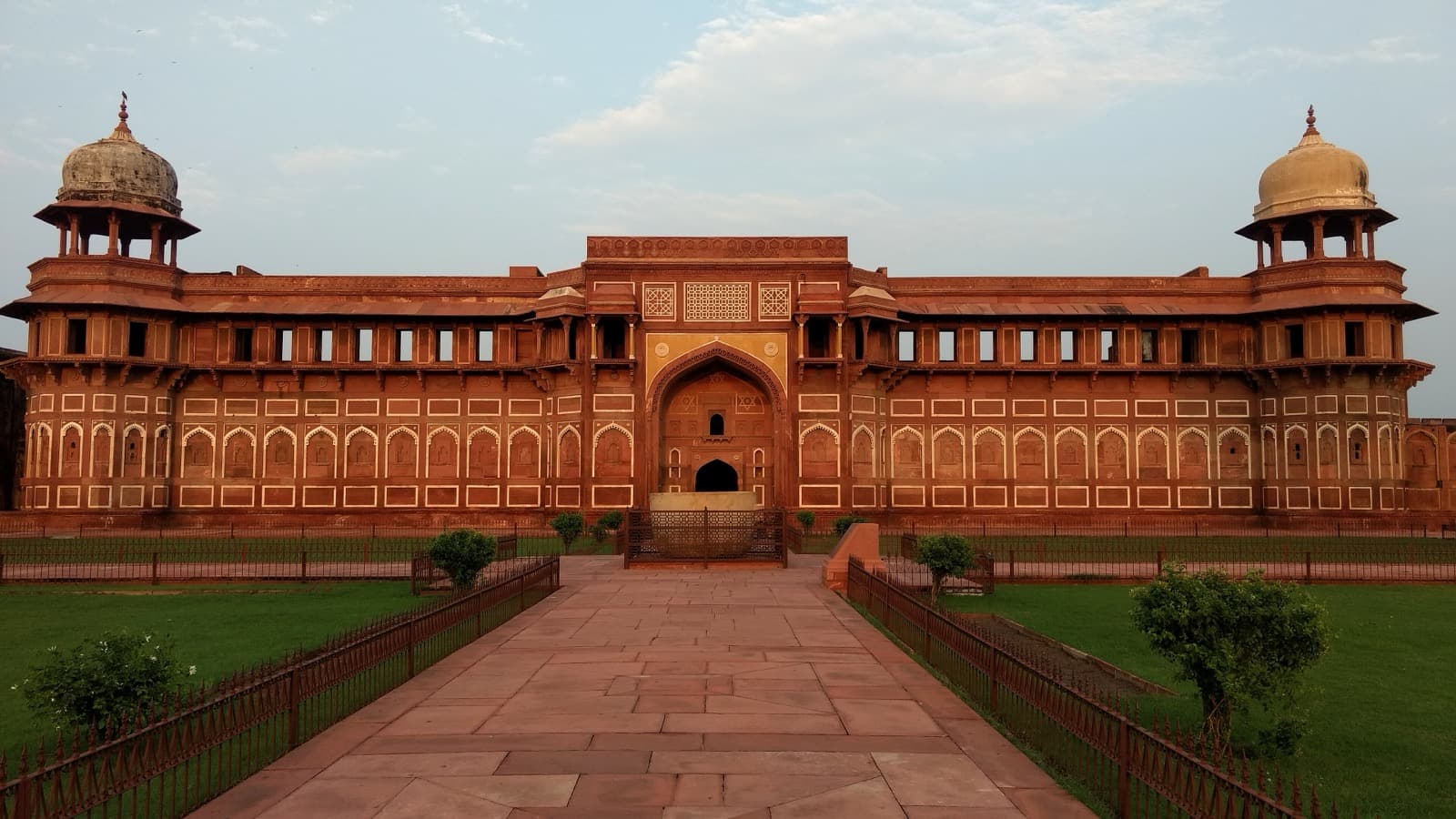
Walk inward and the stone changes color, and with it the whole aesthetic of the empire. Akbar's Jahangiri Mahal, the palace of the royal women, is heavy red sandstone worked with Rajput and Gujarati forms fused with Islamic building, Mughal and Rajput built as one. Then comes Shah Jahan's Khas Mahal, white marble on the riverfront, built around sixteen thirty-one to sixteen forty, delicate with floral inlay and pierced jali screens, overlooking the Anguri Bagh, the Grape Garden. The same family, the same fort, and within three generations the taste turns from robust strength to fragile beauty. At the Diwan-i-Am, the first structure Shah Jahan commissioned after his accession in August sixteen twenty-eight, justice was performed in the open from a marble throne alcove; in front of it lies the grave of John Colvin, a colonial lieutenant-governor who died during the revolt of eighteen fifty-seven, two eras resting a few paces apart.
The window where the arc closes
The story ends at the Musamman Burj, the octagonal marble tower Shah Jahan built on the riverfront. In sixteen fifty-eight his son Aurangzeb seized power and confined his father in these apartments, where the old emperor spent about eight years until his death in sixteen sixty-six, attended by his daughter Jahanara Begum. Tradition holds that he gazed downstream from this tower at the tomb he had raised for his wife. The fortress Akbar built to keep the world out became a cage for the emperor who beautified it, jailed within sight of his own masterpiece. When he died, he was carried to the Taj and laid beside her, which is why his cenotaph breaks the symmetry.
The walk through the fort finishes with white marble turned to prayer: the small Nagina Masjid, the Gem Mosque, a private chapel only about ten metres by seven, and the larger Moti Masjid, the Pearl Mosque, built from sixteen forty-six to sixteen fifty-three and now largely viewed from outside, since part of the fort remains a restricted Indian Army zone.
Two buildings, one river, one century. To read them at your own pace, start with the Agra walking tours and walk the tomb and the fort in whichever order the light favors.
Sources
- UNESCO World Heritage Centre, "Taj Mahal" (inscribed 1983) and "Agra Fort" (inscribed 1983).
- Archaeological Survey of India, site records for the Taj Mahal complex and Agra Fort.
- Encyclopaedia Britannica, "Agra Fort" and "Taj Mahal."
- Roamer tour transcript, "Taj Mahal: An Emperor's Monument to Grief" (fact-audited).
- Roamer tour transcript, "Agra Fort: The Red Sandstone Seat of Empire" (fact-audited).
Frequently asked questions
- How are the Taj Mahal and Agra Fort connected?
- They face each other across the Yamuna river, roughly two and a half kilometres apart. Shah Jahan built the Taj Mahal as a tomb for his wife Mumtaz Mahal, then was later imprisoned in Agra Fort's Musamman Burj by his son Aurangzeb, where tradition holds he gazed downstream at the tomb until his death in sixteen sixty-six. He was then buried beside her in the Taj.
- Did Shah Jahan really cut off the hands of the Taj Mahal's builders?
- No. The story that the artisans were maimed so nothing so beautiful could be built again has no historical evidence and is regarded by historians as myth. The same craftsmen went on to build Shah Jahan's new city at Delhi. It is a legend the crowds repeat, not documented history.
- Was the Black Taj Mahal ever built?
- No. The tale that Shah Jahan planned a matching mausoleum in black marble on the far bank of the Yamuna is dismissed by most historians as folklore. The supposed black marble ruins across the river were found to be discolored white stones. No dark twin was ever constructed.
- Why does Agra Fort change from red sandstone to white marble?
- The fort records three Mughal reigns. Akbar rebuilt it in red sandstone from fifteen sixty-five, and his grandson Shah Jahan later added white marble palaces like the Khas Mahal and Musamman Burj around sixteen thirty-one to sixteen forty. Within three generations the imperial taste shifted from robust red sandstone to delicate white marble.
- When were the Taj Mahal and Agra Fort built?
- Construction of the Taj Mahal began in sixteen thirty-two, after Mumtaz Mahal's death in sixteen thirty-one, and the complex was finished by sixteen fifty-three. Agra Fort was rebuilt by Akbar in red sandstone from fifteen sixty-five and completed by fifteen seventy-three. Both were inscribed as UNESCO World Heritage Sites in nineteen eighty-three.
Ready to experience it?
Taj Mahal: An Emperor's Monument to Grief
90 min · 1 km · easy
More from Agra
Explore more at your own pace.
Agra Travel Guide: How Many Days, Getting Around, and Safety
One Day in Agra: A Walkable Itinerary from the Taj Mahal to Agra Fort
Reading the Taj Mahal as a Tomb: What the Mausoleum Tells You
The Marble Tower Where a Mughal Emperor Was Jailed by His Own Son
Jahangiri Mahal: Akbar's Red Palace Where Mughal and Rajput Built as One