Read the whole Mughal empire as a single building, from Akbar's red-sandstone fortress walls to the white marble tower where his grandson Shah Jahan died a prisoner within sight of the Taj Mahal.
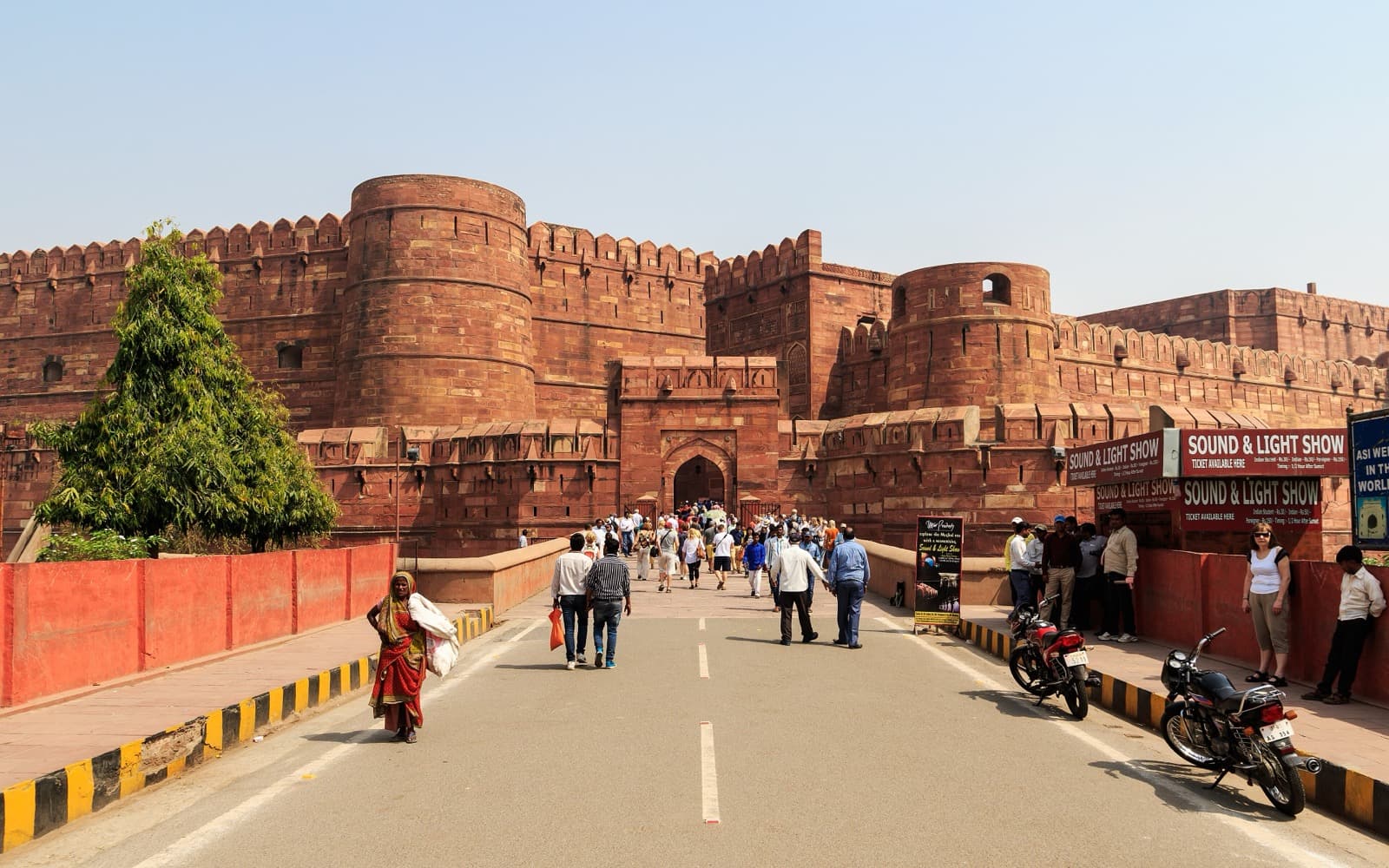
Start · The Amar Singh Gate and the Ramparts: A Gate Bent to Break a Charge
DirectionsStops
- 1
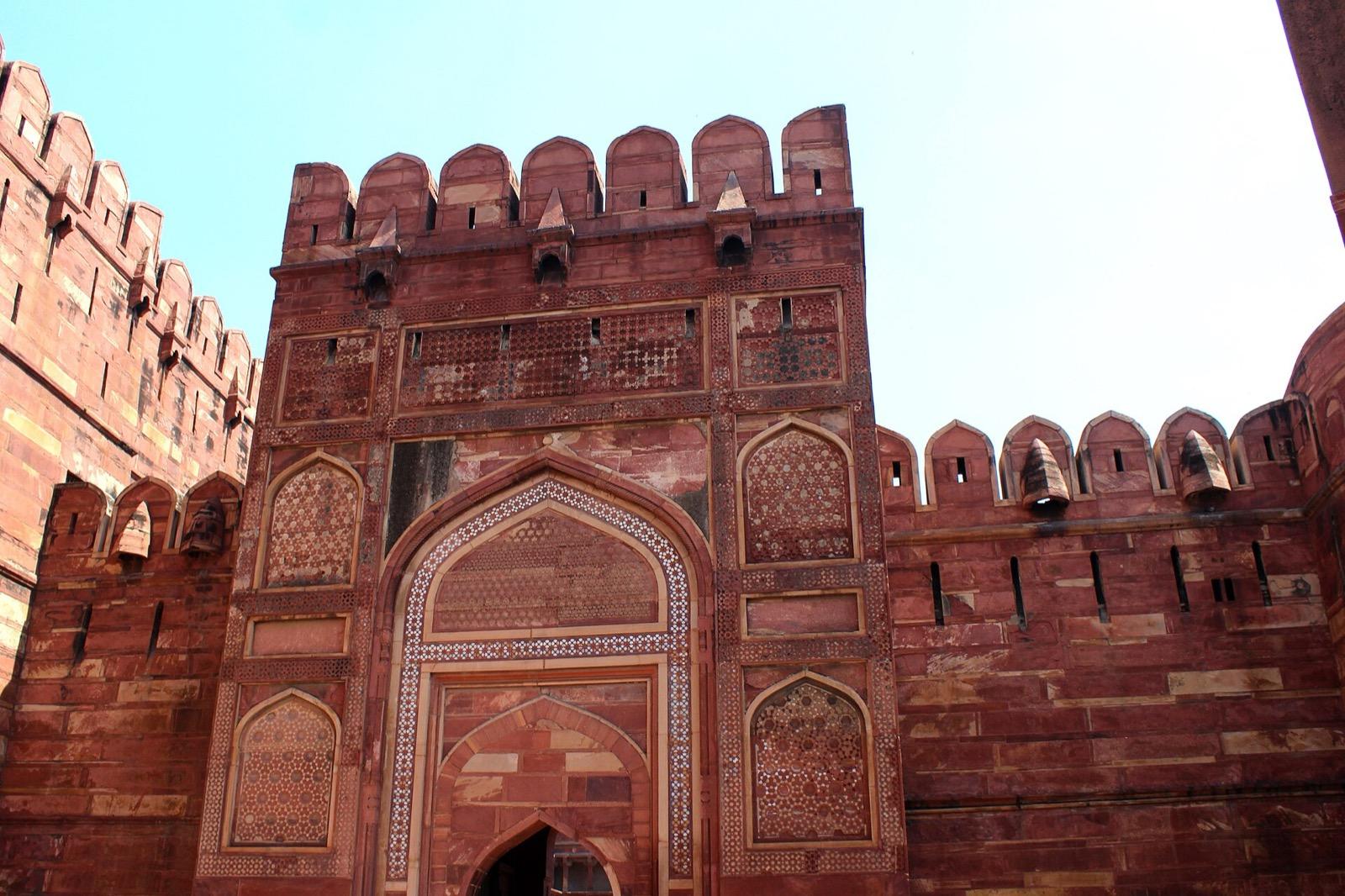
The Amar Singh Gate and the Ramparts: A Gate Bent to Break a Charge
The southern visitor entrance, a deliberately crooked defensive approach set beneath Akbar's colossal red-sandstone walls.
- 2
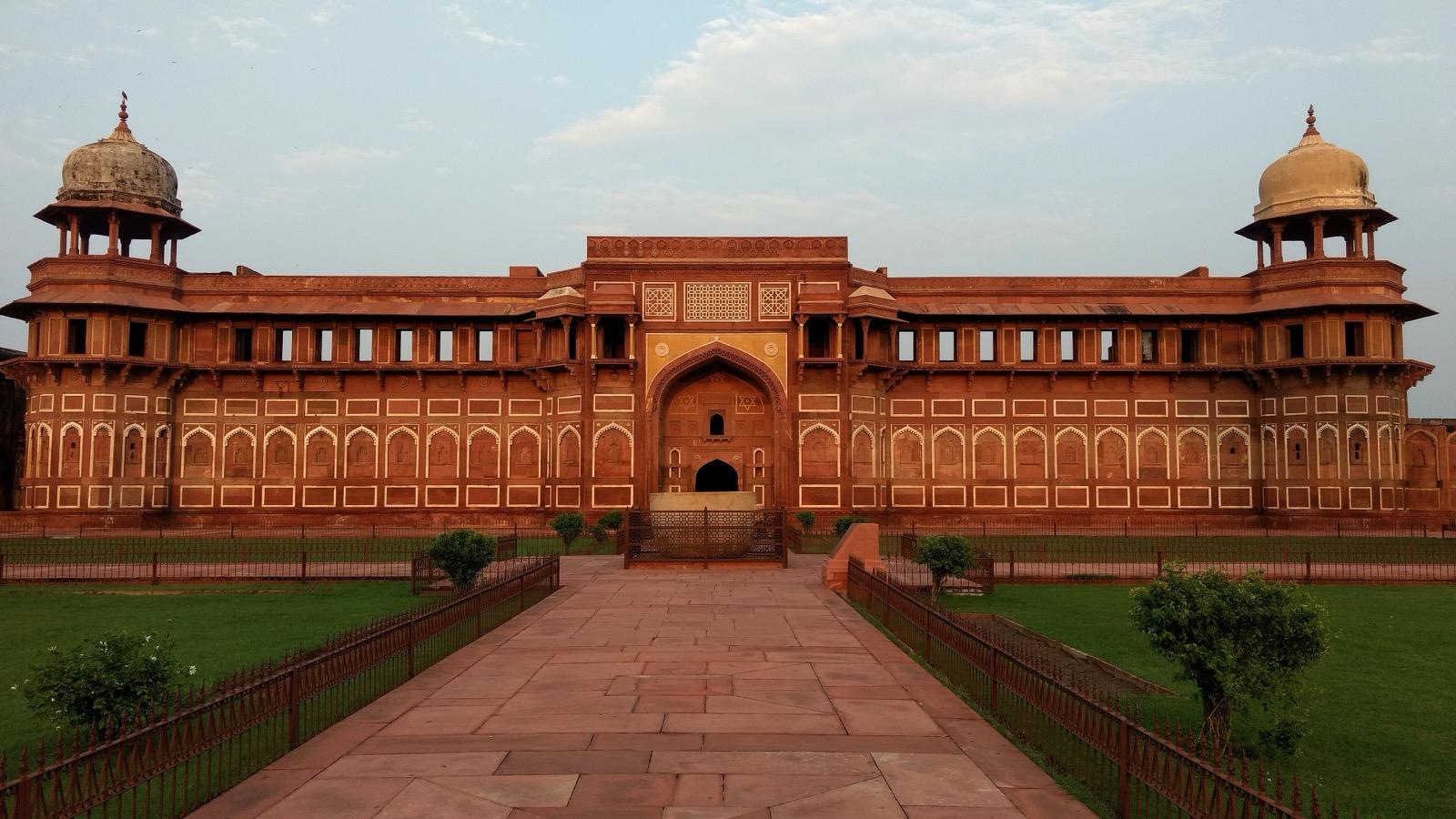
The Jahangiri Mahal: Where the Mughal and the Rajput Built as One
One of the largest surviving palaces of Akbar's original red-sandstone fort, built as the residence of the royal women.
- 3
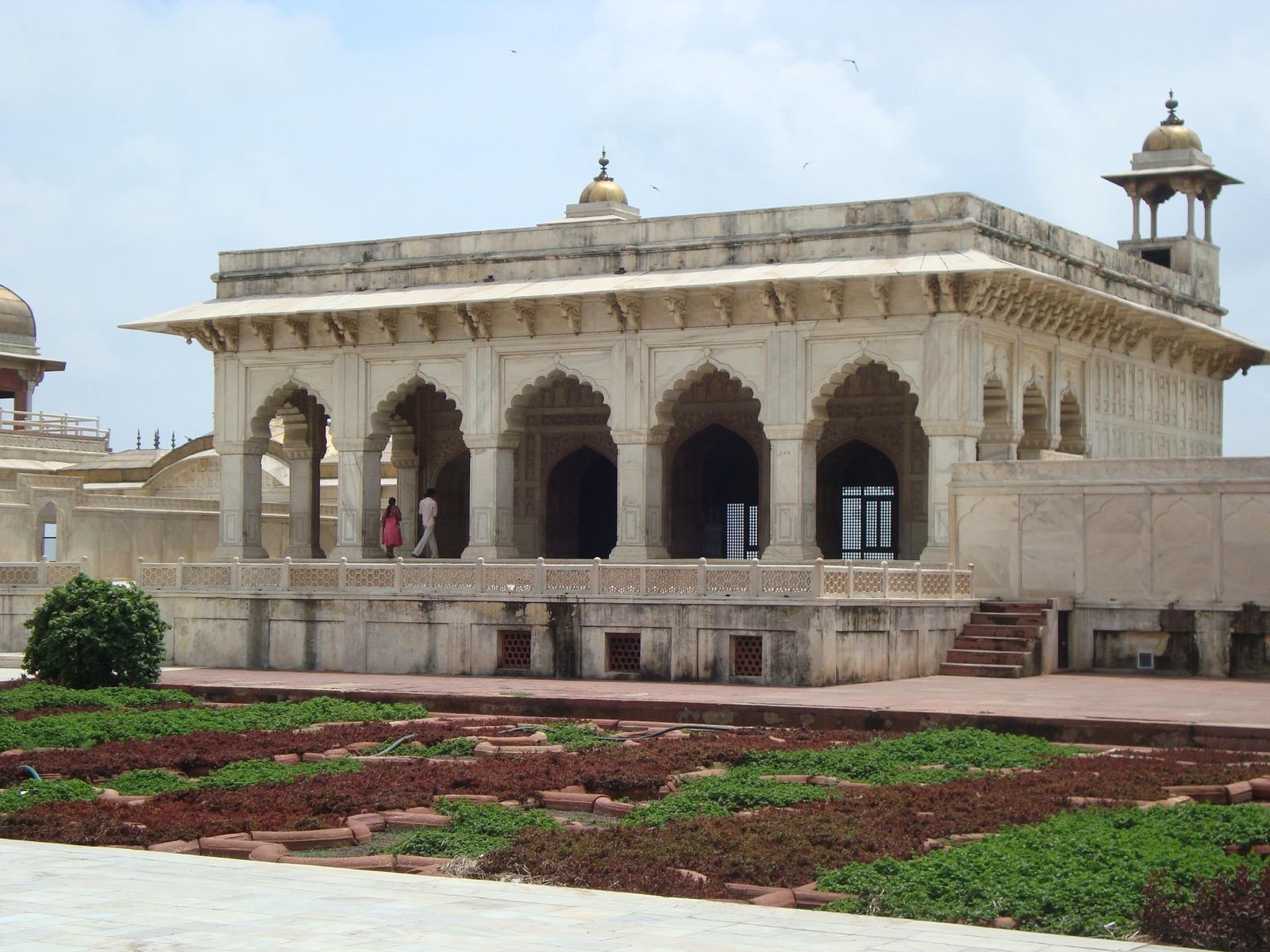
The Khas Mahal and the Anguri Bagh: The Marble That Replaced the Red
Shah Jahan's white marble riverfront palace overlooking a formal fourfold garden, where Mughal taste turns from red to white.
- 4
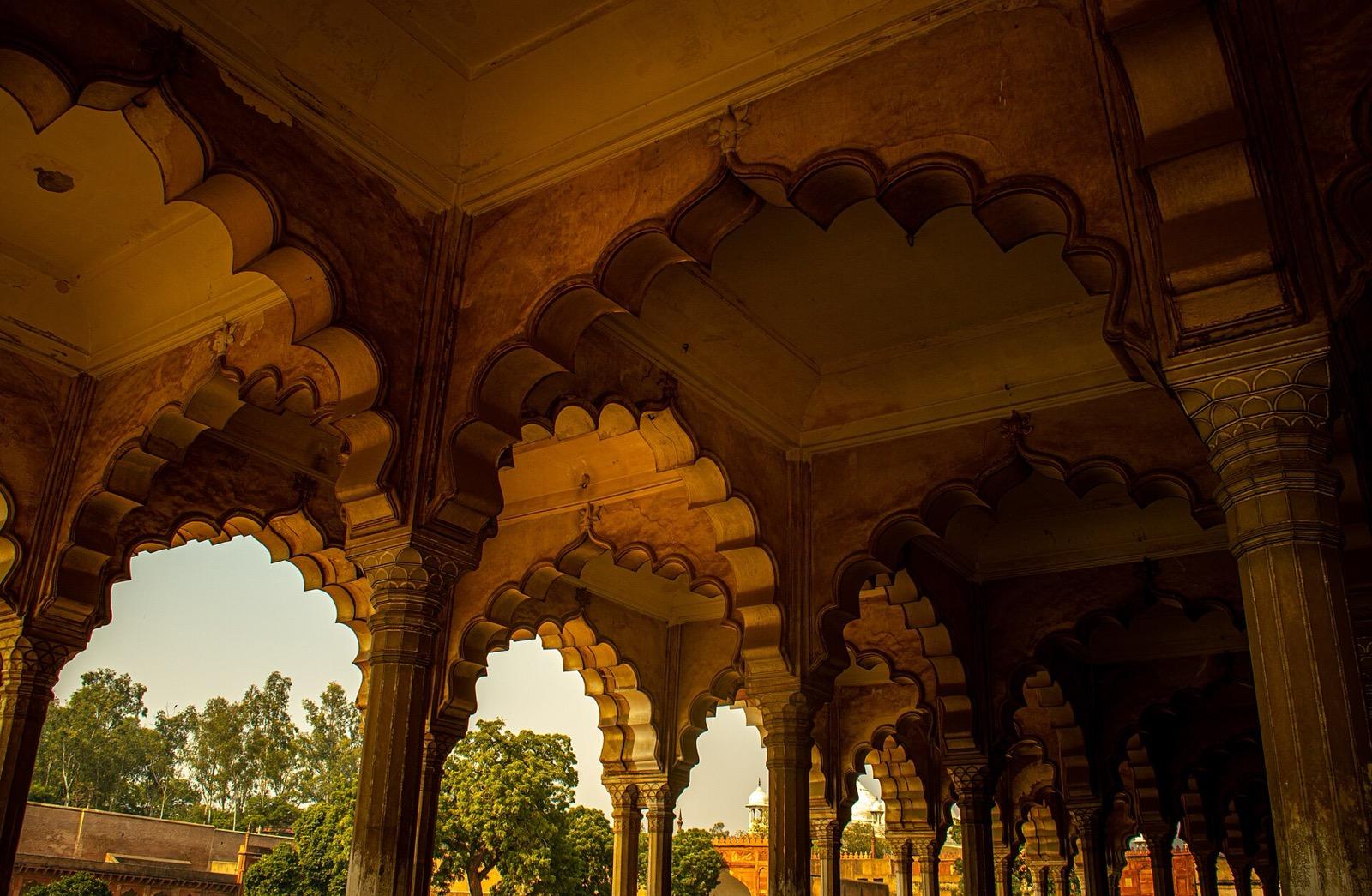
The Diwan-i-Am: The Hall of Public Justice Under the Red Walls
Shah Jahan's arcaded Hall of Public Audience, where the emperor heard petitions from a marble throne alcove.
- 5
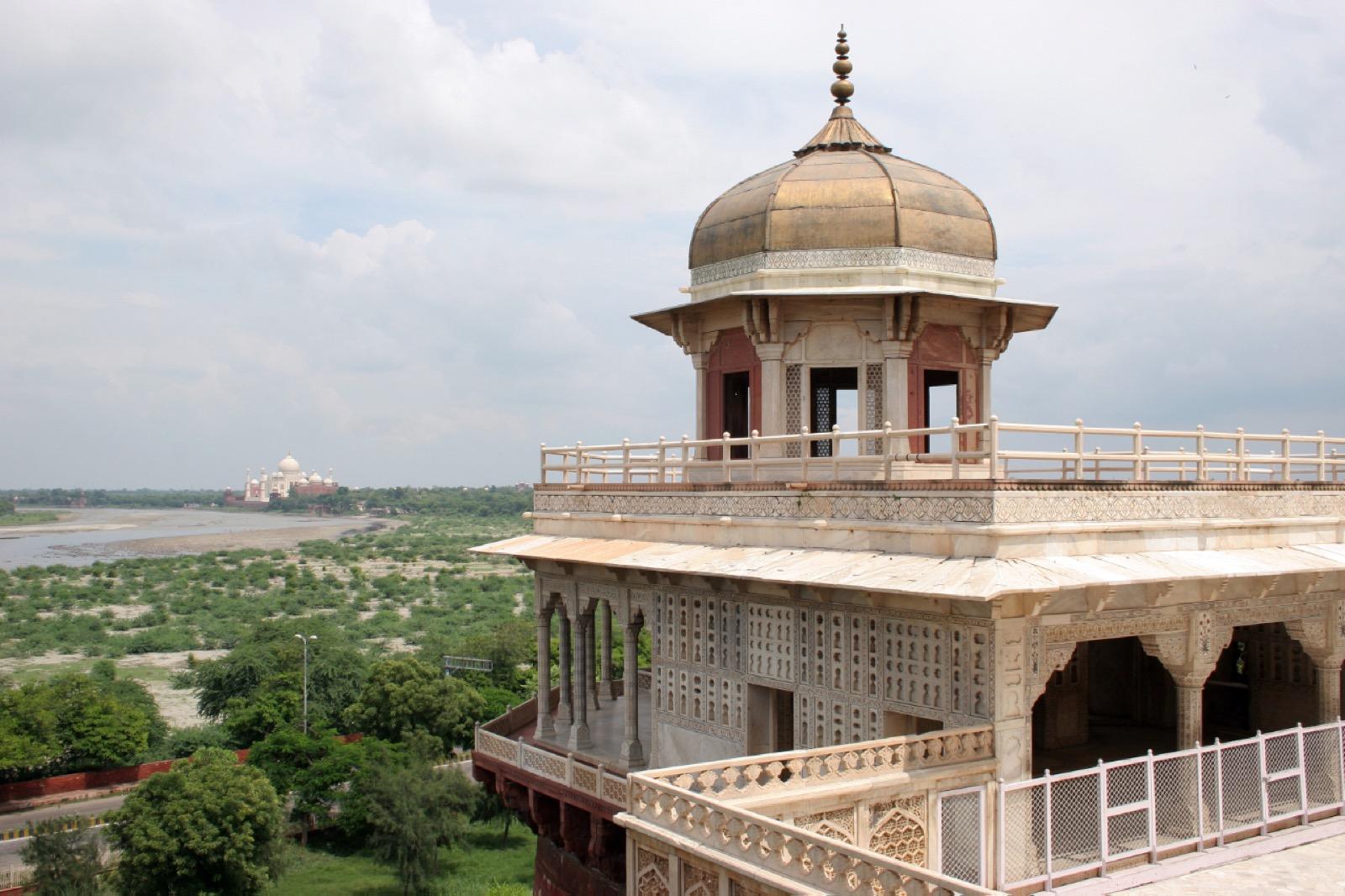
The Musamman Burj and the Diwan-i-Khas: The Tower Where an Emperor Was Jailed Within Sight of His Masterpiece
The octagonal white marble riverfront tower where Shah Jahan was imprisoned by his son, gazing downstream at the Taj Mahal.
- 6
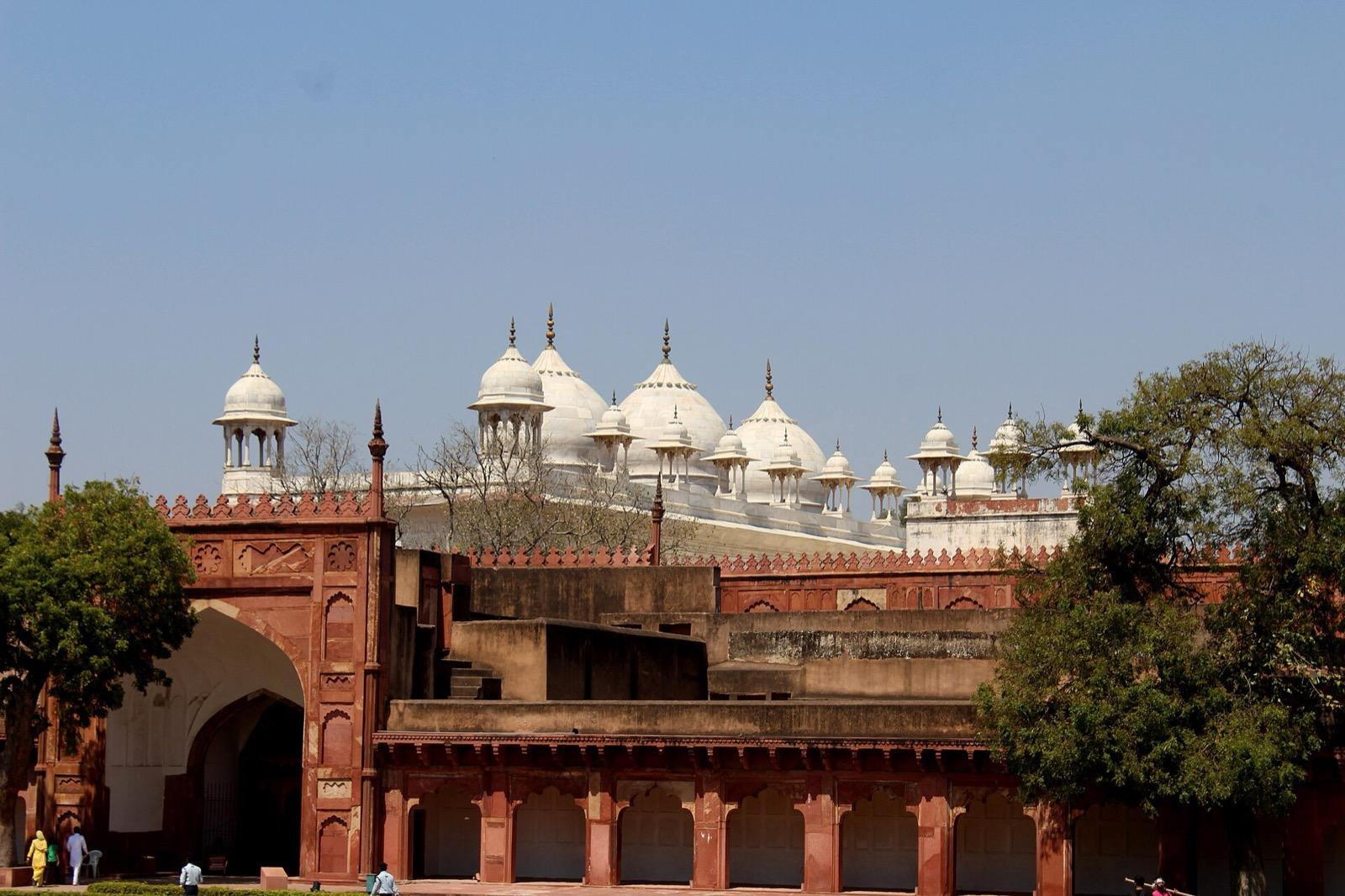
The Nagina Masjid and the Moti Masjid: The Gem and Pearl Mosques Hidden in the Red Fort
Two white marble mosques of Shah Jahan hidden within the red fort, one a private royal chapel, the other a serene congregational hall.
Details
Best Time to Visit
Go at opening or in the last hours before closing to dodge the heaviest crowds and the hardest sun. Early morning brings softer light on the red sandstone and cooler air on the exposed ramparts. From April to June the heat is severe with little shade, so October to March is far more comfortable for a walk of this length.
Pro Tips
- •Enter through the Amar Singh Gate, the southern visitor entrance, and follow the route inward and forward in time, red sandstone first, then the marble riverfront palaces.
- •Pause at the Musamman Burj for the river view Shah Jahan is said to have gazed at; on a clear day the Taj Mahal is visible downstream.
- •Carry small cash in rupees for the ticket and a bottle of water, since shade and refreshments inside the fort are limited.
- •This is your own map at your own pace, so decline the photo-touts and guide-touts politely and linger only where you want to.
- •Treat the Nagina Masjid and Moti Masjid as active places of worship, framing them modestly from the courtyard or exterior, and remember the Moti Masjid sits in a restricted zone and is usually viewed from outside.
- •Give yourself about ninety minutes for the full six stops, more if you want to sit with the marble screens rather than press on.
Safety & Precautions
- •Sun and heat are the main risk: much of the fort is open red sandstone with little shade, so carry water, wear a hat, and avoid the midday hours from April to June when heat is severe.
- •Expect big crowds along with persistent photo-touts and guide-touts; keep valuables secure, agree any service clearly in advance, and feel free to walk on at your own pace.
- •Security is tight and only limited bags are allowed inside, so travel light and check current entry rules before you arrive.
- •The riverfront tower and rampart edges are high and can be busy; watch your footing near the marble jali screens and open parapets, especially with children.
Travel advisory: Exercise Increased Caution (Level 2).
Gallery
Related Reading
Go deeper on what you'll see, hear, and walk through.
Overview
Agra Travel Guide: How Many Days, Getting Around, and Safety
6 min
Overview
Best Self-Guided Walking Tours in Agra (2026)
3 min
Overview
One Day in Agra: A Walkable Itinerary from the Taj Mahal to Agra Fort
5 min
Thematic
Agra: The Mughal Zenith Read Across a River
7 min
Thematic
Best History Walking Tours in Agra (2026)
2 min
Companion
The Marble Tower Where a Mughal Emperor Was Jailed by His Own Son
6 min
Deep dive
Jahangiri Mahal: Akbar's Red Palace Where Mughal and Rajput Built as One
6 min
Read
What to Eat in Agra: Petha, Bedai, and Mughlai Food
5 min
Read the walk
The full story of Agra Fort: The Red Sandstone Seat of Empire, in words. Prefer to listen? Play it narrated, from home or on location.
Introduction
Agra Fort, in the city of Agra in India, is the Mughal empire read as a single building. Its walls hold three reigns at once. The emperor Akbar rebuilt this fort in red sandstone from fifteen sixty-five, a fortress-city on the Yamuna river. Three reigns later his grandson Shah Jahan overwrote the red with white marble, and in one of those marble towers Shah Jahan ended his days a prisoner of his own son, gazing downstream at the Taj Mahal he had built. This tour follows that arc across six stops, moving inward and forward in time, layer by layer.
Expect to spend about ninety minutes and to cover roughly one and a half kilometres on foot, all inside a single site, so no vehicle is needed once you are through the gate. The six stops run from the bent southern gate, through Akbar's red palace, to Shah Jahan's marble apartments, his hall of public justice, the tower of his imprisonment, and the pearl and gem mosques hidden inside the red walls.
Agra Fort is one of the most tout-pressed and crowded monuments on earth, thick with guides and hawkers. This map is yours alone, on your own clock. Linger at the marble jali screens or press on, read the story reign by reign at your own pace, with no group van and no one steering you toward a shop. A good local guide can be fine company here, but nothing about this walk is scheduled around anyone but you. When you arrive at the Amar Singh Gate, the southern visitor entrance, begin with stop one.
1. The Amar Singh Gate and the Ramparts: A Gate Bent to Break a Charge
The way in is not straight, and that is the point. The Amar Singh Gate is the southern gate of Agra Fort, and its passage bends and doubles back on itself. This is a bent entrance, built so that attackers, war elephants and cavalry among them, could not charge straight through at speed. A crooked, angled approach breaks the momentum of any rush. Shah Jahan renamed this gate; it had been the Akbar Darwaza before him.
Around you rises the red sandstone that gives the fort its character. The emperor Akbar rebuilt Agra Fort here from fifteen sixty-five, and the work was completed by fifteen seventy-three. Britannica notes that about four thousand builders worked on it, daily, for some eight years, and that the walls form a roughly crescent-shaped enclosure running about two and a half kilometres and rising some twenty-one metres, about seventy feet, above a surrounding moat. UNESCO records that the site covers an area of some thirty-eight hectares, and that in nineteen eighty-three Agra Fort was inscribed as a World Heritage Site.
Standing at this threshold, you are entering not a single palace but a fortress-city, one that would be built and rebuilt across generations. This is where the red begins, the sober, muscular sandstone of a fortress designed to keep the world out. Over the coming stops that red gives way, slowly, to white marble, and the fortress that kept enemies out becomes, at its climax, a cage. Take the gate at your own pace. There is no group here hurrying you through, only the bend in the stone doing the same job it was cut to do, four and a half centuries ago.
2. The Jahangiri Mahal: Where the Mughal and the Rajput Built as One
This red-sandstone palace is the Jahangiri Mahal, and its name is a small puzzle. Despite carrying Jahangir's name, it was built by his father, the emperor Akbar. In his own memoirs Jahangir recorded that the buildings here were his father Akbar's work. It is one of the earliest surviving buildings of Akbar's reign, and one of the largest surviving palaces of his original fort.
Akbar built it as the principal zenana, the palace for the women of the royal household. According to the site's history it was raised for his Hindu chief queen, Mariam-uz-Zamani, popularly remembered as Jodha Bai, and it later housed Jahangir's wife, the mother of Shah Jahan. Look at how it is made. The red sandstone is worked with carved brackets, heavy beams, and courtyards whose forms echo Rajput and Gujarati building, the Hindu architectural traditions of the region, blended with the Central Asian and Islamic idiom the Mughals carried with them. Under Akbar, Mughal and Rajput built as one, in a single palace, in a single stone.
In the courtyard sits the Hauz-i-Jahangiri, a huge bowl carved from a single block of stone, which once held rose water for the household. This is the deep layer of the fort, Akbar's own century, the sixteenth. It is robust, grounded, and unmistakably red. Hold this palace in your mind as you move on, because within a single family's lifetime, grandfather to grandson, this taste will change utterly. The heavy red of Akbar's zenana will give way to the fine white marble of his grandson's riverfront rooms. Take your time in the shade of the brackets. This quiet corner tends to hold fewer of the crowds pressing at the marble stops ahead.
3. The Khas Mahal and the Anguri Bagh: The Marble That Replaced the Red
Here the stone changes colour. The Khas Mahal is Shah Jahan's private palace, and it is white marble, not red sandstone. He built it on the Yamuna riverfront, according to the site's history, in about sixteen thirty-one to sixteen forty. To the east it looks out over the river;…
Full narration for this stop unlocks with the tour.
4. The Diwan-i-Am: The Hall of Public Justice Under the Red Walls
This is the Diwan-i-Am, the Hall of Public Audience, where diwan means a hall of audience. Here Shah Jahan received the public and heard petitions. The hall is arcaded, built of red sandstone plastered smooth with shell-lime, and divided into three aisles by rows of arches and…
Full narration for this stop unlocks with the tour.
5. The Musamman Burj and the Diwan-i-Khas: The Tower Where an Emperor Was Jailed Within Sight of His Masterpiece
This is the heart of the story. The Musamman Burj is an octagonal white marble tower, and burj means tower; its name marks its eight sides. Shah Jahan built it on the Yamuna riverfront, according to the site's history, in about sixteen thirty-one to sixteen forty, beside the…
Full narration for this stop unlocks with the tour.
6. The Nagina Masjid and the Moti Masjid: The Gem and Pearl Mosques Hidden in the Red Fort
The walk ends with white marble turned to prayer. Here, tucked within the red fort, are two of Shah Jahan's mosques, and masjid means mosque. The first, near at hand, is the Nagina Masjid, the Gem or Jewel Mosque. It is a small mosque of pure white marble with three domes, built…
Full narration for this stop unlocks with the tour.