Old Town: Europe's Great Medieval Square
100 min · 1.5 km · moderate
Krakow's essential eating list is five things the city actually claims as its own: the obwarzanek krakowski (the boiled-then-baked ring sold from street carts), zapiekanka (an open-faced baguette with mushrooms and cheese), maczanka krakowska (slow-cooked pork in caraway sauce dunked into a roll), pierogi (filled dumplings), and a plate from a bar mleczny (a low-cost milk-bar cafeteria). Each dish has a traceable origin in the city or the surrounding region of Lesser Poland, and each one can be ordered at a counter without a reservation, a tip, or a fixed sitting. This guide walks through what to eat, where the tradition comes from, and how to order it the way people who live here do.
Start with the obwarzanek, Krakow's edible mascot
The single most Krakow thing you can eat is the obwarzanek krakowski, a chewy ring of dough that is braided from two strands, boiled, then baked and dusted with poppy seed, sesame, or salt. You will see them stacked on glass-fronted carts on nearly every corner of the Old Town. It is not a bagel and it is not a soft American pretzel, though it is related to both. The name comes from the Polish verb obwarzać, meaning to parboil, which describes exactly how it is made: the dough goes into hot water before it ever sees the oven.
The obwarzanek is not a loose folk snack. Since 2010 it has carried the European Union's Protected Geographical Indication, which means a ring can only be sold under that name if it is made in Krakow or the neighboring Wieliczka county, to a defined weight, shape, and process. The written record goes back much further: the ring is documented in Krakow court accounts from 1394, in the reign of King Wladyslaw the Second Jagiello and Queen Jadwiga. Buy one warm in the morning, because by afternoon they turn dense and dry. Expect to pay only a few zloty, and pay in coins.
There is a Jewish thread here too. A 1610 regulation from the Jewish Council of Krakow, written in Yiddish, mentions a ring-shaped bread given to women who had recently given birth, one of the earliest written records of what would later be called the bagel. Historians generally treat the Krakow obwarzanek and the early bagel as close cousins from the same milieu rather than the same object, so the honest framing is kinship, not a single invention. You can trace that shared world on foot in the old Jewish quarter, Krakow's Kazimierz district walking tour.
Zapiekanka at Plac Nowy, the city's late-night staple
Hear a stop from this walk
The Cloth Hall: Seven Centuries of Market
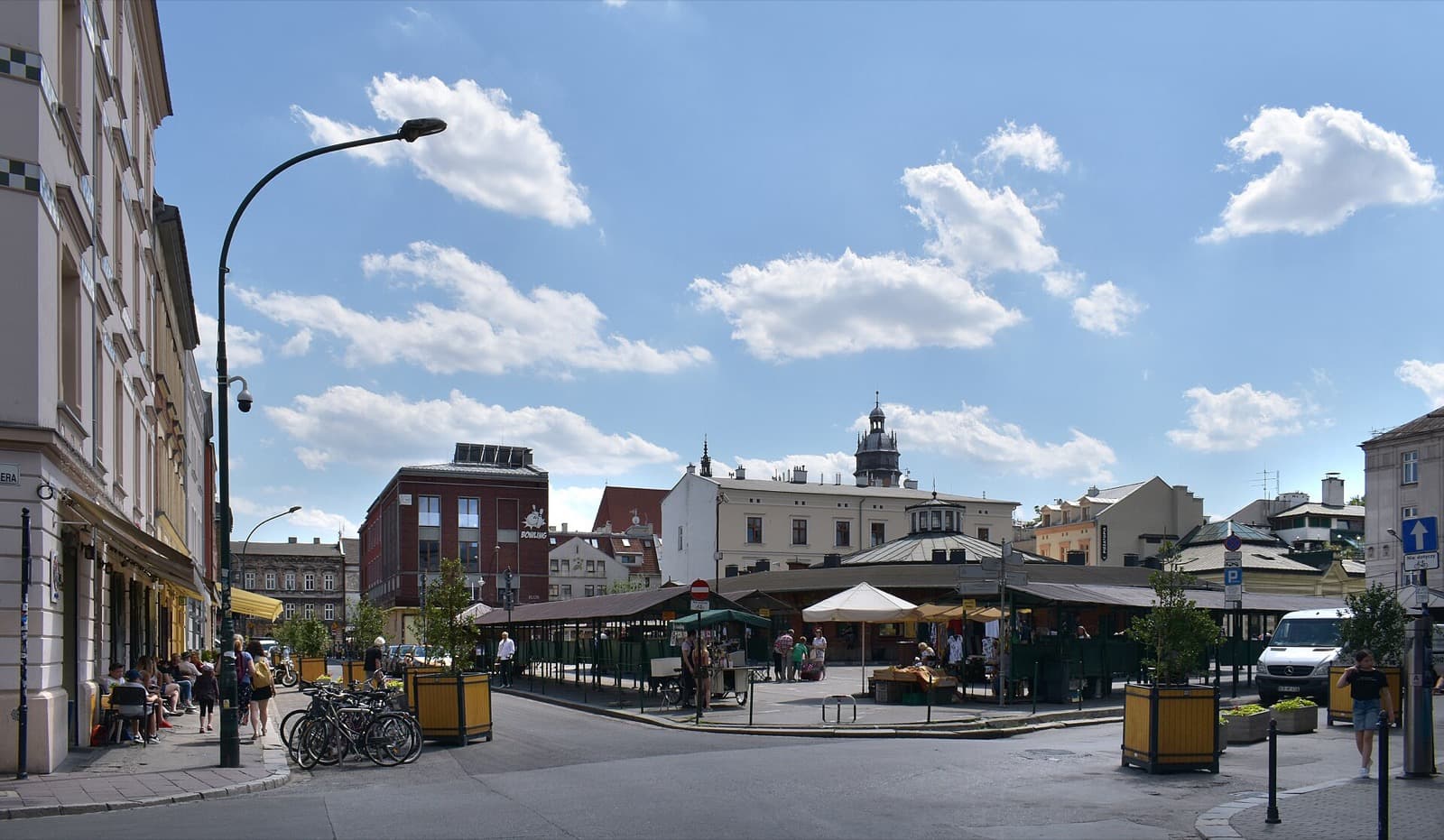
The dish most tied to a single spot is the zapiekanka, a long baguette split lengthwise, topped with sauteed mushrooms and melted cheese, then finished with ketchup and whatever else you point at. Its home is Plac Nowy in Kazimierz, and specifically the round brick building at the center of the square that locals call the Okraglak, meaning the little round one. That rotunda was built in 1900 as a market hall and served in the 1920s as a kosher poultry slaughterhouse for the Jewish community before it became the ring of food stalls it is today.
The zapiekanka itself is a product of the communist decades, a cheap hot meal that appeared on Polish streets in the 1970s and spread fast once private catering was loosened. Order at the hatch, say your toppings, and eat it standing up or perched on the square. It is best late, after the bars empty out, which is when the Okraglak windows do their real business. Plac Nowy is one of the stops on the Kazimierz route in our Krakow walking tours, so you can fold a zapiekanka into the walk itself.
Maczanka krakowska, the dunked pork roll
For something older and more distinctly Krakovian, look for maczanka krakowska. This is slow-cooked pork neck or loin, roasted and stewed soft in a caraway-scented sauce, then piled into a bread roll that has first been dunked into that same sauce. The name comes from maczac, to dunk, and the dunking is the whole point: the roll is meant to be wet and heavy with gravy.
The dish is old. Regional food sources describe it as known in Krakow by around the sixteenth century and a favorite of the city's carriage drivers, who needed something filling they could eat with one hand, though other accounts date its popularity to the nineteenth century, so take the earliest dating as tradition rather than settled fact. Food writers like to call it an ancestor of the modern hamburger, which is a nice line as long as you treat it as folklore rather than proven lineage. You will find it at street-food stands and a handful of dedicated spots rather than at every corner, so it is worth seeking out. Ask for it "z sosem," with sauce, and lean over your plate.
Pierogi and a milk-bar lunch, the everyday core
No Krakow eating list is complete without pierogi, the filled dumplings that count as one of Poland's national dishes. The dough is unleavened and the fillings run both savory and sweet. The classic to order first is pierogi ruskie, filled with potato, soft twarog cheese, and fried onion. The name means Ruthenian, not Russian, and points to the historical region straddling today's southeastern Poland and western Ukraine, not to Russia. Other common versions come stuffed with minced meat, with sauerkraut and mushroom, or, in summer, with fruit and a dusting of sugar. They are usually served boiled with a spoon of fried onion or bacon on top, though you can ask for them pan-fried (odsmazane) for crisp edges.
The cheapest and most local way to eat pierogi and the rest of the Polish canon is in a bar mleczny, a milk bar. These are no-frills cafeteria counters named for the dairy and egg dishes that filled the menu when meat was scarce and rationed. The very first Polish milk bar opened in Warsaw in 1896, but the format spread across the country as a government-subsidized way to feed working people, and the first post-war, state-run milk bar opened on Krakow's Main Market Square on 30 May 1948. A few hundred survive nationwide today, many still partly subsidized and still cheap. Ordering takes nerve: read the board, decide fast, pay at the register, then carry your receipt to a second window to collect the food. Menus are often Polish-only, so learn a few words or point. Portions are large and the bill is small. The Main Market Square where that Krakow milk bar opened is the centerpiece of the Krakow Old Town self-guided tour.
Two regional extras worth chasing: oscypek and Galician flavors
Two things you will see that come from the mountains south of the city rather than Krakow proper. The first is oscypek, a hard, smoked, spindle-shaped cheese made from salted sheep's milk in the Tatra highlands. It has held EU Protected Designation of Origin status since 2007, must be at least sixty percent sheep's milk, and can only be produced in the warm months from late spring to early autumn, when the flocks graze fresh grass. Street grills often serve it warm with a spoon of cranberry, which is a tourist-era pairing but a genuinely good one on a cold day. The second thread is Galician and Jewish cooking that survives in Kazimierz restaurants, a legacy of the region's long Austro-Hungarian and Jewish history. Treat those menus as a living record of a community, and read the honest, non-alarming history of the quarter before you sit down.
A word on practicalities: Krakow is a safe, walkable city for eating, and the Old Town and Kazimierz are compact enough to graze between stops. Carry small cash for carts and milk bars even though cards are widely accepted at restaurants, watch your bag in the busiest square crowds as you would anywhere, and note that many milk bars close by mid-evening while zapiekanka windows run late. Prices, hours, and seasonal items shift, so treat any specific number as a rough guide and confirm on the spot.
Sources
Frequently asked questions
- What food is Krakow famous for?
- Krakow is famous for the obwarzanek krakowski, a boiled-then-baked ring of bread sold from street carts that holds EU Protected Geographical Indication status. Other signature foods include zapiekanka (an open-faced baguette with mushrooms and cheese) sold at Plac Nowy in Kazimierz, maczanka krakowska (slow-cooked pork in a roll), pierogi dumplings, and cheap meals from milk-bar cafeterias.
- Is obwarzanek the same as a bagel?
- No. The obwarzanek krakowski is a braided ring of dough that is parboiled and then baked, sold fresh from Krakow street carts. It is related to both the bagel and the pretzel but is a distinct product with EU Protected Geographical Indication status. A 1610 Jewish Council of Krakow record mentions a ring-shaped bread that is one of the earliest written references to what became the bagel, so the two are close cousins rather than the same food.
- Where do you eat zapiekanka in Krakow?
- The most famous place is Plac Nowy in the Kazimierz district, where food stalls fill the round brick building known as the Okraglak. That rotunda was built in 1900 as a market hall and later served as a kosher poultry slaughterhouse before becoming a ring of zapiekanka stalls. The windows are busiest late at night.
- What is a Polish milk bar and how do you order in one?
- A bar mleczny, or milk bar, is a low-cost cafeteria. The first Polish milk bar opened in Warsaw in 1896, but the format spread most widely as a government-subsidized way to feed working people during the communist era. The first post-war, state-run milk bar opened on Krakow's Main Market Square on 30 May 1948. To order, read the board, pay at the register, then take your receipt to a collection window. Menus are often Polish-only, portions are large, and prices are very low.
- What kind of pierogi should I order first in Krakow?
- Start with pierogi ruskie, filled with potato, soft twarog cheese, and fried onion. The name means Ruthenian, referring to a historical region in today's southeastern Poland and western Ukraine, not Russia. They are usually served boiled with onion or bacon on top, and you can ask for them pan-fried (odsmazane) for crisp edges.
- Is oscypek cheese from Krakow?
- Not exactly. Oscypek is a smoked, spindle-shaped cheese made from salted sheep's milk in the Tatra highlands south of Krakow, not in the city itself. It has held EU Protected Designation of Origin status since 2007, must contain at least sixty percent sheep's milk, and is produced only in the warm months. In Krakow you will often find it grilled and served warm with cranberry.
Ready to experience it?
Old Town: Europe's Great Medieval Square
100 min · 1.5 km · moderate
More from Krakow
Explore more at your own pace.
Krakow: The Great Square, the Coronation Hill, and the Quarter That Survived
Rynek Glowny: Why Krakow's Main Market Square Is the Whole Tour
The Remuh Synagogue and Cemetery: Kazimierz's Wall of Broken Headstones
Plac Nowy and the Okrąglak: The Round Hall Where Kazimierz Still Gathers
St Mary's Basilica in Krakow: The Trumpet That Stops Mid-Note