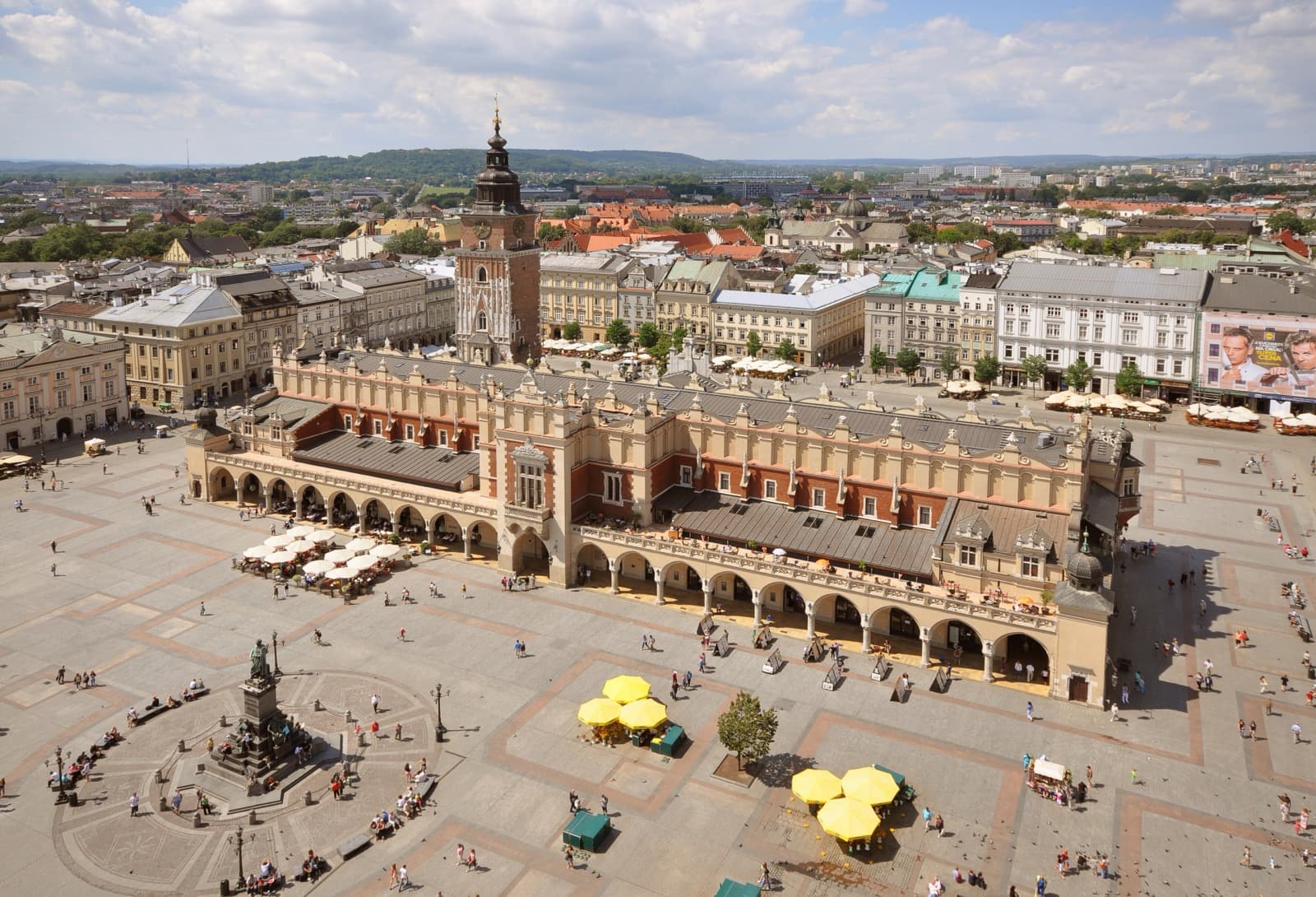
Krakow's Main Market Square, the Rynek Glowny, survives as the intact center of a medieval plan that escaped the wartime destruction most Central European cities suffered, and once you read the square correctly it stops being one photograph among many and becomes the key to the whole Old Town walk. The square is not a monument dropped into a modern grid. It is the grid. Everything you pass on the Royal Route, from the round Barbican in the north to the courtyard where Copernicus studied in the west, was laid out to serve this open ground, and it is still doing its job.
A room, not a sight
Start with a fact from UNESCO's own listing for the Historic Centre of Krakow: the city has Europe's largest medieval market square. The Rynek Glowny measures roughly two hundred metres on each side, on the order of forty thousand square metres of open cobblestone. That scale was a decision, not an accident. The square was laid out after Krakow received its town charter under Magdeburg law in twelve fifty-seven, granted by Prince Boleslaw the Chaste in the years after the Mongol invasion of twelve forty-one had swept through and forced the town to rebuild.
The rebuild produced a strict street grid running off a single great central square. That grid set the shape of the entire Old Town, which is why the walk feels so orderly on the ground. When you come down Florianska Street from the city gate, you are inside the twelve fifty-seven plan the whole way. The streets do not wander. They aim at the square.
What makes the square extraordinary is not only its age but its survival. Krakow was spared the destruction that flattened Warsaw during the Second World War, so the medieval plan survives almost whole. Stand in the middle and the arithmetic is simple: you are inside a nearly eight-hundred-year-old room, still laid out as it was designed, ringed by townhouses and palaces on all four sides. In most of Europe that sentence would be a reconstruction claim. Here it is literal.
What fills the room
Hear a stop from this walk
The Cloth Hall: Seven Centuries of Market
The square is legible because its major pieces each carry one clear idea, and the tour is built to let you read them in order. Down the middle runs the Cloth Hall, the Sukiennice, a long low arcaded building that has been a covered market for the better part of seven hundred years. Its origins lie in a cloth market on this spot around thirteen fifty-eight. After a fire it was rebuilt in Renaissance form, completed in fifteen fifty-nine, which is largely the building you see, with its decorative parapet and the carved stone faces along the roofline. Walk through the ground-floor arcade and it is still doing what it was built to do, lined with stalls. Above, on the upper floor, the Sukiennice Gallery holds the country's great collection of nineteenth-century Polish painting, opened in eighteen seventy-nine. The hall carries two lives at once: everyday commerce below, national art above, in the century when Poland had been wiped off the map.
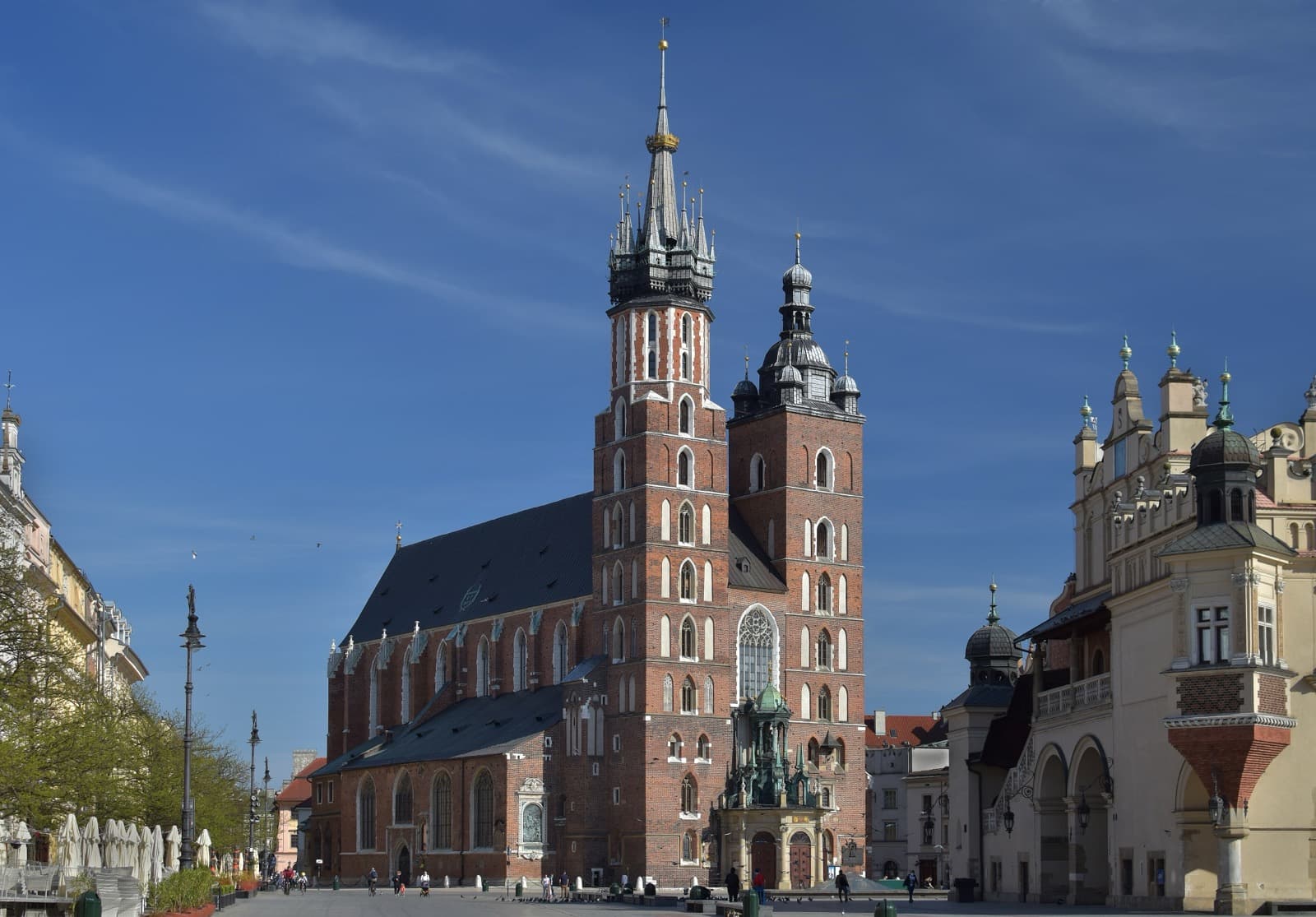
To the northeast corner rise the two brick towers of St Mary's Basilica, the Kosciol Mariacki, founded in the early twelve twenties and rebuilt in the fourteenth century. The towers are deliberately unequal, the taller rising about eighty metres. Inside is the Veit Stoss altarpiece, carved between fourteen seventy-seven and fourteen eighty-nine, the largest Gothic altarpiece in the world: about thirteen metres high with more than two hundred carved figures. Every hour a trumpeter plays the hejnal from the taller tower and it breaks off mid-note. The story that the tune stops to honour a trumpeter shot in the throat by a Mongol arrow is a legend, popularized by an American novel published in nineteen twenty-eight, not documented history. The call itself is entirely real, played live, every hour.
Then there is the single tall tower on the southwest side, the Town Hall Tower, and it is the one piece of the square that speaks of loss. It is all that survives of Krakow's medieval town hall, the seat of civic self-government, the rest of which was demolished in eighteen twenty when the city cleared it to open up the Main Square. That was decades after the Partitions of Poland, when the city's affairs had already passed out of Polish hands. About seventy metres tall, it leans by roughly fifty-five centimetres after a storm in seventeen oh three. In a square otherwise full of what remains, this tower marks what was lost.
Why the square is the argument
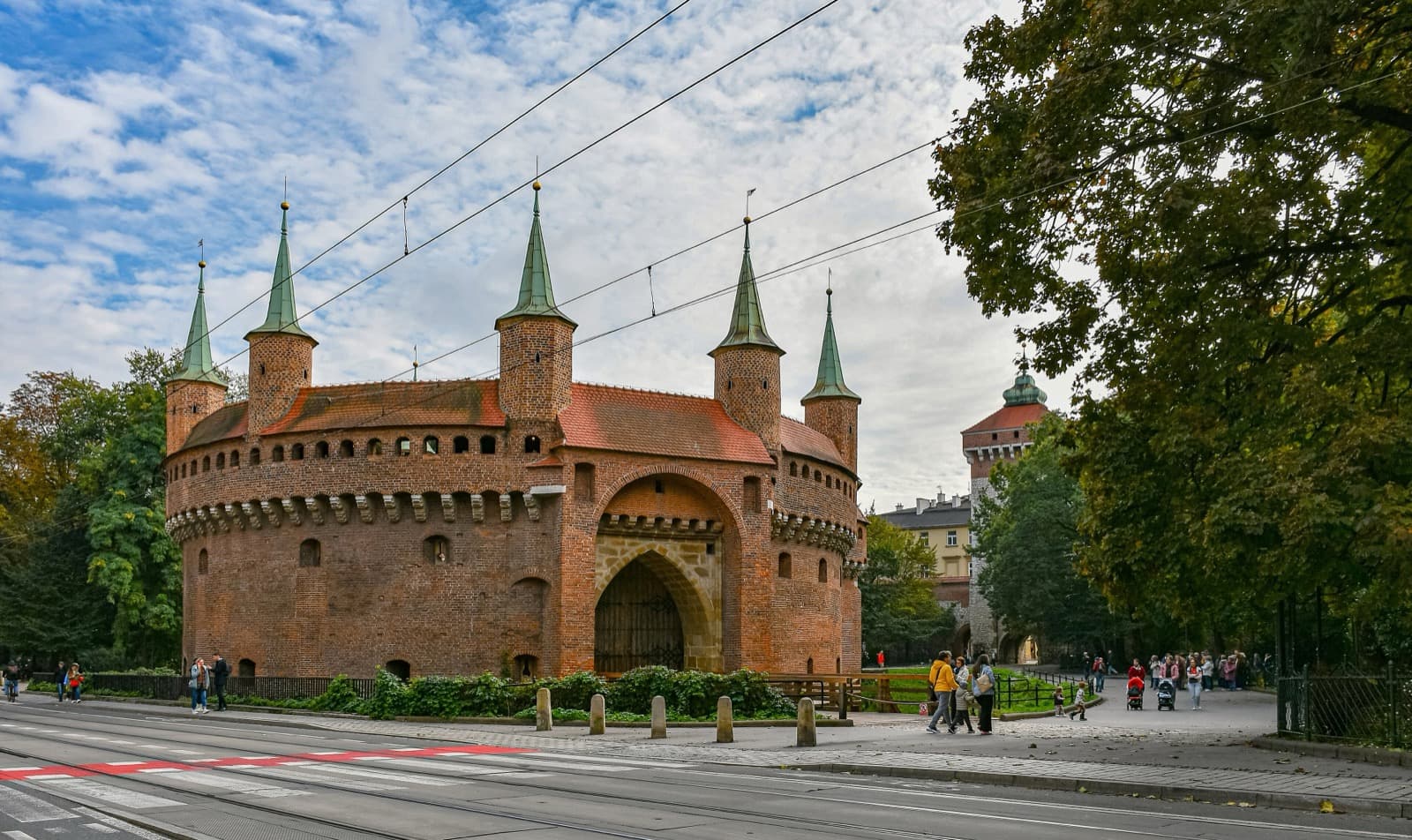
Read those pieces together and the square tells you what the whole walk is about. This is a city that kept its shape. The Barbican and St Florian's Gate at the north end survive only because Professor Feliks Radwanski argued in eighteen seventeen to spare that stretch of wall when the Austrian emperor's order to pull down the fortifications was being carried out. The town hall did not get its Radwanski, so only its tower stands. The square itself, the Cloth Hall, and the great church came through the twentieth century intact where Warsaw did not. Krakow's history is a long negotiation between what a city loses and what it manages to keep, and the Rynek Glowny is where you can see both at once.
That is also why the square rewards the thing a group tour cannot give you: time. UNESCO calls it Europe's largest, but the useful measure is that it asks nothing of you. You can sit as long as you like. No group is waiting, no clock runs but your own. You can catch the hejnal on your own hour, stand under the altarpiece in your own silence, and walk the Cloth Hall arcade at whatever pace suits you.
The tour ends a short walk west, at the Collegium Maius, the oldest surviving building of the Jagiellonian University, founded in thirteen sixty-four by King Casimir the Great. Nicolaus Copernicus studied there in the fourteen nineties, under the arcades of its quiet courtyard. That ending is not a detour from the square's argument. It completes it. The square is the city's commerce and faith and government in one open room; the courtyard is its mind. Together they make the case that Krakow's deepest legacy was never only its kings and towers.
If you want the fuller route, the seven stops run as a natural line north to south and then west, and you can plan the day from our Krakow walking tours hub. Come to the square first, though, and give it an hour before you decide what else you want to see. It will tell you what the rest of the walk means.
Sources
- UNESCO World Heritage Centre, Historic Centre of Krakow (inscription no. 29): confirms the 1978 inscription and the description of Krakow's main square as the largest medieval town square of any European city.
- Wikipedia, "Main Square, Krakow": the square's area, the twelve fifty-seven Magdeburg-law charter granted by Boleslaw the Chaste, the twelve forty-one Mongol invasion, and the surrounding grid plan.
- Wikipedia, "St. Mary's Basilica, Krakow" and "Veit Stoss altarpiece in Krakow": the church's early-thirteenth-century founding, the eighty-metre tower, the altarpiece dates and scale, and the 1928 novel behind the hejnal legend.
- Wikipedia, "Krakow Cloth Hall": the mid-fourteenth-century market origin, the 1559 Renaissance rebuild, and the 1879 gallery opening.
- Wikipedia, "Town Hall Tower, Krakow" and "St. Florian's Gate": the 1820 demolition of the town hall to open the square, the tower's lean, and Feliks Radwanski's 1817 effort to save St Florian's Gate and the Barbican.
Ready to experience it?
Old Town: Europe's Great Medieval Square
100 min · 1.5 km · moderate
More from Krakow
Explore more at your own pace.
Krakow Travel Guide: Days, Transport, Timing, and Safety
Krakow: The Great Square, the Coronation Hill, and the Quarter That Survived
The Remuh Synagogue and Cemetery: Kazimierz's Wall of Broken Headstones
Plac Nowy and the Okrąglak: The Round Hall Where Kazimierz Still Gathers
St Mary's Basilica in Krakow: The Trumpet That Stops Mid-Note