The Dragon's Den beneath Wawel Hill in Krakow is a real limestone cave that carries Poland's oldest surviving legend, first written down in the thirteenth century, and now marked at its mouth by a bronze dragon that breathes actual fire beside the Vistula. Most visitors climb Wawel for the cathedral where kings were crowned and the Renaissance palace above it. Fewer understand that the hill's most-repeated story does not live at the top, in the tombs and the golden dome, but at the bottom, in a hole in the rock by the river. The cave is called Smocza Jama, and standing at its dark entrance is the one moment on Wawel where documented history and national folklore occupy the exact same address.
A genuine cave, not a stage set
Start with the geology, because it is easy to assume the den is a modern invention built for children. It is not. Smocza Jama is a natural limestone cavern in the flank of the same Jurassic outcrop that holds the castle, rock formed roughly one hundred and sixty million years ago. The cave runs some two hundred seventy-six metres through the hill, though only about eighty-one metres are open to the public along the tourist route. You enter through a turret set into the Vistula-side defensive wall, descend a spiral stair cut through the stone, and come out near the water at the foot of the bluff.
That descent is the whole point of putting the den last on a walk of Wawel. The cathedral and the treasury sit at the crown of the hill, at the level of coronations and state. The cave sits at the level of the river, at the level of the story parents tell their children. Poland's most solemn ground and its most beloved fairy tale share one hill, separated only by the climb.
The story, told as a story
Hear a stop from this walk
Wawel Cathedral: Where Kings Were Crowned and Laid to Rest
The legend belongs to the earliest layer of Polish memory. In the reign of the mythical King Krak, the founder-figure whose name the city of Krakow carries, a man-eating dragon was said to live in this cave, terrorizing the settlement above. The tale was first put into writing by Bishop Wincenty Kadlubek in his chronicle in the thirteenth century, which makes it one of the oldest recorded Polish legends still in wide circulation.
Kadlubek's version is not the one most Poles grow up on. Over the following centuries the story acquired a hero, and in the popular later versions that hero is a humble shoemaker, often named Skuba. The detail worth carrying into the cave is how the dragon dies, because it is not by the sword. Skuba does not fight the beast. He fills an animal hide with smouldering sulphur and leaves it out as bait. The dragon swallows it whole, and the burning sulphur lights an unquenchable thirst. The creature drinks and drinks from the Vistula until it swells and bursts. A monster undone not by a knight's strength but by a craftsman's trick: that is a very particular kind of national hero, and it says something about the culture that kept the tale.
None of this is presented as history, and it should not be. The cave is real; the dragon is folklore. Holding those two facts at once is the correct way to stand at Smocza Jama, and it is exactly how the Wawel narrative frames it.
The bronze dragon that actually breathes fire
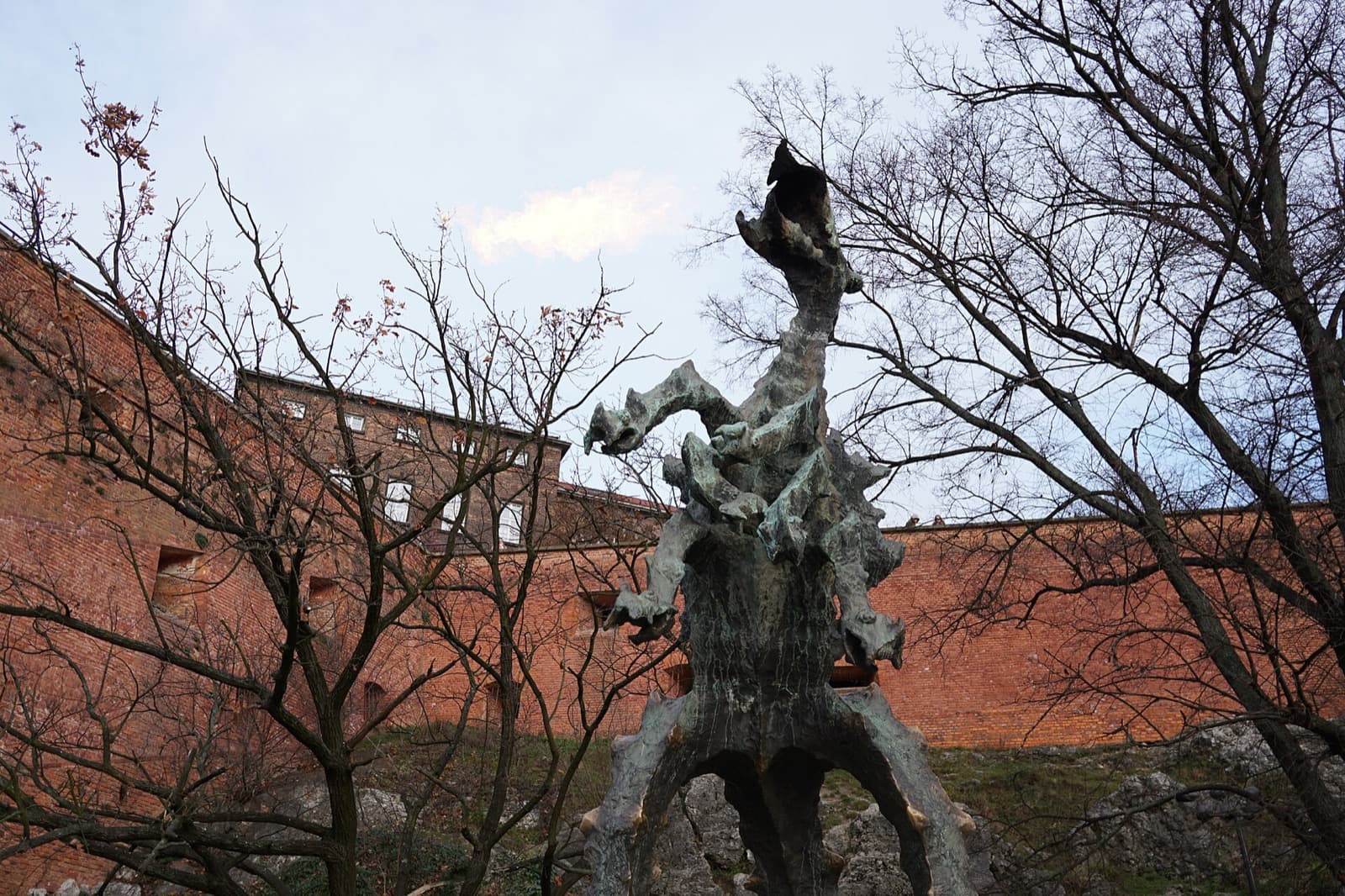
At the cave mouth, beside the river, the legend gets a modern body. A bronze dragon by the Polish sculptor Bronisław Chromy stands here, completed in 1969 and installed on the riverbank in 1972. It is a substantial piece of public art, roughly six metres tall, and its form rewards a second look. What appear to be raised arms are in fact long necks: the sculpture carries seven heads in total, one large and six smaller, a design detail that most passersby never register.
Then there is the fire. Every few minutes a natural-gas nozzle in the dragon's jaws sends a burst of real flame into the air, several feet high, to the reliable delight of every child within sight. The mechanism has been modernized so that the flame can also be triggered by an SMS text message, at intervals of at least fifteen seconds. It is a rare thing: a piece of civic sculpture that a visitor can operate from a phone, honouring a legend more than seven centuries old.
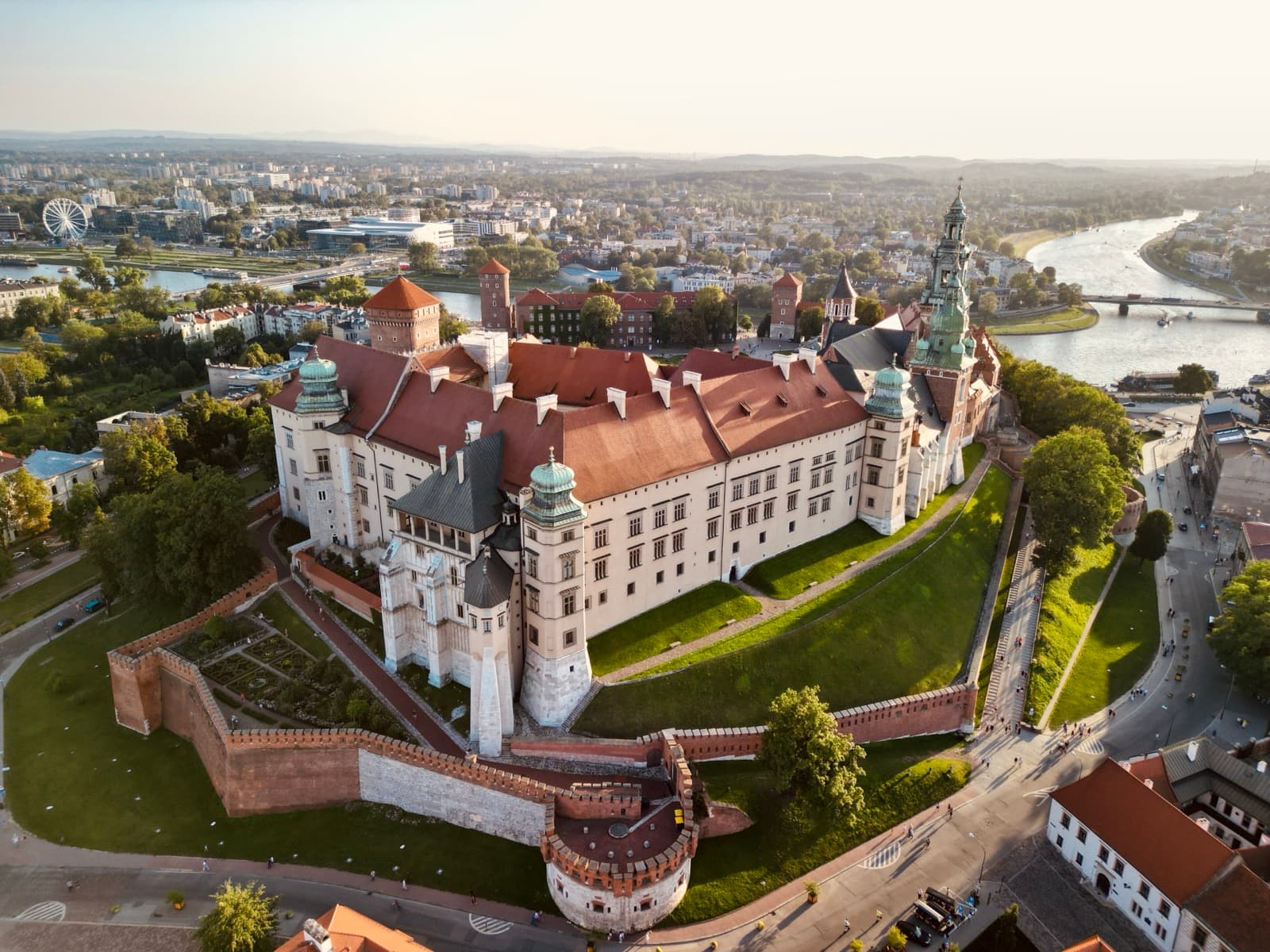
Stand here for a moment before you leave. Behind and above you rise the cathedral and the palace, the coronation church, the royal tombs, the notched sword of the crown jewels. In front of you the Vistula runs on toward the sea. And at your side, a dragon still breathes fire over the water. Few cities close their most important hill on a note this playful, and Krakow does it on purpose. The kingdom's grandest ground ends at a fairy tale, because the fairy tale is as much a part of the place as the kings ever were.
Practical notes for standing here
The bronze dragon is free, outdoors, and reachable at any hour along the riverbank path below the hill. The cave itself is ticketed, seasonal, and reached by that enclosed spiral stair, so it is worth confirming it is open before you plan to end your walk inside it. Some visitors find the stair tight. If the den is closed, the statue alone still delivers the ending the hill was built toward.
The best way to reach the den is to walk down to it from the top, in the order Wawel was meant to be read: cathedral, bell, chapel, courtyard, treasury, and then the river. Our self-guided audio tour, Wawel: The Hill Where Poland Was Crowned, takes that exact path across seven stops and about ninety minutes, entirely at your own pace, with no group and no fixed entry slot pulling you along. It saves the Dragon's Den for last on purpose, so you finish at the water with the palace and cathedral rising behind you and a fire-breathing dragon at your side.
For more ways to explore the city on foot, see our guide to Krakow walking tours.
Sources
- Wawel Dragon (statue), Wikipedia. Height, seven-head design, 1969 completion and 1972 installation, and the SMS-triggered flame mechanism.
- Smocza Jama, Wikipedia. Cave dimensions, the Vistula-side turret entrance, and the folklore first recorded by Wincenty Kadlubek in the thirteenth century.
- Dragon's Den (Smocza Jama), VisitMalopolska official tourism portal. Visitor route, seasonal access, and the cave's place at the foot of Wawel Hill.
- Historic Centre of Krakow, UNESCO World Heritage Centre. Context for Wawel Hill's inscription among the first World Heritage Sites in 1978.
Ready to experience it?
Wawel: The Hill Where Poland Was Crowned
90 min · 1.5 km · moderate
More from Krakow
Explore more at your own pace.
Krakow Travel Guide: Days, Transport, Timing, and Safety
Krakow: The Great Square, the Coronation Hill, and the Quarter That Survived
Rynek Glowny: Why Krakow's Main Market Square Is the Whole Tour
The Remuh Synagogue and Cemetery: Kazimierz's Wall of Broken Headstones
Plac Nowy and the Okrąglak: The Round Hall Where Kazimierz Still Gathers