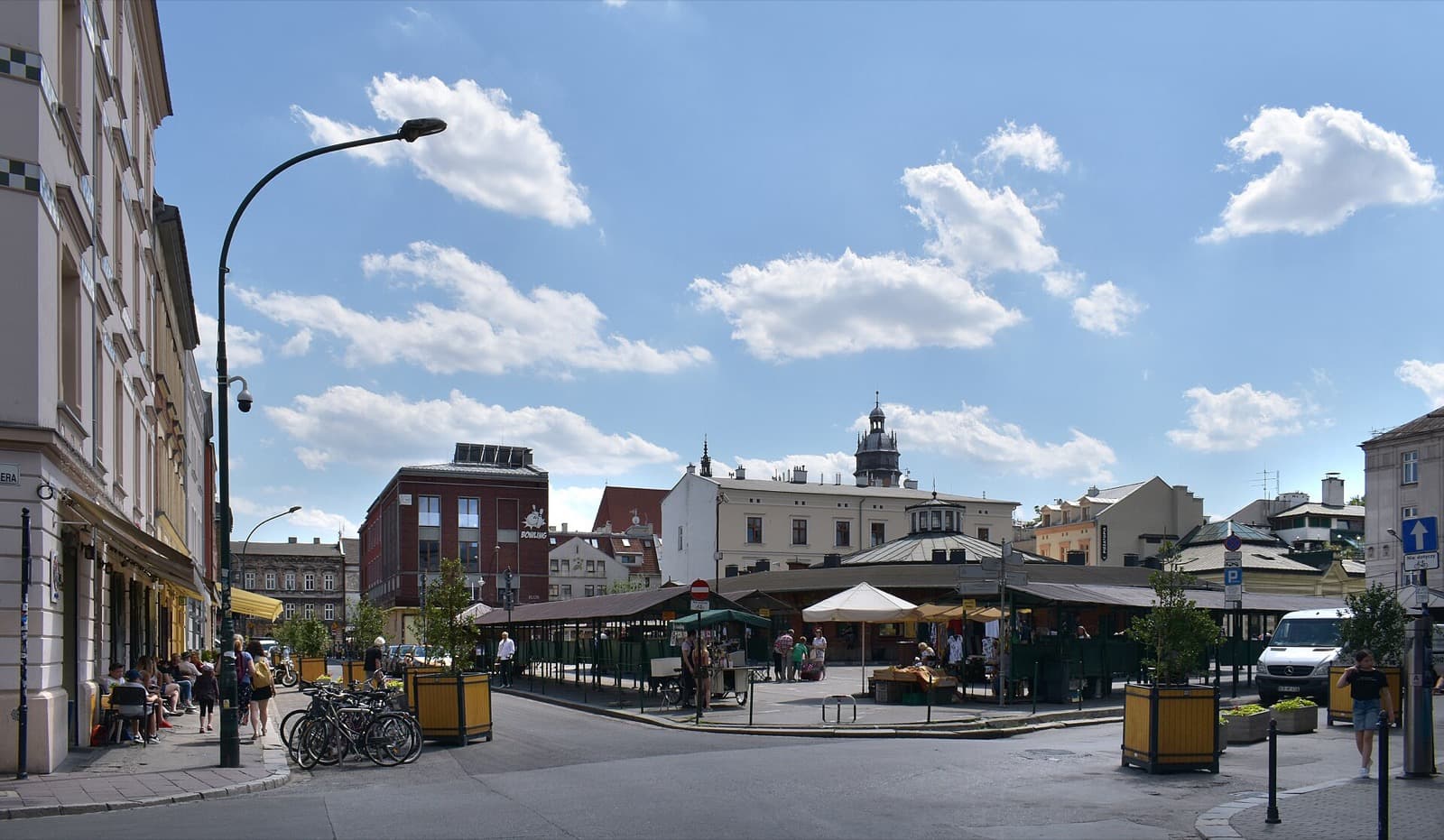
The Okrąglak is the twelve-sided brick market hall at the center of Plac Nowy in Krakow's Kazimierz. Designed in 1899 and opened in 1900, it became a Jewish ritual poultry slaughterhouse in 1927. Today its outer wall's serving windows sell zapiekanki, and Plac Nowy remains Kazimierz's living center with markets, a weekend flea market, cafes, and bars.
The Okrąglak, the round brick market hall at the center of Plac Nowy in Kazimierz, carries the whole story of the old Jewish quarter of Krakow in a single building. It began as a poultry slaughterhouse run by the Jewish community, it survived the destruction of the people who used it, and it became the hall around which daily life in Kazimierz still gathers. Stand at the edge of the square, look at the low round hall in the middle, and you are looking at the quarter's memory and its present life pressed into the same walls.
What you are actually looking at
Plac Nowy means the New Square, and for a place named "new" it is very old in habit. It has long been a hub of ordinary daily life in Kazimierz, and for generations locals called it Plac Żydowski, the Jewish Square, because it was the main marketplace of the Jewish district. The building at its center is the Okrąglak, a name that simply means "the round one." It is not a perfect circle. It is a twelve-sided masonry structure of brick and stone, designed in 1899 and opened in 1900 as a market hall. The design is usually credited to Jan Rzymkowski, though some sources name Władysław Klimczak, so the exact hand behind it stays a little uncertain. What is not uncertain is the shape and the intent: a compact ring of commercial stalls wrapped around an inner hall, built to concentrate the trade of a busy quarter into one tidy rotunda.
The detail that matters most, the one thing to understand while standing in front of it, is what happened to this hall in 1927. That year it passed into the hands of the Krakow Jewish community, and the round building was turned into a ritual poultry slaughterhouse, with a different butcher working each quarter of the plan. This was not a monument. It was a working engine of everyday Jewish life, the place a household went to have a chicken killed according to kosher law before a Sabbath meal. The square around it filled with the ordinary business of buying and selling, and the little round hall in the middle did the unglamorous, essential work that kept a living community fed.
The turn in the story
Hear a stop from this walk
Corpus Christi Basilica: The Tall Gothic Church of the Christian Half
That use ended only with the German occupation, when the community that had leased and filled this hall was forced across the Vistula into the Podgórze ghetto and, in the overwhelming majority, murdered, most of them at the German-run Auschwitz-Birkenau camp. The people who ran the slaughterhouse and shopped in the square were gone. This is where the walking tour that includes Plac Nowy calls this stop the turn, the point where, against everything, life reasserts itself. Because the hall itself did not vanish. After the war the Okrąglak returned to service as an ordinary market hall, and it has held that role ever since.
That continuity is the quiet miracle of the place. Kazimierz lost its Jewish population, but it did not lose this square. The same round building that served a Jewish community before the war went on serving whoever came after it, and by the time the quarter's wider revival began in the 1990s, Plac Nowy was already what it remains today: the buzzing center of daily Kazimierz. By day there is a market with many merchants and, on weekends, a flea market spread across the cobbles. In the evening the square and its little hall draw a lively crowd to the food stalls, cafes, and bars around the edges.
The windows in the round wall
If you have heard of Plac Nowy before arriving, it is probably for food. The outer wall of the Okrąglak is pierced with hatches, little serving windows, and from them the hall now sells Krakow's signature street snack, the zapiekanka: a long baguette split down the middle, toasted, and loaded with mushrooms, melted cheese, and whatever else you point at. It is late-night fuel, cheap and generous, and the queue at the windows is part of the scene. There is no single stall to send you to, and that is the point. The scene is the attraction, not any one counter.
It is worth holding the two layers together as you eat, because they are not in conflict. The hatches that sell zapiekanki are cut into the wall of a building that once slaughtered poultry for a community that was destroyed. Kazimierz asks you to carry both truths at once without letting either cancel the other. You can enjoy the square fully. You can also know what stood here, and what happened to the people who built the trade this hall was made for. The revival of Kazimierz is real and welcome, and it works best when it does not erase the loss underneath it.
Standing at the edge of the square
So take Plac Nowy for what it is: a place where, for well over a century and still now, the quarter comes together. Look at the round hall from across the cobbles. Notice how low and plain it is, how it was built for use rather than display, and how that plainness is exactly why it survived and kept working. The grand synagogues a few streets away tell the story in stone and prayer. The Okrąglak tells it in poultry, produce, and now toasted bread, which is to say it tells the everyday version, the one about a community that ate and shopped and gathered here on ordinary days.
Plac Nowy sits at the center of the wider walk through Kazimierz, roughly midway between the surviving synagogues of Szeroka Street and the Christian half of the old charter-town. If you want the full arc, the Okrąglak makes far more sense with the Old Synagogue, the Remuh cemetery, and the memory of the ghetto around it. You can find it as stop five on the self-paced Kazimierz: The Jewish Quarter That Survived audio walk, or browse the other Krakow walking tours to plan the day at your own pace. The square is free, open, and best in the late afternoon, when the market winds down and the food windows light up.
Sources
- Nowy Square (Plac Nowy) and poultry slaughterhouse, VisitMalopolska. Official regional tourism entry confirming the 1900 hall and its 1927 conversion to a ritual poultry slaughterhouse.
- Hala Targowa „Okrąglak" w Krakowie, Polish Wikipedia. Documents the twelve-sided masonry structure, the 1899 design and 1900 opening, the disputed architect (Rzymkowski or Klimczak), and the 1927 acquisition by the Jewish community.
- Ritual Slaughterhouse in Kraków (Nowy Plac 11), Virtual Shtetl / POLIN. Heritage record of the building's use as a Jewish ritual slaughterhouse until the occupation.
- Plac Nowy, In Your Pocket Kraków. Local guide noting the square's older name Plac Żydowski, the market and flea-market use, the different-butcher-per-quarter arrangement, and the zapiekanka windows.
Ready to experience it?
Kazimierz: The Jewish Quarter That Survived
90 min · 0.8 km · easy
More from Krakow
Explore more at your own pace.
Krakow Travel Guide: Days, Transport, Timing, and Safety
Krakow: The Great Square, the Coronation Hill, and the Quarter That Survived
Rynek Glowny: Why Krakow's Main Market Square Is the Whole Tour
The Remuh Synagogue and Cemetery: Kazimierz's Wall of Broken Headstones
St Mary's Basilica in Krakow: The Trumpet That Stops Mid-Note