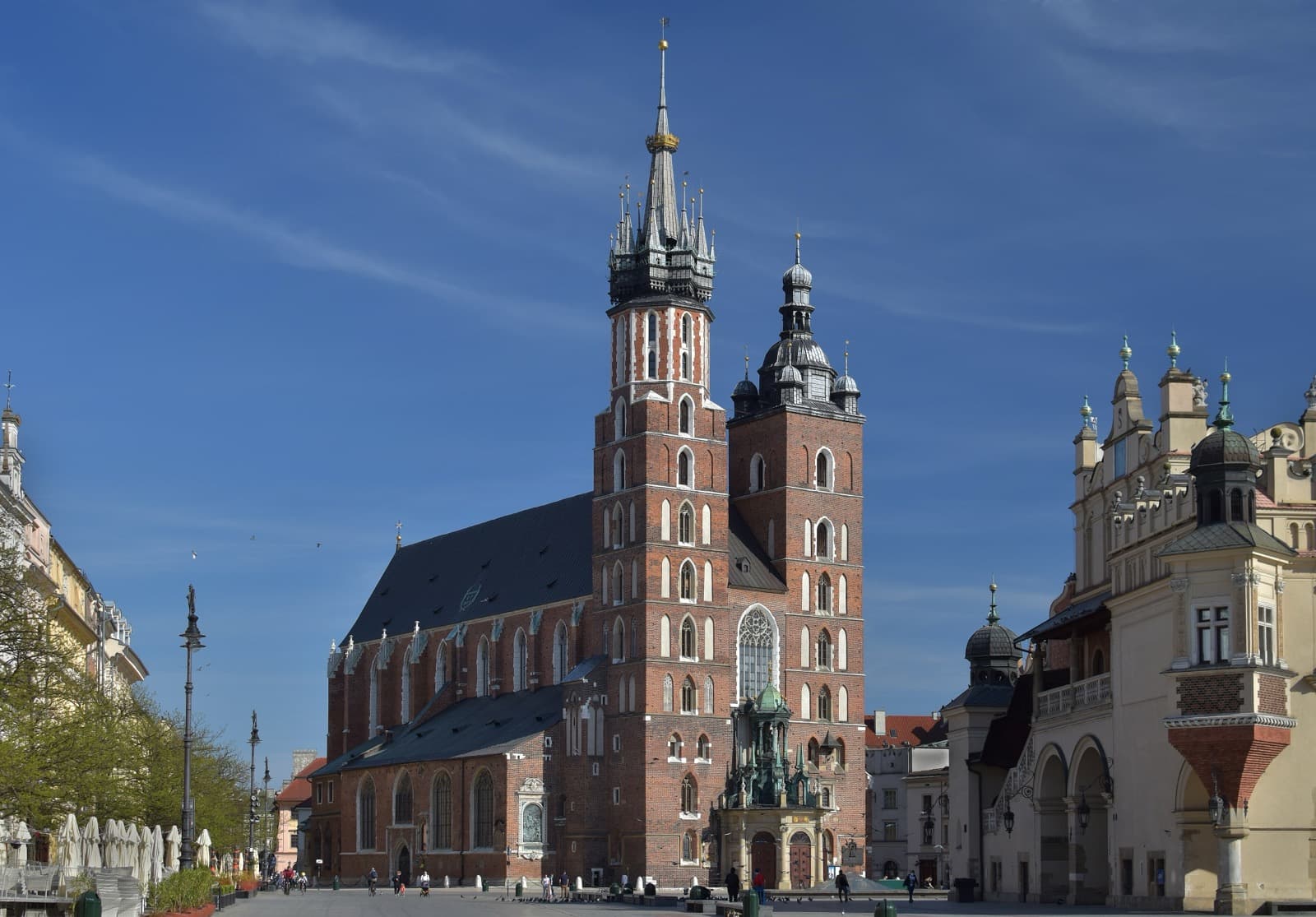
St Mary's Basilica in Krakow pairs the largest Gothic altarpiece in the world with a live trumpet call that sounds every hour and breaks off mid-note. Stand on the northeast corner of the Main Market Square, look up at the two unequal brick towers, and you are looking at the one stop on the whole square where medieval sound and medieval craft both survive intact. The church, known in Polish as Kosciol Mariacki, does not just preserve old things. It performs one of them, live, on the hour, for anyone standing below.
Two towers of different heights
The basilica is one of the foremost examples of Polish brick Gothic. It was founded in the early twelve twenties, wrecked during the Mongol invasion, and rebuilt across the thirteenth and fourteenth centuries. Its two towers rise to noticeably different heights. The taller of the two reaches about eighty metres above the square and carries a gilded coronet added in sixteen sixty-six. That taller tower is the one that matters for what happens on the hour.
Why the towers ended up unequal is not actually settled. Historians have never found a plan that explains it, and the difference has attracted its own folk legend about two rival brothers. What is certain is that the mismatch is the first thing to understand standing in front of the church, because it explains the building's whole posture. This is not a symmetrical cathedral facade meant to overawe from a distance. It is a parish church that grew up crowded against the market, its two towers doing different jobs. The taller one served as a civic watchtower and, for centuries, as the platform for the city's most stubborn tradition.
The hejnal: a live call that never finishes
Hear a stop from this walk
The Cloth Hall: Seven Centuries of Market
Every hour, on the hour, a trumpeter climbs the taller tower and plays a short melody called the hejnal. It always stops abruptly, cut off in the middle of a note, unfinished. This is not a recording and it is not a re-enactment staged for tourists. It is played live, four times each hour toward the four points of the compass, exactly as it has been for a very long time.
The story most visitors hear is that the tune breaks off to honour a trumpeter who was sounding the alarm during a Mongol attack when an arrow struck him in the throat. It is a good story, and it is worth hearing clearly for what it is: a legend, not documented history. The Mongol-arrow version was popularized far more recently than the tradition itself. It was made famous by an American novel, The Trumpeter of Krakow by Eric P. Kelly, published in nineteen twenty-eight, which won the Newbery Medal the following year. The book gave the interrupted call a dramatic origin that stuck in the popular imagination and now travels the world attached to the tune.
What is entirely real is the call itself. A trumpeter really does play it, live, from that tower above your head, and it really does cut off mid-phrase every single time. If you can spare the minutes, wait for the hour and listen. The break in the melody is the point. Whatever its origin, an unfinished note is a strange and moving thing to hear in the twenty-first century, sounded by a person, on schedule, from a medieval tower over Europe's largest medieval market square. The audio walking tour of this square times its St Mary's stop so you can catch it without watching a clock.
The largest Gothic altarpiece in the world
Then step inside, because the interior holds a work worth crossing a country to see. The Veit Stoss altarpiece is the largest Gothic altarpiece in the world. It was carved between fourteen seventy-seven and fourteen eighty-nine by the sculptor Veit Stoss, and its scale is hard to take in from a photograph. When its wings are opened it stands about thirteen metres high and eleven metres wide, and it carries more than two hundred individually carved figures worked in lime, oak and larch. The central scene shows the Dormition of the Virgin.
Numbers only get you so far with a thing like this. The useful way to read it is as a piece of civic ambition frozen in wood. A parish church on a market square commissioned, over roughly twelve years, the single largest object of its kind ever made in the Gothic style, and it is still here, in the place it was built for, above the altar it was carved to crown. It came through a major restoration completed a few years ago, so the colour and gilding you see are close to what its makers intended. You can stand under it in your own silence for as long as you wish, which is the one thing a scheduled group tour rarely lets you do.
The one thing to understand standing here
If you take a single idea away from St Mary's, make it this. Most great medieval monuments survive as objects: you look at them, photograph them, move on. St Mary's survives as a habit. The altarpiece is the object, unmatched anywhere, but the hejnal is a living act, repeated on the hour, that ties the modern city back to its medieval self through nothing more elaborate than a person and a trumpet. Krakow escaped the wartime destruction that flattened Warsaw, so the whole Main Market Square around you survives almost whole. St Mary's is the stop where that survival becomes audible.
The practical notes are simple. The church is a working, dignified place of worship, so dress respectfully, keep your voice low inside, and follow the signs about the visitor entrance and photography. The interior charges a small entry fee in zloty, and climbing the tower is a separate ticket. The square in front is free, and the hejnal costs nothing to hear. Time your visit for a few minutes before the hour, listen for the call, then go in and let the altar hold your attention on your own clock.
St Mary's sits at the fourth stop on a short, unhurried route through the medieval core of the city, alongside the Barbican, the Cloth Hall, the leaning Town Hall Tower, and the university courtyard where a student named Copernicus once walked. You can explore more Krakow walking tours or browse everything on offer in Krakow before you go. However you plan it, arrive at the square a little before the hour. The trumpet is waiting to stop.
Sources
- St. Mary's Basilica, Krakow (Wikipedia): church history, brick Gothic form, the two towers, and the sixteen sixty-six gilded crown on the taller tower.
- St. Mary's Trumpet Call (Wikipedia): the hejnal, its hourly live performance toward the four compass points, and the legend versus documented history distinction.
- The Trumpeter of Krakow, Eric P. Kelly (Wikipedia): the nineteen twenty-eight American novel that popularized the Mongol-arrow legend and won the Newbery Medal in nineteen twenty-nine.
- Veit Stoss altarpiece records: dating of the carving (fourteen seventy-seven to fourteen eighty-nine), dimensions, figure count, materials, and the Dormition of the Virgin central scene.
- UNESCO Historic Centre of Krakow listing: the near-whole survival of the medieval Old Town and the scale of its market square.
Ready to experience it?
Old Town: Europe's Great Medieval Square
100 min · 1.5 km · moderate
More from Krakow
Explore more at your own pace.
Krakow Travel Guide: Days, Transport, Timing, and Safety
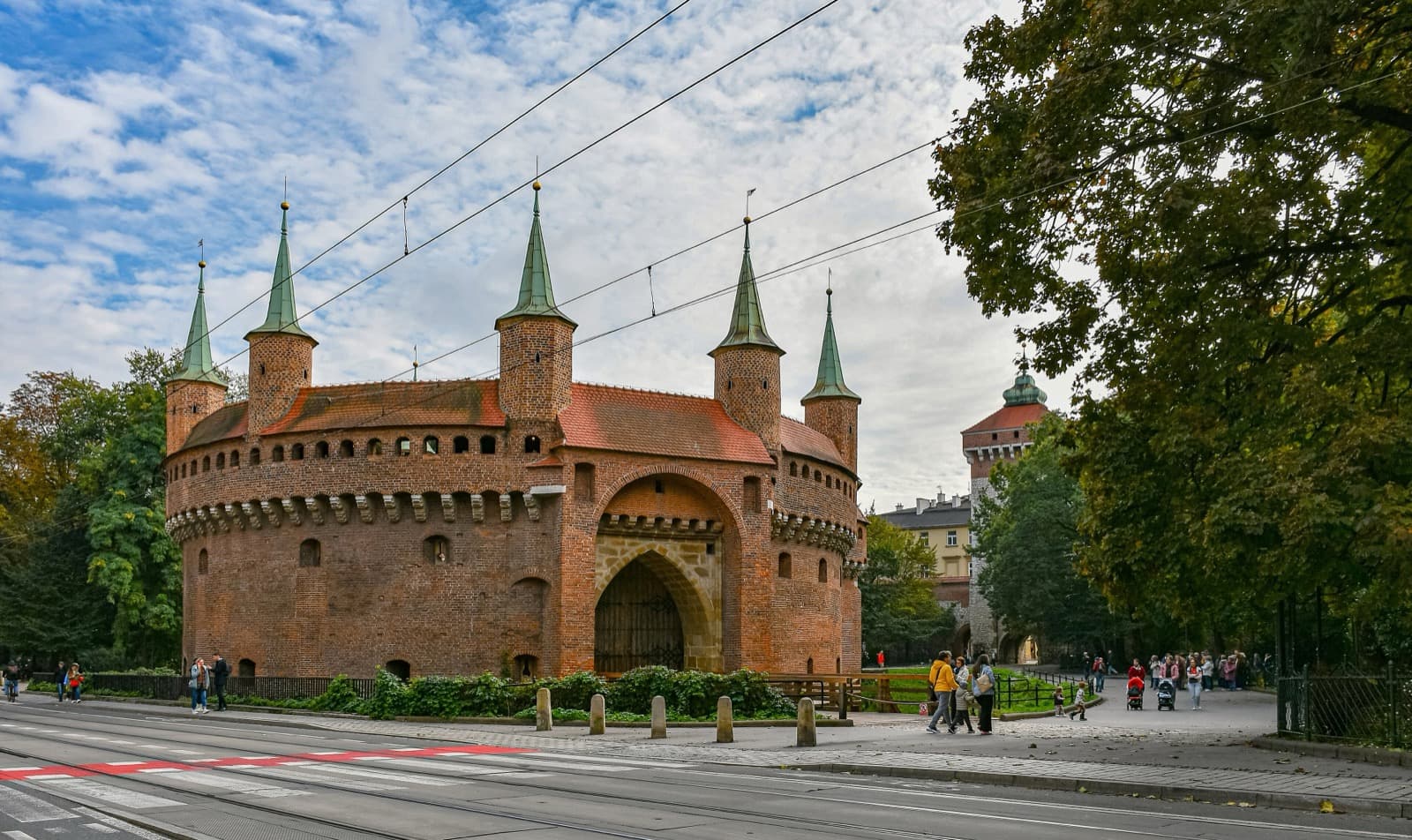
Krakow: The Great Square, the Coronation Hill, and the Quarter That Survived
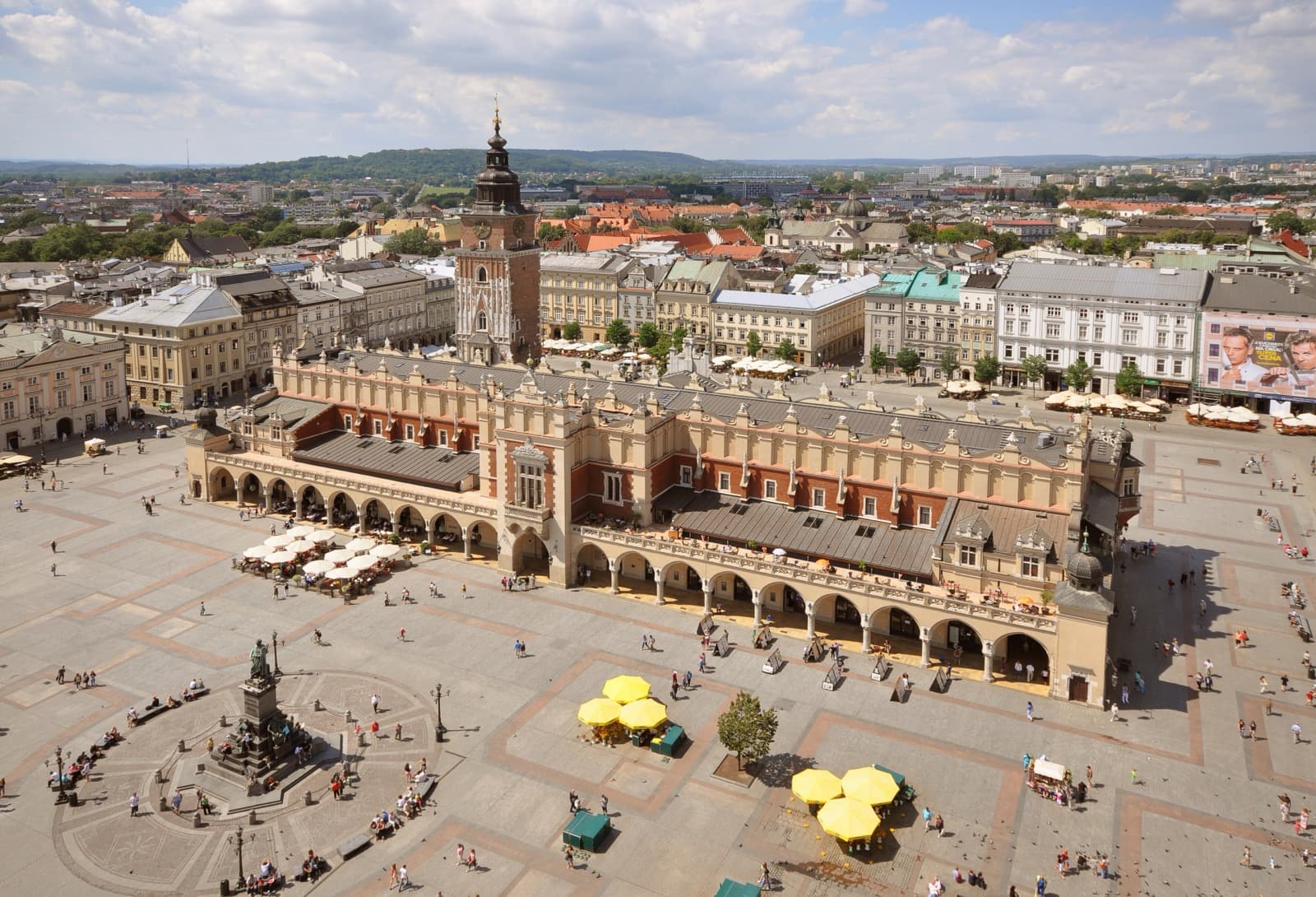
Rynek Glowny: Why Krakow's Main Market Square Is the Whole Tour
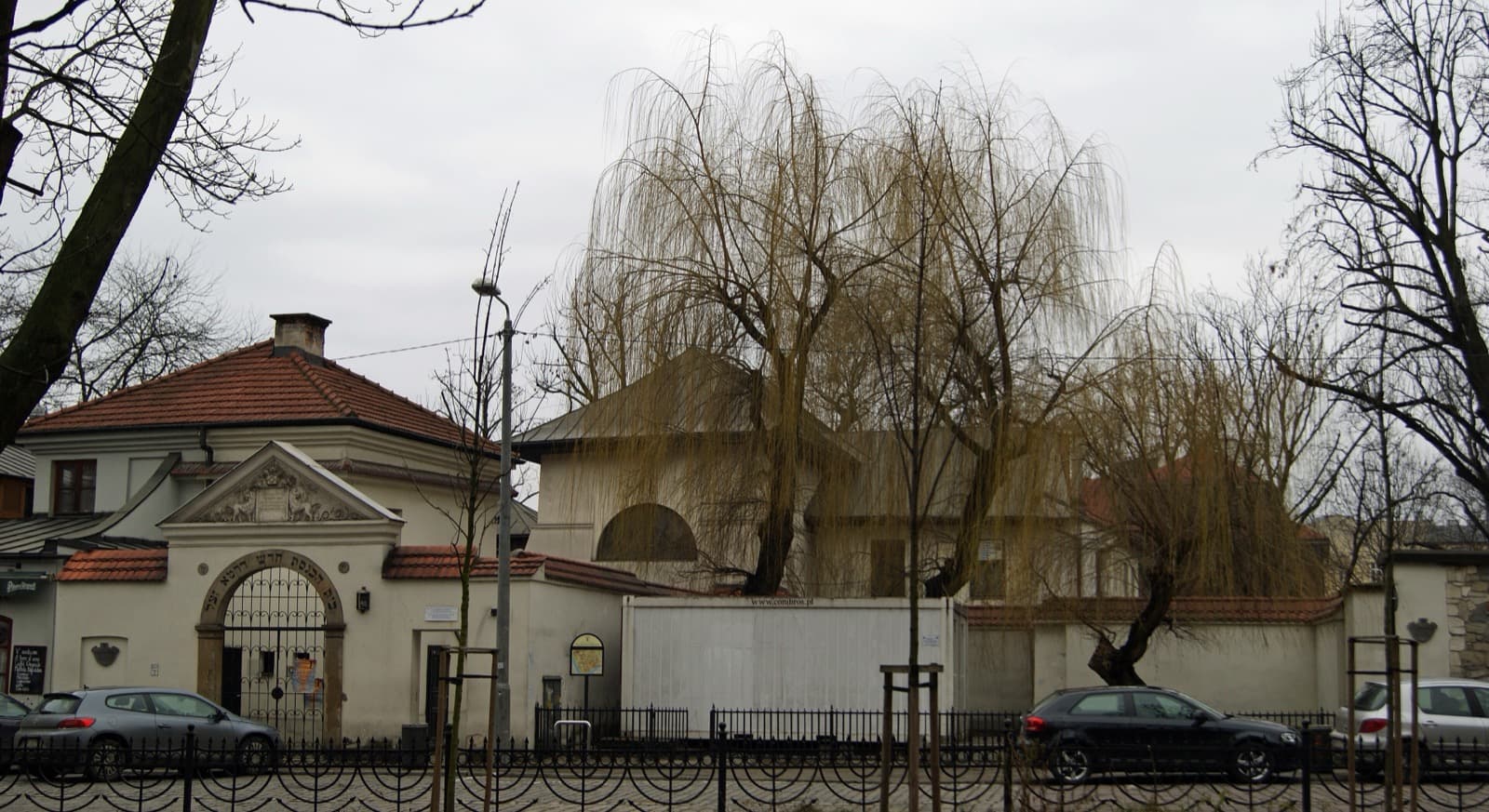
The Remuh Synagogue and Cemetery: Kazimierz's Wall of Broken Headstones
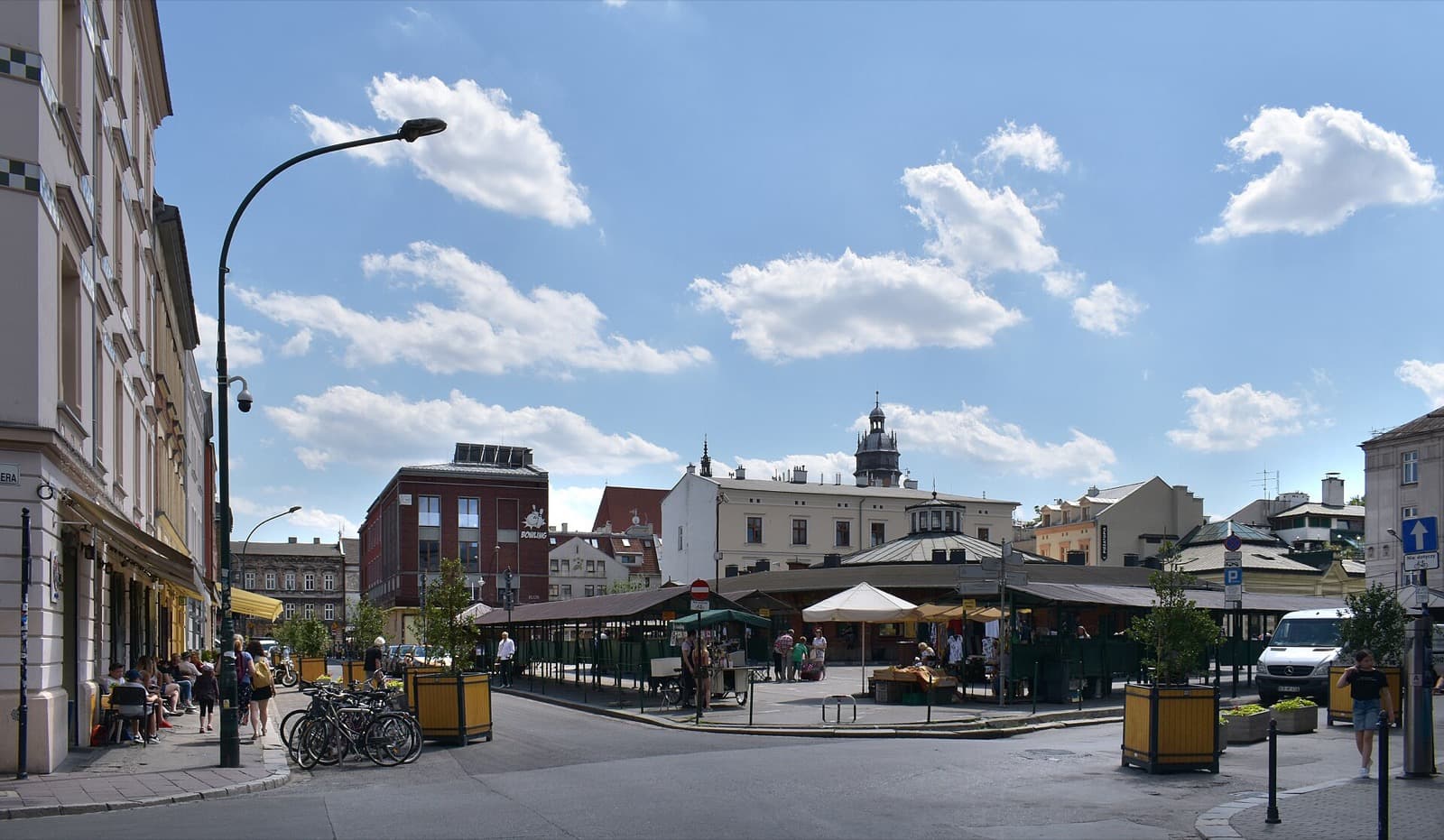
Plac Nowy and the Okrąglak: The Round Hall Where Kazimierz Still Gathers