Omotesando is a shrine approach lined with trees that burned in 1945 and were replanted, and each architect along it answered those trees: a roof hung beside the forest, a building buried to stay at tree height, a facade drawn from the trees, a grid that holds its floors, and a museum hidden behind bamboo. This walk reads the avenue as a sequence of answers. It runs eleven stops over about 2.4 kilometres in roughly seventy five minutes, from the Olympic gymnasium at Yoyogi, down Harajuku's Takeshita-dori and up the zelkova avenue to the Nezu Museum.
The trees come first
Omotesando was laid out as the approach to Meiji Jingu, the shrine dedicated in 1920, and lined with zelkovas, keyaki in Japanese. On the night of 25 May 1945 a great air raid struck this part of Tokyo; the avenue was badly damaged, many people died, and most of the trees burned. They were planted again after the war. So the row every architect here responded to is itself a rebuilding, younger than the bombing, and the shop association that formed in 1973 eventually renamed itself after the trees in 1999. A memorial near the top crossing, put up by Minato City in 2007, marks that night.
A roof hung beside the forest
Hear a stop from this walk
Nezu Museum: Behind the Bamboo
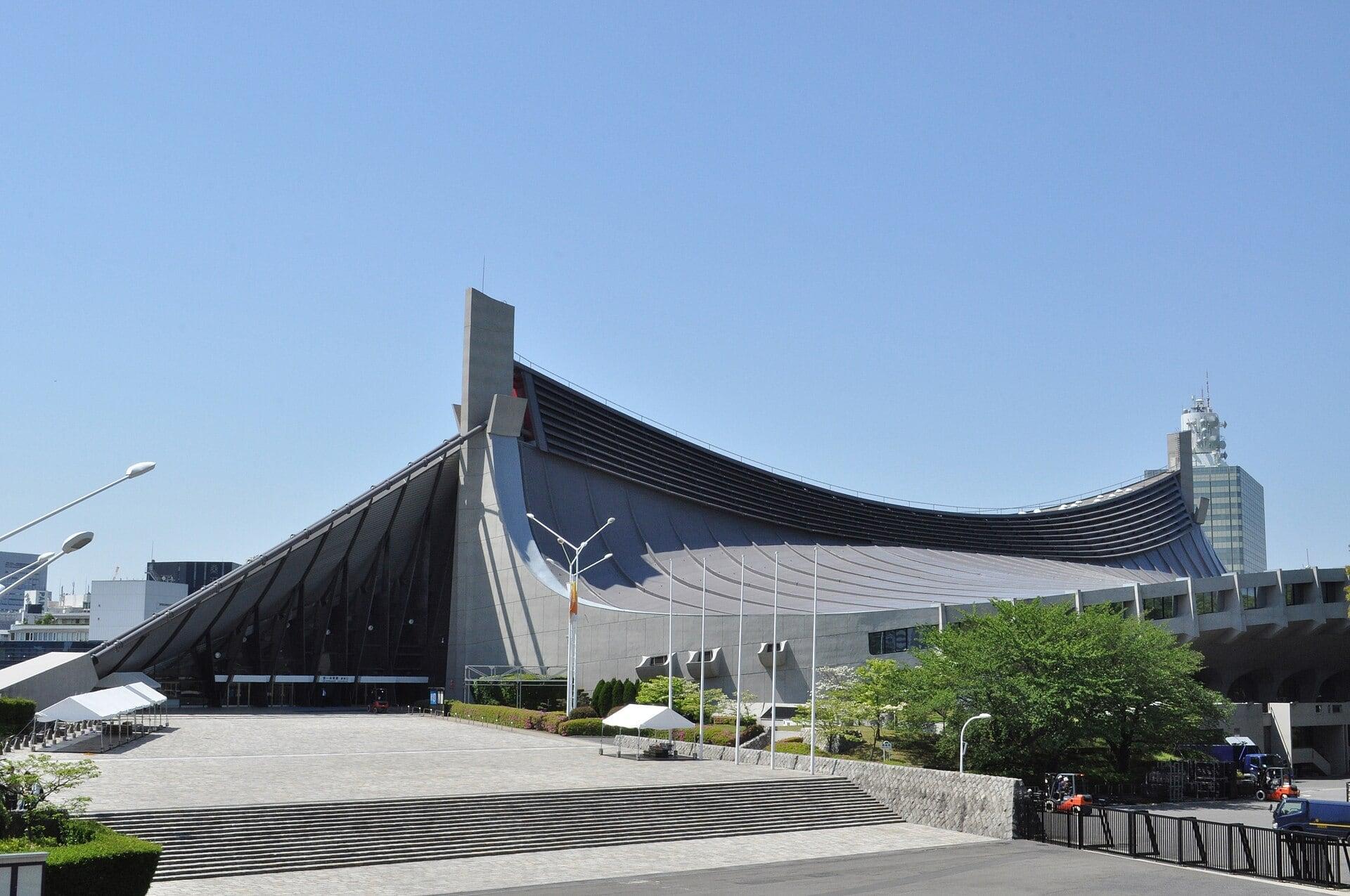
The walk opens at the Yoyogi National Gymnasium, designed by Tange Kenzo for the Tokyo Olympics of 1964. Its roof hangs. Two main steel cables, each 280 metres long, run between two concrete masts and are anchored into the ground by huge concrete blocks, and the roof is slung from them like the deck of a suspension bridge. In plan the main hall is two half circles slid past each other, a shape that pulls crowds in and lets them out. The land had been Washington Heights, housing for the American occupation forces, until it was chosen for the Games in 1961, and the hall was finished on 31 August 1964 on a schedule thought impossible. It became a national Important Cultural Property in 2021. Read it as the first answer: a structure that sweeps and drapes rather than stacking up, set at the edge of the shrine forest.
The street nobody designed
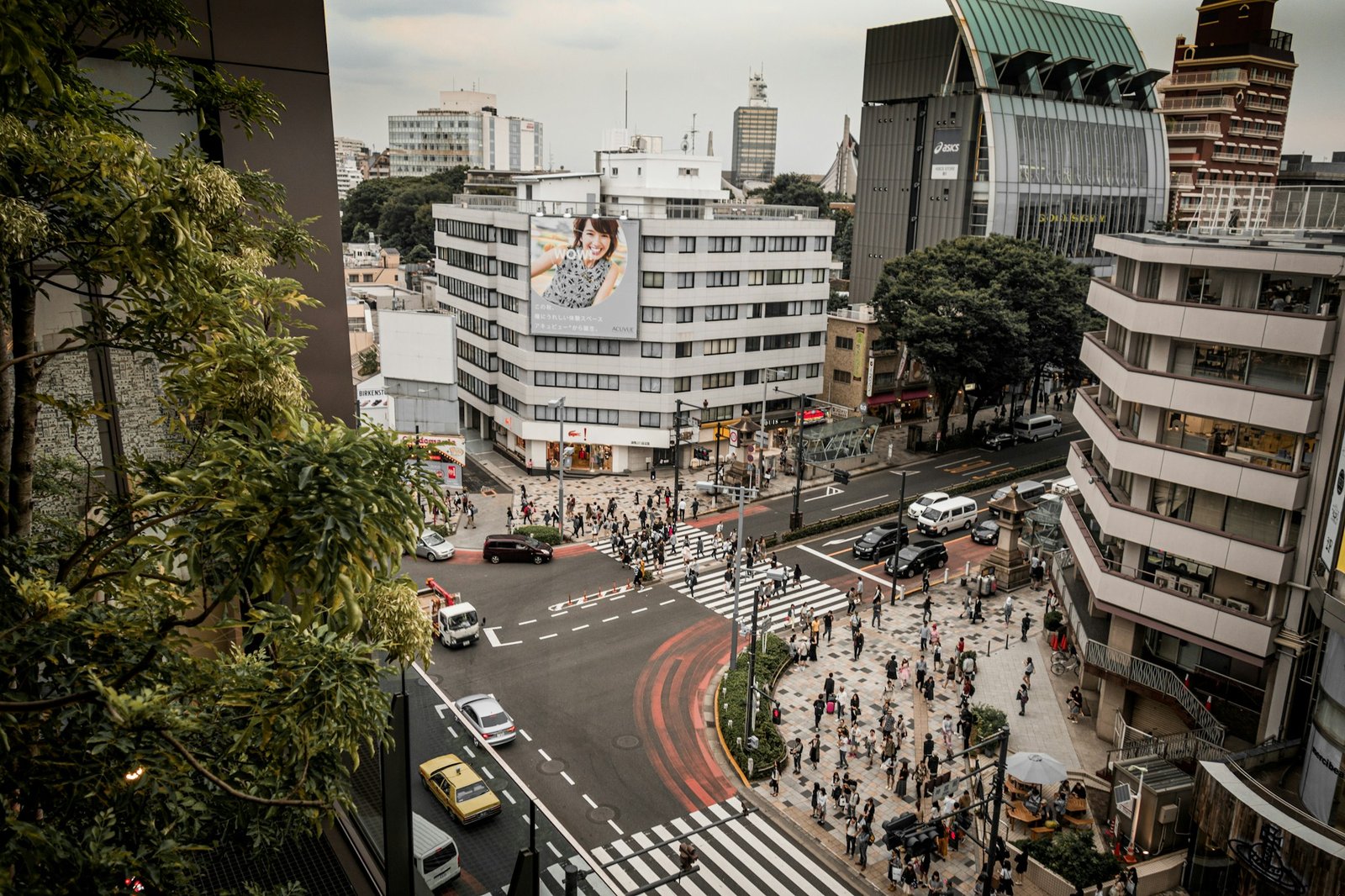
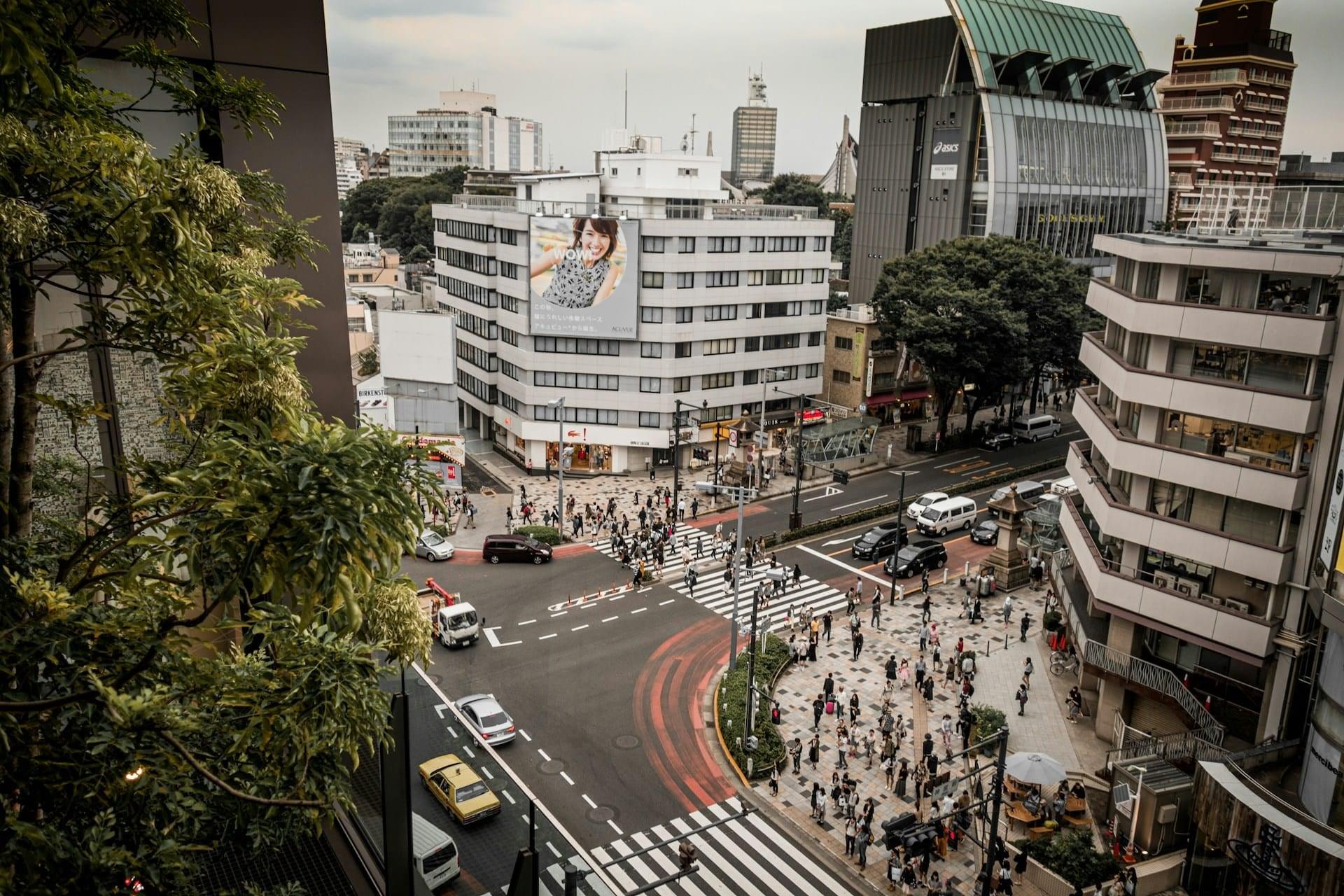
Takeshita-dori is the counterpoint. Its own shopkeepers' history traces it to the shops that opened from 1949 to serve the American families across the tracks at Washington Heights, and counts 1974 as the street's year one. Nobody planned it as architecture. It is one long room of small shops open to the sky, and it is the crowd the avenue's architects were building for. At Jingumae Crossing the two faces meet: the Laforet building of 1978 on one corner, the faceted glass of Omokado and Harakado on the others, and between them the zelkovas begin.
Buried to stay low
Midway up the avenue it dips to cross a river you cannot see, the Shibuya River, now in a culvert under Cat Street. Then comes the most literal answer to the trees. Omotesando Hills, by Ando Tadao, opened in 2006 on the site of the 1927 Dojunkai Aoyama apartments. Its front runs for 250 metres, and Ando's first move was to bury more than half of it: six floors above ground, six below, so that the roofline stays about 23 metres high, level with the zelkovas. His second move brought the street's gentle slope indoors as a spiral ramp of about 700 metres at roughly the same gradient as the avenue. Stand across the road and compare the roof with the canopy. The building is designed to lose that comparison.
A facade drawn from the trees, a grid that holds
A little further on, Ito Toyo's office drew the zelkovas into the building itself. The Tod's facade is nine overlapping tree silhouettes in reinforced concrete thirty centimetres thick, with frameless glass between the branches, and those branches carry the floors. Past the top crossing, on Miyuki-dori, Herzog and de Meuron's Prada Aoyama makes the same move in glass: its diamond grid works with the inner cores to hold the floors up. Both buildings have their own deep dives, on Tod's concrete trees and Prada's glass structure, so here it is enough to see the pattern: skin and structure become one thing, and the trees are the source of the idea at Tod's.
Hidden behind bamboo
The walk ends at the Nezu Museum, founded on the Nezu family's home ground for a collection of Japanese and East Asian art. Fire destroyed much of it in 1945, including the galleries, the garden and the tea house, and exhibitions resumed in 1946. The present building, designed and supervised by Kuma Kengo, was completed in 2009 with a wide roof and a long approach lined with bamboo. From the street you see very little: plants first, building second. It is the last and quietest answer, a building that hides behind green almost entirely.
Walking it yourself
The avenue climbs so gently, about eighteen metres from the dip at Cat Street to the top, that most people never notice. Take it at your own pace: stand back across the road at each building to see the whole front, skip Takeshita-dori if you would rather not be in a dense crowd, or linger at the gymnasium. The museum is ticketed, but its bamboo front is free to look at. The tour is free to start, with no group and no fixed time.
Start at stop 1 of Omotesando and Harajuku: Buildings That Answer the Trees, and find more on the Tokyo city page.
Sources
- Japan Sport Council, Yoyogi National Gymnasium (https://www.jpnsport.go.jp/yoyogi/index.html): built for the 1964 Tokyo Olympics and a nationally designated Important Cultural Property.
- Nezu Museum, about the museum (https://www.nezu-muse.or.jp/en/about/): the foundation of 1940 and opening in 1941 on the family residence, the 1945 fire that destroyed the galleries, garden and tea house, the 1946 resumption, and Kuma Kengo's building completed in 2009.
- Roamer tour research for the Omotesando and Harajuku walk (audited transcript and fact dossier, drawing on the owners of Omotesando Hills, the architects' offices, the Takeshita-dori and Omotesando associations, Minato City and Domus): the cable roof dimensions, Takeshita-dori's timeline, Omotesando Hills' figures, the 1945 raid and memorial, and the zelkova replanting.
Ready to experience it?
Omotesando and Harajuku: Buildings That Answer the Trees
75 min · 2.4 km · easy
More from Tokyo
Explore more at your own pace.
Best Culture Walking Tours in Tokyo (2026)
Best History Walking Tours in Tokyo (2026)
Best Nature Walking Tours in Tokyo (2026)
Asakusa and Senso-ji: Why the Grand Buildings Are Young and the Survivors Are Small
Edo Castle, Gate by Gate: How the Shogun's Fortress Became a Garden Anyone Can Walk Into