A forest built to outlive its builders is what Meiji Jingu really is. The woods around Tokyo's best known shrine look like old growth, but a little over a hundred years ago this ground was mostly fields. From about 1915 to 1920, foresters planted it with donated trees chosen for a polluted city a century ahead, and they staged the planting so the forest would thin and take over by itself. In April 1945 the shrine's halls burned. The broadleaf forest held.
Roamer's walk goes looking for the proof: eleven stops over about two kilometres, around eighty minutes, almost all on gravel, from the Yoyogi Gate in the north to the first torii inside the Harajuku entrance.
A forest made by hand
Meiji Jingu honours the spirits of the Emperor Meiji, who died in 1912, and his empress, who died in 1914. Their graves are in Kyoto: this is a place of worship, not a tomb. The shrine was founded on 1 November 1920, among young trees.
Before that, the site was an imperial estate, and apart from one garden it was mostly open land. The shrine's own pages say about 100,000 trees were offered from across Japan, and that young volunteers gave about 110,000 turns of labour, counted day by day, to the construction. Stand at the first stop and look at the wall of trees beside the service lane. It reads as ancient woodland. It is a planting, and its rule is still the shrine's: nothing is taken out, and fallen trees are left to return to the soil.
Trees chosen for a smoky city
Hear a stop from this walk
First Torii: Out to the City
The second half of the idea is the clever one. The forestry scholars who planned the woods, Honda Seiroku, Hongo Takanori and Uehara Keiji among them, asked what would still grow here in a hundred years. Pollution was already spreading in Tokyo, the shrine writes, and the city's big old trees were dying one after another. So they chose broadleaf evergreens: shii, kashi and kusu, that is chinquapin, evergreen oak and camphor.
They could not plant a finished forest, so they drew it in stages around the red pines already standing. As the plan is usually retold, fast pines would stand on top at first with slower broadleaves underneath, meant to take over as the pines died out. On the west approach, stops 4 and 5, you walk into the result: broad, dark, glossy leaves where you might expect the tall cedars of shrines like Ise.
That choice was argued over. The shrine tells it like this: the prime minister of the day, Okuma Shigenobu, objected that a shrine forest should not be a thicket and should of course be cedar, with avenues like Ise's and Nikko's. The foresters answered that cedar grows in damp valleys and that Yoyogi's soil was wrong for it, and in the end, the story goes, they won him over.
A hundred years on
At the start, counting the trees already there, the inner grounds held about 120,000 trees of 365 kinds. A survey for the centenary, reported in 2013, counted about 36,000 trees of 234 kinds. Natural selection thinned them, the shrine says, and the trees grew big. Fewer, larger, wilder: exactly what a forest designed to manage itself should do.
Then came the test nobody planned for. In April 1945 an air raid burned most of the shrine's buildings. The forest was not badly damaged, and people sheltered in it. The shrine wonders whether it escaped the spreading fire because it was broadleaf evergreen rather than conifer, which burns easily. Perhaps, it says.
Read the buildings against the trees
Once you see the forest as the main work, the buildings become footnotes that confirm it. The 1921 Treasure House at stop 3 is reinforced concrete dressed as an ancient timber storehouse, built for fire and earthquake. The main hall at stop 6 was completed in 1958 and roofed in copper, where the first hall of 1920 had a bark roof and burned. The two camphors in front of it were planted as saplings in 1920. The South Gate at stop 7, from 1920, is one of the few structures that came through the war.
Even the biggest object on the walk folds back into the planting story. The Otorii at stop 8, which the shrine calls the largest wooden torii of its style in Japan, is the second great torii here: the first was struck by lightning in 1966, and the log for its replacement, a Taiwanese cypress more than 1,500 years old, soaked for four years in the North Pond you pass at stop 2 before the gate was finished in 1975. And the 2019 museum at stop 10, designed by Kuma Kengo, keeps its long roofs low so the building sits quietly under the trees.
Walking it yourself
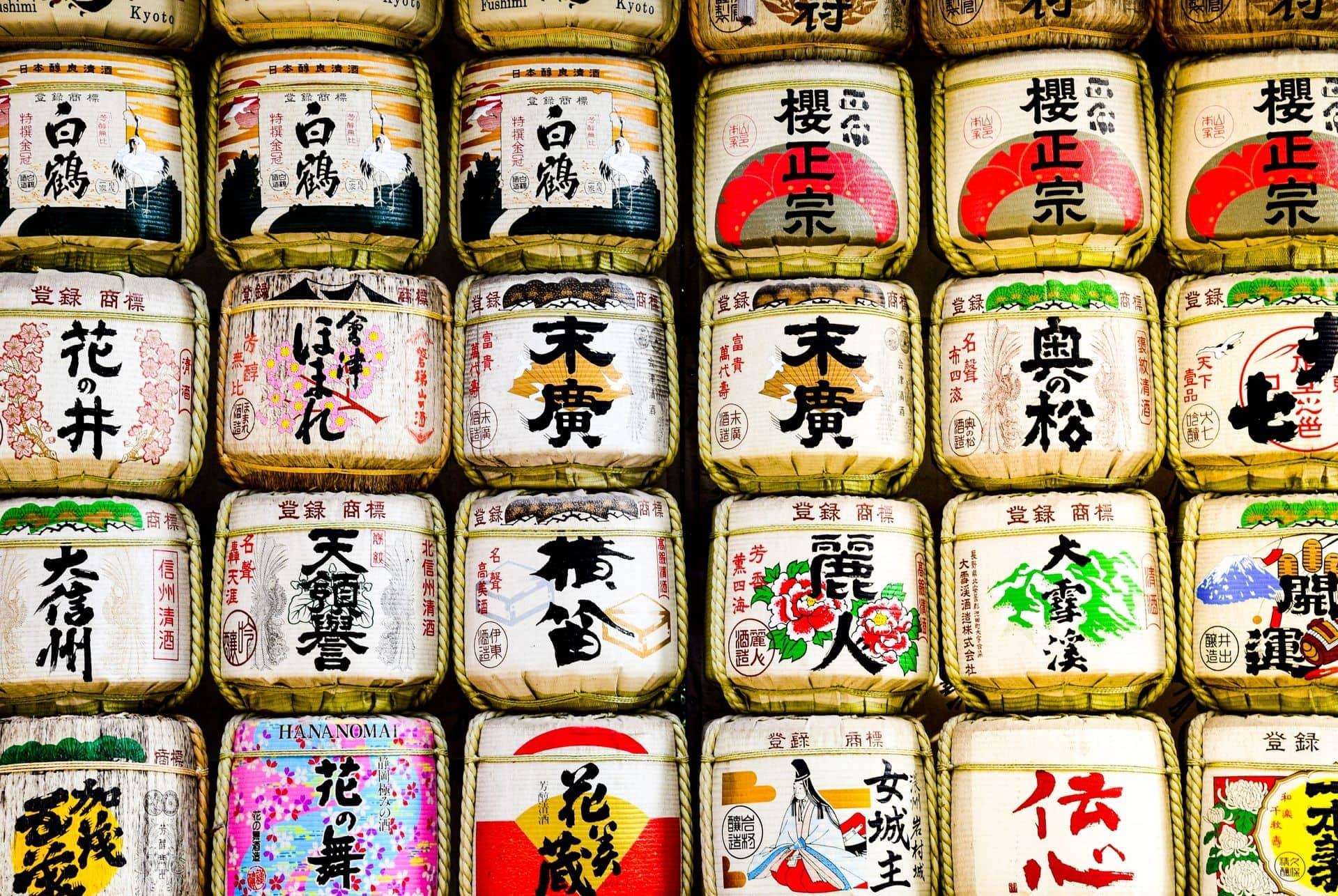
The shrine is free to enter and its gates follow the sun, opening at sunrise and closing at sunset, so in November and December start by early afternoon. Mornings are quietest in the northern half. Because the walk is self-guided, you can linger at the pond, skip ahead past the crowds at the barrels, or sit on the lawn, all on your own schedule and with no group to keep up with. Keep to the side of each approach, and take no photos in front of the main hall where people pray.
Begin at stop 1 of Meiji Jingu: A Forest Built to Outlive Its Builders, and find every route on the Tokyo page. For one stop in depth, read about the Treasure House, concrete dressed as timber.
Sources
- Meiji Jingu, the forest page (杜・見どころ): the man-made forest, about 100,000 donated trees, about 110,000 youth volunteers, the planners Honda, Hongo and Uehara, the choice of shii, kashi and kusu for a polluted city, 365 kinds and about 120,000 trees at the start, 234 kinds and about 36,000 in the second survey, the April 1945 raid and the shrine's "perhaps".
- Meiji Jingu, Q&A (Japanese): founding on 1 November 1920, Okuma and the cedars, the Otorii's lightning strike in 1966, the Taiwanese cypress, the four years in the North Pond and completion on 23 December 1975.
- Meiji Jingu, precinct map (English): the South Gate of 1920 as one of the few survivors, the main hall rebuilt in 1958 with copper roofs, the Otorii as the largest wooden myojin torii of its kind.
- Japan for Sustainability, Newsletter No. 39 (2005): a secondary retelling of the staged planting plan, pines above and broadleaves below.
- Roamer's audited tour transcript for Meiji Jingu (stops 1 to 11) and its fact dossier, which opened the shrine's pages and the national heritage register on 8 November 2026.
Ready to experience it?
Meiji Jingu: A Forest Built to Outlive Its Builders
80 min · 2 km · easy
More from Tokyo
Explore more at your own pace.
Best Culture Walking Tours in Tokyo (2026)
Best History Walking Tours in Tokyo (2026)
Best Nature Walking Tours in Tokyo (2026)
Asakusa and Senso-ji: Why the Grand Buildings Are Young and the Survivors Are Small
Edo Castle, Gate by Gate: How the Shogun's Fortress Became a Garden Anyone Can Walk Into