Senso-ji grew up inside Edo and Tokyo's loudest pleasure ground, and each time fire, earthquake and war flattened temple and show together, the worshippers, the businessmen and the pleasure district paid to rebuild both. That is why, in Asakusa, the grand buildings are young and the survivors are the small things off to the side. The walk, nine stops over about one and a half kilometres and around seventy five minutes, runs from the Sumida River through the Thunder Gate and the temple to the old theatre street, and it reads the district as one long argument between prayer and play that always ends in a rebuilding.
A temple founded on a catch
The story starts in the water. By the temple's own tradition, in 628 two brothers fishing the Sumida, Hinokuma Hamanari and Takenari, kept pulling the same small statue up in their net and nothing else. The local headman recognised it as Kannon, the bodhisattva of compassion, and turned his house into a temple. In 645 a monk named Shokai rebuilt the hall and, after a dream, made the image secret. It has been locked away ever since, and nobody living can tell you what it looks like.
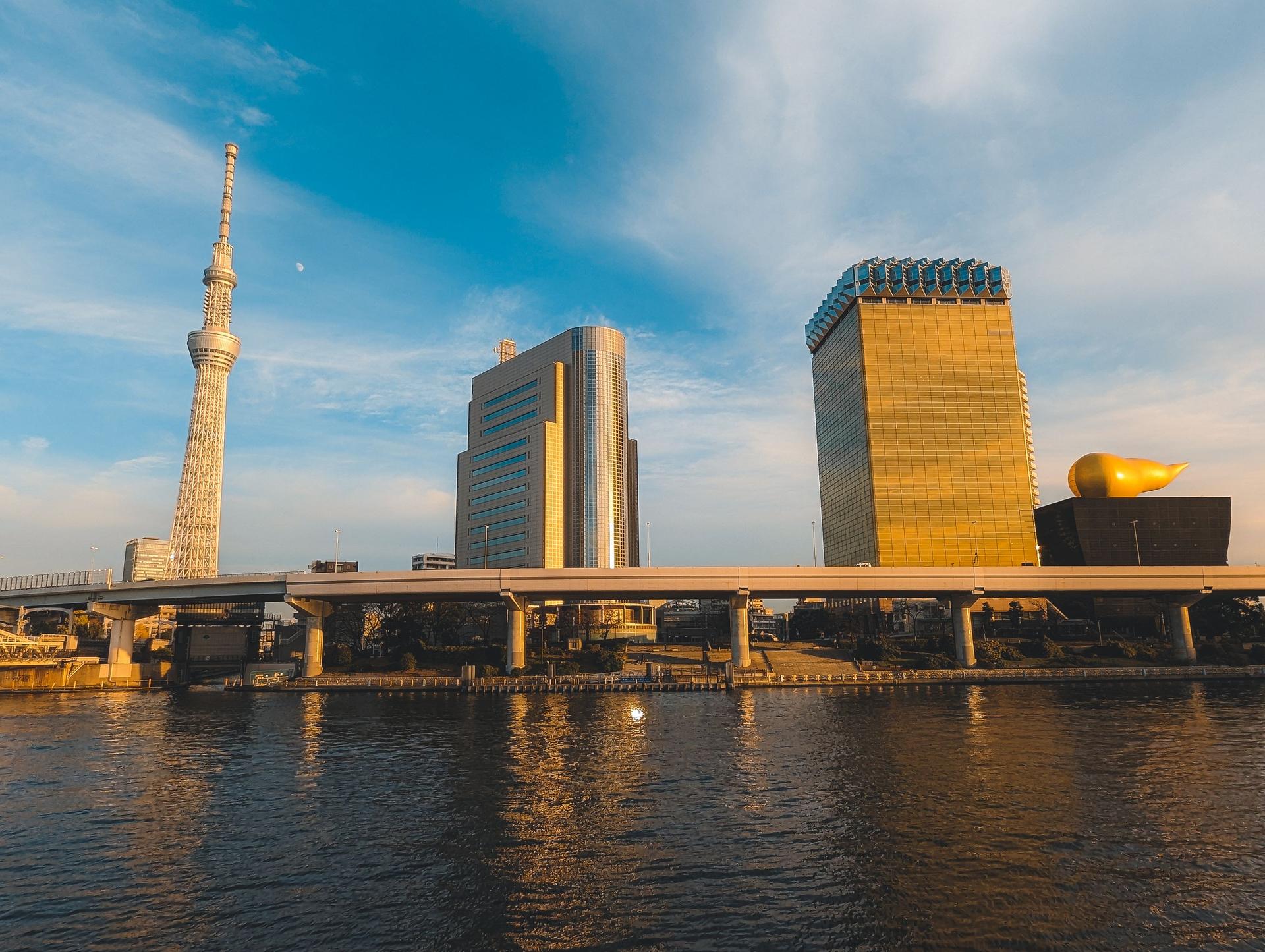
Stand at the Asakusa end of Azumabashi and the opening stop puts that legend beside the newest layer of the city: the amber Asahi tower meant to read as a mug of beer, Philippe Starck's golden flame, and Tokyo Skytree rising behind. The bridge, the railway crossing upstream and the riverside park all date from 1931, built after the 1923 earthquake and fire burned almost all of old Asakusa. The pattern of the whole walk is set before you reach the temple.
Look at what is new
Hear a stop from this walk
Rokku: The Sixth District, Where the Show Moved
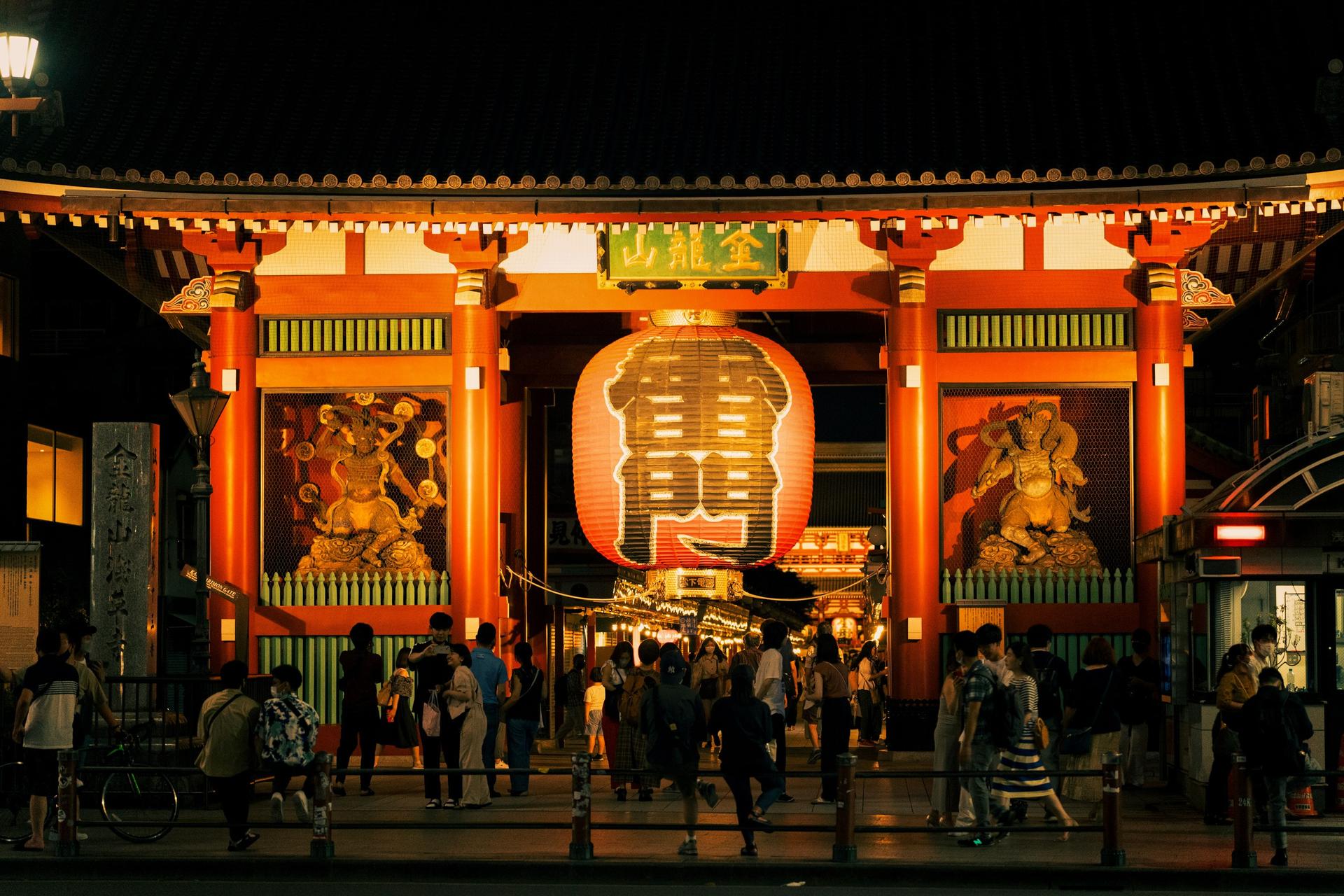
The Thunder Gate is the first lesson in dates. It burned in a great fire in January 1866, and only the heads of the wind and thunder gods were saved. For ninety five years there was no permanent gate. The one you walk through opened in 1960, paid for by Konosuke Matsushita, the founder of the company now called Panasonic, after the abbot's prayers were credited with his recovery from an illness. The giant lantern is his company's gift too, renewed about every ten years.
Nakamise, the shopping street beyond, looks like a bazaar laid on for visitors, but trade on this approach began in the late seventeenth century, when the temple let local residents set up stalls in return for sweeping its grounds. The present shops were rebuilt in reinforced concrete in 1925, burned inside in the air raid of 10 March 1945, and were patched up on their surviving shells. So the oddest fact on the approach is this: the gate behind you, the gate ahead, the main hall and the pagoda were all built after 1950, and the oldest buildings on the street are the shops.
Hozomon, the Treasure House Gate, went up in 1964 as a gift from the industrialist Yonetaro Otani and his wife. The five storey pagoda followed in 1973, on the opposite side from the one that burned. The main hall was built in reinforced concrete between 1951 and 1958 on donations from all over Japan, and its roof was later relaid in titanium tiles at about a fifth of the old weight. Read the scale of these buildings as the scale of the money that came back after each disaster.
The show pays the temple back
The pleasure district is not a backdrop here. It is a funder. The great lantern over the main hall steps reads Shinbashi, the name of a Tokyo geisha quarter whose restaurants, teahouses and geisha have given it since the hall was finished. Behind the temple, in what Edo called Okuyama, stood the city's great popular pleasure ground of teahouses, sideshows and acrobats. When the new government turned the temple grounds into a public park in 1873 and split it into districts in 1884, the shows were moved west into a new sixth district, Rokku, laid out on filled-in rice fields.
Rokku became Tokyo's entertainment street: the Twelve Storeys brick tower of 1890, with Japan's first electric elevator, and the Denkikan, which became Japan's first permanent cinema in 1903. The circle closes in 1951, when Senso-ji filled in the park's gourd-shaped pond and sold the land to help pay for its new main hall. The show, literally, rebuilt the temple.
Count the survivors
Once you know the big buildings are young, the walk becomes a hunt for what is old, and it is all small. Asakusa Shrine, paid for by the shogun Tokugawa Iemitsu and completed in 1649, came through both 1923 and 1945 and is a nationally protected Important Cultural Property. It honours the two fishermen and the headman from the founding story. Nitenmon, the red east gate beside it, is dated to about the same year and survived too. The little six-sided Rokkakudo, which the temple counts as the oldest wooden building in Tokyo, sits off a side path.
The last stop is the smallest of all. Chingodo, the temple's shrine to the tanuki, was founded in 1883 after, as the temple tells it, the raccoon dogs promised the abbot protection from fire in exchange for a home. The abbot's residence and the shrine both came through the earthquake and the air raid. Performers still pray here, which fits: a fire charm in a district that burned again and again, visited by the people of the show, a few steps from the temple they helped put back.
Walking it yourself
Every stop can be seen for free, and the route is short enough to take slowly. Linger at the river, skip the souvenir crush on Nakamise and come back after closing when the painted shutters come down, or spend longer at the shrine. The tour is free to start and works on your own schedule, with no group to keep up with.
Start at the river with stop 1 of Asakusa and Senso-ji: Where Tokyo Came to Pray and Play, and find more walks on the Tokyo city page. For a closer look at single stops, read about Senso-ji's founding and Rokku's first skyscraper and first cinema.
Sources
- Senso-ji, temple history (https://www.senso-ji.jp/about/): the founding tradition of 628 and the Hinokuma brothers, Shokai and the hidden image in 645, the main hall rebuilt 1951 to 1958, and the Kaminarimon rebuilt in 1960 with Konosuke Matsushita's donation, 95 years after the 1865 fire.
- Asakusa Shrine (https://www.asakusajinja.jp/en/): the shrine's three deities, Haji no Matsuchi and the Hinokuma brothers, revered as founders of Asakusa.
- Roamer tour research for Asakusa and Senso-ji (audited transcript and historical notes): Nakamise's origins and rebuilding, Hozomon and the pagoda, Asakusa Shrine and Nitenmon, Okuyama, Rokku, the 1951 pond sale and Chingodo.
- Tour image credits, data/marketing/tokyo-asakusa-image-credits.md: cover photo licence and subject.
Ready to experience it?
Asakusa and Senso-ji: Where Tokyo Came to Pray and Play
75 min · 1.5 km · easy
More from Tokyo
Explore more at your own pace.
Best Culture Walking Tours in Tokyo (2026)
Best History Walking Tours in Tokyo (2026)
Best Nature Walking Tours in Tokyo (2026)
Edo Castle, Gate by Gate: How the Shogun's Fortress Became a Garden Anyone Can Walk Into
Meiji Jingu: The Forest That Was Built to Outlive Its Builders