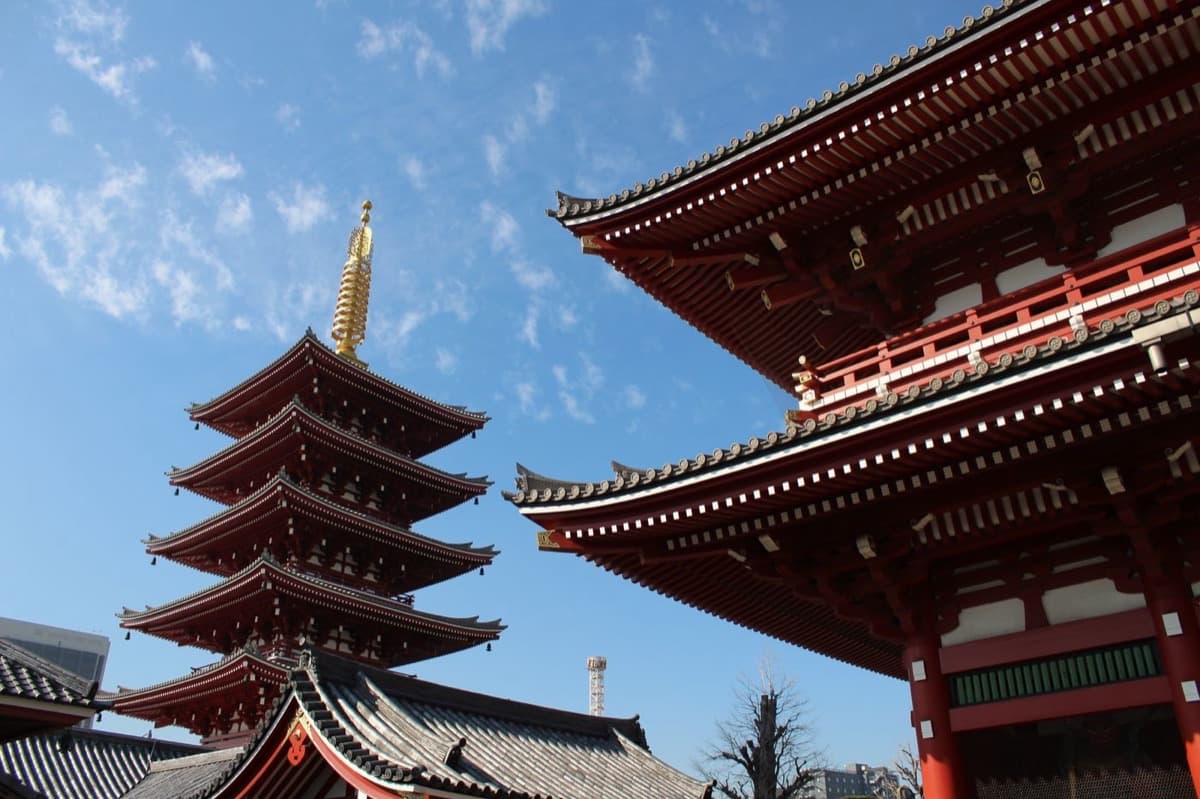
Tokyo is a young city as capitals go, but it has an ancient heart, and that heart is Sensoji. This is, by its own account, the oldest temple in Tokyo, and its origin story reaches back to the year 628, long before Tokyo existed under any name, to two fishermen and a statue caught in a net. Everything Asakusa became, the people's district, the temple town, the great popular capital of old Tokyo, grew from that moment. Read Sensoji as the seed the whole neighborhood sprouted from, and the crowds pouring through its gates make sudden sense.
A statue in the river
The founding legend, as the temple tells it, is specific and vivid. In the year 628, two brothers, Hinokuma Hamanari and Hinokuma Takenari, were fishing in the Sumida River when a statue came up in their net. The village headman, Haji no Nakatomo, recognized it as Kannon, the bodhisattva of compassion. The next morning village children built a grass hut to shelter it, and Nakatomo later converted his own home into a temple so that the people could worship the Kannon. That act, a house turned into a temple around a statue found in the water, is the founding of Sensoji. The temple has been dedicated to Kannon ever since, and it is that promise of compassion that has drawn worshippers to Asakusa for nearly fourteen centuries.
The result is a temple older than the city around it. When Tokyo was still a fishing shore called Edo, centuries from becoming a shogun's capital, Sensoji was already ancient. It is the deepest root in the whole metropolis.
The Thunder Gate and the approach
Hear a stop from this walk
Rokku: The Sixth District, Where the Show Moved
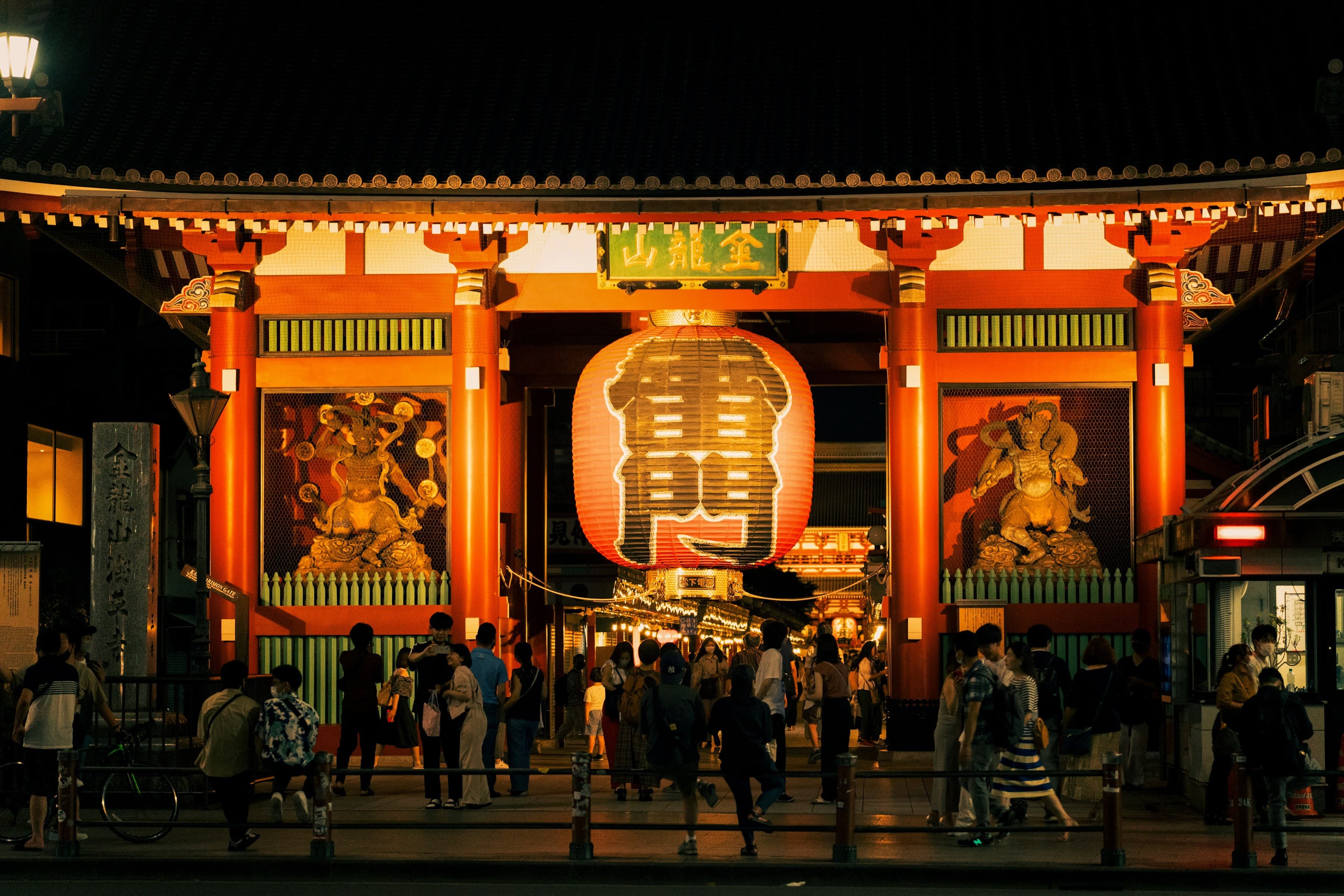
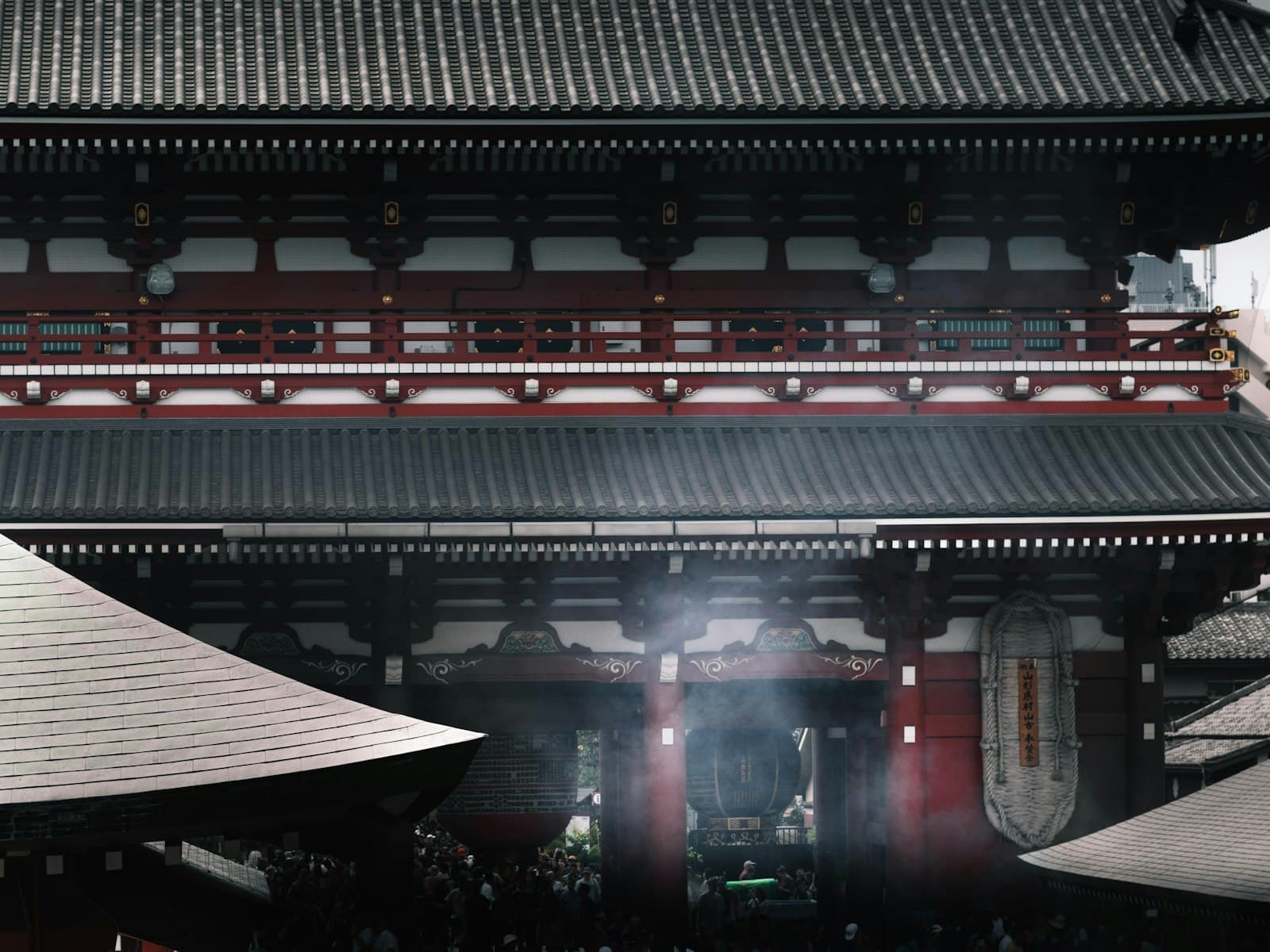
The way in is one of Tokyo's most famous images: the Kaminarimon, the Thunder Gate, with its enormous red paper lantern. The temple dates its first main gate to 942 and the commander Taira no Kinmasa, though that gate stood elsewhere; the gate moved to this spot only centuries later. The structure standing today dates to 1960, rebuilt with a donation from Konosuke Matsushita, the founder of the electronics company Panasonic, a modern industrialist paying for the gate of an ancient temple. The great lantern that hangs in it is close to four meters tall and weighs around seven hundred kilograms.
Beyond the gate runs the Nakamise-dori, an approach lined with about ninety shops over roughly two hundred and fifty meters, selling snacks, crafts, and souvenirs. This is not a modern tourist invention. An approach market has served pilgrims to Sensoji for centuries, and it is part of why Asakusa became a place of pleasure as well as prayer. Roamer's Asakusa and Senso-ji: Where Tokyo Came to Pray and Play reads this whole sequence, starting on the Sumida River where the story began and walking through the Thunder Gate and the market to the main hall, then on to the shrine, Hanayashiki and Rokku. The nearby Rokku entertainment district grew from the same pilgrim crowds.
Destroyed and rebuilt
Sensoji's survival is not to be taken for granted. Before dawn on the tenth of March 1945, the great firebombing raid on Tokyo devastated the district and burned the main hall, the inner gate and the pagoda. The main hall you see today was reconstructed between 1951 and 1958 with donations from across the country, and in 2010 its heavy old tiles gave way to a titanium roof about a fifth of the old weight, beneath its traditional form. So the temple is at once the oldest in Tokyo and, in its main buildings, a postwar rebuilding, a continuity of faith carried across the destruction of the city. Today the temple counts about thirty million visits a year.
Reading it in place
Start on the Sumida, the river that gave the temple its Kannon. Then enter through the Kaminarimon and let the scale of the lantern register, and walk the Nakamise slowly, remembering that pilgrims have walked this approach for centuries. At the main hall, recall that everything here traces, by the temple's own tradition, to a statue found in that river in 628, and that the hall itself was rebuilt after the firebombing, and you will have followed the whole arc of the place. It is busiest by day; early morning is the calmest window for the gate and the approach.
Sensoji is the heart of Roamer's Asakusa and Senso-ji: Where Tokyo Came to Pray and Play. To fit it into a day, see one day in Tokyo, and for the full set of routes, browse Tokyo walking tours.
Sources
- Senso-ji, history and principal-image pages (senso-ji.jp/about/ and senso-ji.jp/about/gohonzon.html) and English page (senso-ji.jp/english/): the founding tradition of 628, told as the temple's tradition (the brothers Hinokuma Hamanari and Takenari, the village children's grass hut, Haji no Nakatomo turning his house into a temple), Senso-ji as the oldest temple in Tokyo by its own account, and about thirty million visits a year.
- Senso-ji, Kaminarimon page (senso-ji.jp/guide/guide01.html) and English page: the first main gate attributed to Taira no Kinmasa in 942 and its later move to the present site, the 1960 gate given by Konosuke Matsushita of Matsushita Electric (now Panasonic), and the lantern at 3.9 meters and about 700 kilograms.
- Senso-ji, Nakamise page (senso-ji.jp/guide/guide02.html), and Taito City tourism (t-navi.city.taito.lg.jp/spot/1002): the approach of about 250 meters, the stalls the temple first allowed around 1685, and about ninety shops today.
- Senso-ji, Main Hall and Hozomon pages (senso-ji.jp/guide/guide04.html and guide03.html) and chronology (senso-ji.jp/about/chronology.html), with Shimizu Corporation's project notes: the hall burned on 10 March 1945 with the inner gate and pagoda, was rebuilt 1951 to 1958 with nationwide donations, and was re-roofed in titanium by 2010 at about a fifth of the old roof's weight.
- Roamer tour transcript, Asakusa and Senso-ji: Where Tokyo Came to Pray and Play (tokyo-asakusa), fact-checked against primary sources: Sensoji, the Thunder Gate, the approach market, and the Sumida riverfront.
Ready to experience it?
Asakusa and Senso-ji: Where Tokyo Came to Pray and Play
75 min · 1.5 km · easy
More from Tokyo
Explore more at your own pace.
One Day in Tokyo: A Walkable Itinerary Across Three Faces (2026)
Tokyo Travel Guide: How Many Days, Getting Around, When to Go (2026)
The Low City and the High City: How to Read Tokyo Like an Edo Map
What to Eat in Tokyo: A Food Guide (2026)
Kayaba Coffee: How a 1916 Townhouse Made Survival a Verb in Yanaka