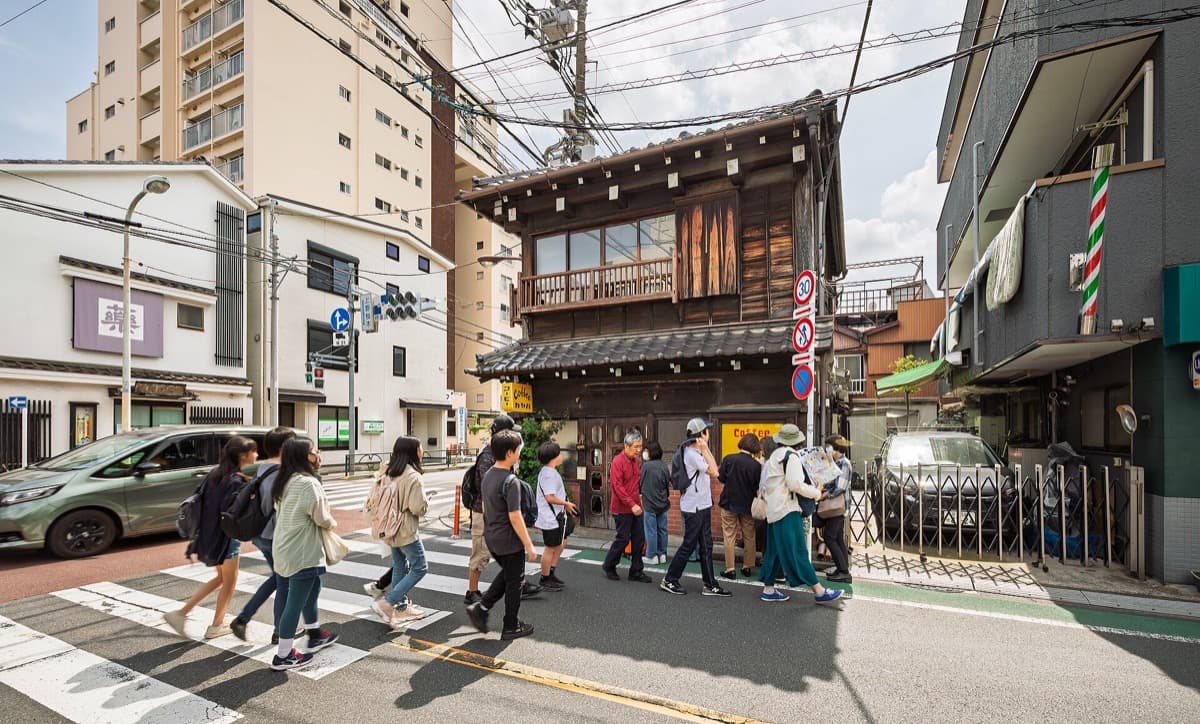
Kayaba Coffee is a wooden townhouse on a Yanaka corner that has poured coffee since 1938, and its long working life is the whole point. Built in 1916, closed after a death in 2006, and revived in 2009 by a local preservation group working with the team behind a nearby gallery, this small kissaten survived two catastrophes and one near-permanent closure. It shows what preservation looks like in Yanaka when a building is kept at work rather than frozen behind glass. Survival here is a verb.
Start with the fabric of the place. The building is a machiya, a traditional Japanese townhouse, and it dates to 1916. That single number carries weight, because most of old Tokyo cannot claim it. The pre-war city was destroyed twice inside living memory: first by the Great Kanto earthquake of September 1, 1923, and again by the American firebombing of 1945, whose raid on the night of March 10 was the deadliest single air attack in history. Between them they flattened almost everything wooden and low across the shitamachi, the low city. Yanaka sits on a ridge in the northeast of Tokyo, on high ground packed with temple firebreaks, and it was largely spared both. So this corner house is not a reproduction. It is one of the actual survivors, and its wooden frame stood through both disasters that erased the streets around it.
From milk hall to kissaten
The building did not begin as a coffee house. It opened as a milk hall and sweets shop, one of the small everyday businesses that filled the low city in the early twentieth century. It became the Kayaba coffee house, a kissaten, in 1938. The two catastrophes bracket that date on either side. The earthquake came before the coffee, the firebombing after, and the little corner came through both while still serving customers. A kissaten is a specific kind of place: a Japanese coffee house that took root in the Showa era, quieter and more domestic than a modern cafe, built around slow cups and regular faces. Kayaba is one of the neighborhood's most loved examples of the form, and for decades it was simply where people in Yanaka went to sit.
That is the ordinary miracle worth naming. The rarest survival in Yanaka is not a monument or a temple gate. It is ordinary life, uninterrupted. A coffee house that keeps its doors open across a century is a stranger thing to find in Tokyo than an old shrine, because commerce is fragile in a way stone is not. Owners age, tastes change, leases lapse. Kayaba kept working while the city around it burned twice and rebuilt itself in glass and concrete.
The near end, and the return
Hear a stop from this walk
Yanaka Cemetery: Where the Last Shogun Lies
The story almost stopped in peacetime, which is the part that makes it honest. The original owner closed the cafe in 2006, after his wife died, ending nearly seventy years of continuous service. For three years the corner was dark. A building can survive fire and earthquake and still quietly disappear when the person who runs it is gone. That is the ordinary way old places die, without drama, one shuttered door at a time.
Then, in 2009, it reopened. The revival was not a corporate takeover but a deliberate rescue. A local historical-preservation nonprofit, the Taito Cultural and Historical Society, worked together with SCAI The Bathhouse, the contemporary art gallery a short walk away, and in consultation with the Kayaba family and local residents, to bring the corner back. The renovation began in 2008 and the doors opened again in September 2009. They kept the original exterior and the old signage exactly as they were, and gave the inside a gentle refresh. The Taisho-era face was restored; the Showa-era warmth was kept.
The SCAI connection is not a coincidence, and it points to a pattern. SCAI The Bathhouse is itself a survival by reuse: a public bathhouse cited as built in 1787, the Kashiwayu, that was gutted and reopened in 1993 as a gallery, its tiled roof, brick chimney, and wooden shoe lockers all preserved while the interior became a white skylit hall. The same instinct that saved the bathhouse saved the coffee house. Both were rescued not by turning them into museums of themselves, but by keeping them at their jobs. One holds art now. The other still holds coffee.
Why the working door matters
This is a deeper kind of preservation than a plaque behind glass. A frozen building is remembered. A working building is used, and use is what kept Yanaka alive in the first place. The shopkeepers along nearby Yanaka Ginza, the roughly 170-metre shopping street of Showa-era wooden shops, did not preserve their street on purpose. They just kept selling croquettes and pickles and senbei crackers, and by working they kept the buildings standing. Kayaba is the same logic distilled to a single corner. Nobody freeze-dried it. They opened the door again and started pouring.
If you go, it is a working cafe. Entry is free, and you pay for what you order. The house classic is the tamago sando, a thick Japanese egg sandwich that has become the cafe's signature. Sit near the old glass, order one, and understand what you are sitting inside: a 1916 house that has outlasted an earthquake, a firebombing, and its own near-death, and answered all three by staying open.
Kayaba is the last stop on a walk through Yanaka precisely because it lands the argument. This ridge is precious not because it is charming, though it is, but because it is genuinely old, and it is genuinely old only because two catastrophes happened to miss it. Its second survival, the one you can taste, is that the people here refused to freeze what they saved. The buildings kept working. Sit down, and let survival be a verb.
You can walk the full Yanaka route, from Nezu Shrine to this corner, in the app: Tokyo.
Sources
- Kayaba Coffee - Time Out Tokyo: confirms the 1916 building, 1938 coffee start, 2006 closure, and 2009 reopening with SCAI The Bathhouse and the exterior kept intact.
- Kayaba Coffee House - Taireki: documents the machiya architecture, the milk-hall origin, the 2006 closure after nearly seventy years, and the 2008 renovation and September 2009 reopening by the Taito Cultural and Historical Society with SCAI The Bathhouse.
- SCAI The Bathhouse - Tokyo Art Beat: background on the former Kashiwayu bathhouse (cited as built 1787), reopened as a gallery in 1993, whose team helped revive Kayaba.
- Yanaka Cemetery - Wikipedia: context on Yanaka's survival of the 1923 earthquake and 1945 firebombing that shaped the neighborhood's preserved fabric.
Ready to experience it?
Yanaka: The Surviving Low City
85 min · 2.5 km · easy
More from Tokyo
Explore more at your own pace.
One Day in Tokyo: A Walkable Itinerary Across Three Faces (2026)
Tokyo Travel Guide: How Many Days, Getting Around, When to Go (2026)
The Low City and the High City: How to Read Tokyo Like an Edo Map
What to Eat in Tokyo: A Food Guide (2026)
Prada Aoyama: The Tokyo Glass Tower Where the Skin Is the Structure