Omotesando and Harajuku: The Architects' Catwalk
80 min · 2 km · easy
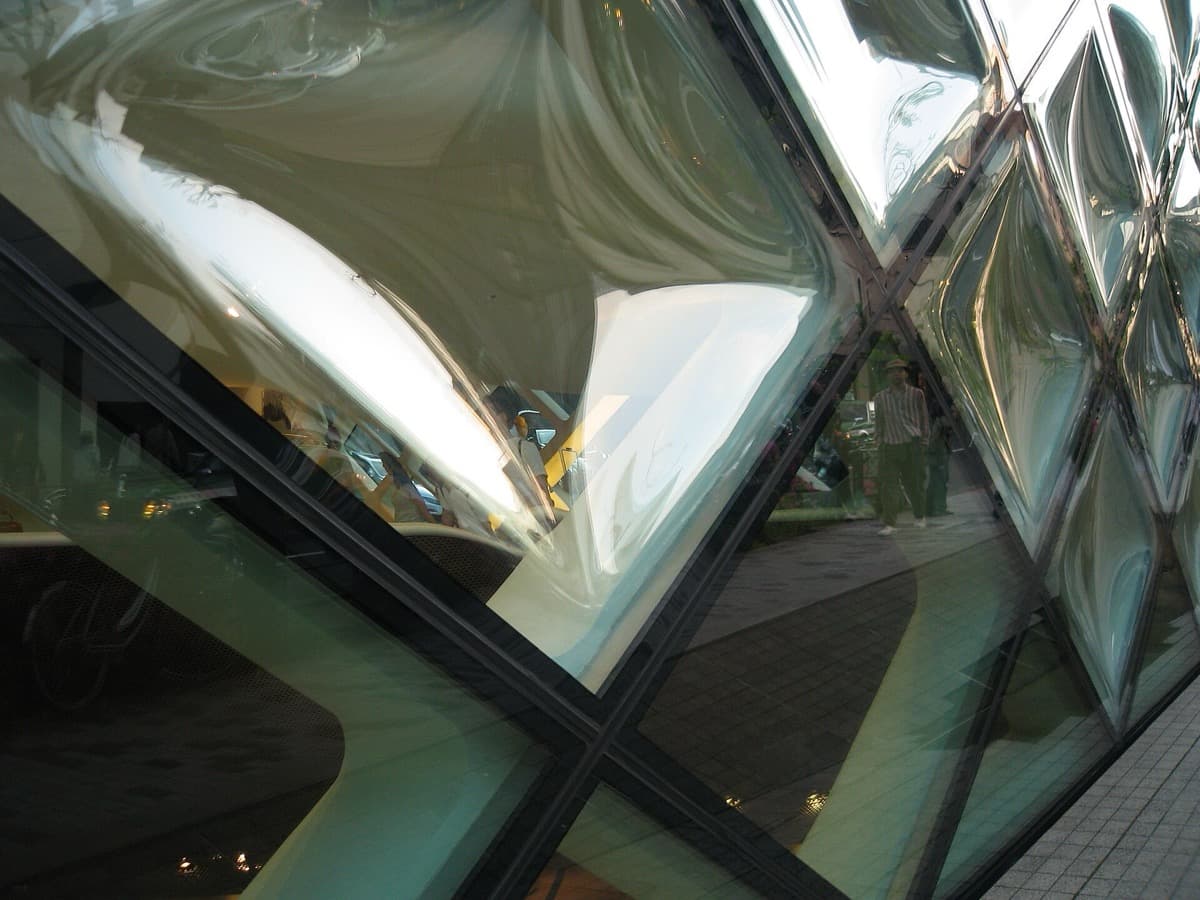
The Prada building in the Aoyama district of Tokyo looks like a single crystal of glass, its surface swelling and denting as if the whole tower were breathing. It is tempting to read that shimmering skin as pure fashion, an expensive wrapper on an ordinary box. That reading is wrong, and correcting it is the whole point. The diamond grid of glass is not decoration applied to a structure. It is the structure. The skin holds the building up. Once you know that, the Prada tower stops being a luxury bauble and becomes one of the clearest lessons in architecture on the whole Omotesando strip.
Architects of the surface
The building was designed by the Swiss architects Herzog and de Meuron and completed in 2003. Herzog and de Meuron are among the most influential architects of the era, known above all for treating a building's surface as its central idea rather than an afterthought, and Prada Aoyama is one of their most concentrated statements of that belief. It rises as a compact glass volume of seven levels on a tight site, and rather than filling every centimeter of its plot, it pulls back to release a small public plaza in front of it, a rare gift of open space in dense Aoyama.
That restraint is the first move. The second is what the glass actually does.
The grid that is the frame
Hear a stop from this walk
Prada Aoyama: The Crystal Where Skin Is Structure
Look closely at the facade and you see a grid of rhombuses, diamond-shaped panes running across the whole surface. The panels are not flat sheets. They are a mix of convex, concave, and flat glass, so that each pane acts like a lens, bulging or hollowing, catching and distorting the reflection of the city. Walk past it and Tokyo warps and slides across the surface. That is the effect everyone photographs.
But the grid is doing structural work at the same time. The rhomboid diagrid, the diamond lattice itself, works together with the building's vertical cores to carry the floor slabs at the perimeter. Because the diagrid holds up the edges of the floors, there is no need for a separate external frame or a row of columns around the outside. The glass lattice you are looking at is the skeleton. Inside, horizontal tubes align with the diamond modules to divide the open floors into zones of display and privacy. Everything you see, the pattern, the bulges, the tubes, is one integrated system in which the appearance and the engineering are the same thing. There is no ornament here. There is only structure that happens to be beautiful.
Why it belongs on the catwalk of architects
Omotesando is often called a catwalk of architecture, because the world's great architects have each built a flagship store along it, and the street reads as a gallery of contemporary design. Prada Aoyama is one of its purest exhibits, because it makes its argument so cleanly: the building is a demonstration that a surface can be a structure. That is exactly the theme Roamer's Omotesando and Harajuku: The Architects' Catwalk tour follows down the whole street. At Tod's Omotesando, the branching concrete of the facade is the frame, a pattern of trees that holds the floors. At Prada, the diamond glass is the frame. Two buildings, two materials, the same radical idea: dissolve the line between skin and skeleton. Reading them together is the best short course in structural facade design you can take on foot.
Reading it in place
Approach Prada Aoyama and first enjoy the surface honestly, the way the convex and concave panes bend the city as you move. Then make yourself see it as an engineer would. Notice there is no separate column grid around the outside, and understand that the diamonds themselves are carrying the floors. Step into the plaza the building gives back to the street. Then walk to Tod's a short distance away and compare how each solved the same problem in a different material. Come by day for the reflections; the glass is at its most alive in changing light.
The building anchors the architectural climax of Roamer's Omotesando and Harajuku. To fit the street into a day, see one day in Tokyo, and for the full set of routes, browse Tokyo walking tours.
Sources
- Herzog and de Meuron project documentation and architecture publications (ArchEyes, Arquitectura Viva, Studio International): the building designed by Herzog and de Meuron and completed in 2003, the seven-level compact glass volume on a small footprint releasing an urban plaza, the rhomboid diagrid facade clad in convex, concave, and flat glass panels acting as lenses, and the facade as an active structural component that works with the vertical cores to support the floor slabs at the perimeter, removing the need for a separate external frame, with interior horizontal tubes aligned to the diamond modules.
- Roamer tour transcript, Omotesando and Harajuku: The Architects' Catwalk (tokyo-omotesando-harajuku), fact-audited: Prada Aoyama as the crystal where skin is structure.
Ready to experience it?
Omotesando and Harajuku: The Architects' Catwalk
80 min · 2 km · easy
More from Tokyo
Explore more at your own pace.

One Day in Tokyo: A Walkable Itinerary Across Three Faces (2026)
Tokyo Travel Guide: How Many Days, Getting Around, When to Go (2026)
The Low City and the High City: How to Read Tokyo Like an Edo Map

What to Eat in Tokyo: A Food Guide (2026)
Kayaba Coffee: How a 1916 Townhouse Made Survival a Verb in Yanaka