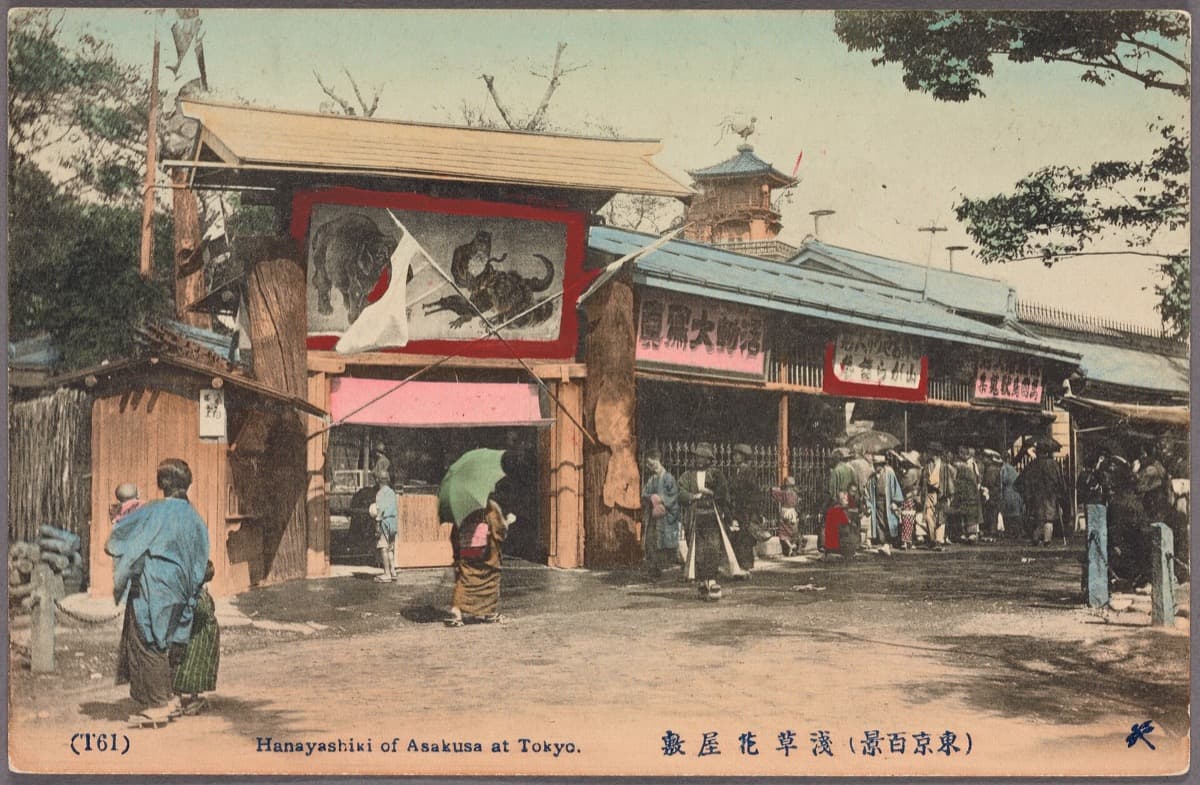
Rokku, the sixth district of Asakusa, is where Tokyo built the tower often called Japan's first skyscraper and where Japan got its first permanent cinema, and the fact that almost nothing of that entertainment core survives is the truest part of its story. Stand in the district today and there is no single grand monument to point at. There are arcades, a discount store, hotels, some modern shops, and a few theaters, among them Asakusa Engei Hall, which has put on rakugo every day of the year since 1964. Yet this ordinary-looking stretch, a short walk west of Sensoji, was once the loudest engine of mass entertainment in the country. It produced a tower billed as the tallest in Japan, and the country's first hall to show moving pictures full time. Then it lost both. To understand Rokku, you have to look at absence and read it as evidence.
The Twelve Storeys
The tower everyone remembered was formally the Ryounkaku, but the neighborhood called it Asakusa Junikai, the Twelve Storeys. It opened in November 1890 and rose twelve floors, the first ten in red brick and the top two in wood. It was advertised at about sixty-seven meters; a survey in 1911 measured it at about fifty-two. Either way it was the tallest building in Tokyo, and it is often called Japan's first skyscraper. The design came from a Scottish engineer named W. K. Burton, who worked in Japan during the Meiji period. For a city that had, until recently, measured its skyline in temple roofs and fire towers, the effect was almost unimaginable. For the price of a ticket, ordinary people could climb above the rooftops and look down on their own city.
The tower carried Japan's first electric elevator, designed by Ichisuke Fujioka. It should have been the marvel inside the marvel. Instead it lasted only about half a year before the police shut it down over safety concerns. That detail says a great deal about the Ryounkaku's whole character. It was a spectacle first and a piece of infrastructure second, a place people came to be astonished rather than to conduct business. Visitors climbed the stairs and kept coming anyway. The tower became shorthand for Asakusa itself, the place to see and be seen, printed on postcards and woodblock prints, folded into novels and songs.
Its end was sudden and total. On the first of September, 1923, the Great Kanto earthquake tore through Tokyo and broke the tower off above the eighth floor. The damaged brick shell was too dangerous to leave standing, and on the twenty-third of that same month army engineers finished bringing it down with explosives. The Twelve Storeys had lasted not quite thirty-three years. Nothing of it stands in Rokku now, but the ground has given it back twice: its foundations were uncovered in 1981 and again in February 2018, about 250 meters north of Asakusa Engei Hall, and a memorial plaque and a brick mural mark the site. If you did not know to look for them, you would walk straight past the ground where it stood.
The First Cinema
Hear a stop from this walk
Rokku: The Sixth District, Where the Show Moved
The second landmark that defines Rokku is the Denkikan. It opened in 1902 as a show-hall of electrical wonders, with X-ray demonstrations, and in October 1903 it was refitted as Japan's first permanent cinema. Before that, moving pictures in Japan were a traveling novelty, shown in rented halls between other acts, part of a variety bill. The Denkikan changed the arrangement. It gave the medium a home of its own, treating cinema as a standing public amusement rather than a passing curiosity, even if that home was rough: plank benches on a dirt floor, with the odd sideshow act still staged alongside the films. That commitment, made in a district already crowded with theaters and sideshows, helped fix Asakusa as the birthplace of Japanese film culture.
The name mattered as much as the building. Denkikan means, roughly, electric hall, a fitting name for a building that began as a show of electrical wonders, and the name travelled. The Kumamoto Denkikan, far to the southwest, opened under it in 1911 and has carried it for generations. The Rokku site now holds the Asakusa Denkikan Building, apartments over shops, completed in 1990 and still carrying the name. A model of the old hall's frontage is on show at the Edo-Tokyo Museum, which reopened in March 2026, a fitting fate for a building whose real legacy was an idea rather than a structure.
Reading An Absence
Put the two together and the pattern of Rokku becomes clear. The same temple that draws pilgrims through the Thunder Gate had long drawn showmen to Okuyama, the ground behind its main hall. In 1884, when the temple grounds had become a public park, Rokku was laid out on filled-in rice paddies to the west to take their show-booths. That district gave Tokyo its tallest tower and Japan its first permanent cinema within about thirteen years of each other. The incense drifting from Sensoji and the flicker of the country's earliest dedicated film screen came from the same neighborhood, feeding the same crowds of pilgrims and pleasure-seekers who had always mixed prayer with amusement in Asakusa.
This is why Rokku rewards a slow, attentive walk more than a photograph. There is little to frame in a picture. What is here is the shape of a place that invented forms of mass entertainment and then survived the loss of the very buildings that made it famous. The earthquake took the tower. The century took the cinema. The district kept going, absorbing discount stores, hotels and modern arcades the way it once absorbed opera houses and sideshows. Entertainment in Asakusa has always been restless, always ready to tear down last decade's marvel for the next one.
When you stand in Rokku, you are walking through the memory of where a great deal of modern Japanese amusement was, in many ways, first made permanent. The absence of the Twelve Storeys and the Denkikan is not a gap in the story. It is the story. This is the plebeian, ever-reinventing heart of the low city, and it does its most important remembering out loud, in the noise of the machines that replaced the ones before them.
To walk Rokku in sequence, from the Sumida River where the whole neighborhood began, through the Thunder Gate and Sensoji, follow the self-guided Asakusa and Senso-ji: Where Tokyo Came to Pray and Play, or browse every route in Tokyo.
Sources
- Hosoma Hiromichi, column for the National Film Archive of Japan's Great Kanto Earthquake film archive (kantodaishinsai.filmarchives.jp/columns/c01.html), and the archive's demolition clip notes citing Tokyo City's earthquake record of 1926 (kantodaishinsai.filmarchives.jp/clips/m01_047.html): where the tower stood, its collapse above the eighth floor, the demolition by army engineers completed on 23 September 1923, and the 1981 and 2018 foundation finds.
- Tokyo Metropolitan Library print notes, University of Tokyo Library exhibition (2012), Taito City culture pages, and the Kanto District Transport Bureau's 2025 study: the November 1890 opening, brick to the tenth floor and wood above, the advertised height of about 67 meters against about 52 meters measured, and the tower as the tallest building of its day.
- National Diet Library Collaborative Reference Database (Tokorozawa Library answer, quoting Hosoma 2001 and other printed sources, and Taito City Board of Education answer on the 2018 find): Japan's first electric elevator, Fujioka Ichisuke, the police stopping it in May 1891, and the 2018 foundation site.
- Edo-Tokyo Museum permanent exhibition (reopened 31 March 2026): W. K. Burton as designer, the Denkikan as Japan's first permanent cinema in 1903, and the model of its frontage.
- Ueda Manabu, paper on the emergence of permanent cinemas and the Denkikan of the 1900s (Art Research vol. 9, Ritsumeikan University): the Denkikan's 1902 opening as an electricity show-hall, its October 1903 refit, the benches on a dirt floor, and the making of Rokku from filled-in paddies in 1884.
- Tokyo Shimbun (2018): the mural set with bricks from the 2018 dig. Toshi Shogyo Kenkyusho (2022): the memorial plaque beside the supermarket now on the tower site.
- Kumamoto City tourism guide: the Kumamoto Denkikan, opened in 1911. Satohide (builder): the Asakusa Denkikan Building, completed in 1990 on the Denkikan site. Asakusa Engei Hall official site: rakugo every day of the year since 1964.
- Roamer tour transcript, "Asakusa and Senso-ji: Where Tokyo Came to Pray and Play," Stop 8 (Rokku and Asakusa Engei Hall). Primary narration for this self-guided walk, fact-checked against primary sources.
- GO TOKYO official travel guide, Tokyo Metropolitan Government. Context on Asakusa as an entertainment and temple district.
Ready to experience it?
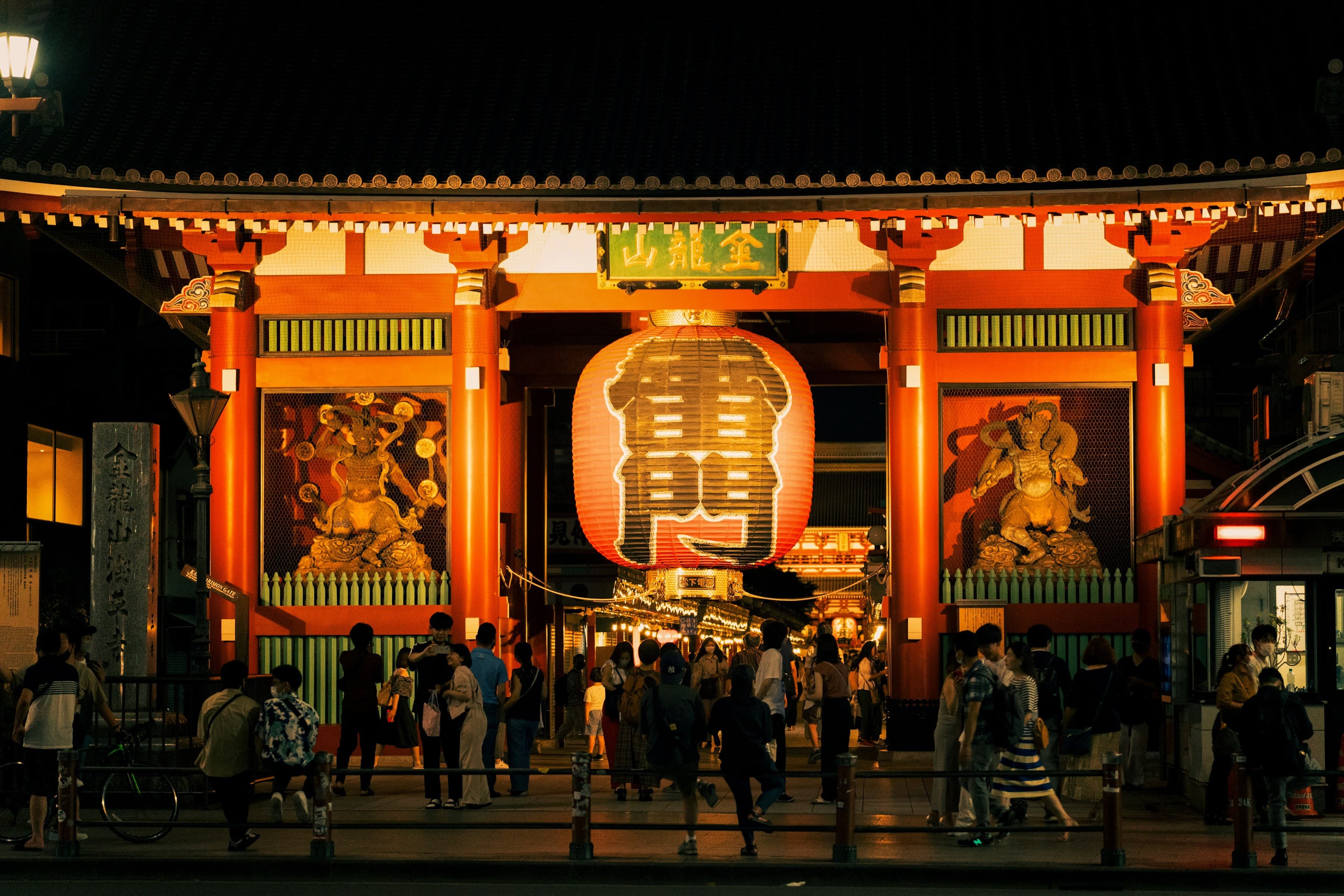
Asakusa and Senso-ji: Where Tokyo Came to Pray and Play
75 min · 1.5 km · easy
More from Tokyo
Explore more at your own pace.
One Day in Tokyo: A Walkable Itinerary Across Three Faces (2026)
Tokyo Travel Guide: How Many Days, Getting Around, When to Go (2026)
The Low City and the High City: How to Read Tokyo Like an Edo Map
What to Eat in Tokyo: A Food Guide (2026)
Prada Aoyama: The Tokyo Glass Tower Where the Skin Is the Structure