Imperial Palace: Edo Castle, Gate by Gate
80 min · 2.9 km · easy
Edo Castle was built to be entered slowly, gate by gate and rank by rank, and at its top its own rulers decided in 1658 that an age of peace needed no keep. The shogun's castle became the emperor's palace and, since 1968, its heart has been a garden anyone can walk into. This walk, eleven stops over about 2.9 kilometres and roughly eighty minutes, goes in the way the castle meant you to: through gates that make you turn, past guardhouses ranked one above the other, up to the empty stone base of the keep and down to a garden at the bottom.
Gates that make you turn
The first stop, Sakuradamon, teaches the grammar of the whole castle. You pass a small, sturdy outer gate and find yourself in a square court of stone walls. The way on does not continue straight. It turns at a right angle under a large gatehouse. This is a box gate, a masugata, and the design is plain to read: an attacker who broke the small gate was trapped in the square, forced to slow down and turn while archers fired from above. The gate you see was rebuilt after a fire of 1772, and after the 1923 earthquake it was taken apart and put back with a modern skeleton of bolts, mortar and a hidden truss.
Sakuradamon also carries the castle's most famous act of violence. On a snowy morning in March 1860, the shogunate's chief minister, Ii Naosuke, was killed outside it by radicals opposed to his treaties with foreign powers. Seven years later the shogunate was gone.
Keep the box shape in mind. You meet it again at Otemon, the castle's main gate in the shoguns' time, used by the shogun and the great lords. Its big gatehouse was destroyed in the war and rebuilt in 1967, but the layout is the same small gate, large gate and turn.
The postcard view, and what it hides
Hear a stop from this walk
Ninomaru Garden: An Edo Plan, Made in 1968
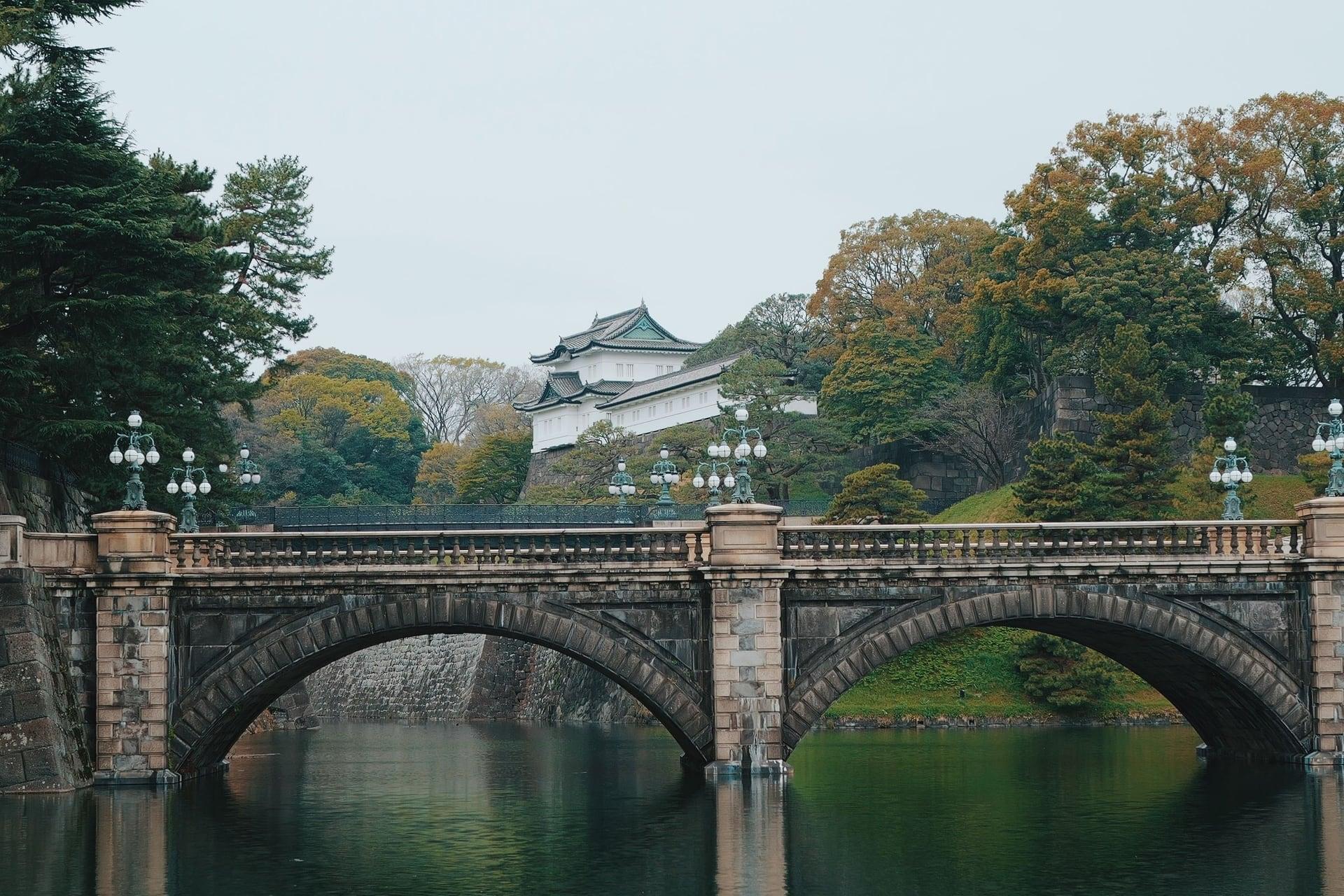
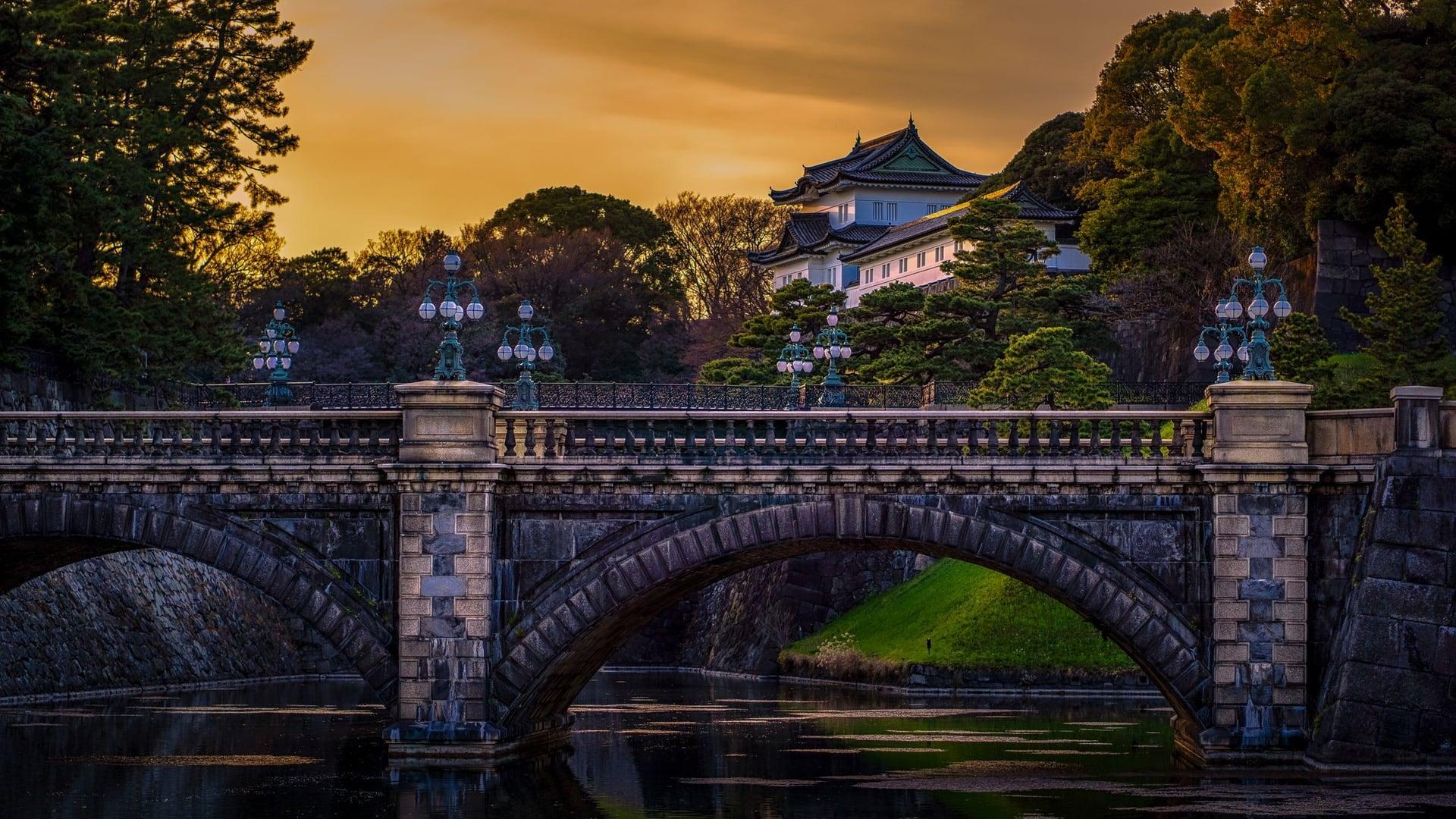
Nijubashi, the bridge on every postcard, is a small lesson in reading names. Most people use the word for both bridges in view, the stone one with two low arches and the higher iron one behind it. The Ministry of the Environment notes that strictly it belongs to the far bridge, whose earlier version needed a stand halfway across and so was built in two tiers. Above them on the wall stands Fushimi Yagura, a corner tower. Beyond lies the palace itself, rebuilt between 1964 and 1968 after the Meiji palace burned in an air raid in May 1945. None of it shows from the railing.
Walk on across the plaza and notice the open ground. About two thousand black pines stand in lawns that were once packed with the mansions of the shogun's senior officials. After the shogunate fell, the new government cleared the land, planted pines from 1888 and shaped one great open square in front of the palace. Office towers press up to the moats, and in the middle is gravel and pruned pine.
Rank by rank
Once through Otemon you are in the East Gardens, and the castle's second principle takes over: the closer you came to the shogun, the higher the rank of the men who checked you. Hyakunin-bansho, the hundred-man guardhouse, runs forty five metres along the path. The Imperial Household Agency says four musketeer companies took turns here day and night, each of twenty officers and a hundred foot soldiers. A smaller guardhouse below it was for low-ranking guards; a third one above, for higher-ranking samurai, was restored in 1968.
Look up at the walls of the next gate. The stones are cut into long rectangles and laid dry, without mortar, fitted with small gaps. Lords from Kumamoto first built this wall in 1638, and it was taken down and rebuilt between 2005 and 2007 after centuries of bulging. On the way up you also pass Fujimi Yagura, the Mount Fuji viewing tower, which you first saw from outside across the moat. The agency calls it the only surviving three-roofed tower of the castle; it burned in 1657 and was rebuilt in 1659.
The decision at the top
At the top of the castle a stone marker shows where the Corridor of Pines ran, the hall where in 1701 the lord of Ako drew his sword on a court official. That attack set off the revenge of his retainers, the story Japan knows as Chushingura.
Then comes the walk's turning point: the Tenshudai, the base of the keep. The keep completed in 1638 had five roofs and stood about 58 metres from the ground, which the Imperial Household Agency calls the tallest castle keep Japan ever had. The great fire of 1657 destroyed it. The next year the stone base was rebuilt, and the keep never was. Hoshina Masayuki, uncle and guardian of the fourth shogun, argued that a keep was unnecessary in a peaceful age, and his view prevailed. Everything you walked past was built for war, and at the summit the castle's own rulers chose to leave its greatest tower unbuilt. The empty platform is that choice in stone.
From castle to garden
The descent, down the steep Shiomizaka slope, once looked out over an inlet of the sea where Tokyo Station now stands. At the bottom lies the Ninomaru Garden. It looks old and is not: the agency says the stroll garden was made for the opening of the East Gardens in 1968, laid out from a garden drawing of about the middle of the eighteenth century. The gardens opened on 1 October 1968 and entry is free on the days they are open.
Walking it yourself
The first six stops are outside the East Gardens and the last five inside, so check the gardens' opening days before you set out; the tour explains the way round on a closed day. It is a walk that rewards going slowly, which is the castle's own logic, and you can pause at any gate or skip the optional climb onto the keep platform. The tour is free to start and runs on your own schedule.
Begin at stop 1 of Imperial Palace: Edo Castle, Gate by Gate, and see the other walks on the Tokyo city page. The Tsukiji and Ginza walk ends at Sukiyabashi, where the castle's outer moat once ran.
Sources
- Imperial Household Agency, East Gardens structures and gardens (https://www.kunaicho.go.jp/visit/higashigyoen/structures-gardens/): the 1638 keep at about 58 metres, the 1657 fire, Hoshina Masayuki's view, Hyakunin-bansho's 45 metres and musketeer companies, Fujimi Yagura rebuilt 1659, and the Ninomaru Garden made for the 1968 opening.
- Imperial Household Agency, East Gardens overview (https://www.kunaicho.go.jp/e-event/higashigyoen02.html): the gardens built on the former Honmaru, Ninomaru and Sannomaru and open to the public since 1968.
- Ministry of the Environment, Kokyo Gaien National Garden (https://www.env.go.jp/garden/kokyogaien/): the lawn plaza with its black pines, moats and gates.
- Roamer tour research for the Imperial Palace walk (audited transcript and fact dossier): Sakuradamon's construction and the 1860 attack, the naming of Nijubashi, the plaza's history, Otemon, the Nakanomon wall and Shiomizaka.
Ready to experience it?
Imperial Palace: Edo Castle, Gate by Gate
80 min · 2.9 km · easy
More from Tokyo
Explore more at your own pace.

Best Culture Walking Tours in Tokyo (2026)
Best History Walking Tours in Tokyo (2026)
Best Nature Walking Tours in Tokyo (2026)
Asakusa and Senso-ji: Why the Grand Buildings Are Young and the Survivors Are Small
Meiji Jingu: The Forest That Was Built to Outlive Its Builders