María Luisa Park and the Plaza de España are one long project. A palace garden left to Seville in a princess's will became a public park in 1914, and then the ground of a world's fair planned for 1914 and opened, fifteen years late, in 1929. Plaza de España: The Garden That Became a World's Fair walks it north to south in twelve stops, about 2.6 km and 75 minutes, and every stop is a piece of it.
The palace whose garden came first
The walk starts at the Palacio de San Telmo, stop 1, today the seat of Andalusia's regional president. It began as a naval college; the Duke and Duchess of Montpensier lived there from 1849. Its main front and portal face west, toward the river, and the side you see from the Puerta de Jerez is the newest part. The Infanta María Luisa died in the palace on 2 February 1897. Her will, dated 1893, left the building to the archbishop and most of its gardens to the city, for the future park that carries her name. So she left the gardens, rather than giving them in 1893, as guides often say.
The fair's front door
Hear a stop from this walk
Palacio de San Telmo
At stop 2, the Puerta de Jerez, Seville's old south gate stood until 1864. The 1929 Exposition dressed the spot for its visitors: the fountain of Seville surrounded by children and turtles, installed in 1929 to mark the fair, and the Hotel Alfonso the Thirteenth, opened on 28 April 1929. The fair had been meant to open in 1914. A historian of the event, Lara Campos Pérez, writes that the first project failed mainly for lack of money; Portugal and Brazil were invited in 1921, the name changed from Hispano-American to Ibero-American, and the Exposition finally opened on 9 May 1929. It closed in June 1930.
The factory it grew around
The Royal Tobacco Factory, stop 3, was already here, built from 1728 to 1758 for the crown's tobacco monopoly. The University of Seville's heritage record explains its oddest feature: the original building had a single door, facing north, for the greatest control against theft or fraud, and a moat with sentry boxes ran round it. The other three portals are from a reform of 1950. It has been the university's since the mid twentieth century. Carmen, who worked here in Mérimée's novella and Bizet's opera, is fiction.
Then the fair's own pieces: the bronze El Cid by the American sculptor Anna Hyatt Huntington at the main entrance, stop 4; the Teatro Lope de Vega, stop 5, whose domed hall was the Exposition's casino and which reopened in September 2026 after a city refurbishment of about 10 million euros; and, in the park, the monument to the poet Bécquer of 1911, stop 6, older than the fair.
The plaza that faces America
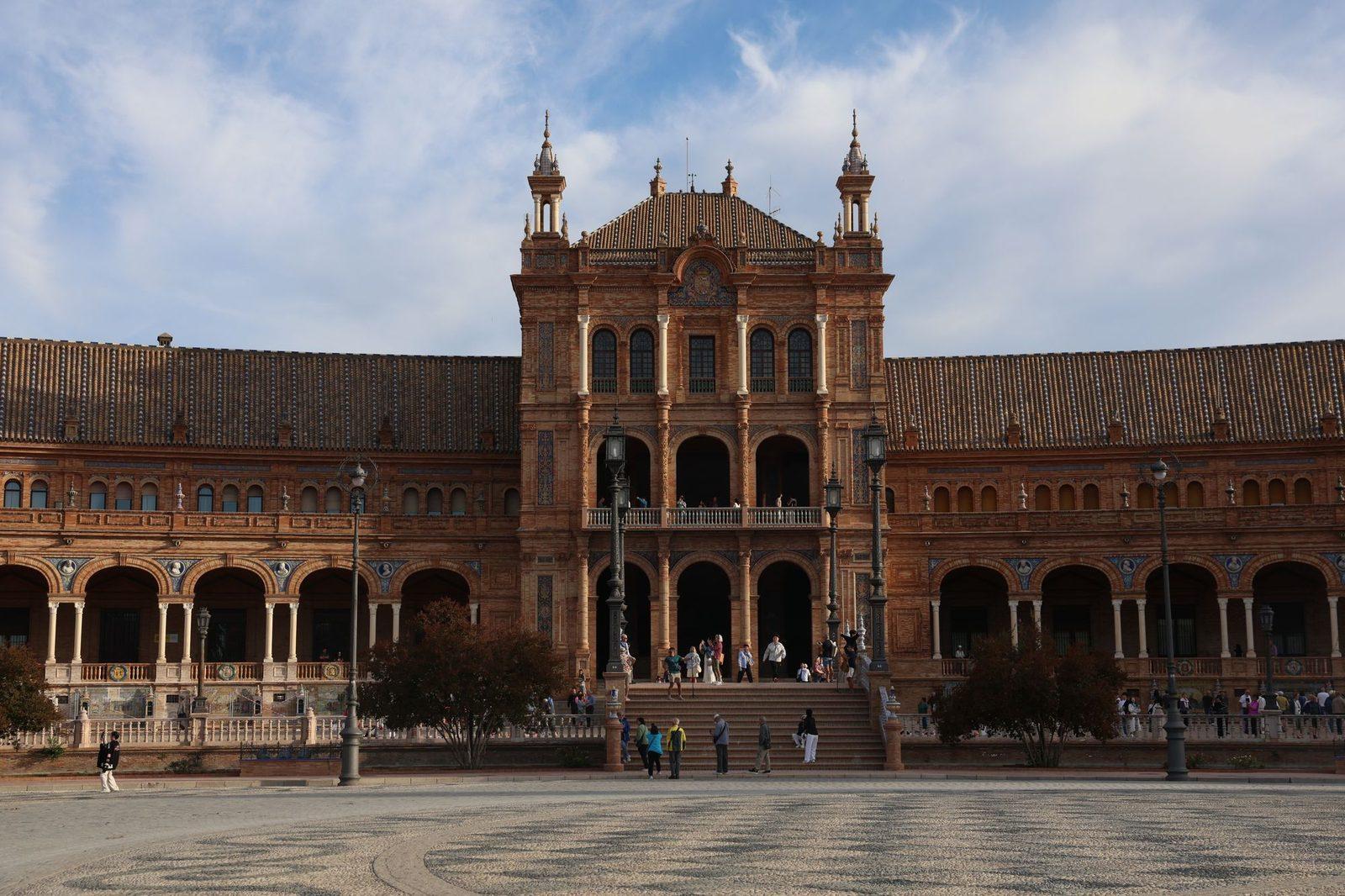
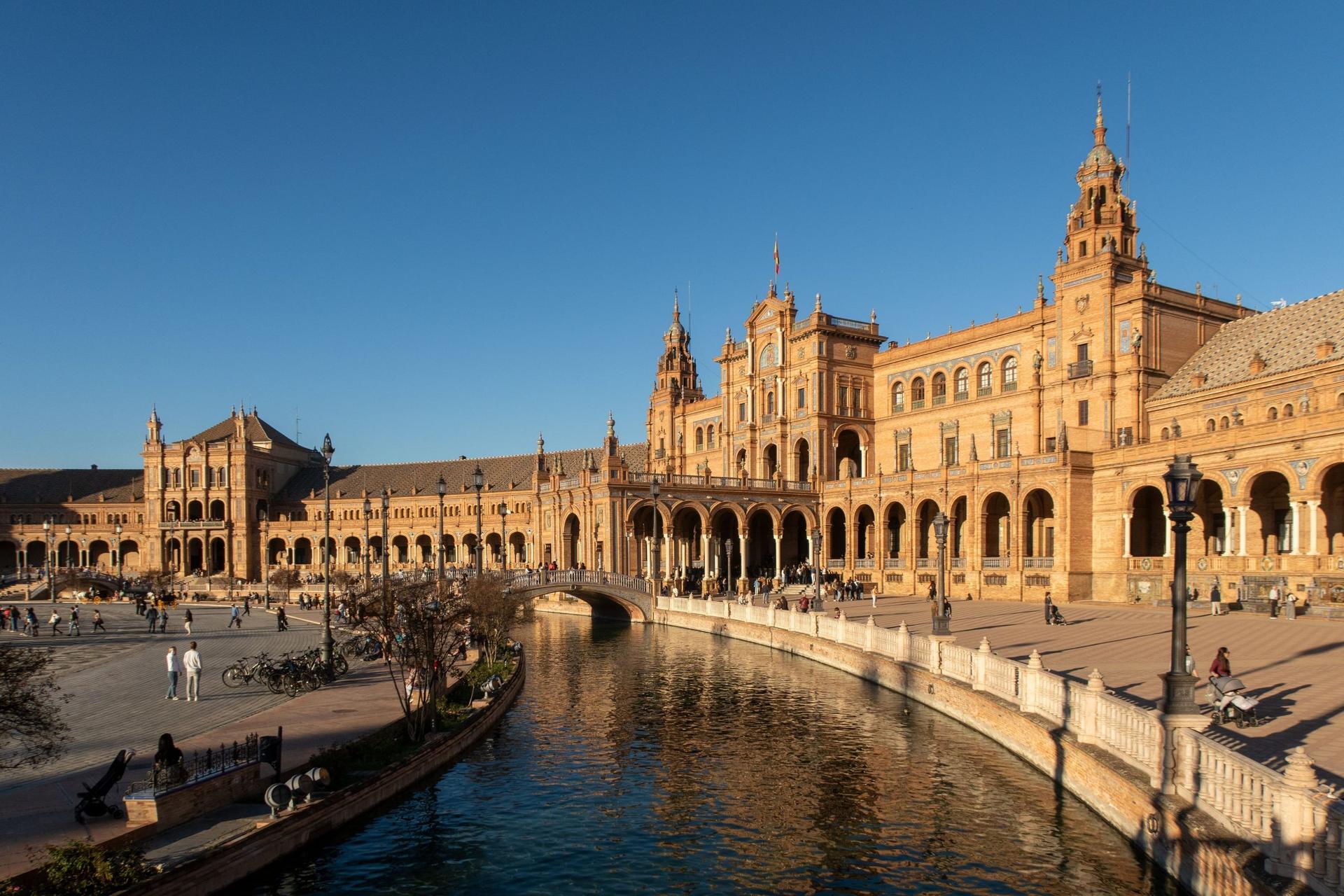
The Plaza de España, stops 7 to 9, came from a competition of 1911 won by Aníbal González, whose statue stands on its axis. The royal decree that protected it in 2023 gives the figures: a half circle 230 meters across between towers 74 meters high, built mainly of brick, with 48 benches against the facade dedicated to Spain's provinces, each with its tile map and a scene from its history, and a canal 510 meters long crossed by four bridges named for Castile, León, Aragon and Navarre. Guides often say 515 meters; the decree says 510. Its shape, the decree says, symbolizes Spain's embrace of its former American territories, facing the Guadalquivir as the road to America. That was the organisers' message, under the dictatorship of Primo de Rivera. The benches run in alphabetical order, and Seville province has none.
A French gardener's park
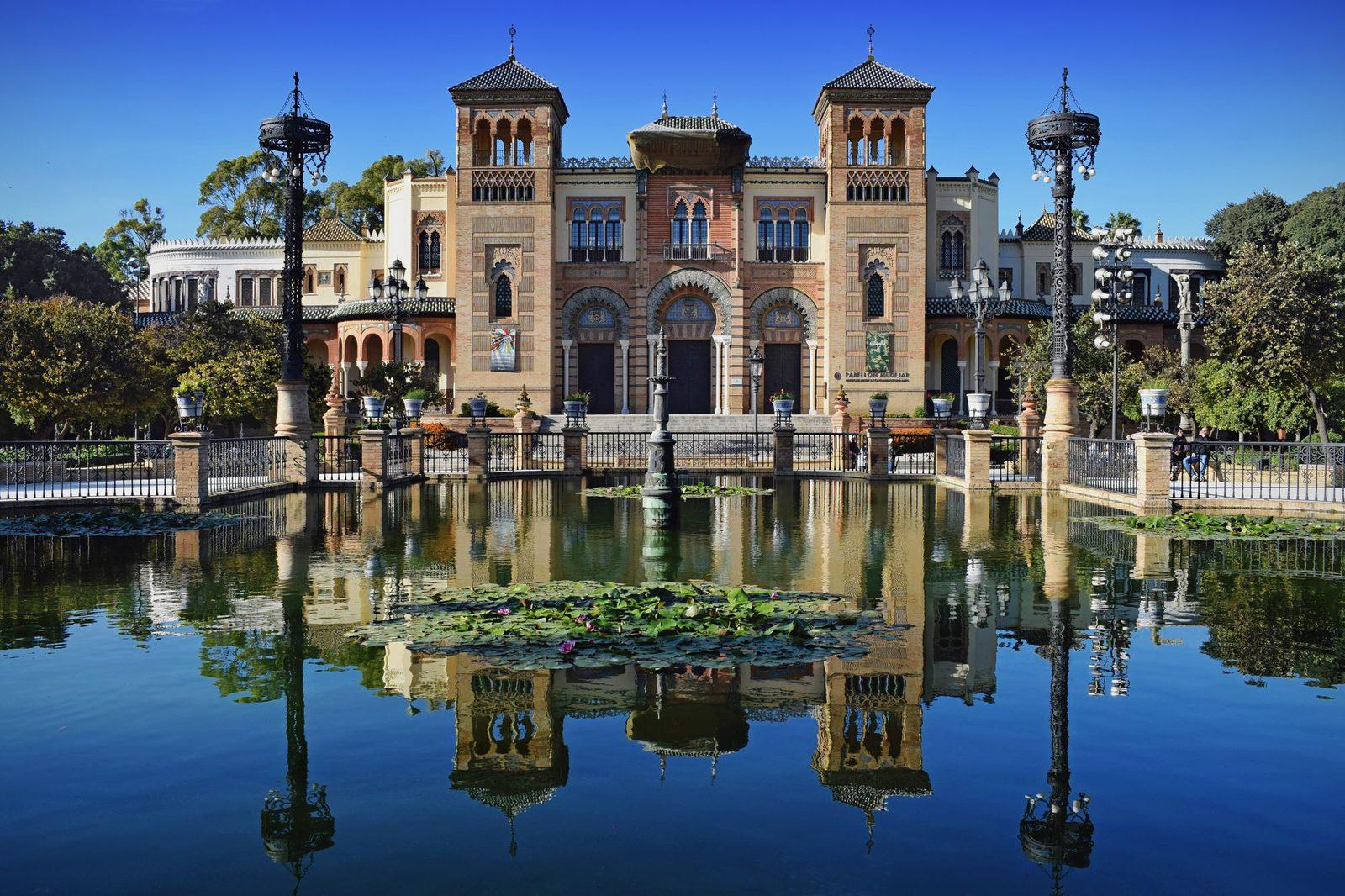
The park itself was remade between 1912 and 1922 by Jean-Claude Nicolas Forestier, chief gardener of the Bois de Boulogne, who turned a palace garden into a public one with references to the Alhambra and the Alcázar. The walk passes his duck pond and his lion fountain, stops 10 and 11, and ends at the Plaza de América, stop 12, where Aníbal González built three pavilions in Mudéjar, Gothic and Renaissance dress. Our piece on María Luisa Park tells the garden's side.
Walking it
The walk starts on the forecourt of San Telmo on the Avenida de Roma, about 250 meters from the Puerta de Jerez Metro station, and ends at the Plaza de América. Everything on it is free and open: the plaza is municipal, and a 2024 plan to fence it and charge was refused. The park opens daily from 8:00 to midnight by the tourist office's page. From 5 December 2026 to 5 January 2027 a craft fair fills the Jardines del Cristina beside the Puerta de Jerez. In summer, go early: the Plaza de América is fully exposed to the sun.
The tour is free to start in the Roamer app: the introduction and first stop play in full, and every later stop plays a short preview. No group, no fixed start, your own pace. A good part of the plaza's tiles were made across the river in Triana: see the Centro Cerámica Triana.
Ready to experience it?
Plaza de España: The Garden That Became a World's Fair
75 min · 2.6 km · easy
More from Seville
Explore more at your own pace.
Seville Monument Tickets, Hours and Closures (Checked November 2026)
Best History Walking Tours in Seville (2026)
Las Setas and the Macarena: A Companion to Seville's Northern Old Town
Alameda de Hércules, Seville: The Lagoon That Became a Garden
María Luisa Park, Seville: A Princess's Will and a French Gardener