Northern Seville can be read in layers from the street. Roman and Andalusi houses are kept under a timber roof of 2011; Mudéjar parish churches stand on the plots of mosques; a flood hollow was drained in 1573 and 1574 to make a public promenade; a palace was kept by its tenants; and the twelfth-century wall still stands at the edge it drew round the city. Las Setas and the Macarena: From Roman Houses to the Wall walks those layers in thirteen stops, about 2.9 km and 80 minutes, from the Plaza de la Encarnación to the wall at the Macarena.
A timber roof over Roman houses
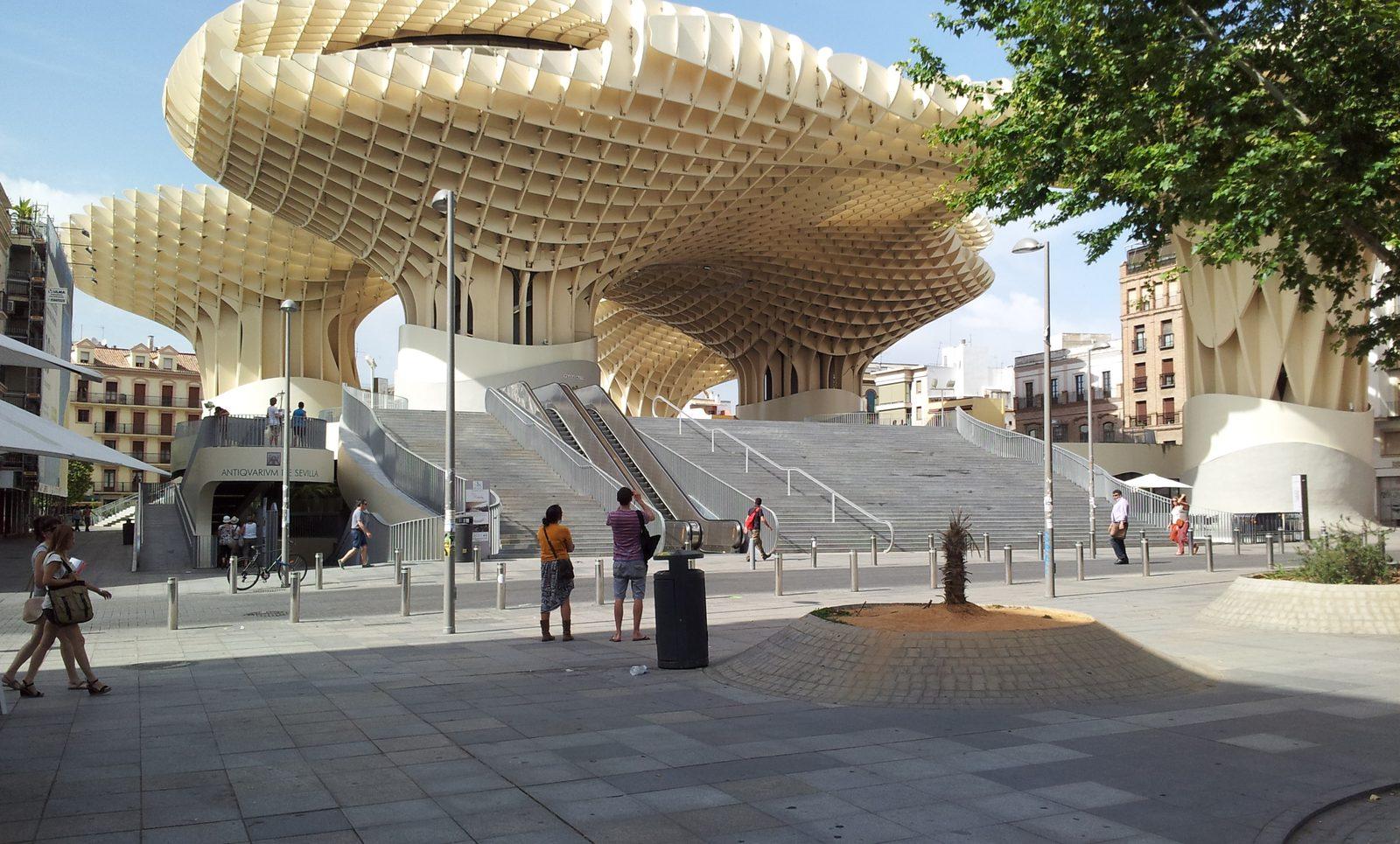
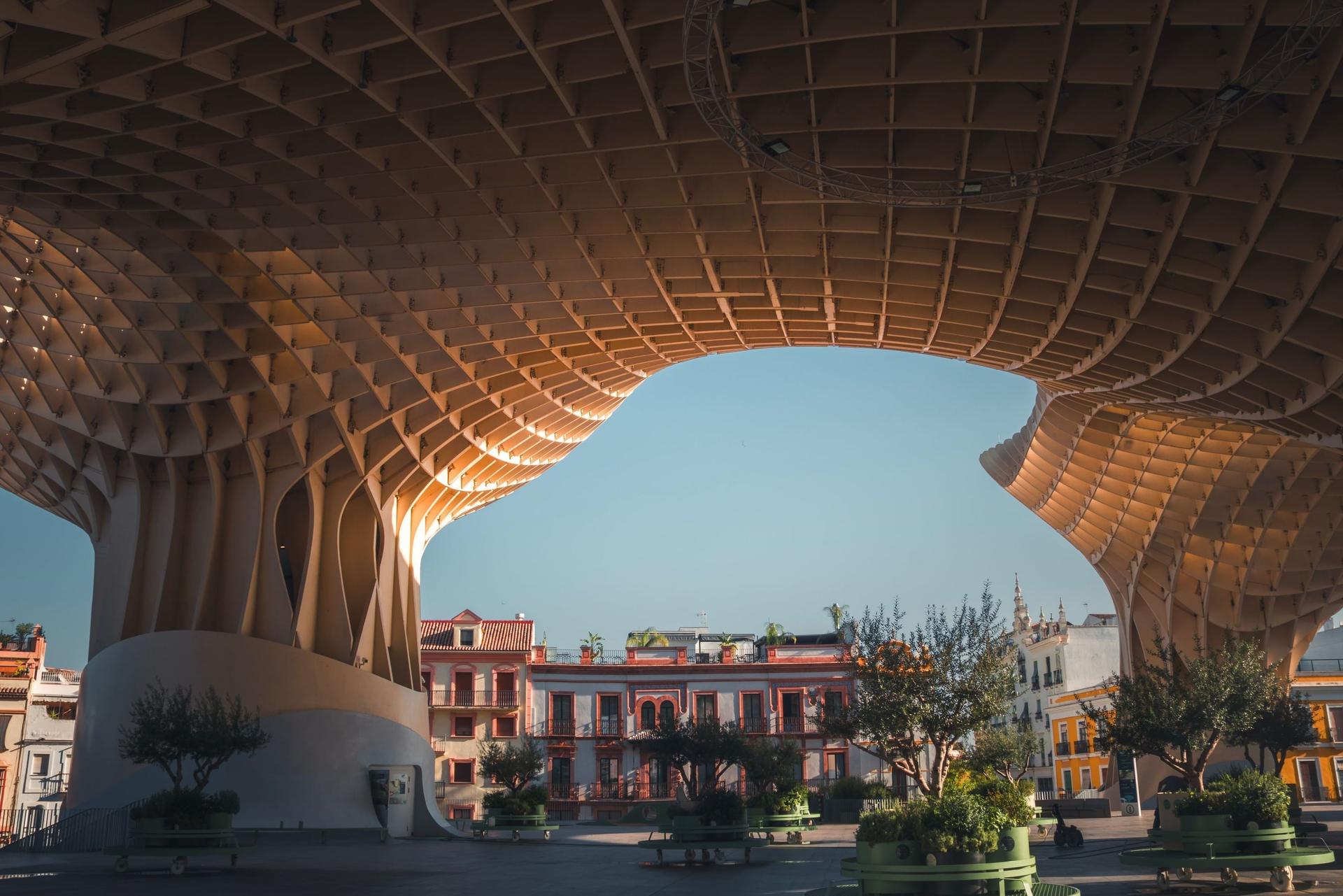
Las Setas, the Mushrooms, is the city's nickname for the Metropol Parasol, stop 1. A competition was held in 2004 and won by the architect Jürgen Mayer H. with Andre Santer and Marta Ramírez Iglesias, with the engineers Arup. The architecture journal Arquitectura Viva describes six parasols between 20 and 26 meters high, covering about 150 by 75 meters, in microlaminated fir sealed with a few millimeters of polyurethane, over a raised plaza, a market, and a museum of Roman and Andalusi remains found during the works. It opened in 2011. The operator's banner calls it the largest wooden structure in the world; that is their claim. Before the parasols the site was a convent, then a market, then a parking lot.
Churches on mosque plots
Hear a stop from this walk
Las Setas
Seville surrendered in November 1248, and its new parishes rose in the old neighborhoods. Diego Velázquez was baptized at San Pedro, stop 2, in June 1599; his birth date is unknown, so this is the painter's first record. Santa Catalina, stop 3, wears a Gothic doorway moved there in 1930 from another church, Santa Lucía. At San Juan de la Palma, stop 5, the proof of an older building is in a museum: an inscription found in the church, now in Seville's Archaeological Museum, links the raising of a mosque's minaret to the king al-Mutamid and his consort Rumaykiyya at the end of the eleventh century. Between them, stop 4, the Palacio de las Dueñas hides behind its gate; the poet Antonio Machado was born in one of its dwellings on 26 July 1875, and opened a famous poem with the line that his childhood is memories of a patio in Seville.
A drained lagoon
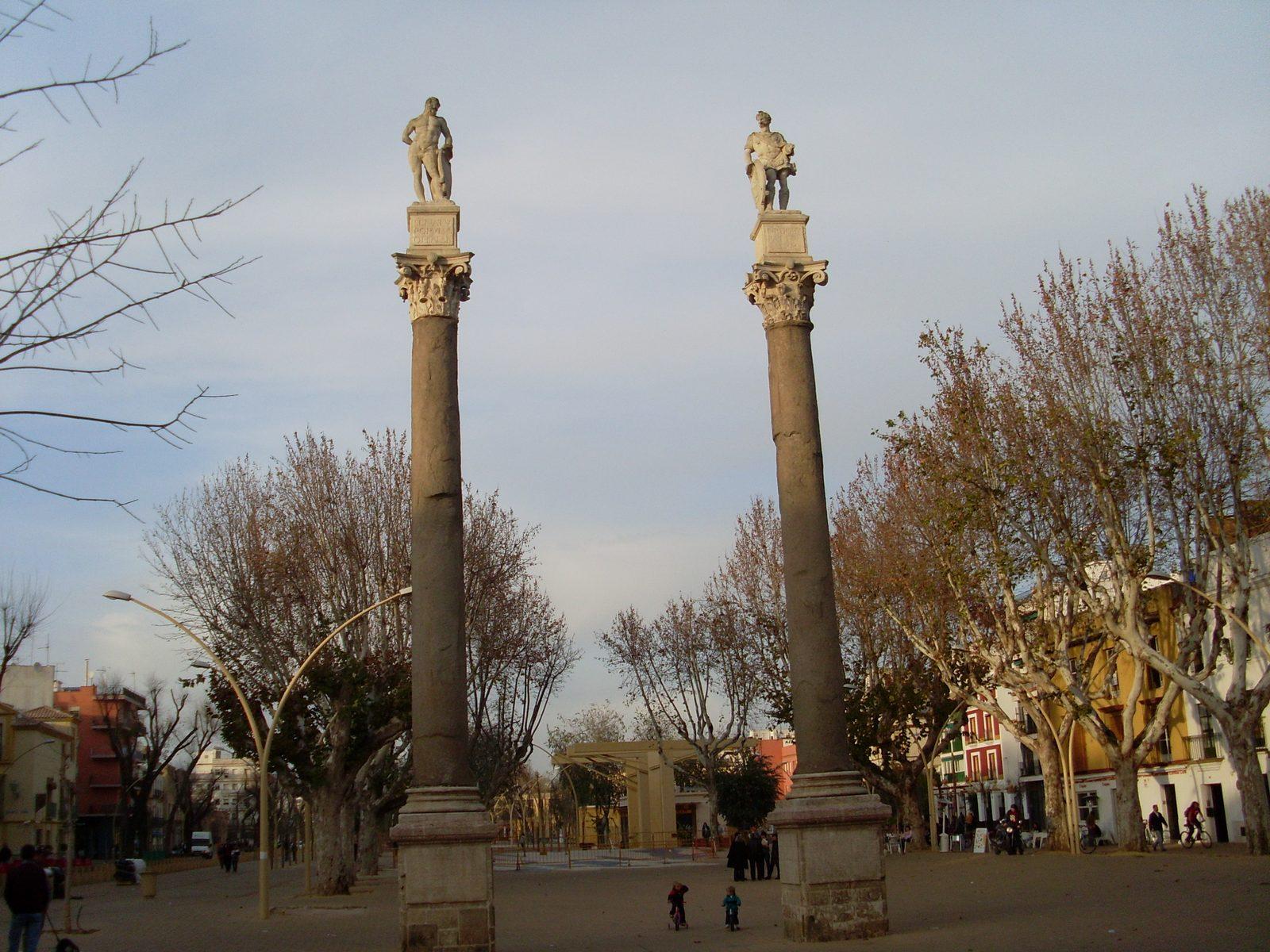
The Alameda de Hércules, stops 6 and 7, began as a flooded hollow. A chronicler of 1587 explains that a flood broke in here, the houses fell from the water and damp, and the place took the name of the Lagoon, until the Count of Barajas drained it in 1573 and 1574, brought water to three fountains and raised two Roman columns crowned with Hercules and a Roman general. The full story, and the claim it is not, is in our piece on the Alameda.
A market, a palace and the people who kept it
Calle Feria, stop 8, holds a covered market and the church of Omnium Sanctorum on one block. El Jueves, the Thursday street market a block off the route, was first recorded in 1292 under King Sancho the Fourth and moved to Calle Feria in the nineteenth century. Past the Jesuit church of San Luis de los Franceses, stop 9, the Casa Palacio del Pumarejo, stop 10, tells a modern story: an eighteenth-century palace that became a tenement in 1883, saved from a hotel scheme by its neighbors' campaign and protected in 2003.
The wall
The walk ends at the city's medieval edge. The Basílica de la Macarena, stop 11, was built from 1941 to 1949 by Aurelio Gómez Millán and is the home of the Esperanza Macarena brotherhood, which processes in the early hours of Good Friday. Next to it, stop 12, the Puerta de la Macarena looks classical because it was refaced in 1723 and 1795; underneath it is a fortified gate. A study of the walls by Jiménez Maqueda dates them to the Almoravids in the 1120s and 1130s, raised and given vaulted towers and an outer wall by the Almohads in the first quarter of the thirteenth century. Stop 13 is the wall itself, running east from the gate for roughly 400 meters with its towers.
Walking it
The walk starts at the Setas' south edge on Plaza de la Encarnación and ends on the wall's footway by the Torre Blanca on the Ronda. It crosses one signalled road, at Plaza de San Pedro, and none with a tram. Everything on it works from the street; the Setas' walkway (from 16 euros, 09:30 to 01:00) and the Antiquarium (2 euros, Tuesday to Sunday, free for Seville residents and under-16s) are optional, checked on 23 November 2026, and our tickets and hours guide has the rest. Go on a Thursday morning for El Jueves.
The tour is free to start in the Roamer app: the introduction and first stop play in full, and every later stop plays a short preview. No group, no start time; stop for a drink on the Alameda whenever you like.
Ready to experience it?
Las Setas and the Macarena: From Roman Houses to the Wall
80 min · 2.9 km · easy
More from Seville
Explore more at your own pace.
Seville Monument Tickets, Hours and Closures (Checked November 2026)
Best History Walking Tours in Seville (2026)
Plaza de España, Seville: A Companion to the Garden That Became a World's Fair
Alameda de Hércules, Seville: The Lagoon That Became a Garden
María Luisa Park, Seville: A Princess's Will and a French Gardener