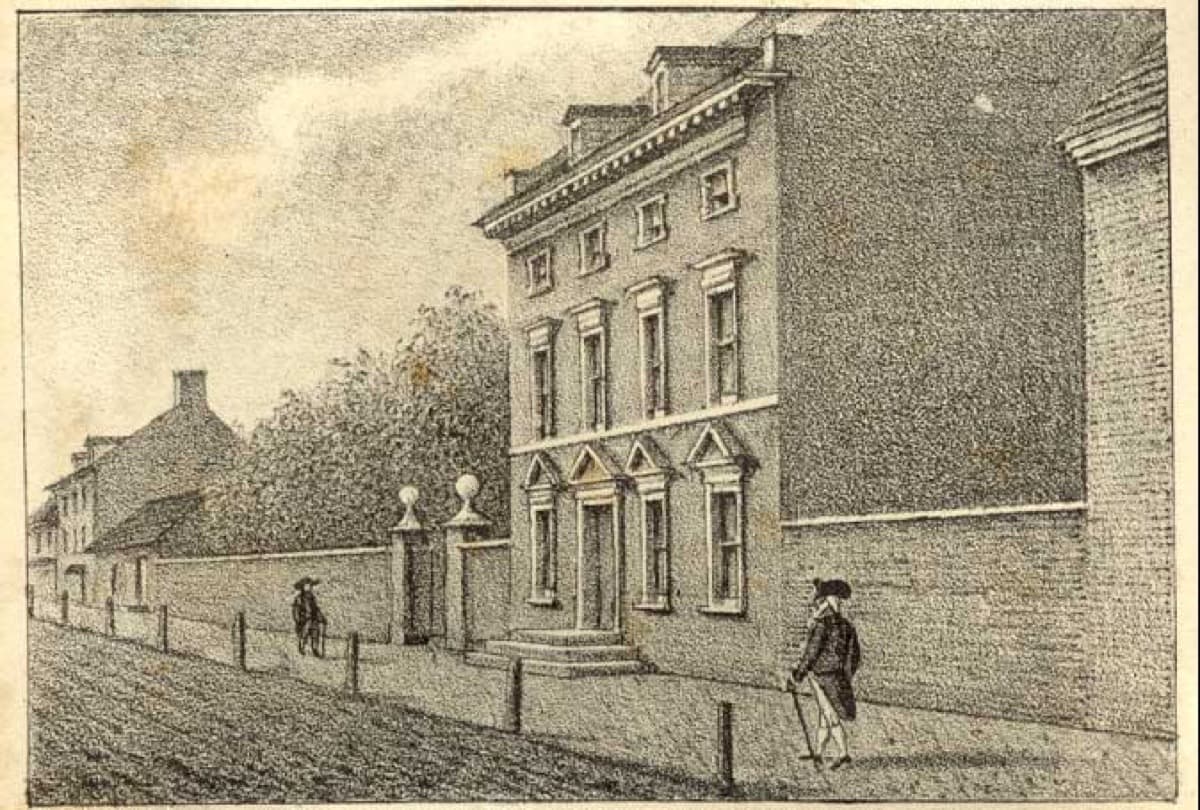
The most important stop on the Old City tour is a building that is not there. At 6th and Market Streets, in the sightline of the Liberty Bell, stood the President's House, the first executive mansion of the United States. George Washington governed from here, and then John Adams. The house is gone. What stands on the spot is an open-air memorial that opened in 2010, and its entire reason for existing is to say nine names out loud.
Who lived here
From 1790 to 1800, Philadelphia was the national capital while Washington, D.C. was being built. Washington lived in the mansion at 6th and Market with an initial household of about two dozen people. Nine of them were enslaved Africans brought north from his Mount Vernon plantation: Moll, Oney Judge, Christopher Sheels, Austin, Giles, Paris, the cook Hercules Posey, Hercules's son Richmond, and a coachman remembered as Postilion Joe.
These are documented names, not composites. Washington brought them to serve the president of a republic whose founding document, written a block away, held that all men are created equal.
The loophole
Hear a stop from this walk
Old City Hall and the Second Bank: The Institutions the Room Built
Pennsylvania had passed a Gradual Abolition Act in 1780, the first such law of its kind in the country. It did not free anyone already enslaved outright, but it contained a provision that mattered inside this house: any enslaved person held in the state for six continuous months could petition for freedom.
Washington's response is in his own correspondence, which is why it can be stated as fact rather than inference. He arranged to rotate his enslaved workers in and out of Pennsylvania so that none of them ever accumulated six unbroken months of residence. He was careful, and he was deliberate, and the paper trail is his own. The man presiding over the new nation was actively managing his household to prevent the enslaved people in it from becoming free under the law of the state he was governing from.
The two who freed themselves
The loophole held for most of the household. It did not hold for everyone.
Oney Judge was an enslaved seamstress in her early twenties, personal attendant to Martha Washington. In May 1796 she walked out of the President's House while the family was at dinner and escaped by ship to Portsmouth, New Hampshire. The Washingtons tried to recover her, including through federal contacts, for years. She was never returned. She married, had children, and lived the rest of her life free in New Hampshire, giving newspaper interviews decades later in which she said she had left because she wanted to be free.
Hercules Posey was the household's celebrated cook, a man of real reputation in Philadelphia. He escaped in early 1797. He, too, was never recaptured. Two of the nine people held in the first executive mansion of the United States freed themselves from it, in defiance of the most powerful household in the country.
Why the site was empty for so long
For most of the twentieth century, none of this was marked. The house was demolished, and part of its footprint was paved as a pedestrian approach to the Liberty Bell pavilion, so that visitors literally walked over the site of the slave quarters to reach the symbol of liberty. Archaeological work in 2007 uncovered foundations of the house, including elements associated with the enslaved household, and drew crowds who watched the dig in person.
The memorial that resulted opened in 2010. Designed by the firm that won a 2007 competition, it traces the outlines of the house in brick, holds video screens telling the enslaved household's story, and carries the names of all nine enslaved people. It sits, on purpose, so that the President's House and the Liberty Bell are in the same view. The Old City tour companion explains how this stop reframes the entire walk, and the founding-city thesis sets it in the city's larger pattern of building monuments on top of erased lives.
What to do when you stand here
Read the names. That is the memorial's request and it is the right one. Moll, Oney Judge, Christopher Sheels, Austin, Giles, Paris, Hercules Posey, Richmond, Postilion Joe. They lived in the first house of the presidency, they served the man who led the Revolution, and for two hundred years the country that they helped build did not say their names on the spot where they were held. Now it does. Stand in the outline of the house, look toward the Bell, and hold both facts at once. That is the whole tour in one place.
Ready to experience it?
Old City: The Room Where the Country Was Argued
85 min · 1.8 km · easy
More from Philadelphia
Explore more at your own pace.
One Day in Philadelphia: A Walkable Historic-Core Itinerary (2026)
The Founding City on Top of Erased Histories
From Crackdown to Canvas: A Mural Arts Companion
One Market, Three Immigrations: A South 9th Street Companion
Penn's Green Country Town: A Center City Companion