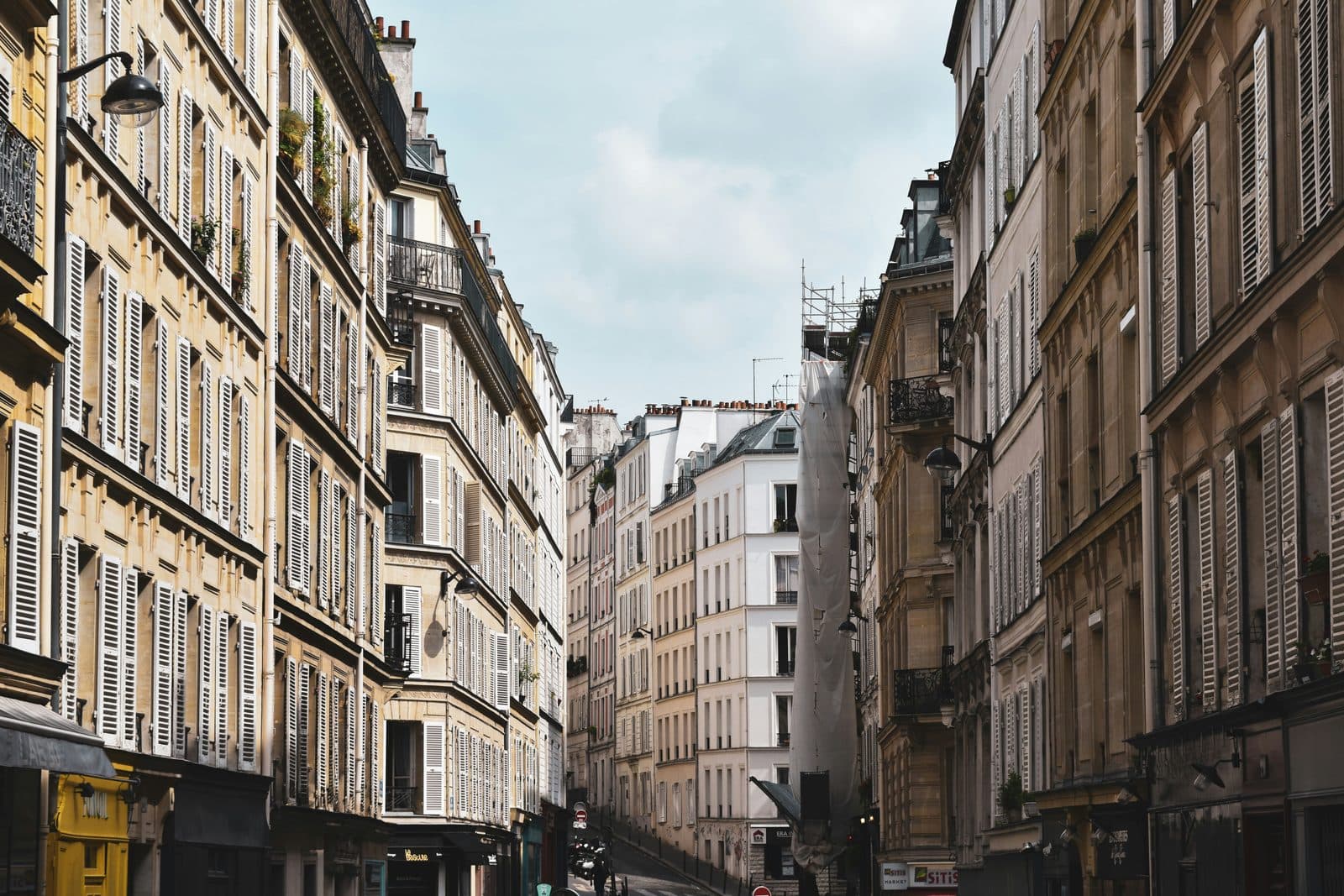
The Le Marais walk crosses the 3rd and 4th arrondissements in eleven stops, from the Hôtel de Ville to the Rue des Rosiers, and finds a different century at each: a wall of the 1190s, an archbishop's town house, two timber-framed houses, a royal square of 1605 to 1612, Renaissance and seventeenth-century mansions, and a synagogue of 1913 to 1914. This guide gives you the through-line the audio hangs on: the mansions the rich left were not demolished, they went to work, and public money later brought them back.
The name, and the ground
"Marais" means marsh, and the ground here was low and crossed by old arms of the Seine. But the word also came to mean market-garden land, drained and cultivated by convents from the thirteenth century. The church of Saint-Gervais, where the walk begins, stands on a "monceau", a high flood-free mound in marshy ground first mentioned in a will of the late sixth century.
A wall, then a king's square
Hear a stop from this walk
Rue des Rosiers: The Heart of the Pletzl
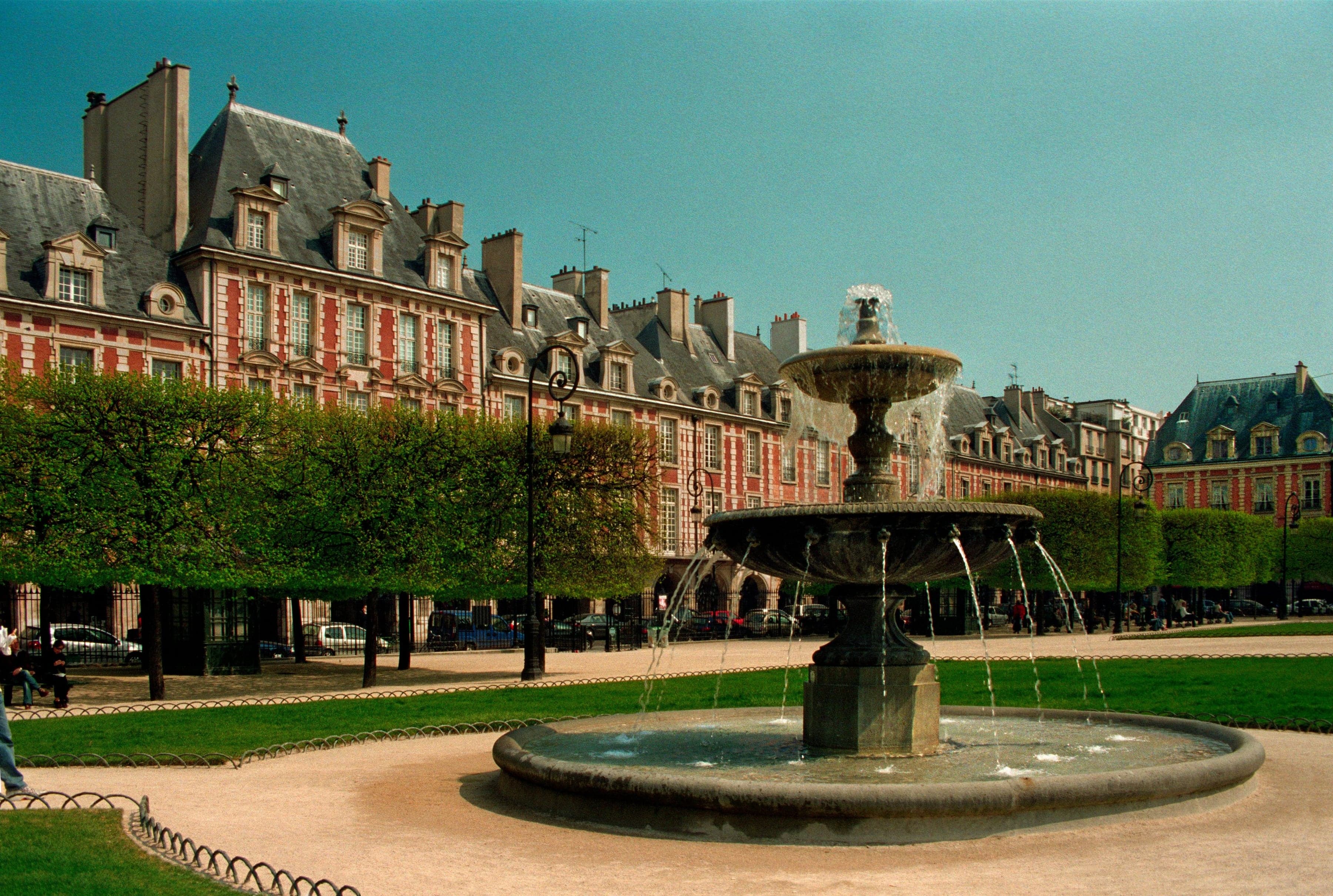
The oldest stratum you can stand beside is the rampart of Philippe Auguste from the 1190s, a stretch of which survives on the Rue des Jardins-Saint-Paul. The layer that made the Marais fashionable is the Place des Vosges, begun in 1605 as the Place Royale under Henri IV and inaugurated in 1612: thirty-six pavilions in one brick-and-stone design, with the taller Pavillon du Roi and Pavillon de la Reine facing each other. It is one of the first planned squares in Paris, though not the oldest in France. For how that royal idea fits the larger city, read Paris in layers.
The mansions that went to work
The Hôtel de Sens was built between 1475 and 1519 for the archbishop of Sens; later it housed a haulage firm and a laundry, and since 1961 it has held the Bibliothèque Forney. The Hôtel de Sully was built from 1624 for the financier Mesme Gallet, bought in 1634 by the duc de Sully, who lived there in his last years; in the nineteenth century it housed shops and craftsmen, and it has belonged to the State since 1944. The Hôtel de Lamoignon, begun in 1559, later became a factory and shops before the City bought it in 1928 and made it a library in 1969. The Hôtel Carnavalet, built from 1548 to 1560, was home to Madame de Sévigné from 1677, though she died in the south, at Grignan, in 1696; the City bought it in 1866 and the museum opened in 1880. A popular explanation says the Marais survived because it was too poor to be worth demolishing. We could not source that as a cause, and the record we can source points to public money and, later, a law of 1962 that carries André Malraux's name.
Two timber-framed houses on the Rue François-Miron, numbers 11 and 13, were plastered over, rediscovered and restored in 1967 and 1968, when the architect redrew their gables. They are often called the oldest houses in Paris. They are not.
The Hôtel de Ville is a copy
The City Hall that opens the walk was burned by the Communards on 24 May 1871 and rebuilt in the same Renaissance style, with the works finished in 1882. What you see is a copy.
The Jewish quarter
The street name is older than the quarter: the Rue des Rosiers was already so called in 1230, for rose bushes growing in the gardens along the rampart. From 1881 to 1914 about 20,000 Jews from Romania, Austria-Hungary and Russia came to Paris, and the area around the street became known as the Pletzl, usually translated from Yiddish as "little place". Sephardic Jews from North Africa are part of the street too; we have not dated their arrival. The synagogue at 10 rue Pavée was built from April 1913 to June 1914 by the architect Hector Guimard, who also designed the Métro entrances, for Agoudas Hakehilos, a congregation formed of nine Orthodox societies of mainly Russian origin. It is Guimard's only religious building, in hollow stone blocks on a reinforced-concrete frame, and it was inscribed as a historic monument in 1989. The street carries recent memory too: on 16 and 17 July 1942 French police arrested 13,152 Jews in Paris, including 4,115 children, and on 9 August 1982 an attack at the Goldenberg restaurant on the Rue des Rosiers killed six people and wounded 22. The food layer of this story has its own guide: eating the Marais.
Walking it
Read each stop as a stratum and the neighborhood becomes a legible core sample, with the City's rescue as the thread through it. For how differently the nineteenth-century rebuild treated the island and the Left Bank, see our Haussmann field guide.
Ready to experience it?
Le Marais: The Mansions That Went to Work
90 min · 2.6 km · easy
More from Paris
Explore more at your own pace.
Musée d'Orsay: What to See, Floor by Floor
The Code of Hammurabi at the Louvre: Which Room, and the Story of the Stone
The Louvre: What to See, by Wing and Room Number, and a Two-Hour Route

The Mona Lisa: Which Room It Is In and What to Know
The Raft of the Medusa at the Louvre: Where It Hangs and the True Story