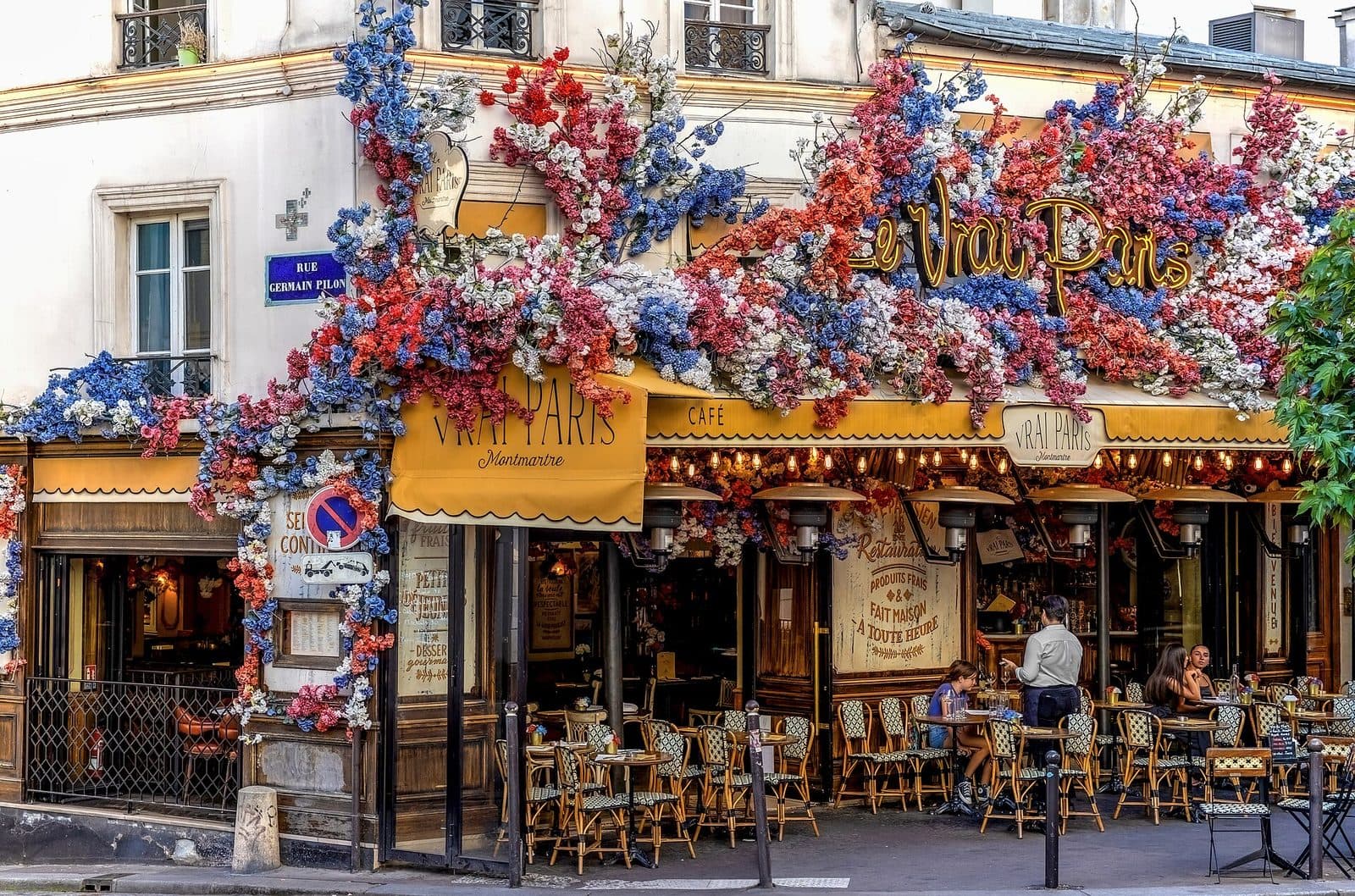
The lower Rue de Belleville is Paris's second Chinatown. Unlike the better-known Asian district in the 13th arrondissement, this one grew up inside an already-diverse working-class neighborhood, so the food here is genuinely mixed rather than themed. Eating it is the most direct way to understand the "first stand" the Belleville companion describes: the post-colonial migration of France, assembling itself shop by shop on a hillside.
How the Chinatown got here
Paris's second Chinatown emerged in Belleville in the 1980s. From the late 1970s, as China reopened, a large community arrived from Wenzhou, a port city south of Shanghai, and they remain the most important Chinese community in the neighborhood, which is why so many restaurants advertise the affiliation. In the 1980s they were joined by Teochew, or Chaozhou, Chinese, many of them merchants who had first settled the 13th arrondissement after leaving Indochina. The first Chinese restaurant in Belleville is generally said to have opened in 1978, at the corner of rue de Rampal and rue de Belleville.
The mix that makes it Belleville
Hear a stop from this walk
Rue des Rosiers: The Heart of the Pletzl
What sets Belleville apart from a conventional Chinatown is that the Chinese food never displaced what was already there. On the 20th-arrondissement side of the Rue de Belleville, Wenzhou restaurants share the pavement with Kabyle cafés and Tunisian bakeries, the North African layer left by the migration from Algeria and Tunisia that the Belleville companion describes. You can eat hand-pulled noodles and, two doors down, buy a Tunisian pastry. That coexistence is not a marketing concept. It is what happens when several immigrations settle the same affordable hill in sequence and none of them leaves.
What to look for
Follow the Wenzhou signage for the most authentic tables: this is regional eastern-Chinese cooking, not the standardized menu of tourist Chinatowns, and the restaurants that name Wenzhou are usually cooking for their own community. Ravioli and dumpling houses, noodle counters, and grocers stocking ingredients you will not find in central Paris line the lower street. Then cross the culinary border on the same block for a Kabyle coffee or a North African bakery. The point is not any single dish. It is the density of different kitchens within one short walk.
Eating it with the tour
Belleville is a hill that keeps redefining who belongs to France, and its food is the clearest evidence of the most recent chapter of that story. Read the companion for the history, from the last barricade of the Commune to today's immigrant strip, and eat the lower Rue de Belleville for the present tense of it. For the other great immigrant food street of Paris, where two Jewish traditions share one block, see eating the Marais, and walk it on the Le Marais walk, which ends on the Rue des Rosiers. For the whole city read as a stack, see Paris in layers.
Ready to experience it?
Le Marais: The Mansions That Went to Work
90 min · 2.6 km · easy
More from Paris
Explore more at your own pace.
Musée d'Orsay: What to See, Floor by Floor
The Code of Hammurabi at the Louvre: Which Room, and the Story of the Stone
The Louvre: What to See, by Wing and Room Number, and a Two-Hour Route
The Mona Lisa: Which Room It Is In and What to Know
The Raft of the Medusa at the Louvre: Where It Hangs and the True Story