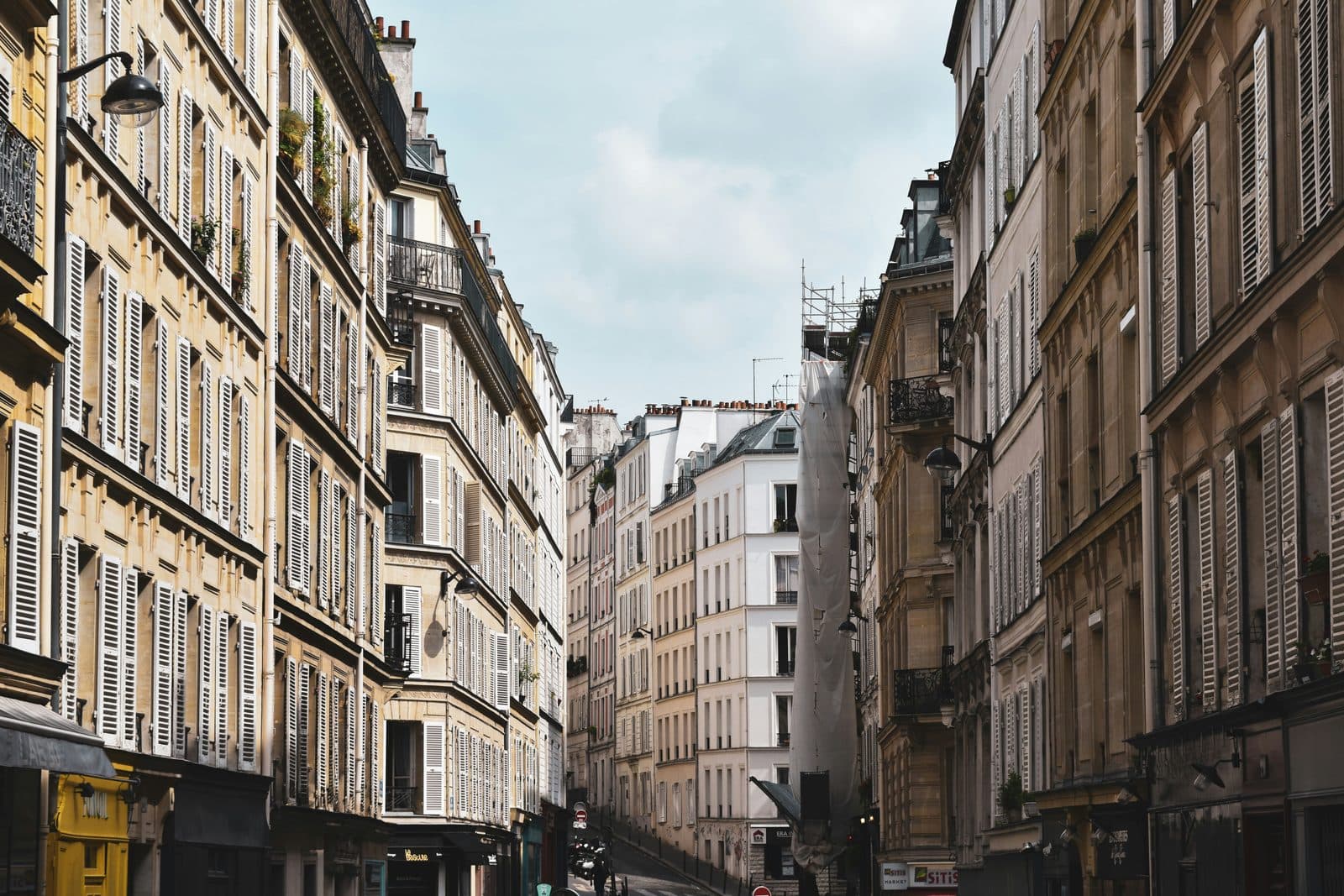
The Latin Quarter and Saint-Germain walk runs through the 5th and 6th arrondissements in twelve stops, from the church of Saint-Julien-le-Pauvre through the Luxembourg Garden to Saint-Germain-des-Prés, in under three kilometres. Every stop is another answer to what a regime wanted to say about itself. This guide gives you the frame, so the walk reads as one continuous story rather than twelve separate landmarks.
Why it is called the Latin Quarter
The name is literal. The City of Paris notes that all the teaching here was once given in Latin, and it was the Revolution that gradually replaced Latin with French. The official tourism office dates the name "Quartier Latin" to the late eighteenth century. Teaching on the Left Bank began in the open air in the twelfth century, and colleges for poor students grew up on the flank of the Montagne Sainte-Geneviève.
Rome, then the Middle Ages
Hear a stop from this walk
Saint-Germain-des-Prés: The Abbey Tower
The oldest structure you will walk past is Roman: the frigidarium of the baths of Lutetia, built around the turn of the first and second centuries and now inside the Cluny museum, with vaults more than 14 metres high. Beside it the Hôtel des Abbés de Cluny was begun in 1485 for the abbot Jacques d'Amboise, who built around the existing Roman structure rather than demolish it. Nearby, Saint-Julien-le-Pauvre dates from the second half of the twelfth and first half of the thirteenth century, and Saint-Séverin is a Flamboyant church rebuilt after the Hundred Years' War. In the square in front of Saint-Julien grows a robinia the City calls the oldest tree in Paris, planted in 1601.
The college for poor students
The Sorbonne is named for Robert de Sorbon, chaplain and confessor of Louis IX, whose college for poor students was founded in the twelve-fifties; the Chancellerie des universités says 1253 and the City says 1257. It is not the University of Paris, only one college among many. Richelieu became its head in 1622 and had it rebuilt by Jacques Lemercier. His chapel, whose first stone was laid in 1635, with a Roman-style lantern tower after Michelangelo's St Peter's, is the only survivor of that Sorbonne; the rest was rebuilt between 1885 and 1901. The chapel is normally closed to the public, and opens on a few days a year such as Heritage Days. For where this layer sits in the wider city, see Paris in layers.
The revolutionary answer
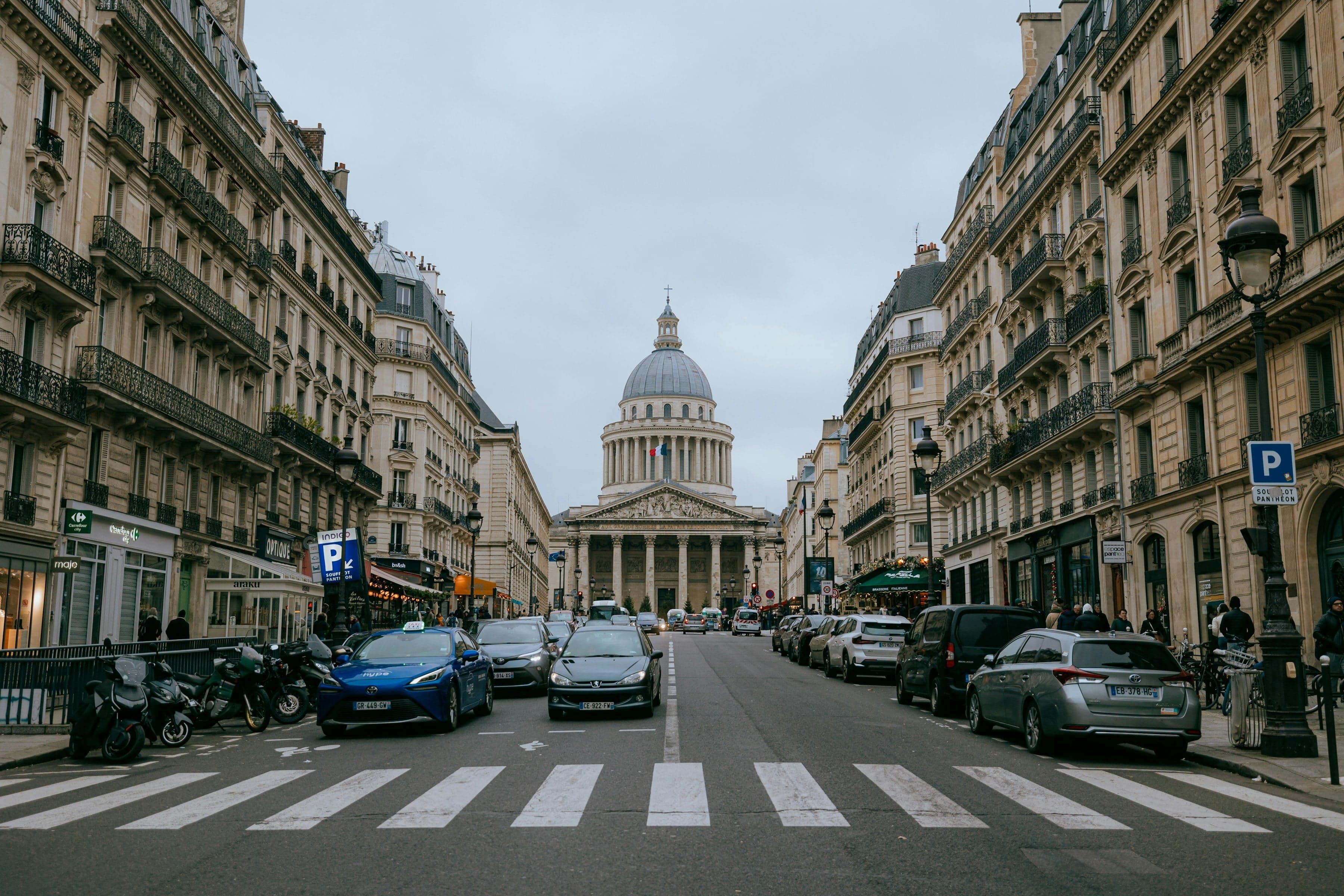
On the hilltop stands the Panthéon. In 1744 Louis XV, gravely ill at Metz, vowed a new church for Saint Genevieve, a royal lottery paid for it, and the king laid the first stone on 6 September 1764. After Mirabeau's death in 1791 it became a national necropolis. In the same year the Revolution closed the Sorbonne. Voltaire was brought into the Panthéon in 1791 and Rousseau in 1794, and from 1790 to 1889 it was the highest point in Paris. Inside, Foucault's pendulum hangs on a wire 67 metres long with a 28 kilogram bob.
The nineteenth century cuts through
Haussmann's works extended the Boulevard de Sébastopol onto the Left Bank as the Boulevard Saint-Michel from 1855. At the Pont Saint-Michel the new view ran into a huge blank gable, and Haussmann commissioned Davioud's fountain to hide it. The same works took the edges of the Luxembourg Garden, whose 23 hectares are roughly the land Marie de Médicis acquired between 1614 and 1631, and a decision of 1865 to build along its south side brought a petition of 12,000 signatures. The older layers survive in the lanes beside a boulevard built to cut through them.
May 1968
The most recent regime in this story is the street. The Sorbonne was closed on 3 May 1968, and the night of 10 to 11 May saw around sixty barricades, according to the Larousse yearbook of the time. We give no clock time and no arrest figure, because no source we could open settles them.
Walking it
Do not walk this as a list of colleges and churches. Walk it as a hill that every regime has wanted to put its mark on, from the Roman baths to Richelieu to the Third Republic to the barricades. The walk ends at Saint-Germain-des-Prés, whose parish says its bell tower, begun around the year 990 and finished in 1170, is the oldest in Paris. For the district of mansions and immigrants on the other side of the river, compare the Marais.
Ready to experience it?
Latin Quarter and Saint-Germain: Remade by Every Regime
90 min · 2.7 km · easy
More from Paris
Explore more at your own pace.
Musée d'Orsay: What to See, Floor by Floor
The Code of Hammurabi at the Louvre: Which Room, and the Story of the Stone
The Louvre: What to See, by Wing and Room Number, and a Two-Hour Route
The Mona Lisa: Which Room It Is In and What to Know
The Raft of the Medusa at the Louvre: Where It Hangs and the True Story