Notre-Dame and Île de la Cité: An Island Rebuilt Three Times
90 min · 2.1 km · easy
Baron Haussmann's name comes up on almost every Roamer walk in Paris, and no single walk is named for him. His work is not one neighbourhood but a set of cuts, copies and cover-ups scattered across the center. This guide tells you where to find them and, just as useful, which popular claims about him we could not source.
Who he was, and what we will not quote
Georges-Eugène Haussmann was prefect of the Seine under Napoleon III, the official who ran the works that opened new streets through the old city from the 1850s. Online you will meet exact-sounding totals for buildings demolished, buildings built, residents displaced and francs borrowed. The published figures disagree with one another and the City's own pages avoid them, so we quote none. For the same reason we leave out the neat slogans attributed to his commission and the story of how his career ended.
On the island: the City's own sentence
Hear a stop from this walk
Quai d'Anjou and the Hôtel de Lauzun: A Plain Front, a Rich House
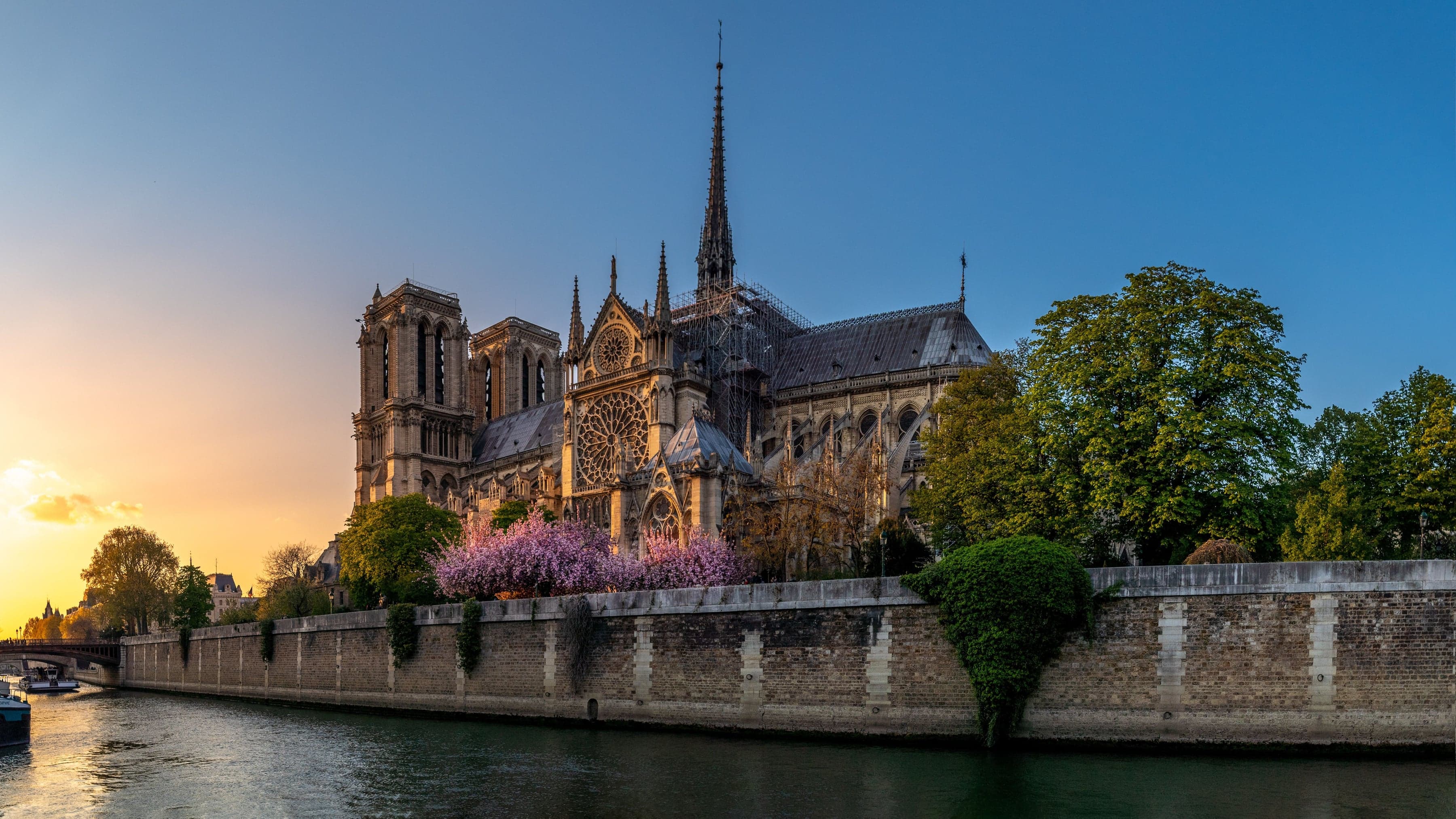
The most reliable statement about what he did to the Île de la Cité comes from the Ville de Paris: apart from the cathedral and the Conciergerie, only the Place Dauphine and the heart of the block between the Rue d'Arcole and the Rue du Cloître-Notre-Dame resisted the massive demolitions of the nineteenth century. Among the buildings that replaced the old lanes is the Tribunal de commerce, built from 1860 to 1865 by Antoine-Nicolas Bailly, who was chosen by Baltard and by Prefect Haussmann, in the style we now call Second Empire. The Île de la Cité walk is the one to take if you want to stand inside that sentence.
On the Left Bank: a boulevard, a wall and a fountain
From 1855 the works extended the Boulevard de Sébastopol across the river as the Boulevard Saint-Michel. At the Pont Saint-Michel the new view ran into a huge blank gable at the corner of the Rue Saint-André-des-Arts, and Haussmann commissioned Davioud's fountain to hide it. The same works took the edges of the Luxembourg Garden: the boulevard, a widened Rue de Vaugirard, and a decision of 1865 to build along the garden's south side that drew a petition of 12,000 signatures. The Latin Quarter walk passes the fountain and the Luxembourg gate.
On the Right Bank: a long street, a copied city hall and a museum
The uniform look of the Rue de Rivoli is older than Haussmann. The street was opened under a decree of 9 October 1801, and the architects Percier and Fontaine drew up façades on arcades, with a rule that the buildings be of stone, balconies of wrought iron and an attic under a balustrade. Only the roofs were left free. Haussmann carried the street on to Saint-Paul. The Louvre and Tuileries walk looks at Rivoli at its seventh stop. Further east, the Hôtel de Ville was burned in the Commune on 24 May 1871 and rebuilt, as the City records it, with its Renaissance-style façade copied as it was; the Marais walk opens in front of it. The Hôtel Carnavalet, now the City's own museum, was bought in 1866 following a suggestion by Prefect Haussmann.
What we could not source
Two popular stories fail our checks. The first is that Haussmann's boulevards simply missed the Marais; we found nothing that says so, and the district lost streets to the new ones. The second is that the Avenue de l'Opéra was aimed at the Palais Garnier and left treeless so that nothing would block the view. It is repeated everywhere, but we could not trace it to a primary source, so we do not tell it.
Walking it
Use the walks as a reading lesson, not a monument tour. Where something looks too tidy, ask whether it is a cut, a copy or a cover-up. For how the same top-down instinct returned a century later under a different regime, read Mitterrand's Grand Louvre, and for how this layer sits above the older Paris, see Paris in layers.
Ready to experience it?
Notre-Dame and Île de la Cité: An Island Rebuilt Three Times
90 min · 2.1 km · easy
More from Paris
Explore more at your own pace.
Musée d'Orsay: What to See, Floor by Floor
The Code of Hammurabi at the Louvre: Which Room, and the Story of the Stone
The Louvre: What to See, by Wing and Room Number, and a Two-Hour Route
The Mona Lisa: Which Room It Is In and What to Know
The Raft of the Medusa at the Louvre: Where It Hangs and the True Story