Historic Center: Spaccanapoli and the Greek City
90 min · 2.1 km · easy
Naples is a vertical city. Read it the way its own tours do and the street stops being a surface: it becomes a lid on carved emptiness below and a shelf for stacked centuries above. The same soft golden tuff the Greeks and Romans quarried from directly beneath the settlement was cut into blocks to build the city standing on top of it, so the buildings and the void are the same stone turned inside out. A dead-straight Greek surveyor's line still splits the old center. Catacombs and aqueducts and a buried market still sit under living neighborhoods. Roamer's three Naples walks each pick one axis of that verticality and follow it: the ancient grid drawn across the surface, the hollow scooped out below, and one quarter that turned its buried dead into a future.
The grid that never bends
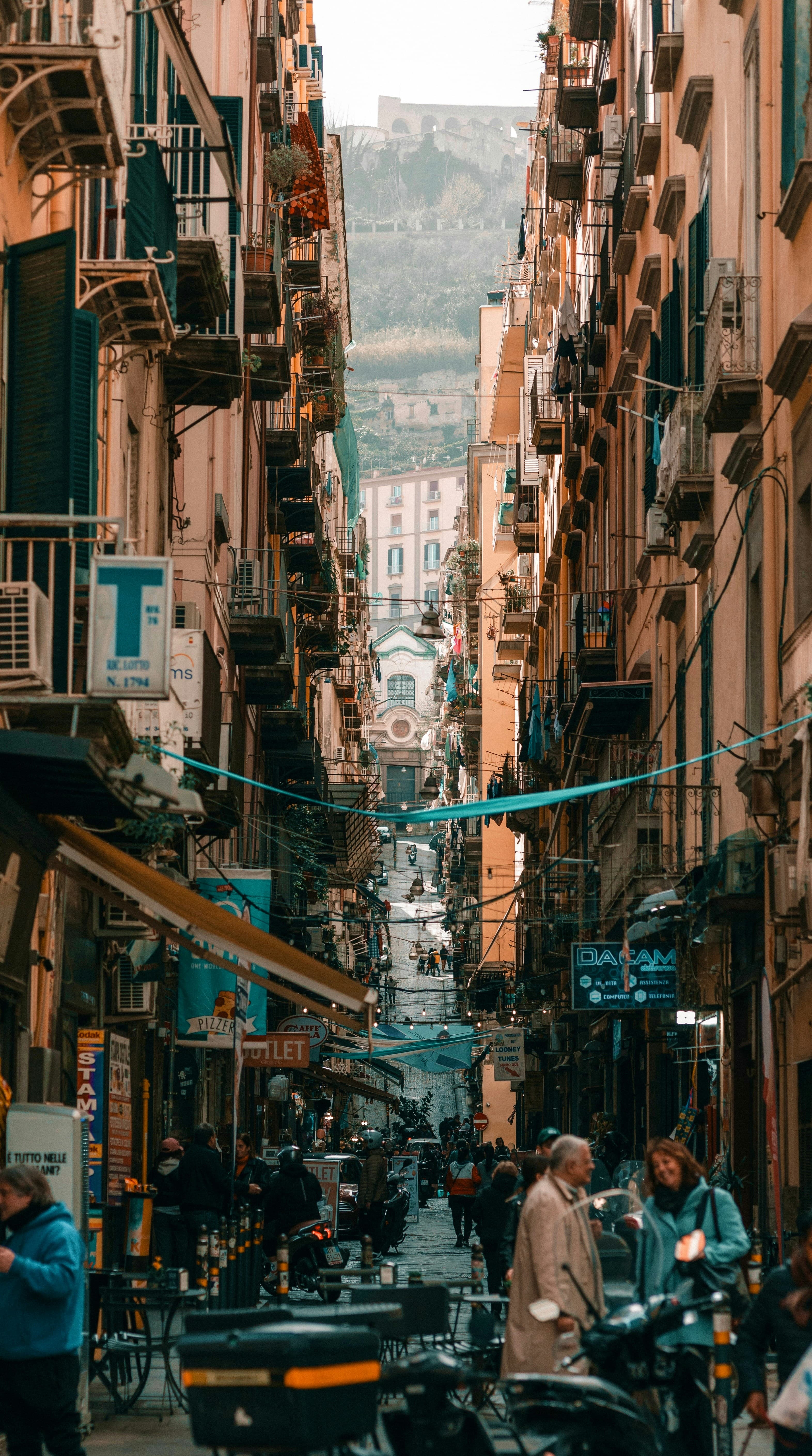
The clearest evidence that Naples is built on an old idea is a street you can see from any hill above it. Historic Center: Spaccanapoli and the Greek City follows Spaccanapoli, the straight line of streets whose nickname means the one that splits Naples, because from above it appears to divide the old city in two. The stones are not ancient. The geometry is. Inside the old walls the line traces the lower of three parallel east to west streets, the decumani, laid out by the Greek founders of Neapolis and kept by the Romans, and all three were crossed by some twenty narrow north to south lanes that are still legible in the modern map. The walk then climbs through that grid to the other two.
The walk holds one tension at every stop: rational abstraction underneath, improvised life on top. At Piazza del Gesù Nuovo, just outside the Greek walls, the church wears a diamond-studded piperno facade that was never designed for a church at all. It was built in the year fourteen seventy for a palace of the Sanseverino family, princes of Salerno, and kept when the Jesuits, who bought the palace in fifteen eighty-four, built the church behind it, consecrated in sixteen oh one. On the line itself, the Basilica di Santa Chiara teaches the whole lesson in one building: a Gothic complex begun in thirteen ten by King Robert of Anjou and Queen Sancha of Majorca, layered over in Baroque, then almost entirely destroyed by Allied bombing on the fourth of August in nineteen forty-three and rebuilt in its original Gothic style. Its Cloister of the Clarisses hides pillars sheathed in painted majolica, remodelled between seventeen thirty-nine and seventeen forty-two, a garden turned to ceramic. A few minutes on, at Piazza San Domenico Maggiore, you cross the line of the Greek city's western wall.
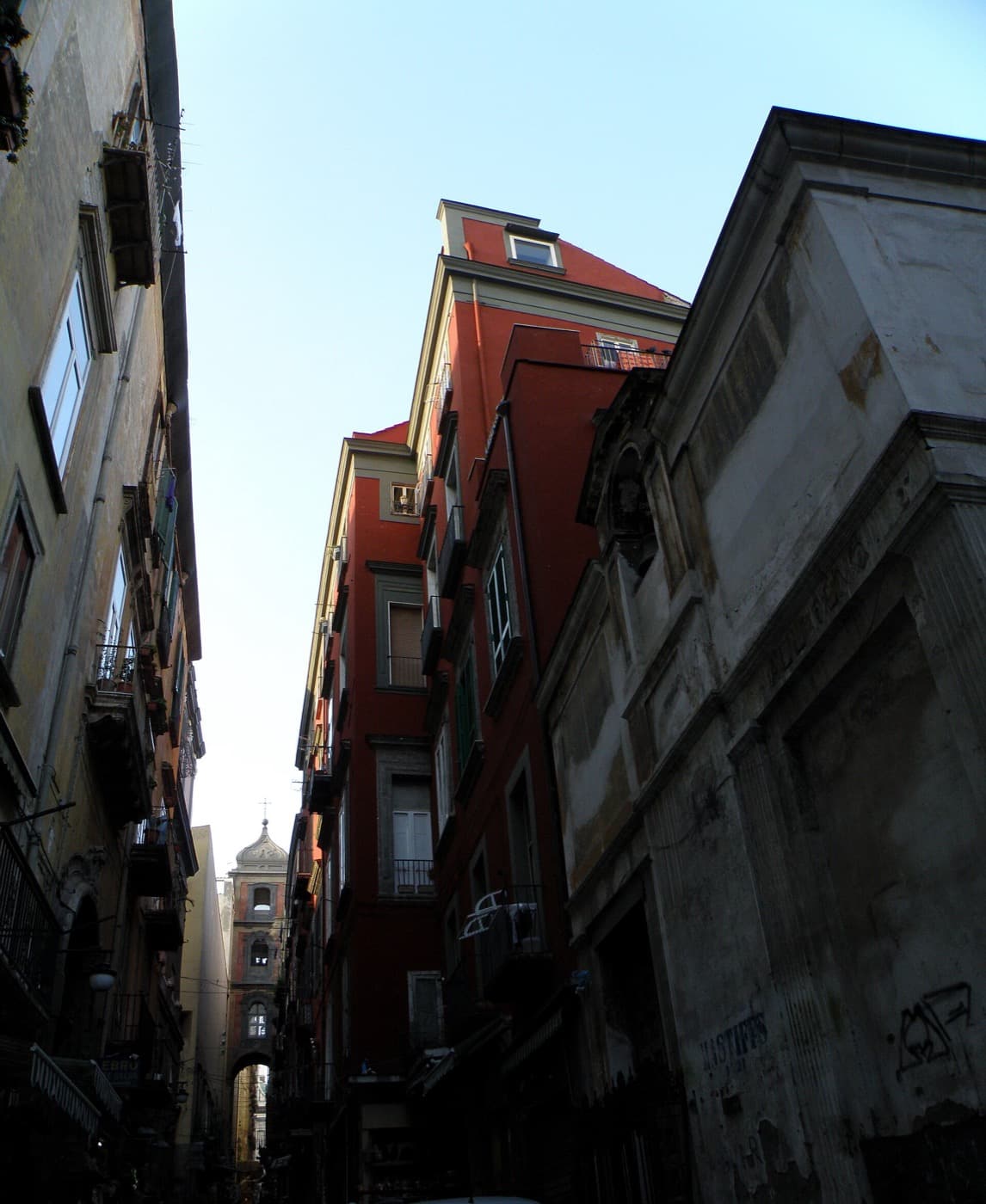
Turn up Via San Gregorio Armeno and the grid runs the other way. This crib-makers' street follows an ancient cardo, so stepping onto it from Spaccanapoli means stepping from one line of the Greek plan onto another. Tradition, disputed by archaeologists, puts a Roman temple to Ceres under the church of San Gregorio Armeno and makes clay offerings to her the ancestors of the crib figures; it is a legend, but the workshops really do make crib figures year-round. At its top the street meets Via dei Tribunali at Piazza San Gaetano, the old Greek agora and Roman forum, and a short walk on stands the Duomo, cathedral of San Gennaro, on Via Duomo north of the straight cut. It swallowed older churches whole, and one of them, Santa Restituta, survives inside it. A rational surveyor's grid delivers you to the great irrational devotion the city keeps: the dried blood said to liquefy three times a year. The walk then climbs to the highest Greek street, Via Anticaglia, where brick arches of the Roman theatre span the lane, passes the skull-gated church of Purgatorio ad Arco and the Pietrasanta bell tower of recycled Roman stones, and ends in Piazza Bellini, looking down at the Greek city wall itself.
The city carved out below
Hear a stop from this walk
Piazza San Domenico Maggiore: Into the Greek City
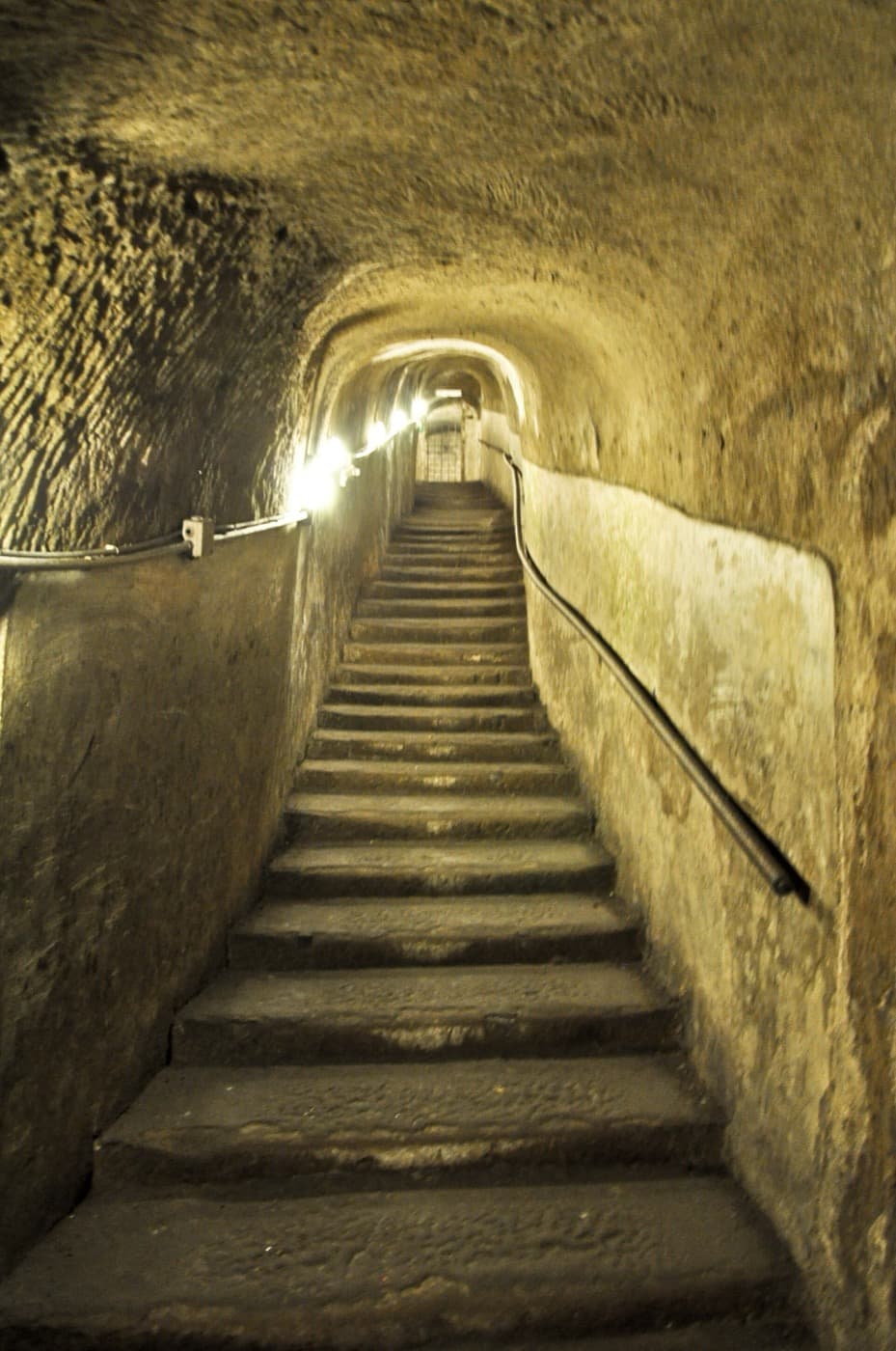
If the grid is the surface logic, the hollow is the mass. The City Below reads each square as a ceiling. The descent at Napoli Sotterranea drops about one hundred and thirty-six steps to roughly forty metres down, a depth that recurs across the whole walk. The void began as a Greek quarry cut into the tuff, became a Roman aqueduct fed from the Serino springs about seventy kilometres away, and in the twentieth century sheltered families from wartime bombing. One hollow, three lives: quarry, plumbing, refuge.
At San Lorenzo Maggiore the void breaks the surface. Beneath the Franciscan church, about half of a Roman market, a macellum, has been excavated, built over the earlier Greek agora and buried by a fifth-century mudslide that paradoxically preserved it. The dig took roughly a quarter century and opened to the public in nineteen ninety-two. Stand in Piazza San Gaetano and you are on the hinge of the ancient city, the site of the Greek agora and Roman forum, at the crossing of Via dei Tribunali (the old decumanus maior) and Via San Gregorio Armeno. San Paolo Maggiore beside it still shows two Corinthian columns from a first-century temple to Castor and Pollux reused in its facade.
The hollow is not only structure. At Santa Maria delle Anime del Purgatorio ad Arco, erected in sixteen sixteen and consecrated in sixteen thirty-eight, the underground crypt held a folk cult in which devotees adopted anonymous skulls and prayed for the poor souls, the anime pezzentelle, the most venerated known as Lucia. The hollow is also engineered on purpose: the Galleria Borbonica, commissioned in eighteen fifty-three by Ferdinand the Second of Bourbon as a royal escape route, cut straight into older cisterns already honeycombing the tuff, was never finished, then served as a wartime shelter and hospital. The transect ends at Castel Nuovo by the sea, begun in twelve seventy-nine under Charles the First of Anjou, where the city stops digging down and builds up, greeting the water with the marble arch that marks Alfonso of Aragon's entry in fourteen forty-three.
The quarter that dug up its own future
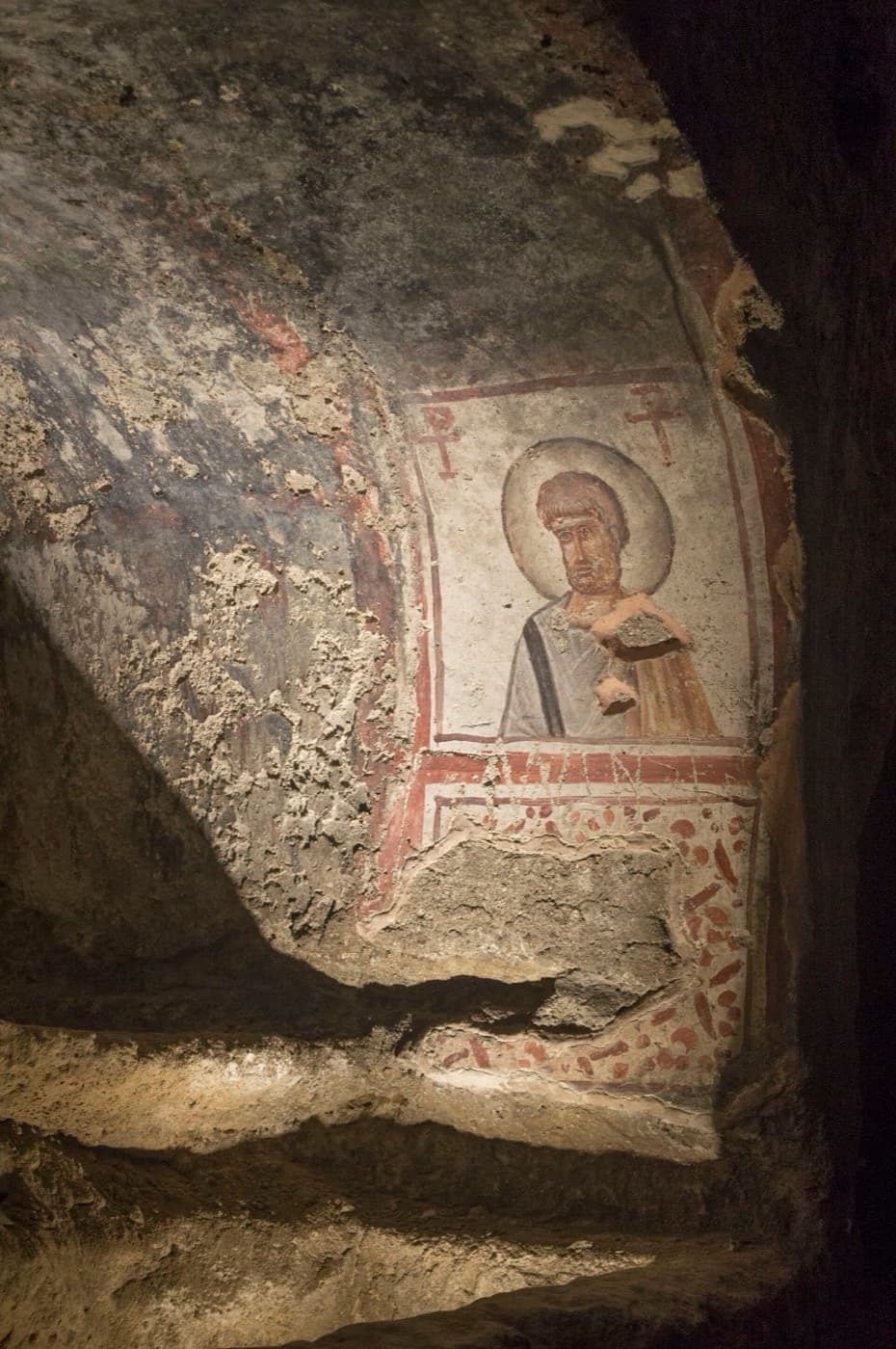
The third walk shows what verticality means for people, not just plans. The Quarter They Feared enters the Rione Sanita, a valley the city above once told outsiders to avoid, and follows how its own residents turned an inheritance of death into work and pride. It begins on the Capodimonte hill at the Catacombe di San Gennaro, the largest Christian catacomb complex in southern Italy, its lower level dating to the third and fourth centuries, its earliest frescoes among the oldest Christian images in the region. In the year two thousand and six, young locals formed a cooperative called La Paranza, working with the association l'Altra Napoli, to recover the site and make jobs from the quarter's buried heritage. The people the city feared reached into the ground beneath their feet and pulled up a future.
Down in the valley, the Basilica di Santa Maria della Sanita, built between sixteen oh two and sixteen thirteen by the Dominican friar Giuseppe Nuvolo on a Greek-cross plan under a yellow-and-green majolica dome, sits directly over the Catacombs of San Gaudioso, its crypt entrance under the altar. The living build their brightest church on top of the dead. Two rococo palaces prove the quarter was once grand: the Palazzo dello Spagnolo of seventeen thirty-eight and Ferdinando Sanfelice's own Palazzo Sanfelice of the seventeen twenties, both with open double-ramp staircases so daring that people nicknamed the architect Ferdinando levat a sott, roughly get out from under, though nothing ever fell.
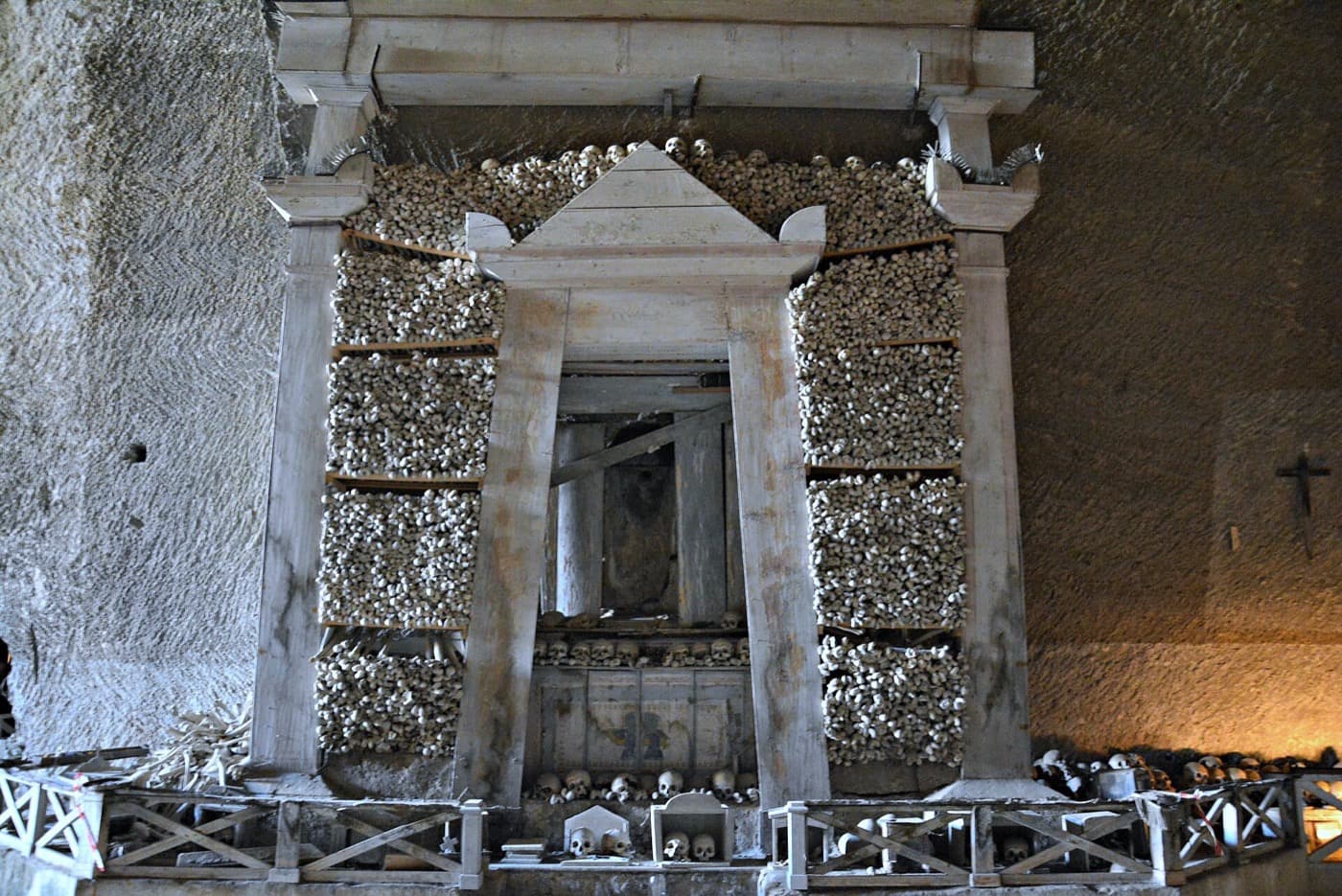
Then comes the wound. The Ponte della Sanita, completed around eighteen oh eight and eighteen oh nine during Joachim Murat's Napoleonic kingdom, vaulted a grand new road clean over the valley on six arches, so the traffic and money of Naples passed above the quarter's head. That isolation is exactly why the Sanita stayed one of the most authentic neighborhoods in the city. The walk closes at the Cimitero delle Fontanelle, an ossuary in a former tuff quarry where plague and cholera dead were kept, catalogued by Father Gaetano Barbati in eighteen seventy-two, and cared for through the same devotion to the poor souls seen underground elsewhere in the city. Cardinal Corrado Ursi restricted that cult in nineteen sixty-nine. From the catacombs on the hill to the ossuary in the valley wall, the quarter kept faith with its own dead all along.
Read together on Naples walking tours, the three routes make one argument. Naples is not a place you cross. It is a place you read in section: an ancient line on top, a carved void beneath, and neighborhoods that live on both floors at once.
Sources
- Historic Center: Spaccanapoli and the Greek City tour (Roamer, rebuilt September 2026): fact-audited transcripts for Piazza del Gesù Nuovo, Santa Chiara, Piazza San Domenico Maggiore, Via San Gregorio Armeno, Piazza San Gaetano, the Duomo, Via Anticaglia, Purgatorio ad Arco, Pietrasanta and Piazza Bellini.
- The City Below tour (Roamer): fact-audited transcripts for Napoli Sotterranea, San Lorenzo Maggiore, Piazza San Gaetano, Santa Maria delle Anime del Purgatorio ad Arco, Galleria Borbonica, and Castel Nuovo.
- The Quarter They Feared tour (Roamer): fact-audited transcripts for the Catacombe di San Gennaro, Basilica di Santa Maria della Sanita, Palazzo dello Spagnolo, Palazzo Sanfelice, Ponte della Sanita, and Cimitero delle Fontanelle.
- UNESCO World Heritage listing: Historic Centre of Naples, which covers the Greco-Roman grid and the historic core these walks trace.
Frequently asked questions
- Why is Naples called a vertical or layered city?
- Naples was built from the same soft golden tuff quarried directly beneath it, so the city and the void it came from are the same stone. Above the street sit stacked centuries of building along an ancient Greek grid, and below run quarries, aqueducts, and buried markets roughly forty metres down. Reading the city in section, from the surface line down into the hollow, is the through-line of Roamer's three Naples walks.
- What is Spaccanapoli and how old is it?
- Spaccanapoli is the nickname, meaning the street that splits Naples, for a dead-straight line of several named streets, well over a kilometre and a half end to end, that from above appears to divide the old city in two. Inside the old walls it traces the lower of three ancient east to west streets, the decumani, laid out by the Greek founders of Neapolis in the fifth century BC and kept by the Romans. The current stones are not ancient, but the straight geometry survives from the original grid.
- How deep is underground Naples and what was it used for?
- The descent at Napoli Sotterranea runs about one hundred and thirty-six steps to roughly forty metres below the street, a depth that recurs across the underground network. The void began as a Greek tuff quarry, was reused as a Roman aqueduct fed from the Serino springs about seventy kilometres away, and sheltered families from bombing during the Second World War.
- Why did people once avoid the Rione Sanita, and what changed?
- The Rione Sanita is a valley that the city above wrote off as poor and dangerous, an isolation deepened when the Ponte della Sanita vaulted a new road clean over it around eighteen oh eight and eighteen oh nine. In two thousand and six, young local residents formed the cooperative La Paranza, with the association l'Altra Napoli, to recover the quarter's catacombs and turn its buried heritage into jobs and pride.
- What is the cult of the anime pezzentelle in Naples?
- The anime pezzentelle, the poor or abandoned souls, were the anonymous dead of Naples. In folk devotions at sites like Santa Maria delle Anime del Purgatorio ad Arco and the Cimitero delle Fontanelle, believers adopted an individual skull, tended it, and prayed for its soul in exchange for hoped-for grace and protection. Cardinal Corrado Ursi restricted the practice in nineteen sixty-nine as it spread widely across the city.
Ready to experience it?
Historic Center: Spaccanapoli and the Greek City
90 min · 2.1 km · easy
More from Naples
Explore more at your own pace.
Naples Travel Guide: Days, Transport, Timing, Safety, and Budget
The Catacombs That Taught the Rione Sanità to Rewrite Itself
The Hollow City: Reading Naples From the Void Beneath Napoli Sotterranea
Via San Gregorio Armeno: How the Crib Street Reveals the Greek Grid Under Naples
Cappella Sansevero: The Marble Veil That Reads as Cloth