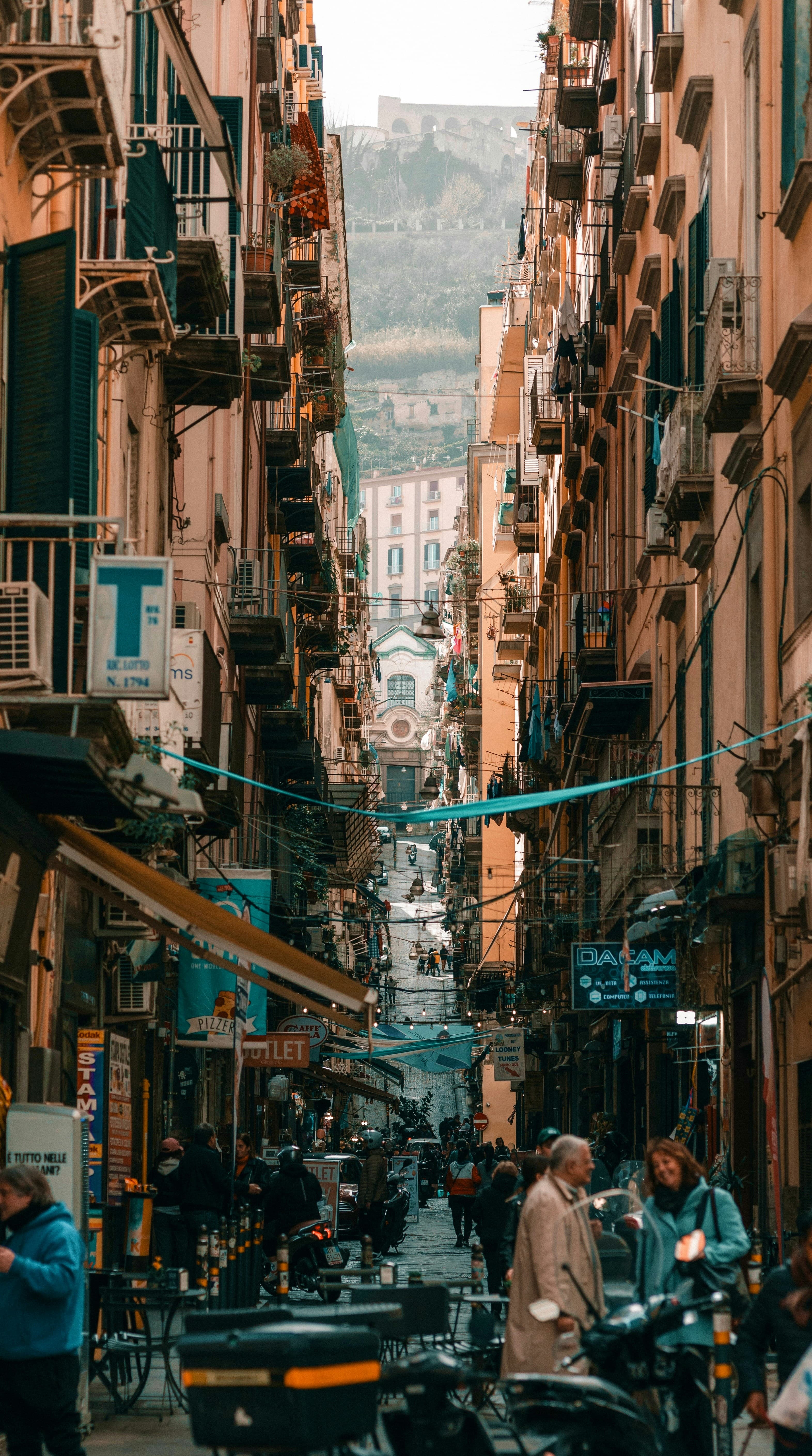
Via San Gregorio Armeno, the crib-makers' street, follows an ancient cross-street of the grid the Greeks laid out and the Romans kept, and that single fact splits open the whole logic of old Naples. Turn off the long straight cut of Spaccanapoli onto this narrow lane of terracotta shepherds, and you are not wandering into a random side alley. You are stepping from one axis of a plan about two and a half thousand years old onto another. The grid runs both ways. Every scooter, every saint in a glass box, every string of drying laundry had to line up along a decision made by Greek settlers in the fifth century BC and kept by Rome, and the crib street is where that hidden geometry becomes something you can hold in your hand.
The grid runs both ways
The street that Neapolitans call by the nickname Spaccanapoli, the one that splits Naples, is a straight line of several named streets, well over a kilometre and a half end to end. Seen from any hill above the historic center, it cuts the old city clean in half. That straightness is not a medieval accident. Inside the old walls it traces the lower of three great parallel east to west streets, the decumani, laid out by the Greek founders of Neapolis around 470 BC and kept by the Romans. The stones underfoot are not ancient. The line they follow is.
What most people forget is that those long streets were crossed at right angles by a set of north to south lanes, the cardini. Via San Gregorio Armeno is one of them. So the moment you leave the main line and head up between the workshops, you are walking a second thread of the same ancient loom. The decumanus you just left and the cardo you are now on were both drawn by the same hands. The whole grid is still legible in the modern map, and this narrow lane is the clearest place on the walk to feel it.
A living craft on an ancient line
Hear a stop from this walk
Piazza San Domenico Maggiore: Into the Greek City
What fills the cardo today is pure Naples. It is the street of the pastori, the crib makers' shepherds. It is known for the presepe, the Nativity crib, and here the crib is not a seasonal thing that appears in December and vanishes in January. The workshops make figures all year round: shepherds, angels, the Holy Family and whole miniature villages. The street is busiest in November and December, but you can walk it in July and find the same figures on the shelves that you would find at Christmas.
The artisans also follow the news. Alongside the Holy Family and the traditional shepherds, you will spot each year's famous faces, celebrities, footballers and politicians, and the footballer Maradona is an evergreen. It is devotion and topical fun sold from the same shelf, which is a very Neapolitan combination. The historic center of Naples is a UNESCO World Heritage site, listed in nineteen ninety-five. In March 2026 Italy's national UNESCO commission also approved a candidacy for the art of the nativity scene on UNESCO's Intangible Cultural Heritage list. It is a joint candidacy with other countries, about the presepe in general and anchored on Greccio and Assisi rather than on Naples, and it has not been inscribed.
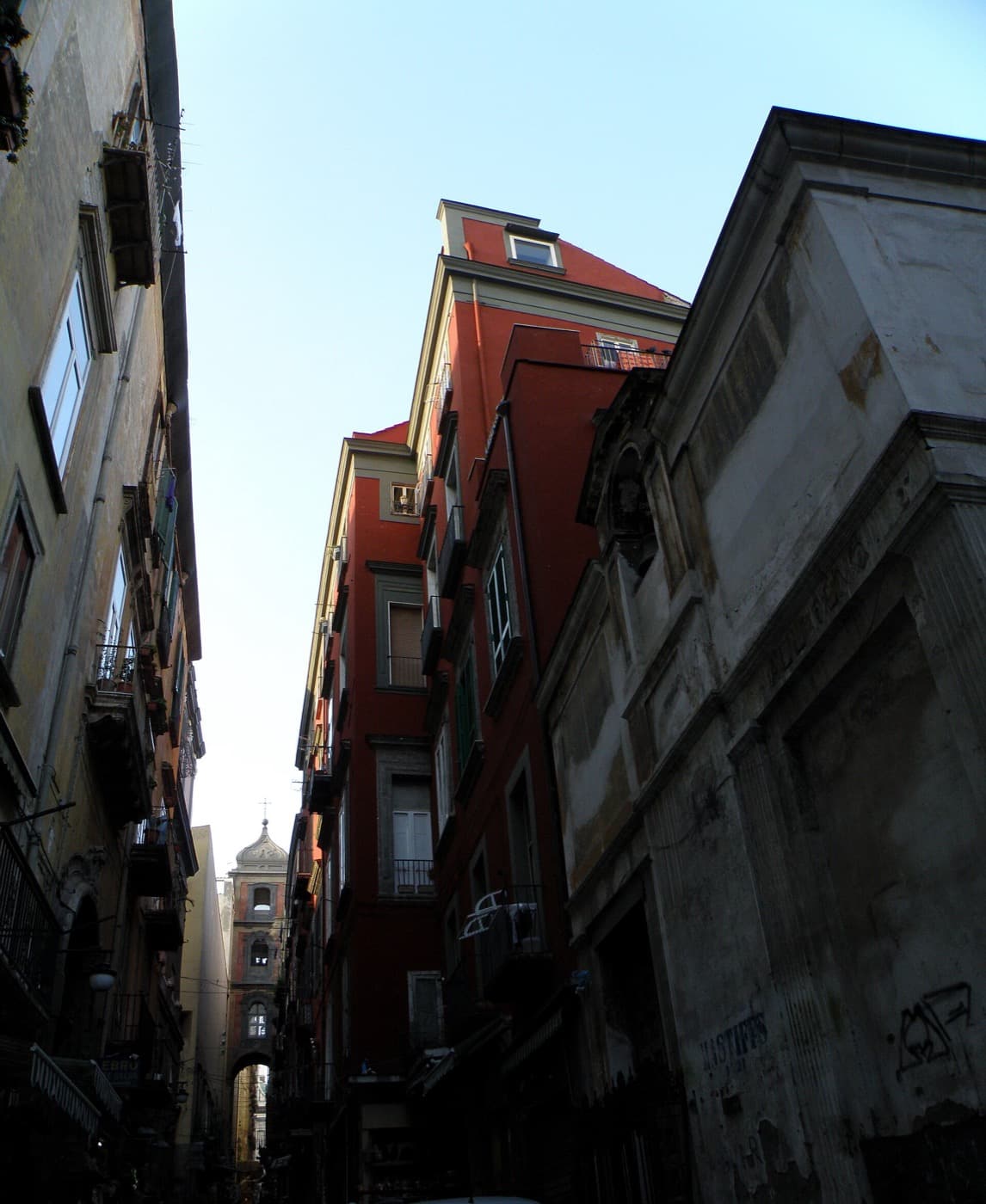
At the bottom of the lane, on your left as you walk up from Spaccanapoli, stands the church of San Gregorio Armeno, begun in fifteen seventy-four. Ahead, its convent's bell tower crosses the street on an arch. And here the theme of the walk surfaces one more time, as a legend. Tradition says the church stands over a Roman temple to Ceres, and that the little clay offerings people made for her were the first crib figures. Scholars disagree about the temple: one archaeologist placed Demeter's sanctuary up on Caponapoli instead, where votive statuettes of the goddess were actually found, and nobody has found offerings on this street. Tell it as the legend it is. It sticks because it fits so well: a street of clay shepherds imagined on top of a temple of clay offerings. Stand still for a moment on the cardo and let the layers stack: a Greek cross-street, a legendary temple, a living workshop of tiny figures, all in one narrow lane.
Why this stop opens the whole tour
Once the grid clicks into place on the crib street, the rest of the walk reads differently. That is the argument the full tour makes: twelve stops over about two kilometres and an hour and a half, from Piazza del Gesù Nuovo to Piazza Bellini, along the straight cut and then up through the grid, each one a different century stacked on the same ancient plan. If you want the route mapped and narrated stop by stop, see the other Naples walking tours.
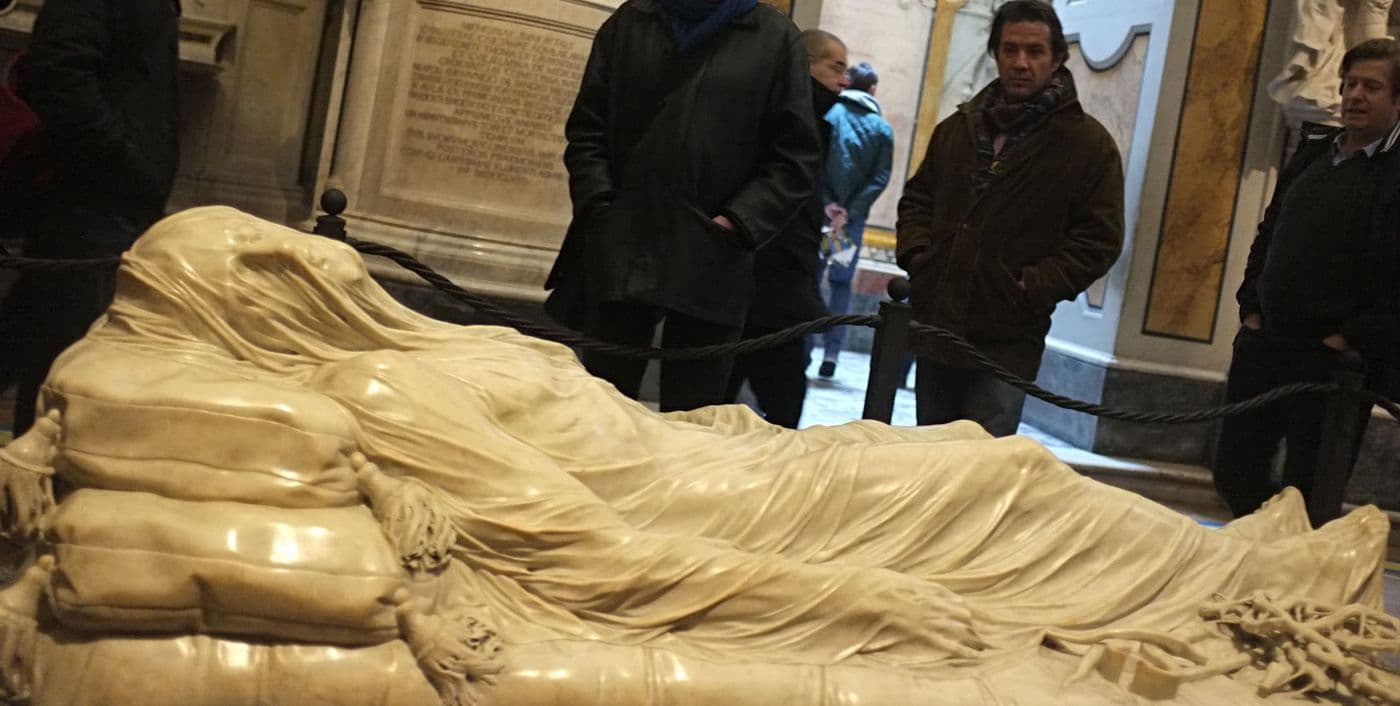
The walk begins at Piazza del Gesù Nuovo, just outside the old Greek walls, where a church wears a diamond-pointed stone facade it inherited from a fifteenth-century palace, a building that changed identity but not geometry. On the line itself stands Santa Chiara, a Gothic complex begun in thirteen ten by King Robert of Anjou and Queen Sancha of Majorca, almost entirely destroyed by bombs in 1943 and rebuilt, hiding a cloister sheathed in painted majolica tiles, remodelled between seventeen thirty-nine and seventeen forty-two, a monastic courtyard turned into a garden of ceramic. At Piazza San Domenico Maggiore you cross the line of the Greek city's western wall, and just north of that square the Cappella Sansevero holds the Veiled Christ, carved by Giuseppe Sanmartino and completed in seventeen fifty-three, a marble veil cut so fine from the same block as the body that the stone appears to turn translucent.
Then comes the crib street, the hinge of the whole route, the moment the plan reveals itself as a two-way grid rather than a single line. The walk turns north up it to Piazza San Gaetano, the old Greek agora and Roman forum on Via dei Tribunali, the middle of the three Greek streets. From there it reaches the Duomo di Napoli, the cathedral of San Gennaro, which stands on Via Duomo, north of the straight cut. The Gothic cathedral swallowed older churches whole, and one of them, Santa Restituta, by tradition the city's first cathedral, survives inside it. Here is kept what the faithful venerate as the dried blood of the city's patron saint, which by tradition liquefies three times a year: on the Saturday before the first Sunday in May, on the nineteenth of September, and on the sixteenth of December. A rational Greek grid delivering you to the city's great irrational devotion. From there the walk climbs to the highest Greek street, Via Anticaglia, under the brick arches of the Roman theatre, and finishes at the Greek city wall itself, still standing in Piazza Bellini. That is the tension the walk is built to pay off.
You do not have to walk it in order or in one push. Every stop is short and skippable, the ticketed interiors like Santa Chiara's cloister and the Cappella Sansevero are yours to slot in or pass by, and the crib street is best simply wandered. Come mid-morning on a weekday, when the light reaches down into the narrow lane and the crush has not yet built. Start on the cardo, feel the grid turn under your feet, then follow the straight cut and let the centuries stack up. To plan the walk and its neighbourhood, start with Naples.
Sources
- Treccani, Enciclopedia dell'Arte Antica, "Napoli". The founding of Neapolis around 470 BC, the orthogonal Greek street plan that still survives, and the line of the Greek walls through Piazza San Domenico.
- ICOMOS evaluation of the Historic Centre of Naples (1995). The UNESCO inscription and the authenticity of the Graeco-Roman town plan.
- Suore Crocifisse Adoratrici dell'Eucaristia, the nuns' own pages on the monastery and church of San Gregorio Armeno. The refugee Greek nuns, Lucrezia Caracciolo, and the church begun in 1574.
- Il Mattino, Vittorio Del Tufo, column on Demeter and San Gregorio Armeno. The competing placements of the temple of Ceres, under the church or on Caponapoli.
- Il Mattino, 19 March 2026. Italy's UNESCO candidacy for the art of the presepe.
- NapoliToday, December 2025. The best-selling celebrity figurines, and Maradona as an evergreen.
- Monastero di Santa Chiara (monasterodisantachiara.it). Construction begun in 1310, the 1943 bombing, and the majolica cloister of 1739 to 1742.
- Museo Cappella Sansevero (museosansevero.it). The Veiled Christ by Giuseppe Sanmartino, 1753, carved from the same block as the body.
- Duomo di Napoli (duomonapoli.it) and Museo del Tesoro di San Gennaro (tesorosangennaro.it). Santa Restituta inside the cathedral and the three dates of the blood.
Ready to experience it?
Historic Center: Spaccanapoli and the Greek City
90 min · 2.1 km · easy
More from Naples
Explore more at your own pace.
Naples Travel Guide: Days, Transport, Timing, Safety, and Budget
Naples Read in Section: The Vertical City Above and Below the Street
The Catacombs That Taught the Rione Sanità to Rewrite Itself
The Hollow City: Reading Naples From the Void Beneath Napoli Sotterranea
Cappella Sansevero: The Marble Veil That Reads as Cloth