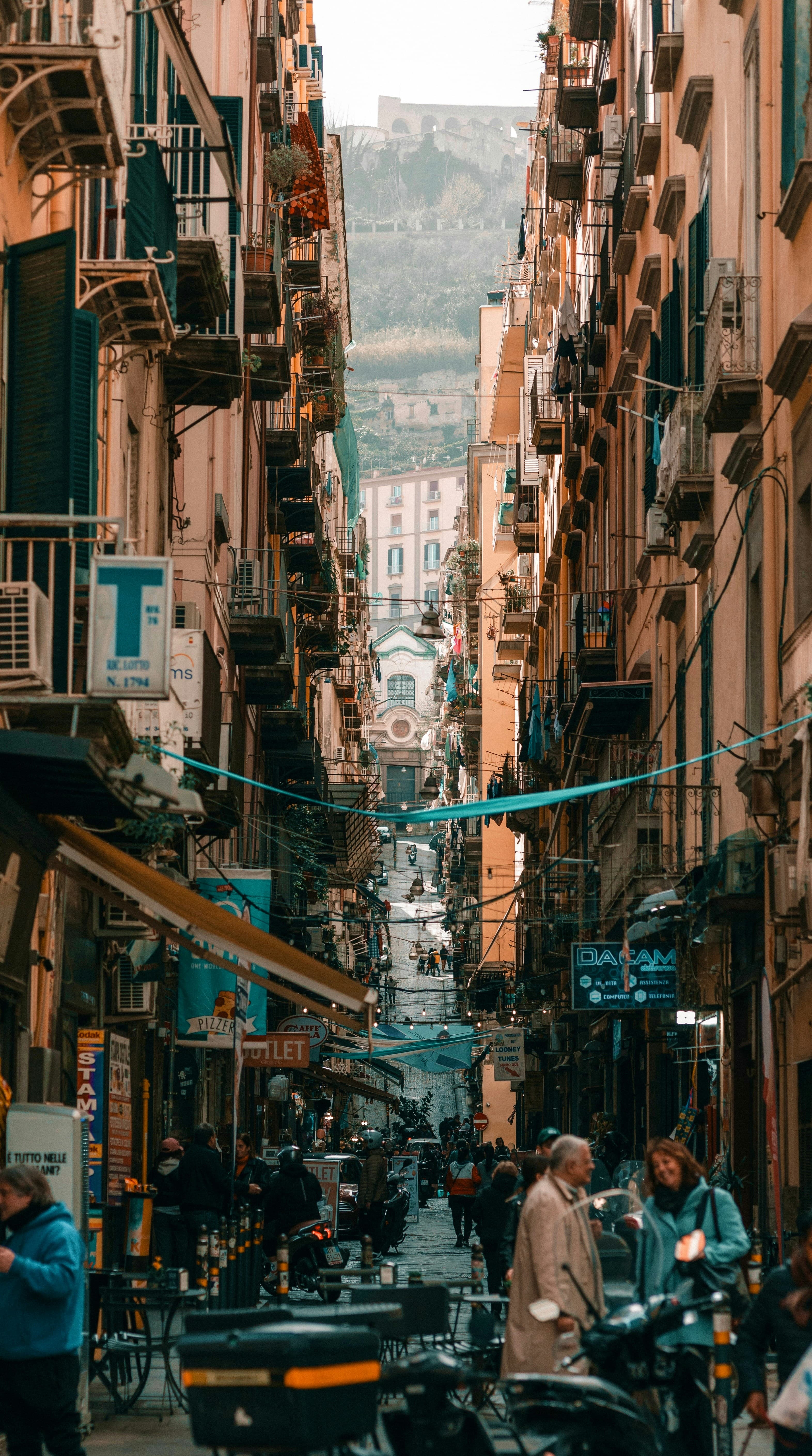
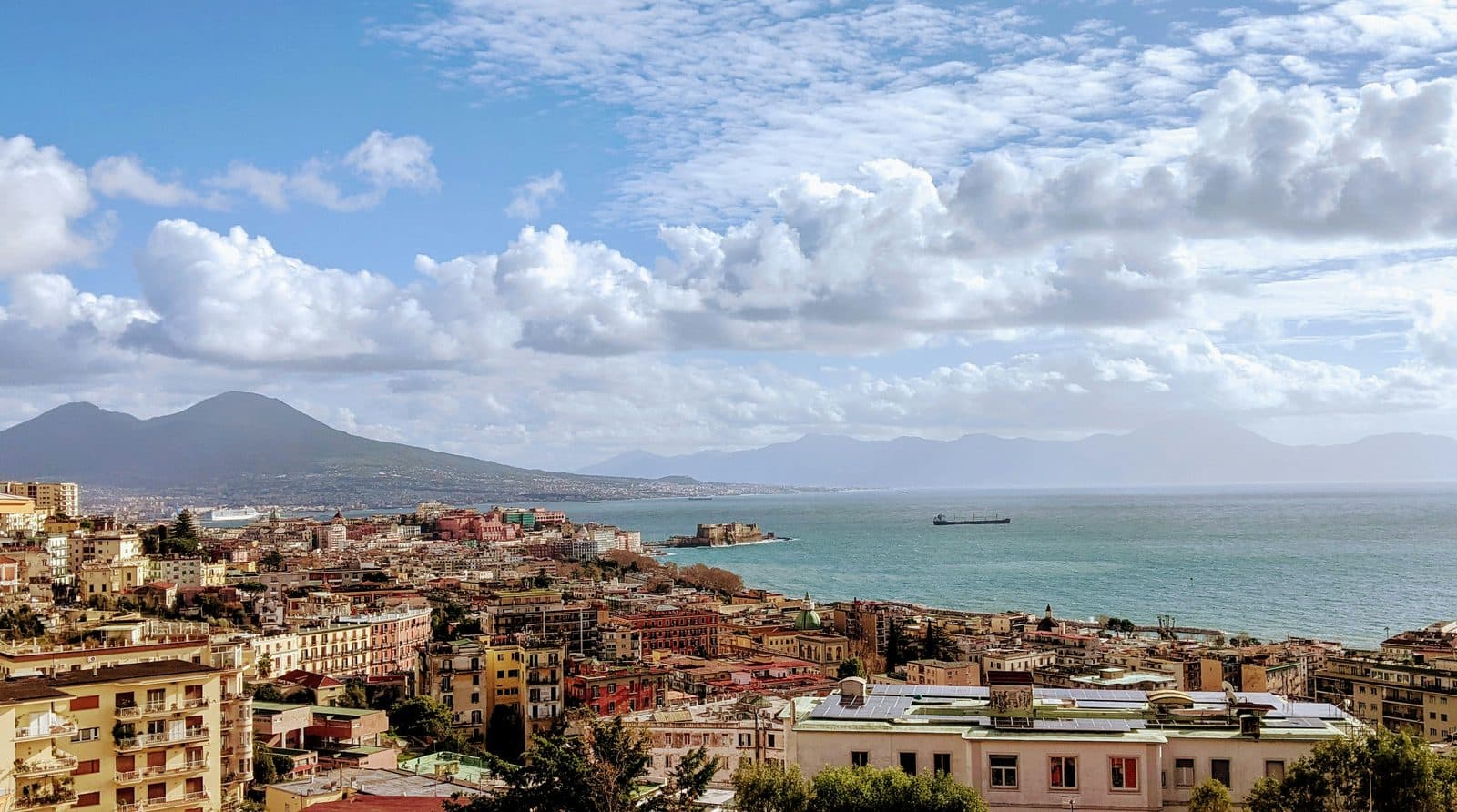
A walk through the Historic Center of Naples along the grid its Greek founders laid out: Piazza del Gesù Nuovo, Santa Chiara, Spaccanapoli, the crib makers of San Gregorio Armeno, the ancient forum, the Duomo, the Roman theatre's arches and the Greek wall in Piazza Bellini.
Start · Piazza del Gesù Nuovo: A Palace Front on a Church
DirectionsStops
- 1
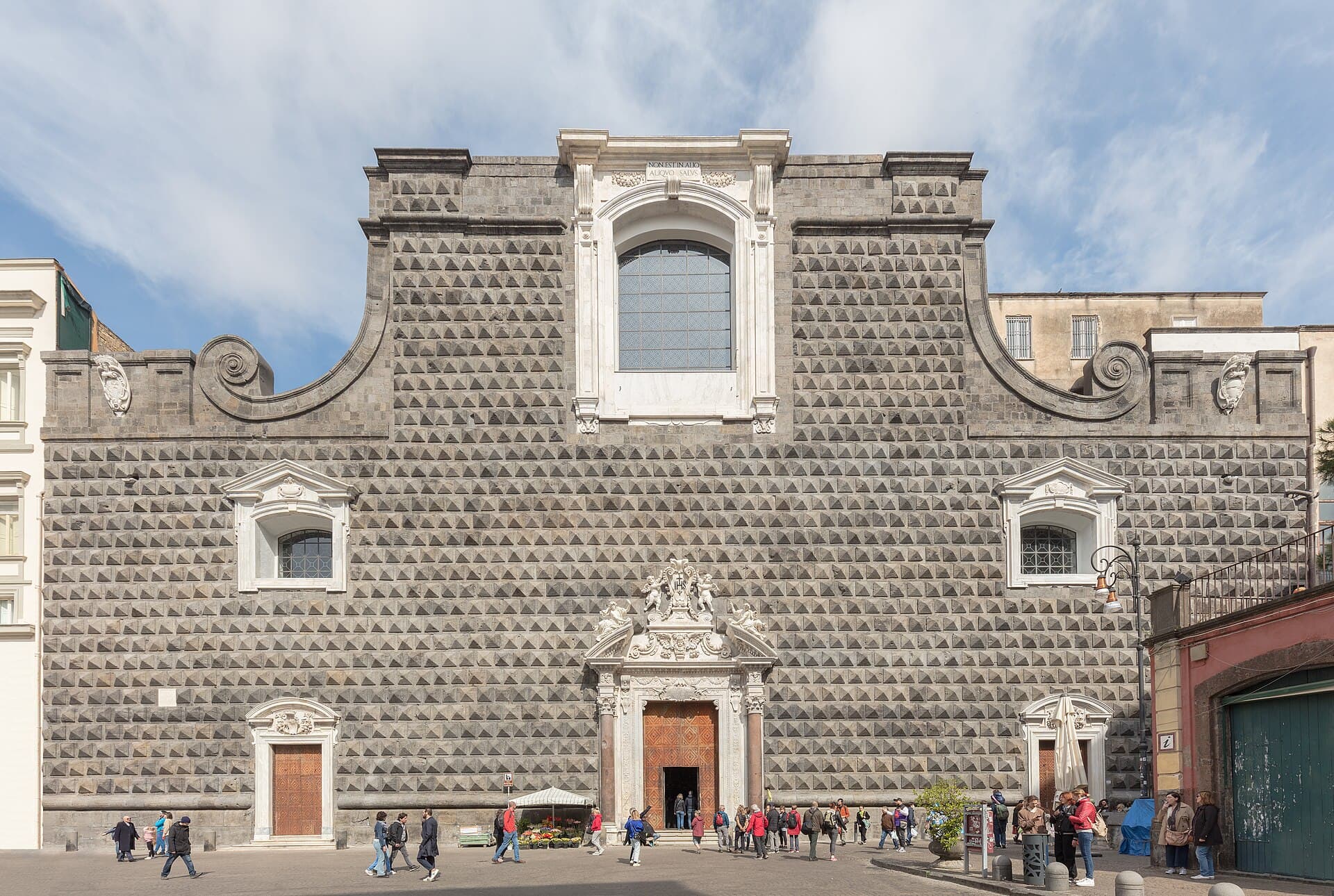
Piazza del Gesù Nuovo: A Palace Front on a Church
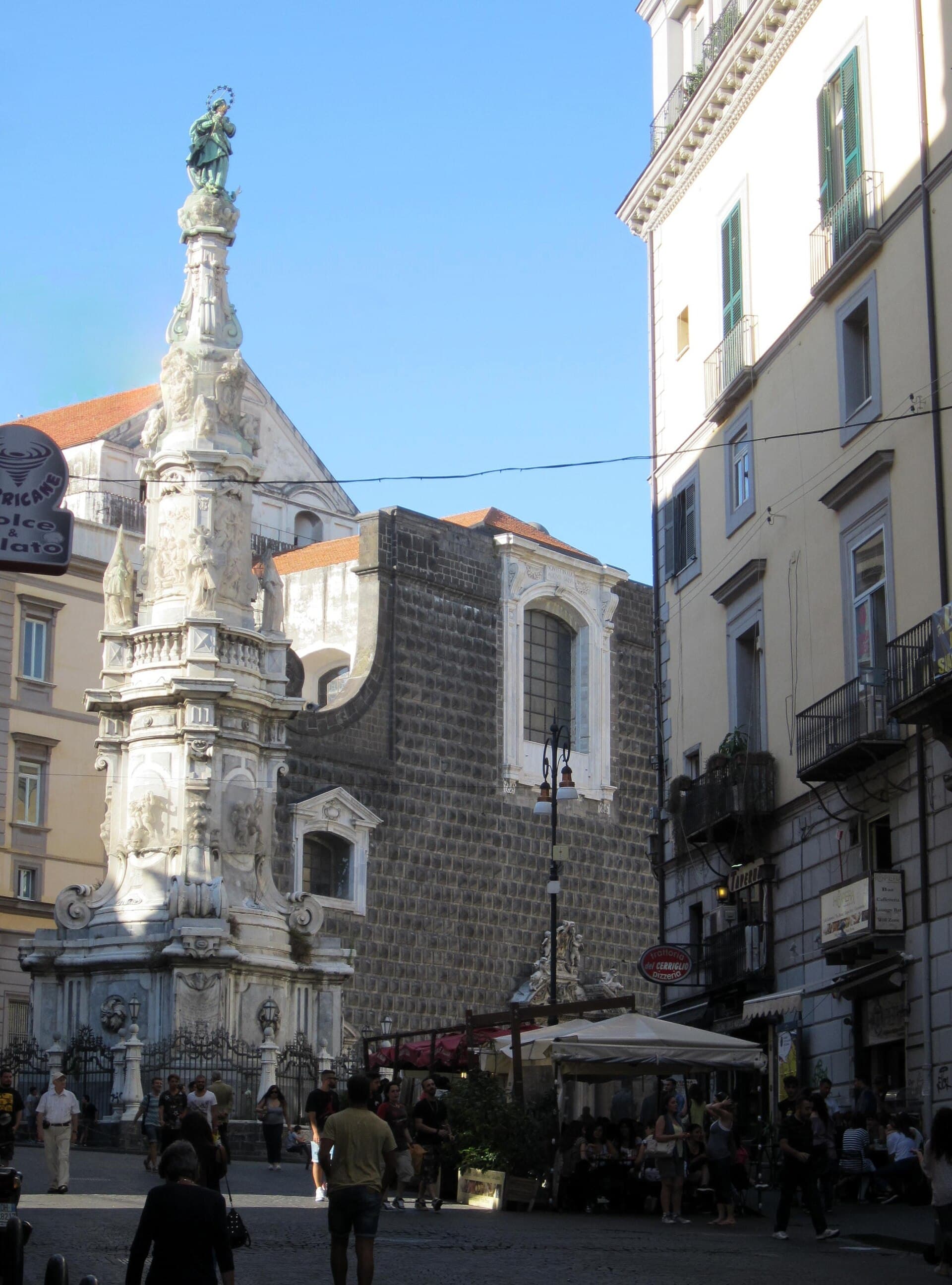
A church behind a palace front. The Jesuits bought a Renaissance palace in 1584 and kept its diamond-cut stone face; the spire in the square is from the 1740s.
- 2
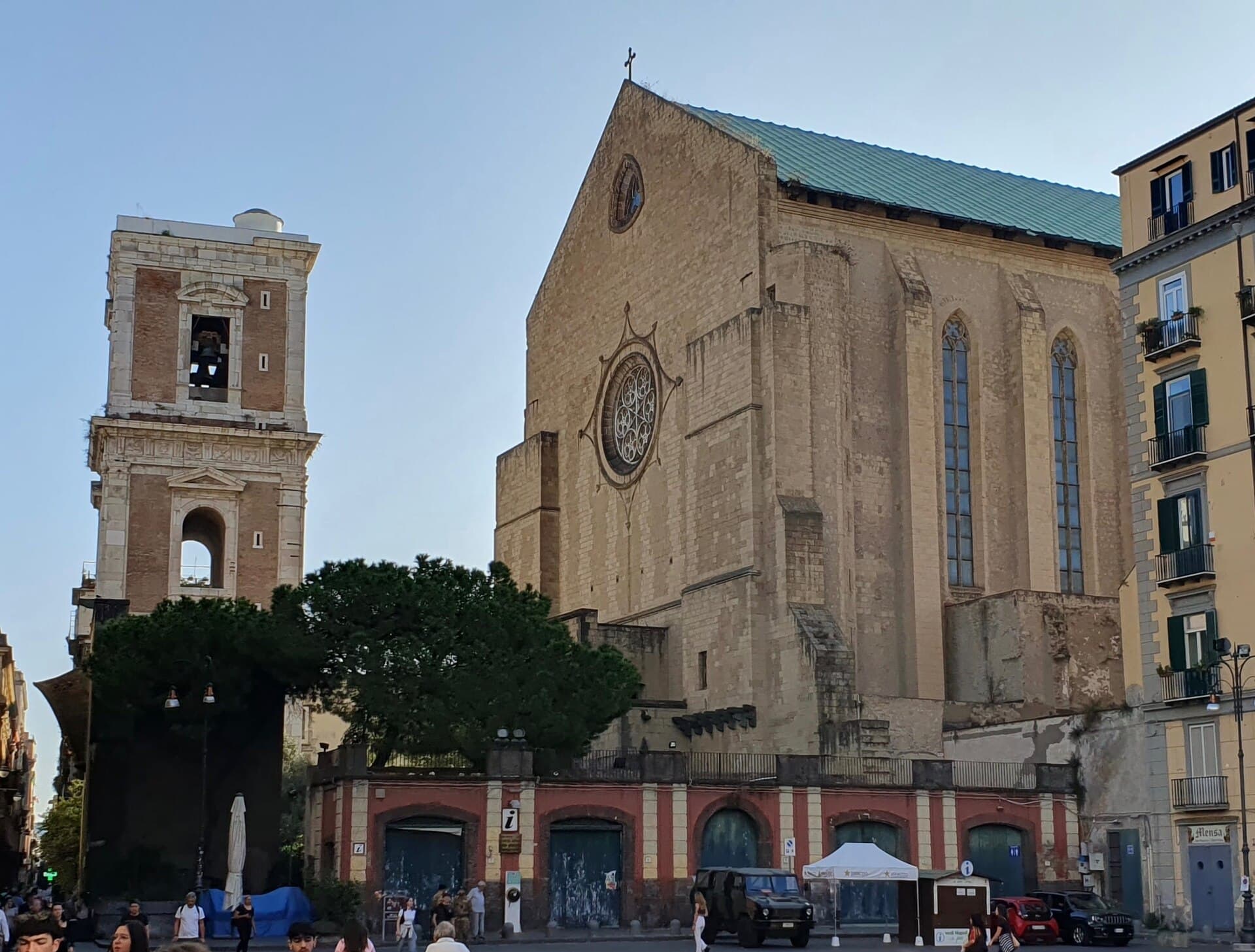
Santa Chiara: The Queen's Church, Bombed and Rebuilt
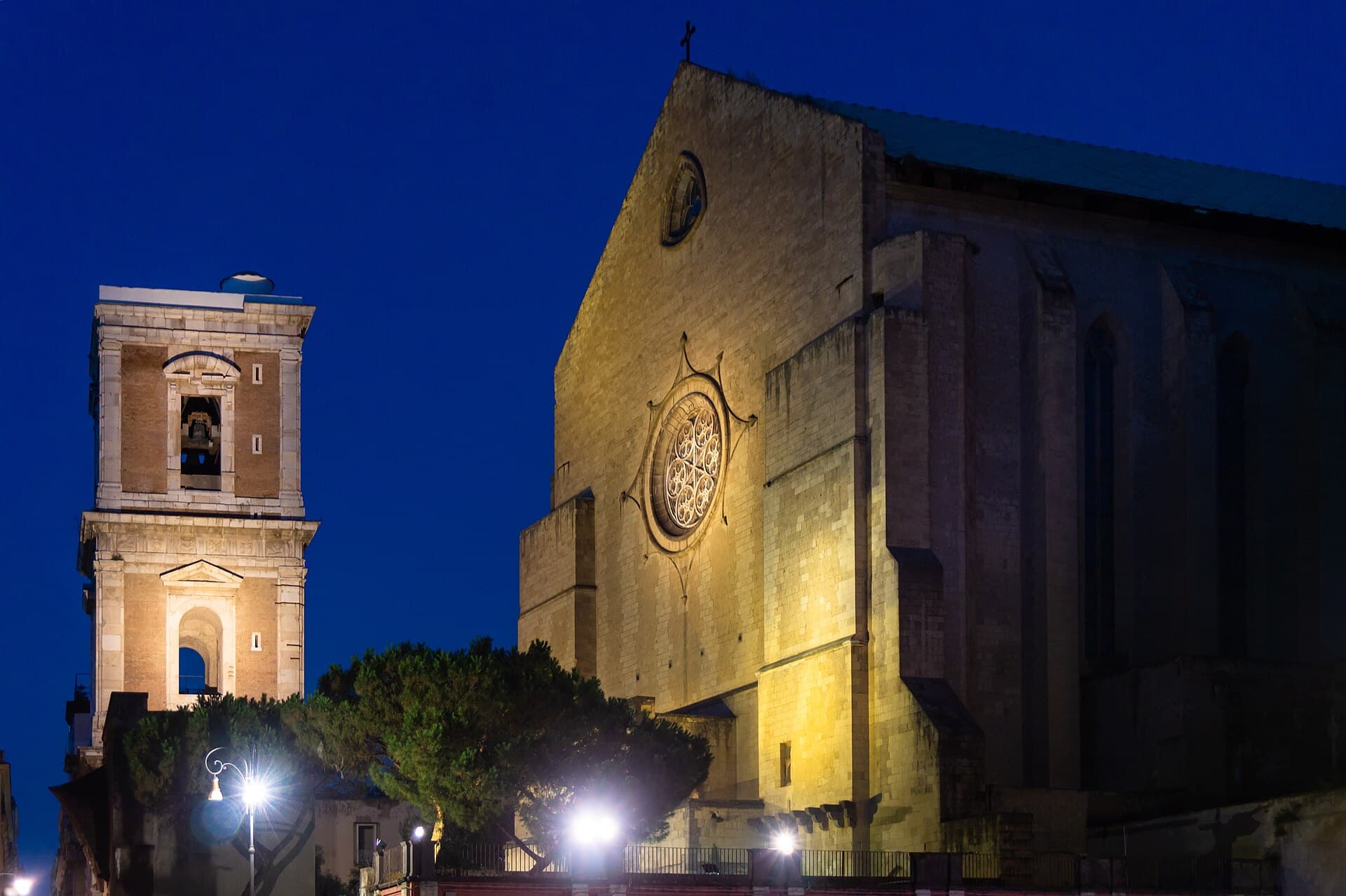
A royal church rebuilt after 1943. Begun in 1310 by Robert of Anjou and Sancha of Majorca, almost destroyed by bombs in 1943 and rebuilt in its original Gothic style.
- 3
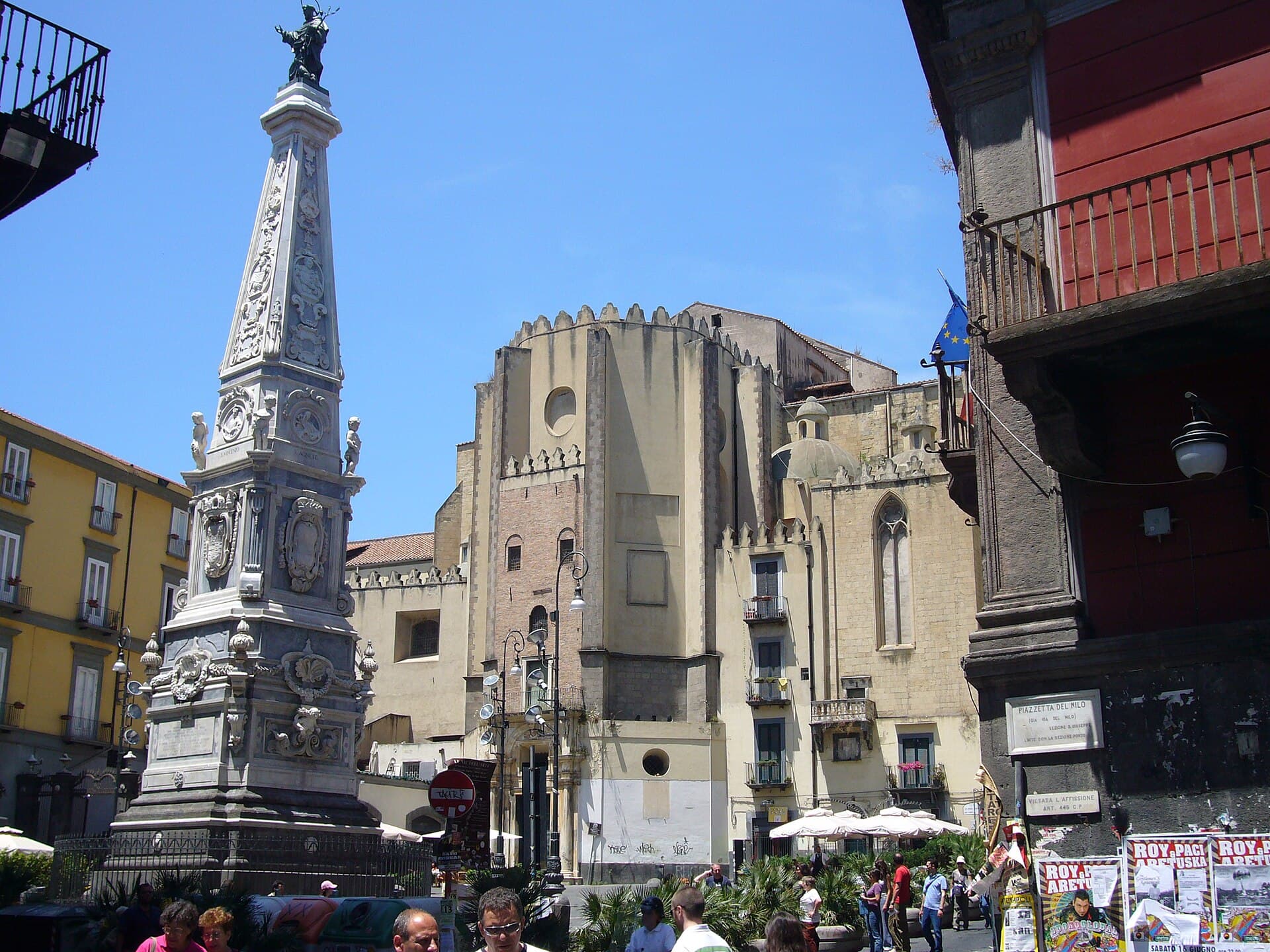
Piazza San Domenico Maggiore: Into the Greek City
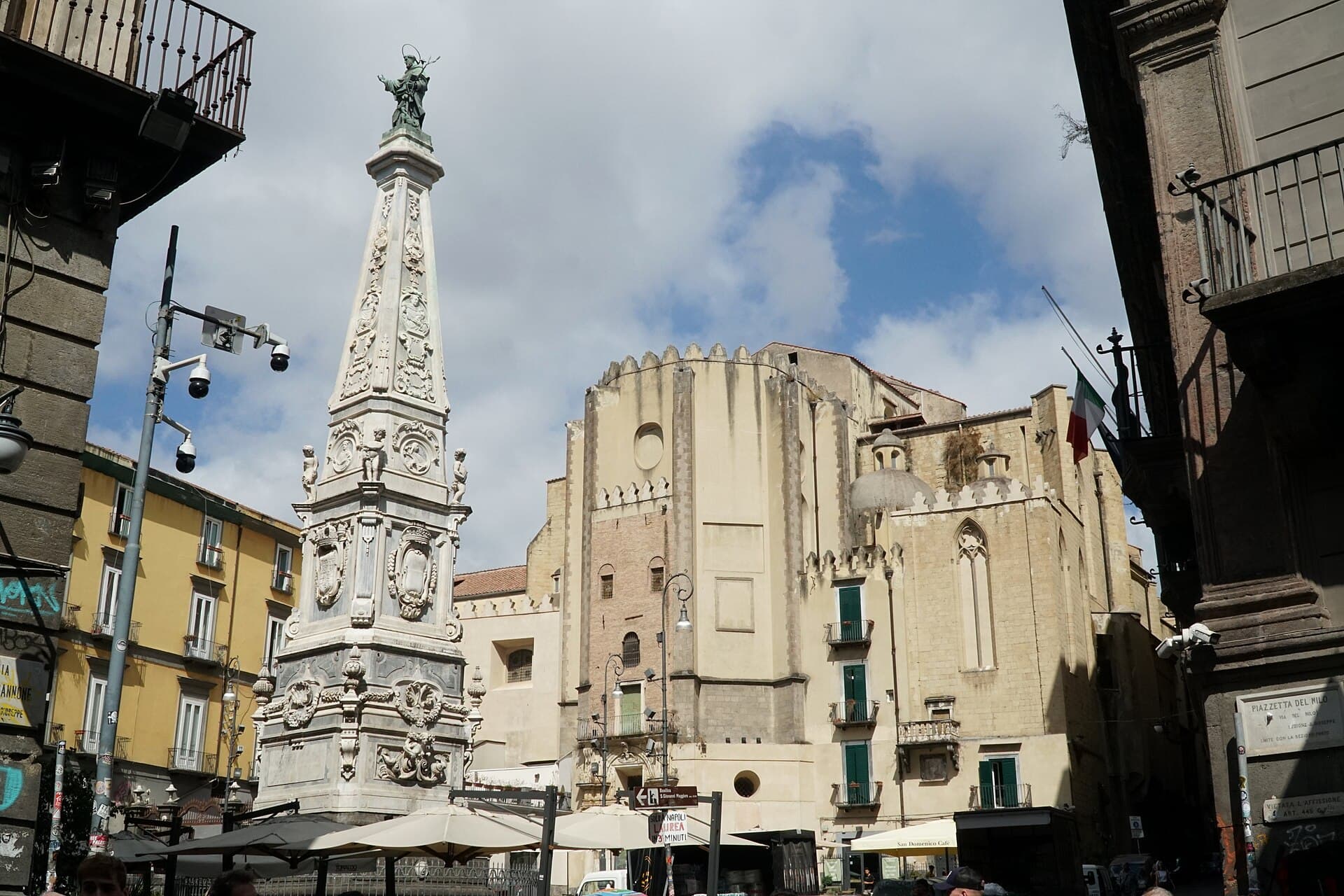
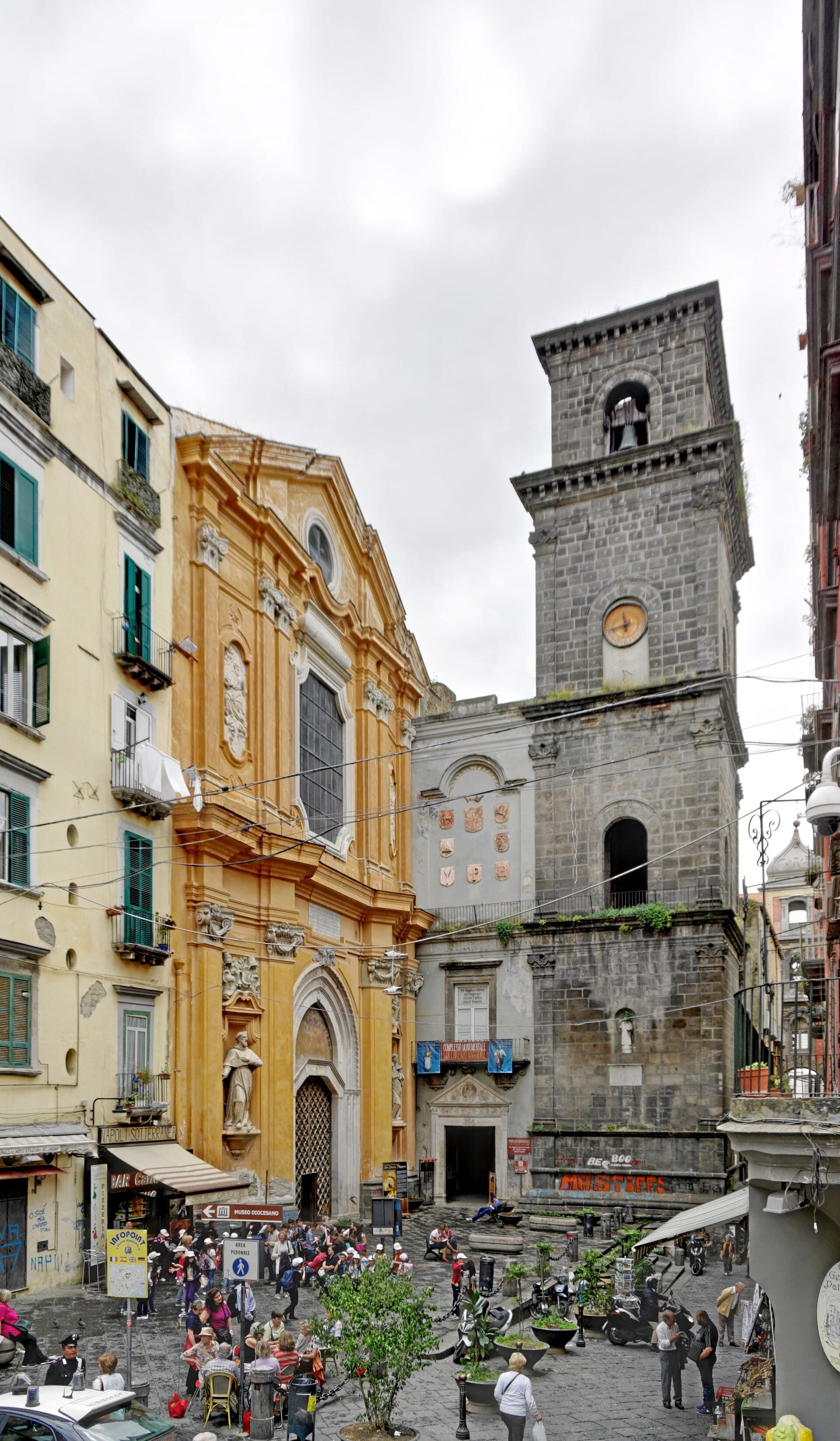
The square where the Greek city began. The Greek wall line ran through here; on this square lived the prince behind the Veiled Christ.
- 4
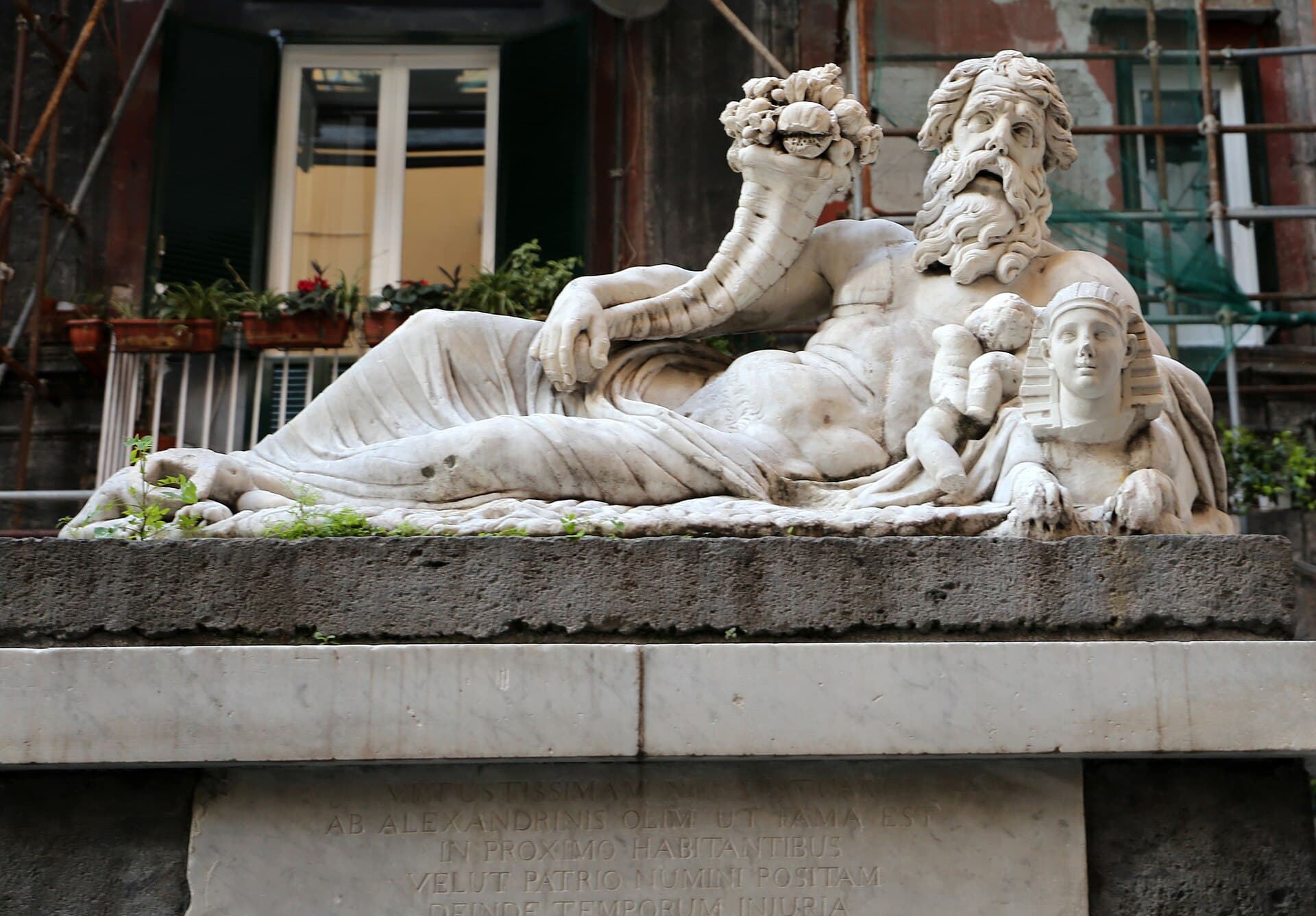
Statue of the Nile: The Body of Naples
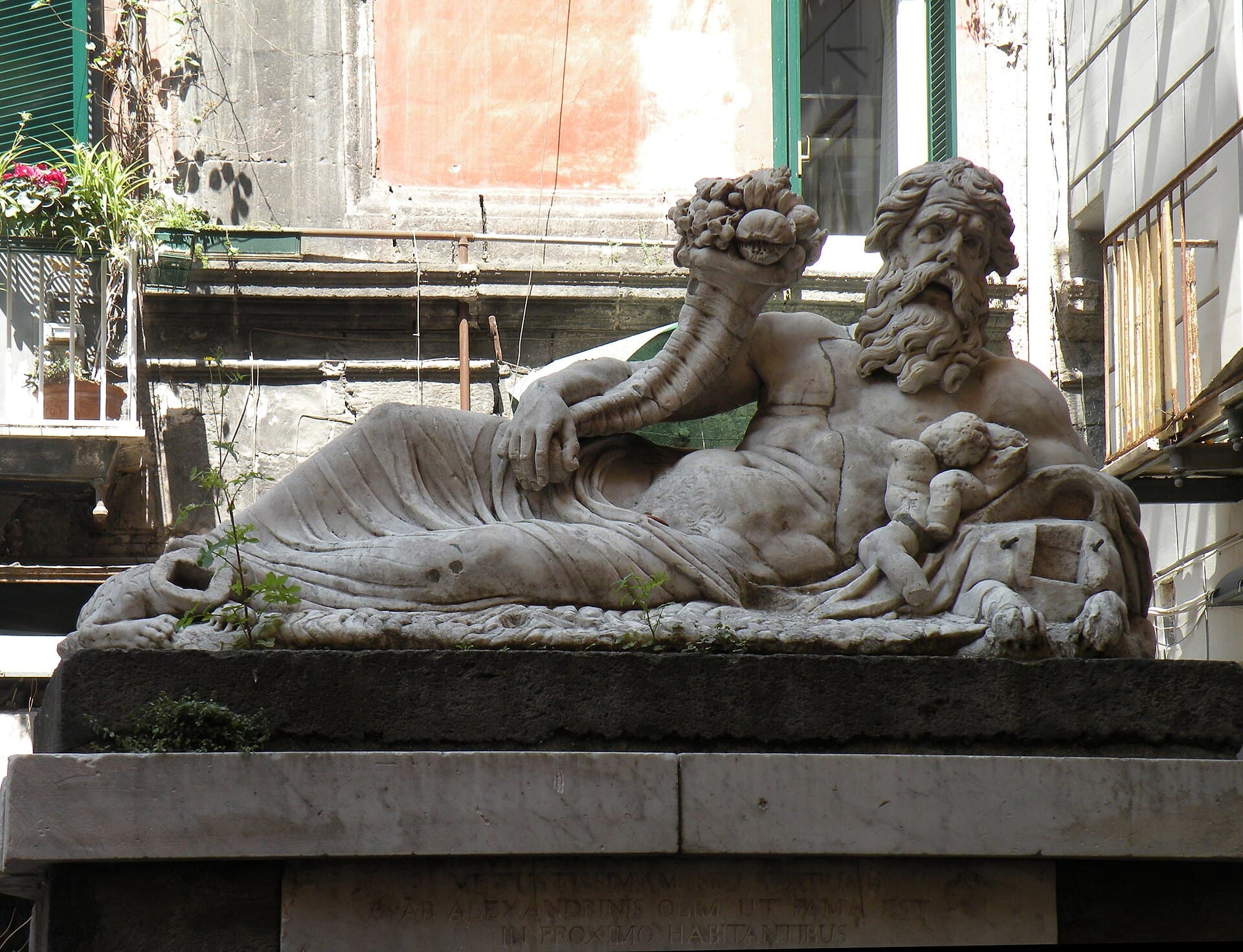
A Roman god of the Nile, renamed by Naples. Alexandrian merchants lived here; headless, the statue was taken for a mother and called the body of Naples.
- 5
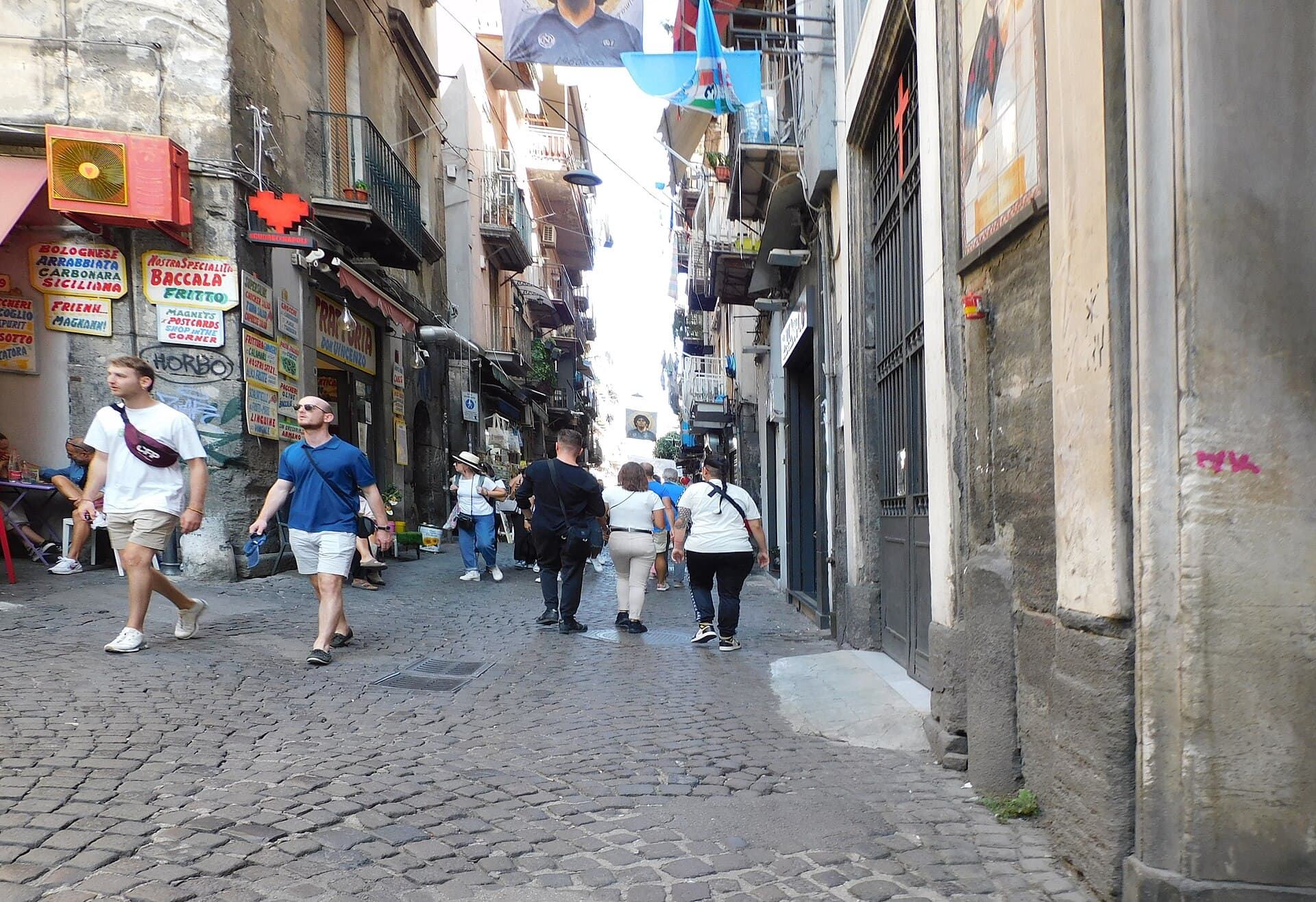
Via San Biagio dei Librai: The Booksellers' Street
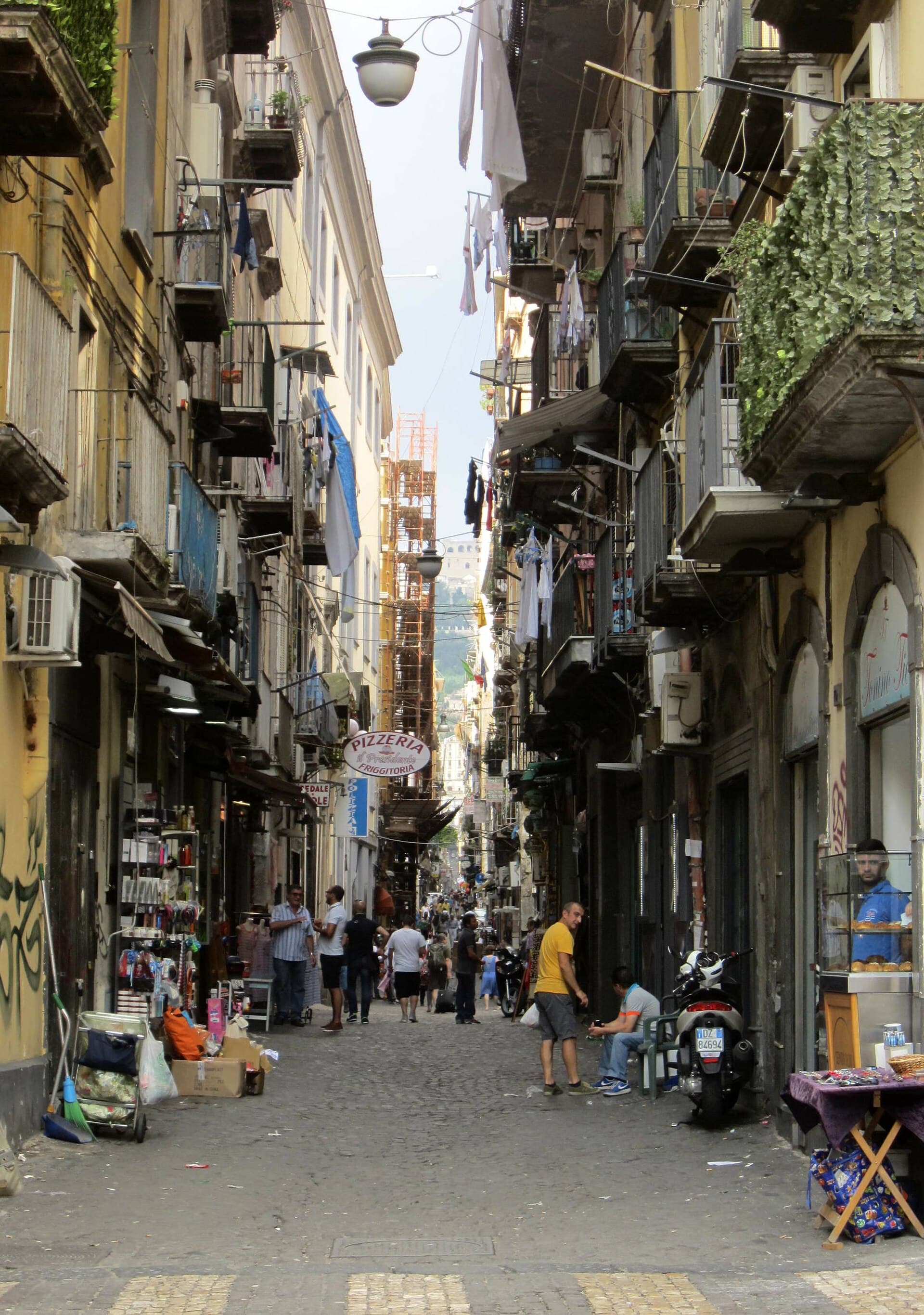
The Greek street renamed for booksellers. Vico was born here, Donatello's horse stood in a courtyard, and a pawnshop grew into a bank.
- 6
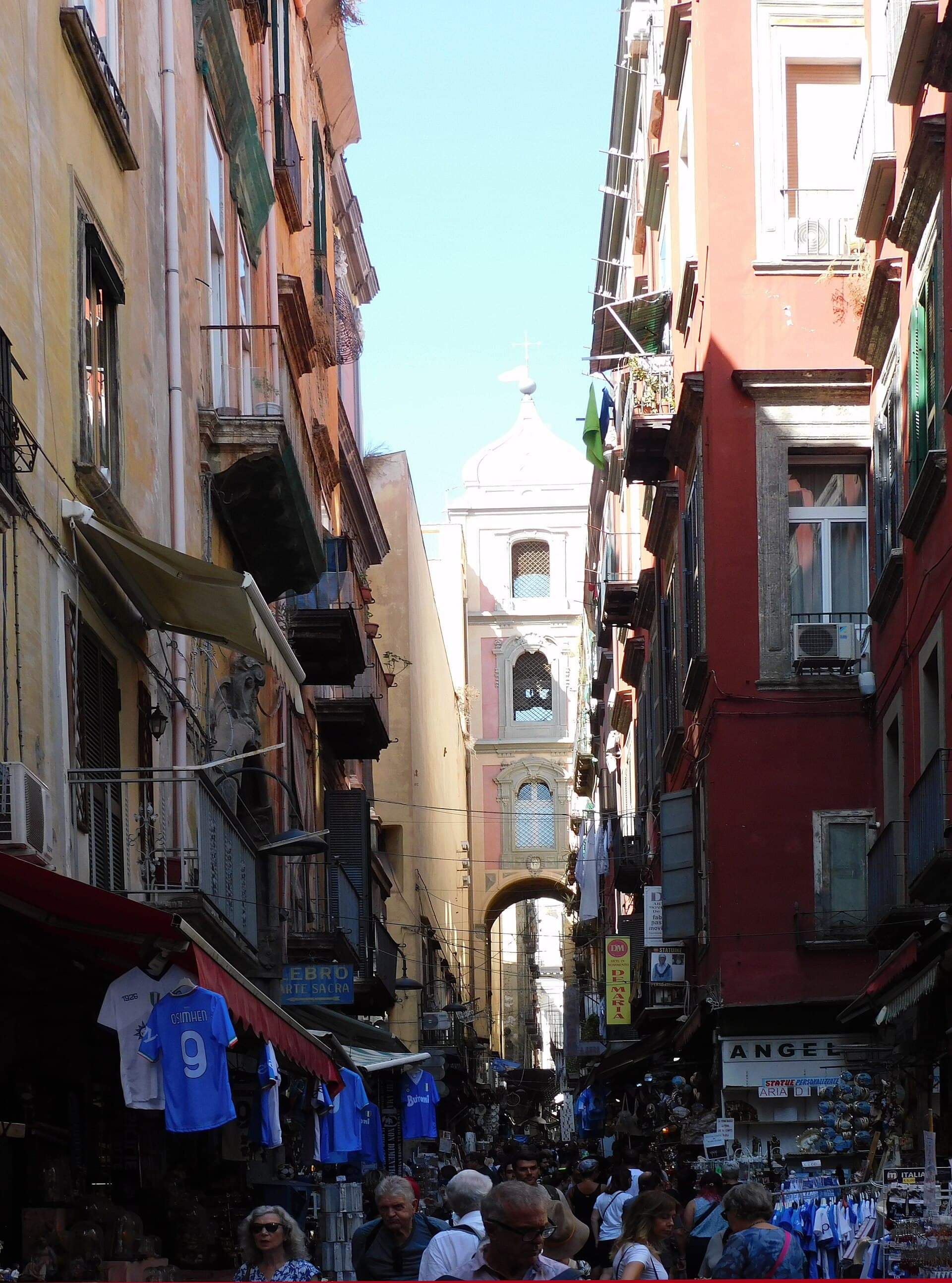
Via San Gregorio Armeno: The Crib Makers
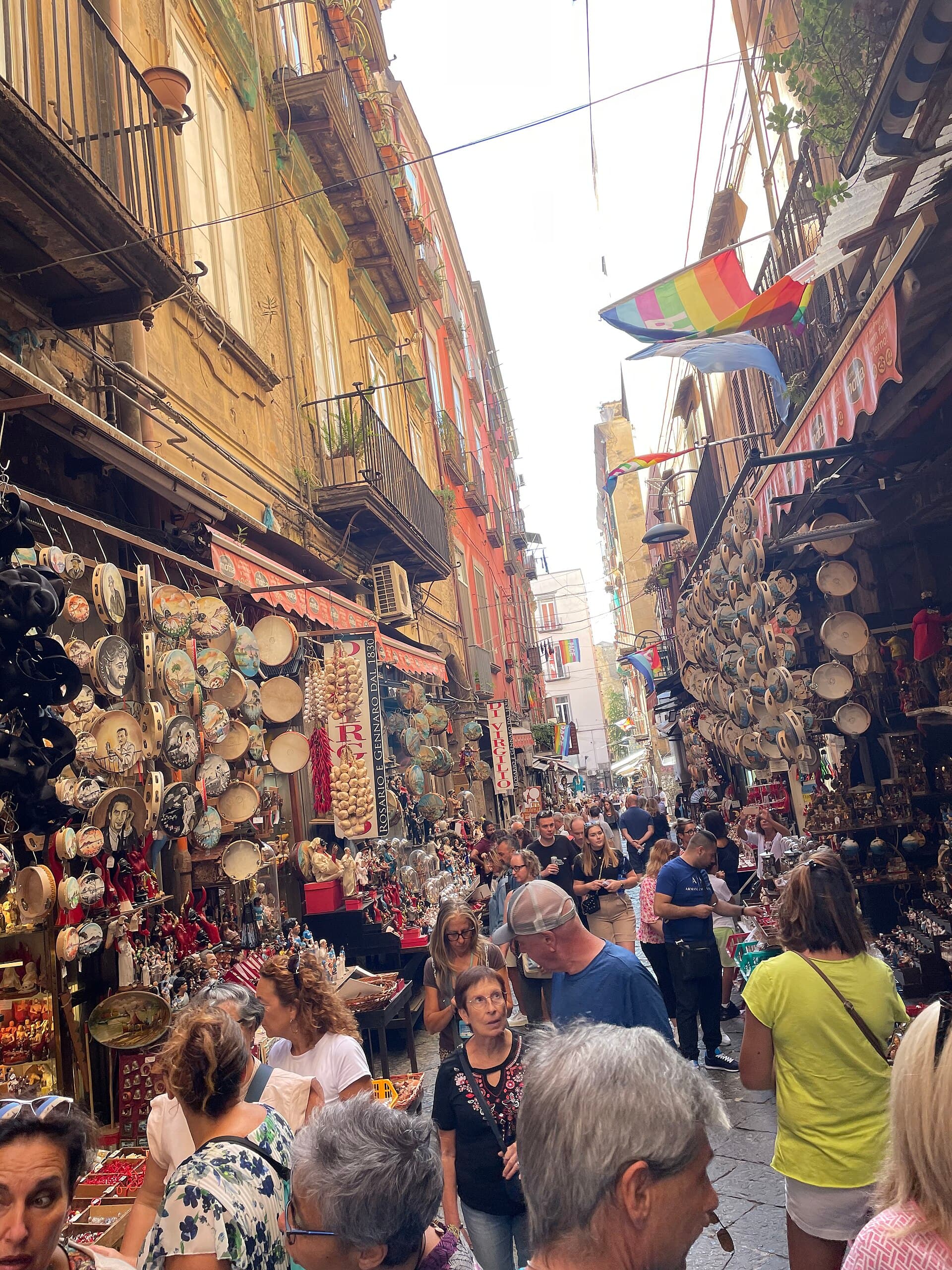
The street of the nativity figure makers. Workshops sell crib figures all year, beside a convent founded by refugee Greek nuns.
- 7
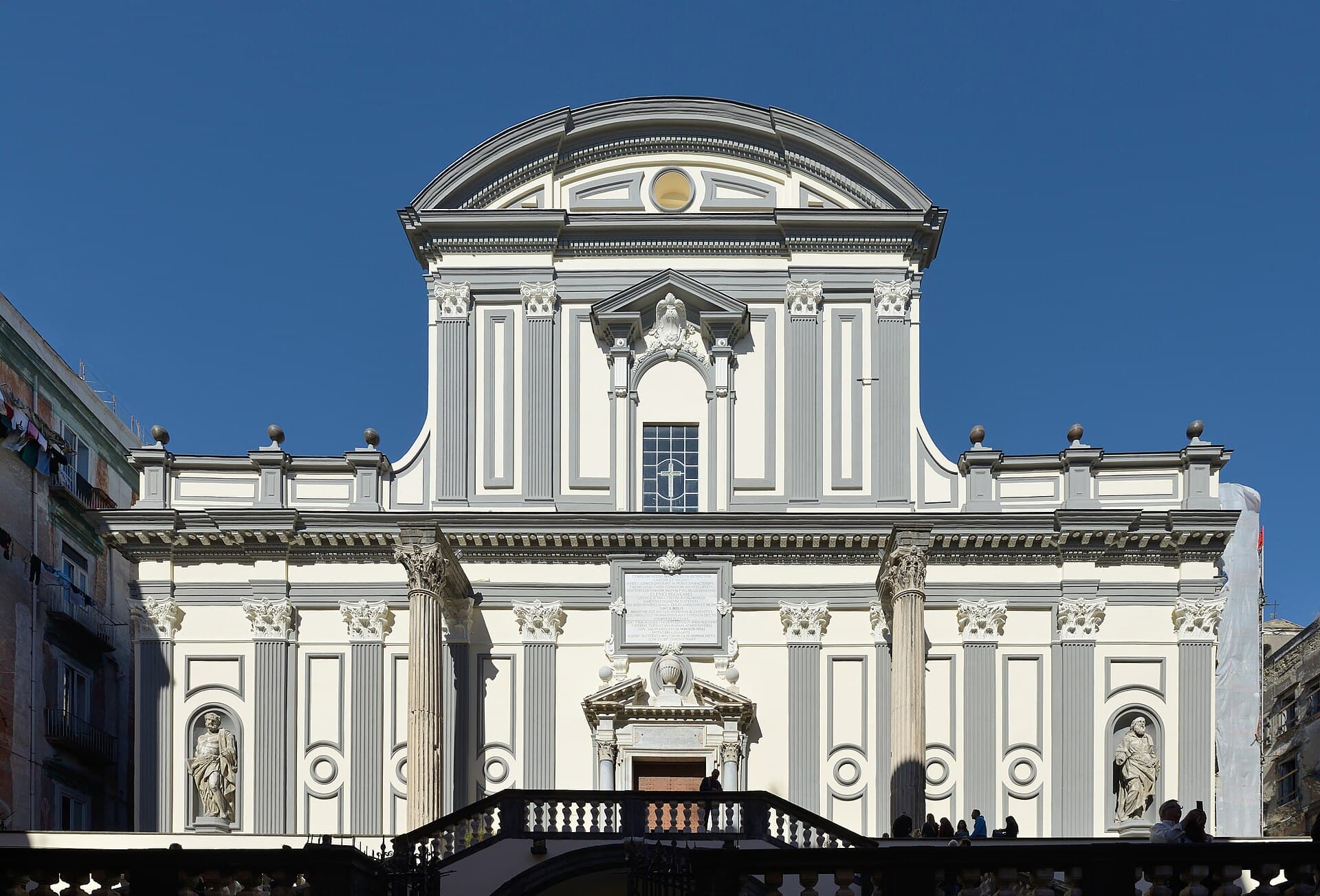
Piazza San Gaetano: The Ancient Forum
The Greek agora and the Roman forum. Two columns of a temple to Castor and Pollux still stand on a church front; Petrarch rode out a storm across the street.
- 8
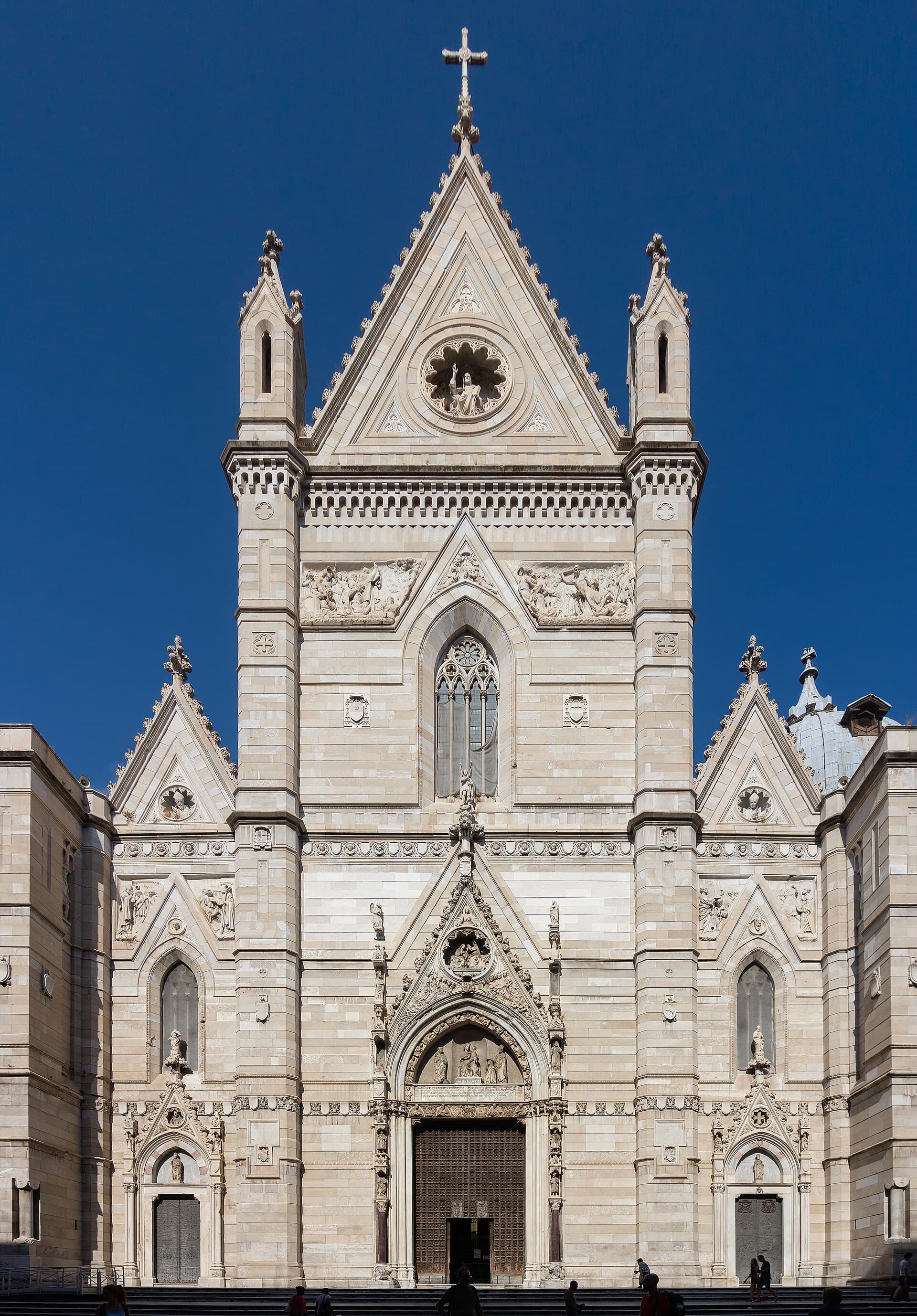
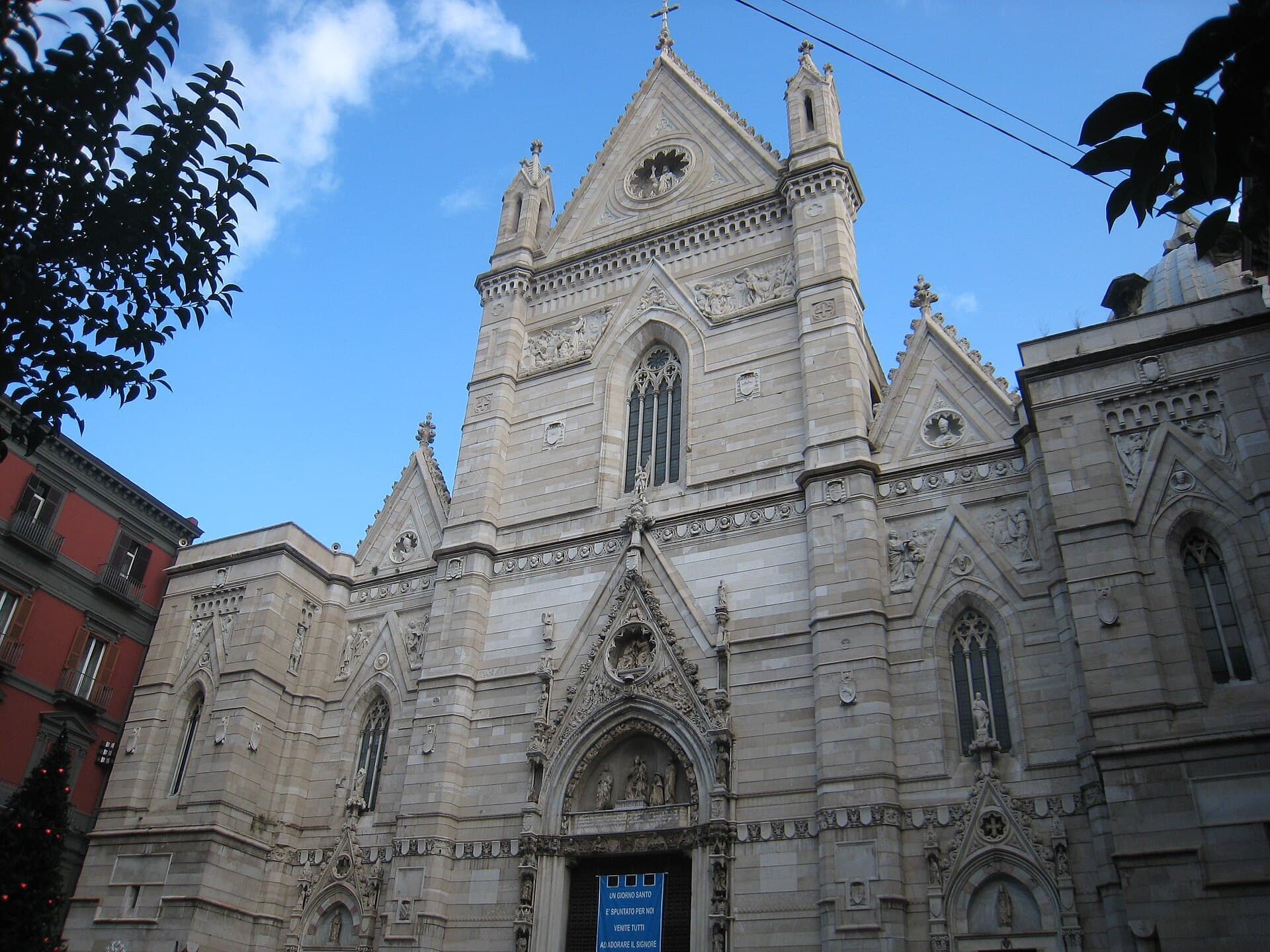
Naples Cathedral: The Pact With San Gennaro
The cathedral of San Gennaro's blood. In 1527 the city signed a notarised pact with its saint at the high altar; the facade was finished in 1905.
- 9
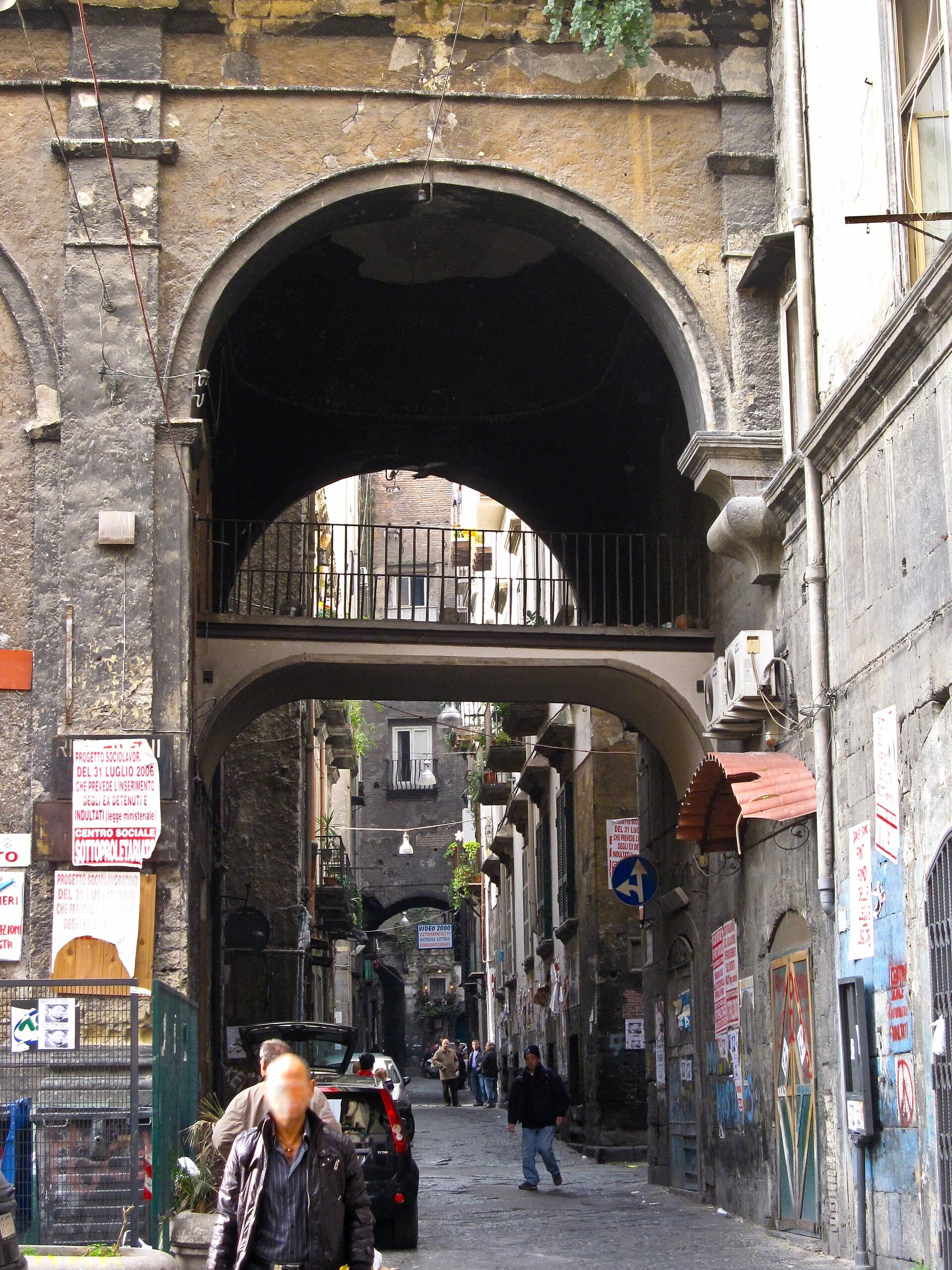
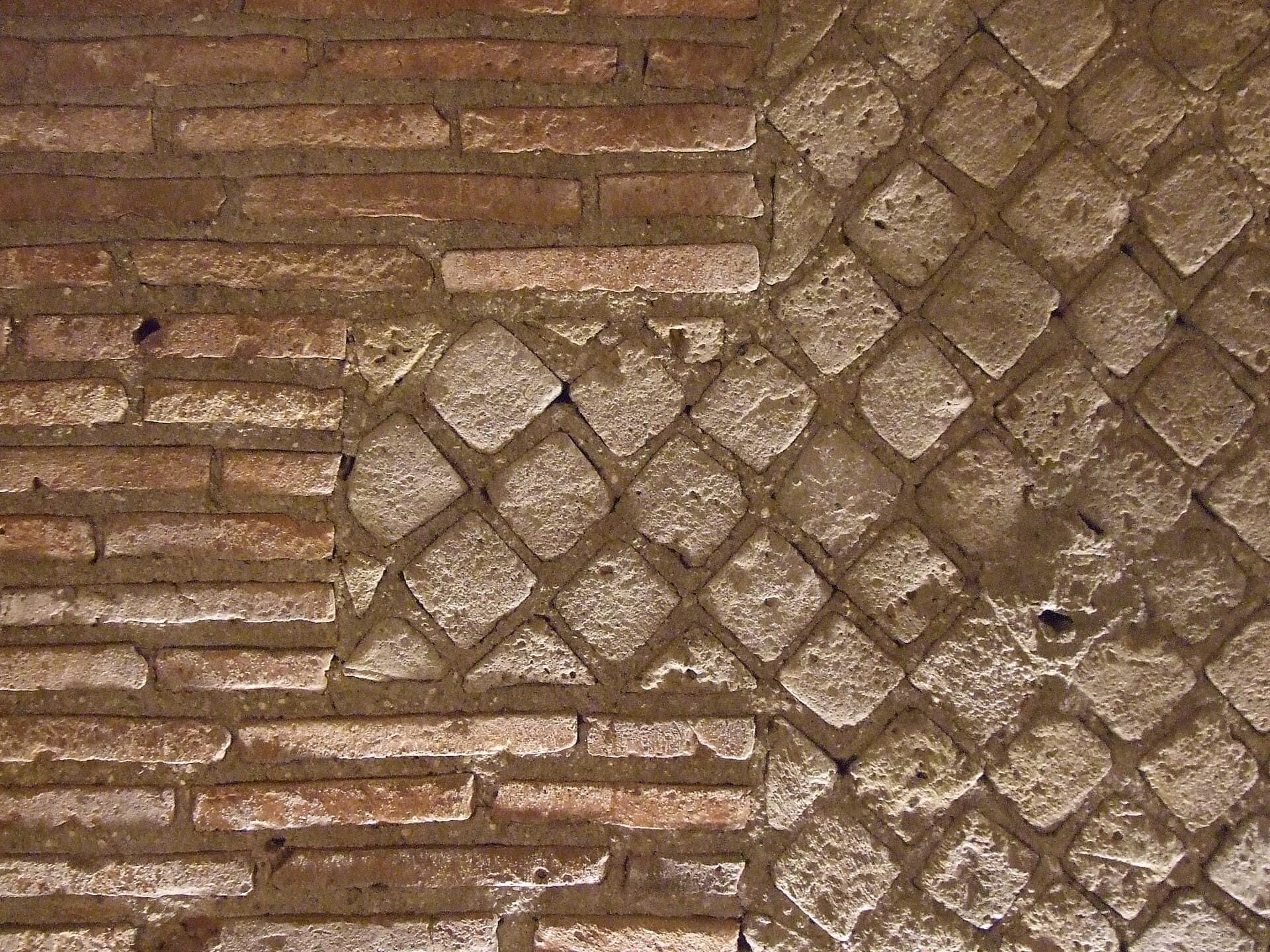
Via Anticaglia: The Roman Theatre's Arches
Two Roman brick arches over the street. The theatre of Neapolis lies hidden in the houses here; Nero made his stage debut in Naples.
- 10
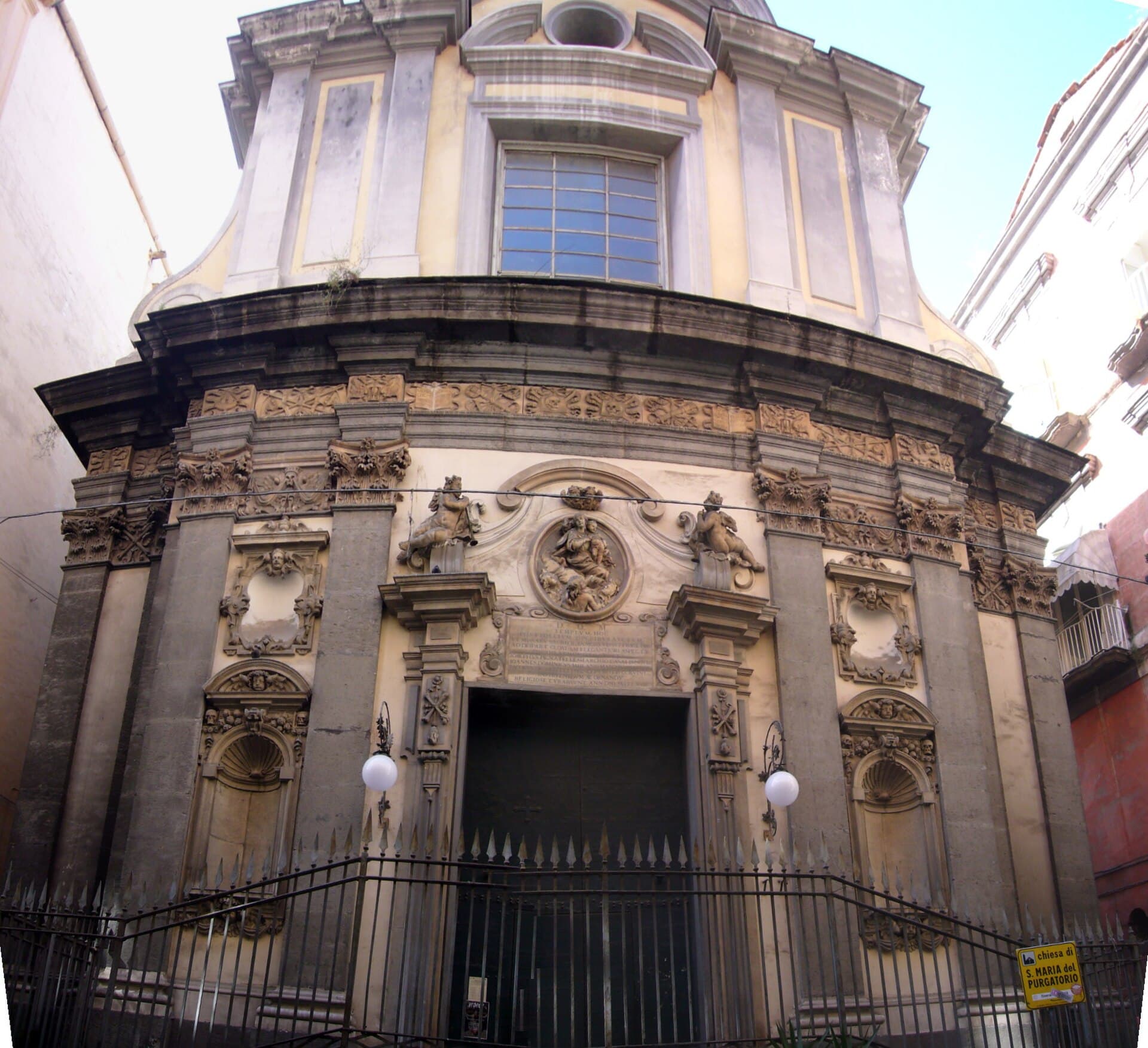
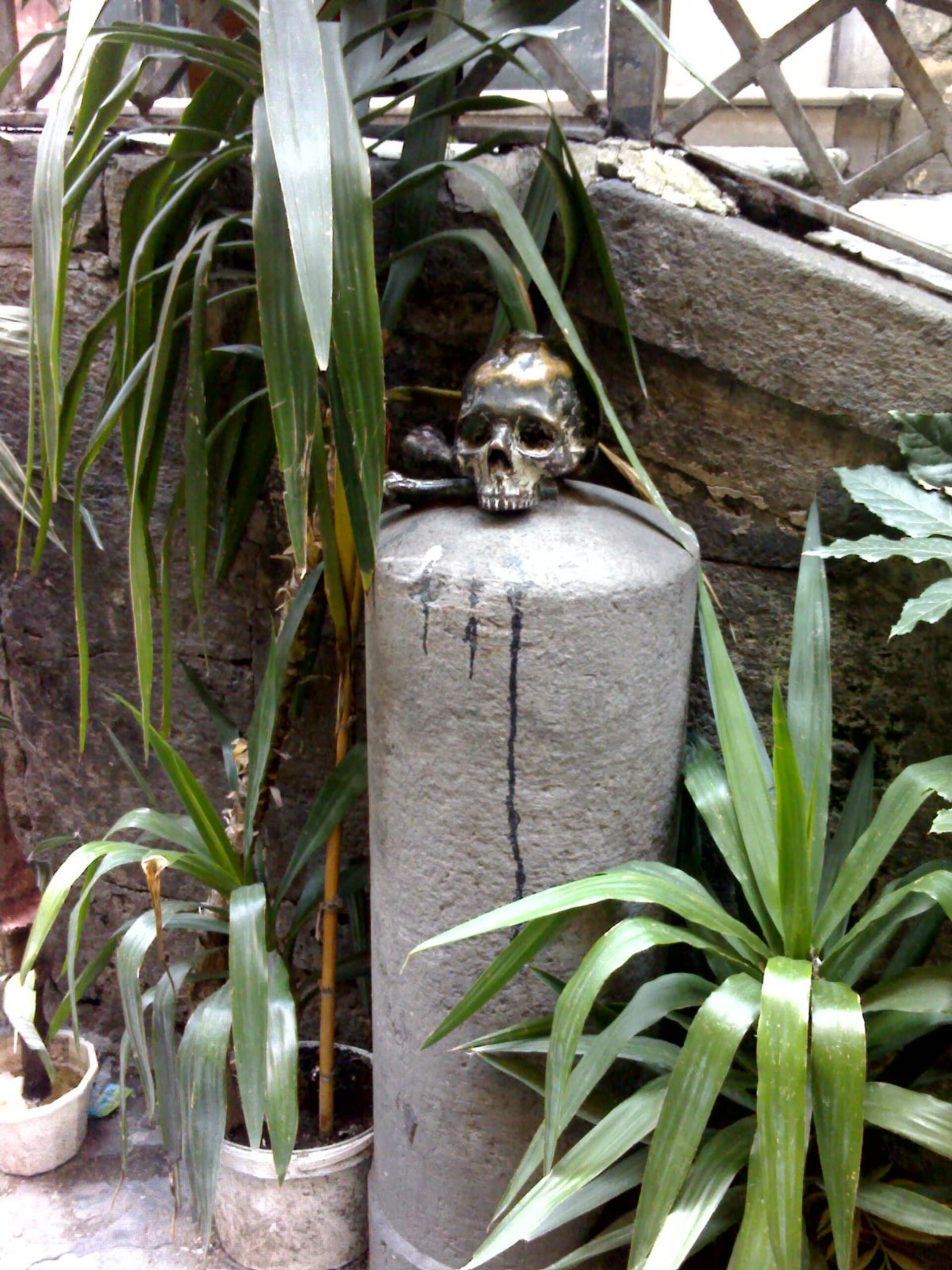
Purgatorio ad Arco: The Skulls of the Souls
A church with bronze skulls at its gate. Below it, Neapolitans adopted anonymous skulls and prayed for them, and kept on after the Church banned it.
- 11
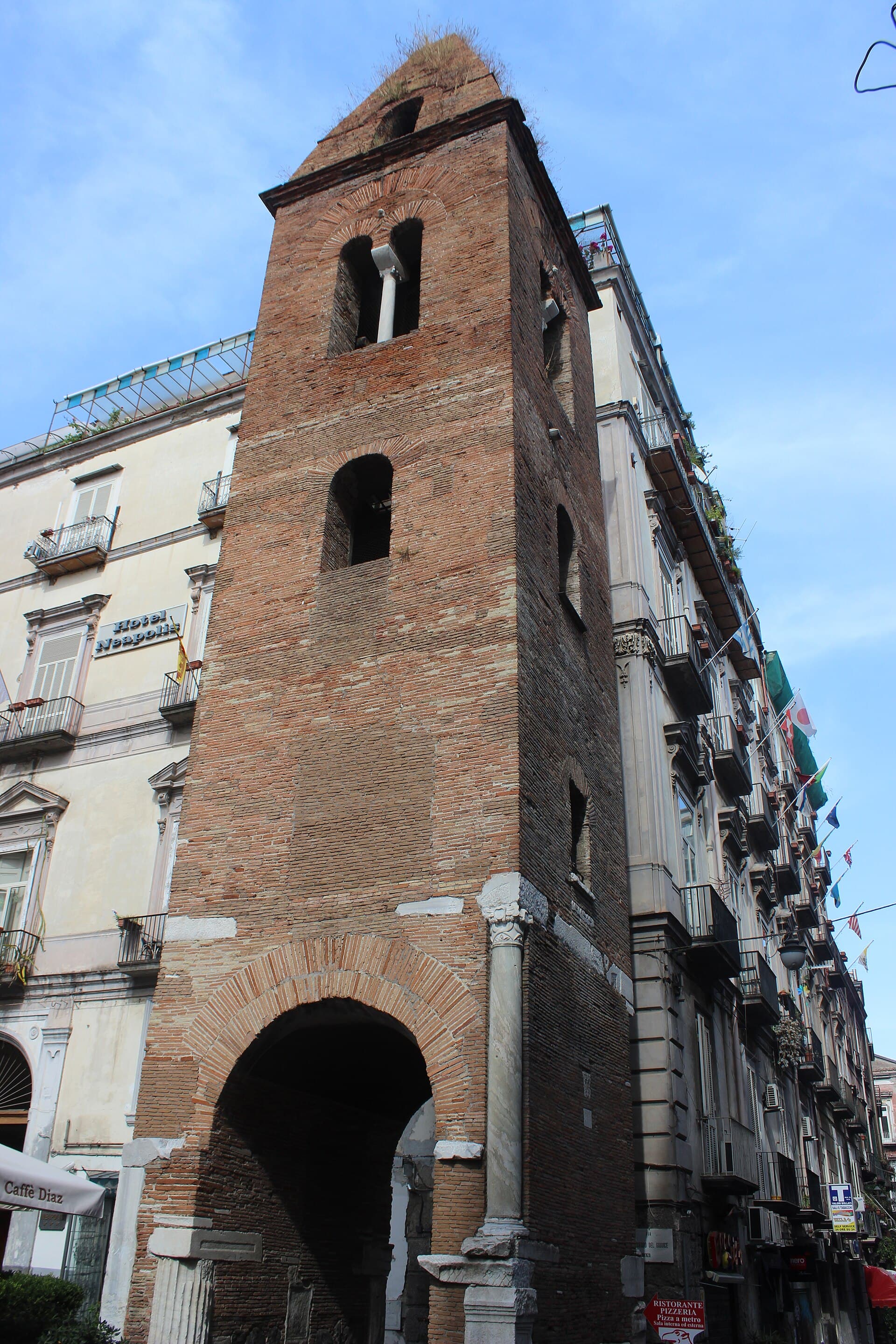
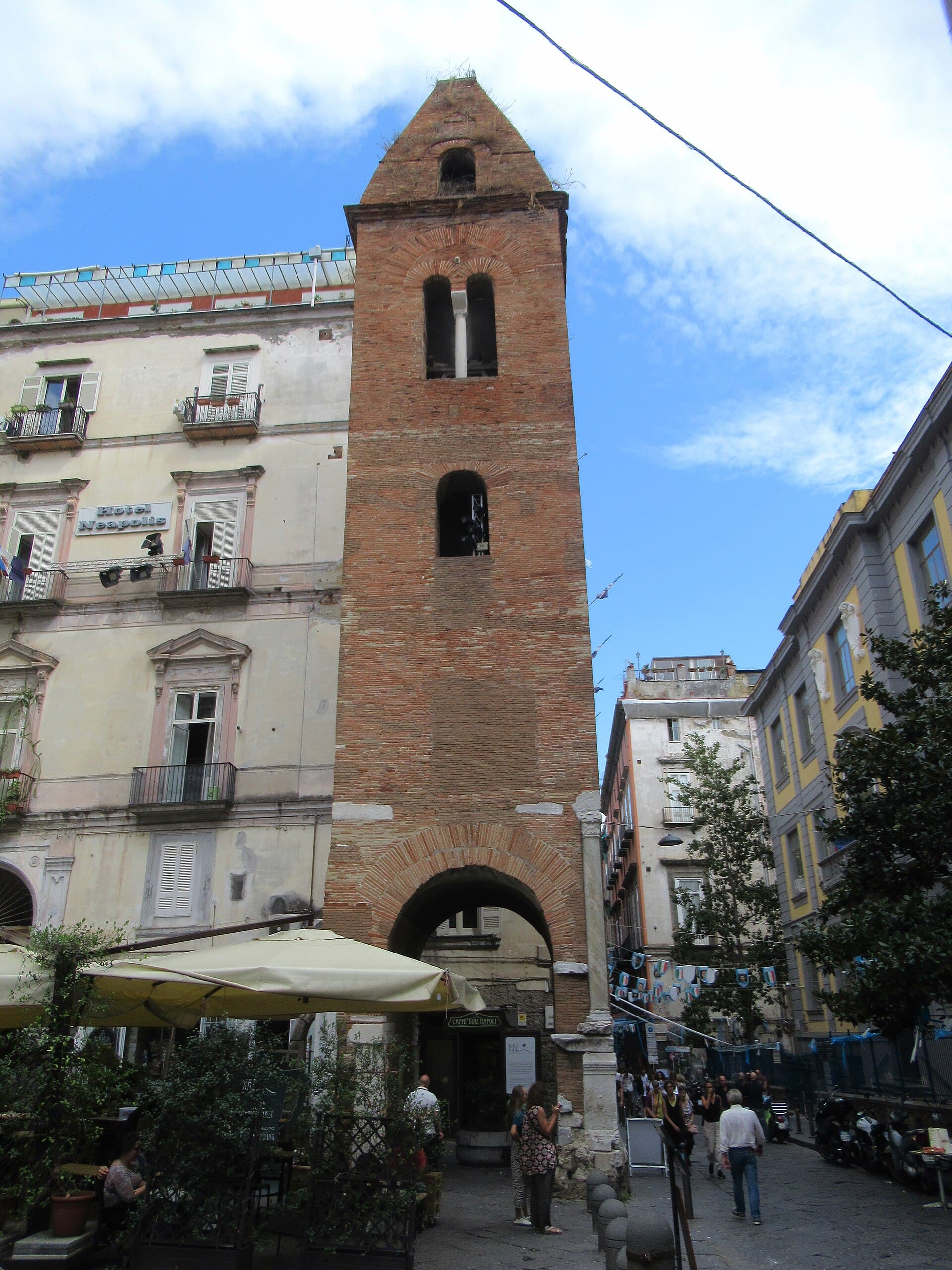
Pietrasanta: A Bell Tower of Roman Stones
A tower of recycled Roman stones, about a thousand years old. Roman carvings are built into its brick, and a church legend involves the devil as a pig.
- 12
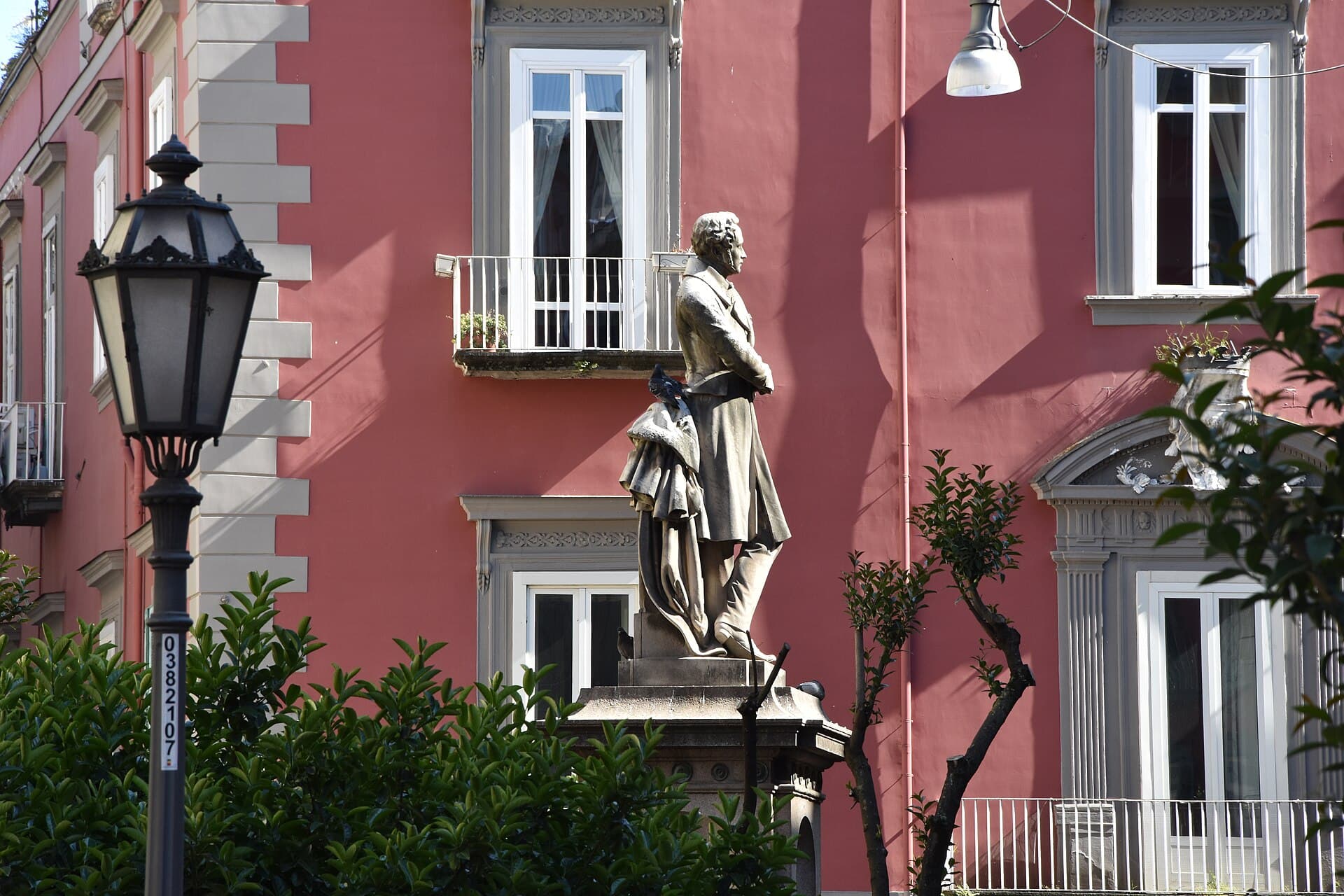
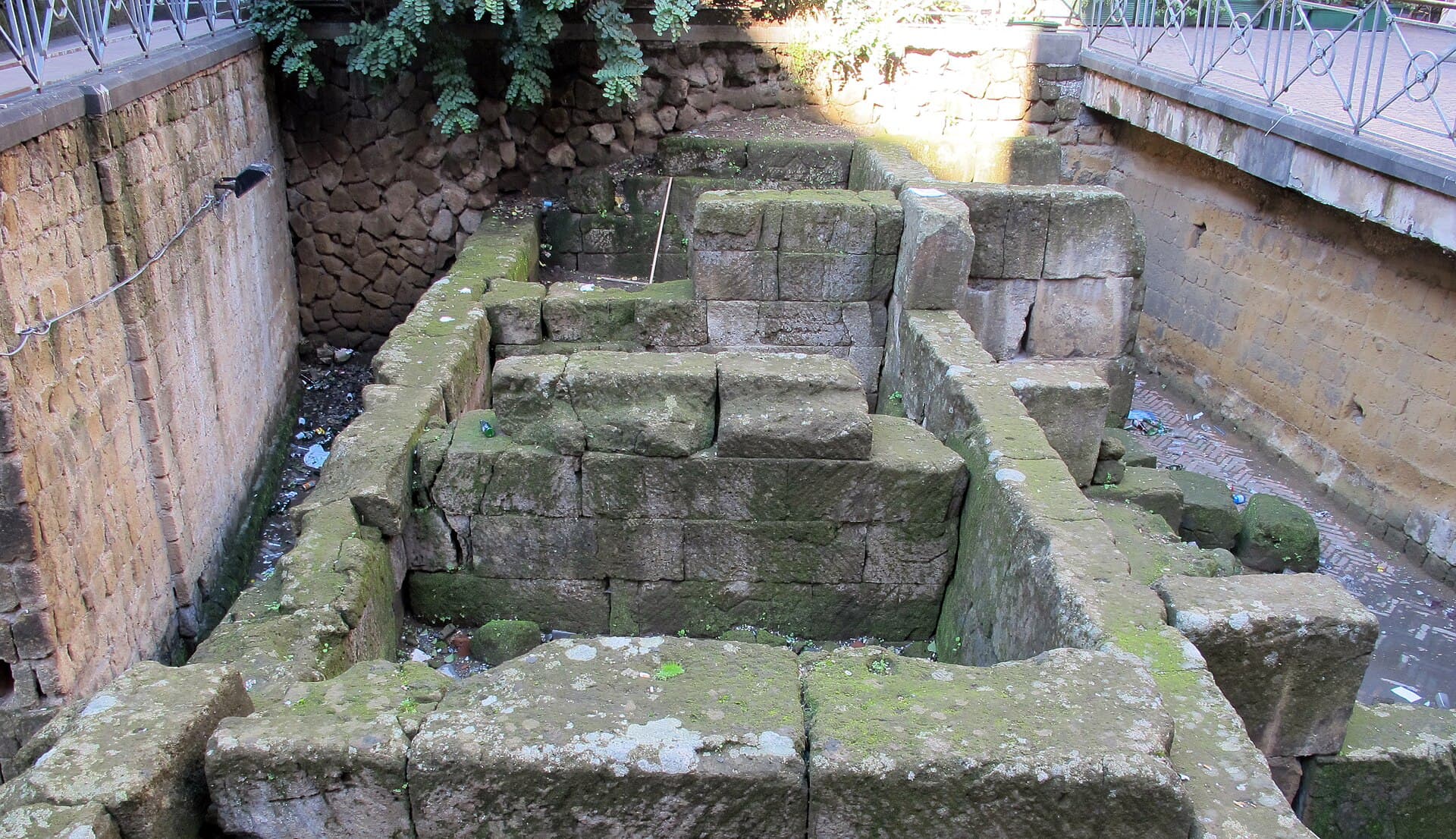
Piazza Bellini: The Greek Wall
The wall of Greek Neapolis, open to the sky. Tufa blocks of the fifth and fourth centuries BC, found by chance in 1954, where the old main street began.
Details
Best Time to Visit
Mornings are the calmest time in the old streets, and most churches are open then. Via San Gregorio Armeno is at its busiest on weekend afternoons and in November and December, when the crib market fills it. Piazza Bellini is liveliest in the evening. The whole route is outdoors, free and paved, so it works at any hour of daylight.
Pro Tips
- •Checked 23 September 2026: the Cappella Sansevero (Via Francesco De Sanctis 19/21) opens daily 9:00 to 19:00 except Tuesdays; booking online is mandatory; tickets 12 euros, 8 euros for ages 18 to 26, 6 euros for ages 10 to 17.
- •Checked 23 September 2026: Santa Chiara's majolica cloister and museum open Monday to Saturday 9:30 to 17:00 and Sunday 10:00 to 14:00; 7 euros full price. The church itself is free.
- •Checked 23 September 2026: the cathedral, Santa Restituta and the baptistery are free but must be booked, with visits every hour from 9:30 to 17:00. The Chapel of the Treasure is free; the Museo del Tesoro next door costs 15 euros.
- •Checked 23 September 2026: Caravaggio's Seven Works of Mercy is in the Pio Monte della Misericordia, Via dei Tribunali 253, just east of Via Duomo: Monday to Saturday 10:00 to 18:00, Sunday 9:00 to 14:30, 10 euros.
- •Checked 23 September 2026: Napoli Sotterranea (Piazza San Gaetano 69) is by guided tour only, with English departures at 10:00, 12:00, 14:00, 16:00 and 18:00. The San Lorenzo Maggiore excavations across the square open daily 9:30 to 17:30, 9 euros.
- •Checked 23 September 2026: the crypt of Purgatorio ad Arco is visited on a guided tour of about 45 minutes, 7 euros; the upper church is free. Under the Pietrasanta square, the LAPIS museum's Greek and Roman remains cost 12 euros, about 75 minutes.
- •The Doll Hospital is at Via San Biagio dei Librai 39, just east of the San Gregorio Armeno corner.
- •From late November to Christmas the city can make Via San Gregorio Armeno one-way for pedestrians, and the direction changes by date. If it is running south, turn left at stop 5 into the narrow covered lane, Vico San Nicola a Nilo, and follow it up to Via dei Tribunali. Turn right there for stop 7, and look down Via San Gregorio Armeno from its top.
Safety & Precautions
- •Spaccanapoli and Via dei Tribunali are narrow and shared with motor scooters. Keep to the edge of the street and listen behind you.
- •Via Duomo carries buses and cars. The route keeps to its left-hand (west) pavement and never crosses it. If you detour to the Pio Monte della Misericordia, cross at the corner with Via dei Tribunali, with care: there is no signalled crossing there.
- •The stone paving is uneven and slippery when wet. Wear shoes with grip.
- •The old streets are crowded at busy times. Keep bags closed and phones in hand.
- •Churches may close to visitors during services. Cover shoulders and knees to go in.
Travel advisory: Exercise Increased Caution (Level 2).
Gallery
Related Reading
Go deeper on what you'll see, hear, and walk through.
Overview
Best Self-Guided Walking Tours in Naples (2026)
3 min
Overview
Naples Travel Guide: Days, Transport, Timing, Safety, and Budget
7 min
Overview
One Day in Naples on Foot: A Walkable Morning-to-Evening Itinerary
6 min
Thematic
Best History Walking Tours in Naples (2026)
2 min
Thematic
Naples Read in Section: The Vertical City Above and Below the Street
8 min
Companion
Via San Gregorio Armeno: How the Crib Street Reveals the Greek Grid Under Naples
8 min
Deep dive
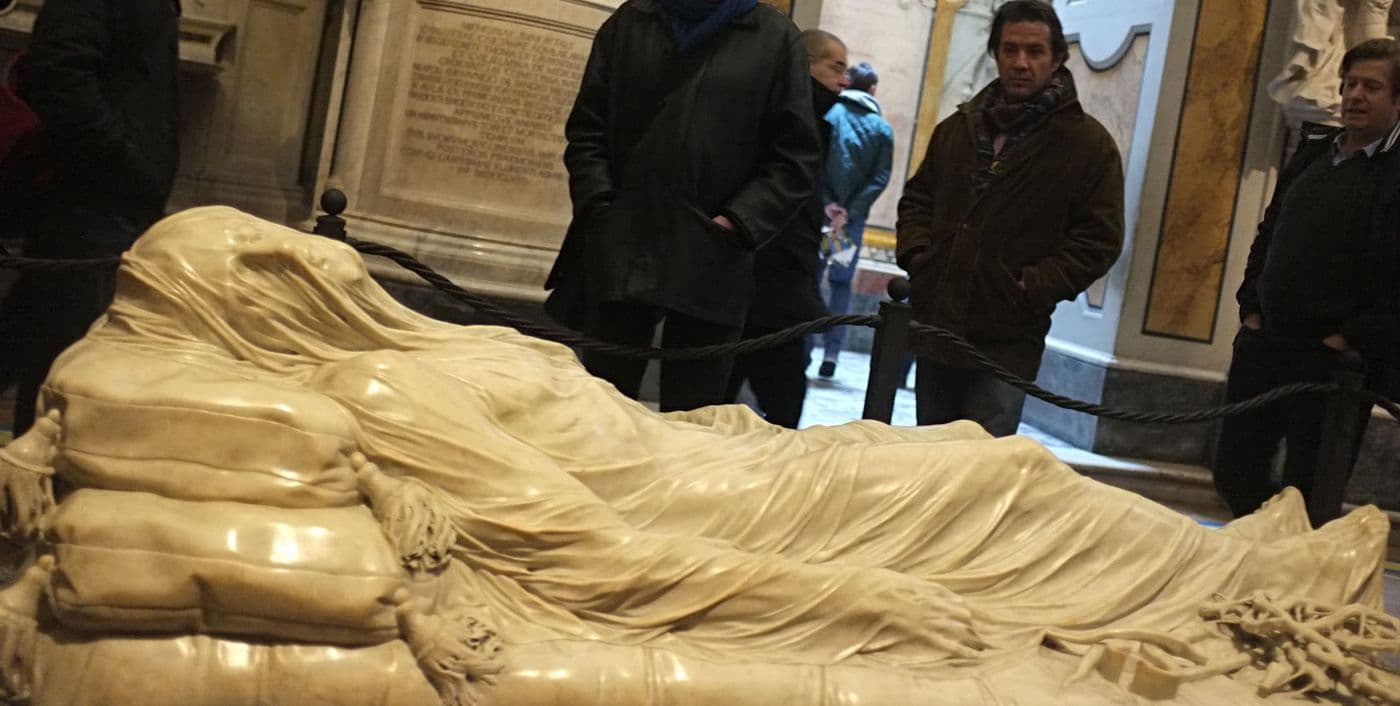
Cappella Sansevero: The Marble Veil That Reads as Cloth
6 min

Read
What to Eat in Naples: The Dishes, Their Origins, and How to Order
6 min
Read the walk
The full story of Historic Center: Spaccanapoli and the Greek City, in words. Prefer to listen? Play it narrated, from home or on location.
Introduction
This is Naples, in southern Italy, and this walk goes through the heart of its historic center, the old city that UNESCO listed in nineteen ninety-five. Around four hundred and seventy BC, Greeks from nearby Cumae founded a new city here and called it exactly that: Neapolis, the new city. They laid it out in straight lines, three long streets running east to west, crossed by some twenty narrow lanes, and Naples has never stopped living inside that plan. Temples became churches, a theatre became houses, Roman stones went into a bell tower, and the streets kept their lines. Twelve stops, about two kilometres, around an hour and a half at an easy pace, and every stop is free to see from the street. You start just outside the Greek city, cross the line of its old wall, and walk its lowest street, the one Neapolitans call Spaccanapoli. Then you climb to its ancient forum and its cathedral, pass under the brick arches of its Roman theatre, in the city where Nero first sang in public, and finish at the Greek wall itself, still standing in a square. No group, no fixed start, nobody waiting on you: linger, step into any church that is open, skip whatever you like. When you arrive at Piazza del Gesù Nuovo, begin with stop one.
1. Piazza del Gesù Nuovo: A Palace Front on a Church
Welcome to Naples. You are in Piazza del Gesù Nuovo, and two things fill it. In the middle stands a tall stone spire, crusted with carving and topped by a gilded Virgin. On the north side of the square is a church whose front looks nothing like a church: a flat wall of grey stone cut into sharp little points, like the facets of a diamond. That is because it was not built as a church. In fourteen seventy the architect Novello da San Lucano built this front for a palace of the Sanseverino family, princes of Salerno. The family lost it after Ferrante Sanseverino joined a revolt in fifteen forty-seven, and in fifteen eighty-four the Jesuits bought the palace for forty-six thousand ducats. They kept the diamond-cut front, built a new church behind it, and consecrated it in sixteen oh one. Look closely at the lower stones and you will find small cut marks. The church says they are masons' marks, the signs stonecutters left on their work. In two thousand and ten a researcher proposed that they are a musical score, read backwards, and it has been played as a concert piece. The church's own account still calls them masons' marks. You can decide for yourself. The spire is the Guglia dell'Immacolata, raised in the seventeen-forties for King Charles of Bourbon and his queen, its statues finished in seventeen fifty-three. Every eighth of December, firefighters climb a long ladder to put roses in the Virgin's hands. Inside the church lies Giuseppe Moscati, the doctor Naples venerates as a saint. One thing to know before you set off: this square is outside the old Greek city. Its wall ran about two hundred and fifty metres east of here, and you will cross its line at stop three. Leave the square by the narrow, dead-straight street that starts at the right-hand corner of the church front and heads east. That street is Spaccanapoli, and stop two is a minute along it.
2. Santa Chiara: The Queen's Church, Bombed and Rebuilt
A few steps along, on your right, a gateway in a high wall opens onto a paved forecourt, and just beyond it, at the edge of the street, stands a massive square bell tower. This is Santa Chiara. King Robert of Anjou and his wife, Queen Sancha of Majorca, began it in thirteen ten as a double monastery, one convent for Poor Clare nuns and one for Franciscan friars, around a great church consecrated in thirteen forty. Robert is buried inside. Over the centuries the church was dressed in Baroque marble and gilding. Then, on the fourth of August nineteen forty-three, Allied bombs hit the roof. It collapsed, and the fire burned on long after the raid. The monastery's own history says the church was almost entirely destroyed. It was rebuilt in its original, plain Gothic style, and reopened ten years later. So the tall, bare church you can see through the gateway is both very old and quite new. The bombing went into a song. In nineteen forty-five, Munasterio 'e Santa Chiara told of an emigrant who longs to come home to Naples, and is afraid of what he will find there. It is still remembered as one of the great songs of postwar Naples. Restoring the monastery after the war also brought Roman baths to light in the grounds, which stood outside the Greek city's wall. If you have time, the ticketed cloister behind the church, its pillars and benches covered in painted tiles, is one of the loveliest places in the city. On this stretch of the street, in Palazzo Filomarino, the philosopher Benedetto Croce made his home from nineteen twelve. The street now carries his name. Carry on east along it. In about two hundred metres the buildings on your left open into a square with another carved spire. Walk into the square.
3. Piazza San Domenico Maggiore: Into the Greek City
This is Piazza San Domenico Maggiore, and here you cross an invisible line. The western wall of the Greek city ran through this square. Everything behind you, Santa Chiara and the Gesù, grew up outside it. From here on you are inside Neapolis, and the straight street you came in on is the lowest of the three main streets the Greeks laid out. Above the square, a flight of steps climbs to the side of the church of San Domenico Maggiore. Charles of Anjou, the future King Charles the Second, paid for it from twelve eighty-three, and Thomas Aquinas came here in the twelve-seventies to run the Dominicans' school of theology. The spire in the middle was begun in sixteen fifty-eight, soon after the great plague of sixteen fifty-six, and took decades to finish. Now the palaces around you. The di Sangro family, princes of Sansevero, had theirs on this square. In October fifteen ninety the composer Carlo Gesualdo, who was living in the Sansevero palace, killed his wife, Maria d'Avalos, and her lover. The viceroy let the case drop. A later prince, Raimondo di Sangro, born in seventeen ten, was a soldier, an inventor, and grand master of the city's Masonic lodge, until the Pope's ban made him recant. His book was put on the Index of forbidden books. In seventeen seventy he crossed the bay in a paddle-wheeled sea carriage of his own design. He also filled the family chapel, about a hundred metres up the lane to the north, with astonishing marble, and the most famous piece is the Veiled Christ. For two and a half centuries Neapolitans said the prince had turned real cloth into marble by alchemy. The bank records say otherwise. In seventeen fifty-two he paid the sculptor Giuseppe Sanmartino for a dead Christ covered by a veil, also of marble, and he wrote that the veil was cut from the same block as the body. The chapel is a ticketed museum. When you are ready, go back to the straight street and carry on east. In two or three minutes, look ahead on the left for a reclining marble old man.
4. Statue of the Nile: The Body of Naples
On the left of the street, on a stone base, lies a bearded old man, propped on one elbow, with small children clambering around him and a sphinx under his arm. He is the Nile, the river god of Egypt, carved in marble by the Romans. From the early days of the Roman empire, merchants and sailors from Alexandria settled in this part of the city. The medieval city still called it the Nile quarter, and this little square the lane of the Alexandrians. The Latin plaque on the base, put up in seventeen thirty-four, says the Alexandrians who lived nearby set the statue up to their native god, and then, honestly, adds: as rumour has it. For a long time the figure had no head. Headless, with babies around it, Neapolitans took it for a woman nursing her children, in other words for Naples itself, and they gave it the name it still has: the body of Naples. In the sixteen hundreds the city restored it and gave it the bearded head you see. Old writings even had the statue gossiping with the river Sebeto, like the talking statues of Rome. Now look at the sphinx. At the end of the nineteen-fifties someone stole its small marble head. In twenty thirteen the art squad of the Carabinieri found it in a private collection in Austria, and it came home. In November twenty fourteen the statue was unveiled wrapped in a white sheet with a big red bow, like a present, while a Carabinieri band played. A god from Egypt, carved by Romans in a Greek city, taken for a mother, and adopted as the city itself. Carry on east. The street changes its name here, but not its line.
5. Via San Biagio dei Librai: The Booksellers' Street
You are now on Via San Biagio dei Librai, Saint Blaise of the booksellers: the same Greek street, under a new name. The name remembers the bookshops that once lined it, and one of them mattered. On the twenty-third of June sixteen sixty-eight, the philosopher Giambattista Vico…
Full narration for this stop unlocks with the tour.
6. Via San Gregorio Armeno: The Crib Makers
This is Via San Gregorio Armeno, the street of the crib makers. All year round its workshops make figures for the presepe, the Neapolitan nativity scene: shepherds, angels, the Holy Family and whole miniature villages. They are busiest in November and December, when the street…
Full narration for this stop unlocks with the tour.
7. Piazza San Gaetano: The Ancient Forum
At the top of the street, stop where it meets Via dei Tribunali, the main street of the Greek city. You are standing in its heart. This was the agora of Greek Neapolis, and then the forum of Roman Naples. Ahead and to the left, a church stands at the top of a high flight of…
Full narration for this stop unlocks with the tour.
8. Naples Cathedral: The Pact With San Gennaro
On your right rises the front of Naples Cathedral, the Duomo. Its tall neo-Gothic facade is younger than it looks. It was designed by Enrico Alvino, who died in eighteen seventy-two before a stone of it was laid, and others built it between eighteen seventy-seven and nineteen oh…
Full narration for this stop unlocks with the tour.
9. Via Anticaglia: The Roman Theatre's Arches
You are on Via Anticaglia, the highest of the three Greek streets, and here two brick arches span the street, one just ahead and one a little further on. Anticaglia means, roughly, old remains, and the arches are the reason. They belonged to the outer structure of the Roman…
Full narration for this stop unlocks with the tour.
10. Purgatorio ad Arco: The Skulls of the Souls
On your right, behind a gate, is the church of Santa Maria delle Anime del Purgatorio ad Arco, and at its entrance are bronze skulls with crossed bones. Skulls repeat across its Baroque front. The church belongs to a congregation of Neapolitan nobles founded in sixteen oh five,…
Full narration for this stop unlocks with the tour.
11. Pietrasanta: A Bell Tower of Roman Stones
On your right, in a small square, stands a square brick bell tower, about a thousand years old. It belongs to the church of Santa Maria Maggiore della Pietrasanta, the holy stone. Its builders mortared pieces of Roman buildings and Roman inscriptions into it, the older city…
Full narration for this stop unlocks with the tour.
12. Piazza Bellini: The Greek Wall
This is Piazza Bellini, the last stop, and the edge of the Greek city. Find the marble statue of the composer Vincenzo Bellini, and beside it, below a railing, a sunken rectangle of huge squared blocks of tufa stone. That is the wall of Neapolis, built in the fifth and fourth…
Full narration for this stop unlocks with the tour.
- Spaccanapoli looking west to the San Martino hill — Antonio Vetere, Unsplash License · source
- Church of Gesù Nuovo, Naples, Italy — Diego Delso, CC BY-SA 4.0 · source
- Chiesa del Gesù Nuovo e Guglia dell' Immacolata a Napoli — Luca Aless, CC BY-SA 4.0 · source
- Santa Chiara (Naples) - Exterior — Yair Haklai, CC BY-SA 4.0 · source
- Belltower and façade of Santa Chiara of Naples in the evening. — Marco Ober, CC BY-SA 4.0 · source
- Napoli, piazza di San Domenico Maggiore, con abside della chiesa e guglia di San Domenico. — Lalupa, Public domain · source
- Piazza San Domenico Maggiore, Naples — Adam Harangozó, CC BY-SA 4.0 · source
- Naples, city center — Sailko, CC BY 3.0 · source
- Аллегория реки Нил — Vitold Muratov, CC BY-SA 4.0 · source
- Uliczka Via San Biagio dei Librai w Neapolu — Panek, CC BY-SA 4.0 · source
- Via San Biagio dei Librai (parte della celebre Spaccanapoli) a Napoli — Luca Aless, CC BY-SA 4.0 · source
- Ulica św. Grzegorza Oświeciciela w Neapolu — Panek, CC BY-SA 4.0 · source
- via San Gregorio Armeno — Photo2023, CC BY 4.0 · source
- The Basilica di San Paolo Maggiore church in Naples. — Wolfgang Moroder, CC BY-SA 3.0 · source
- Naples, San Lorenzo Maggiore, Piazza San Gaetano — Berthold Werner, CC BY-SA 3.0 · source
- Façade of the Naples Cathedral (Cattedrale di Santa Maria Assunta). — Marco Ober, CC BY-SA 4.0 · source
- Naples Cathedral façade — Avemundi, CC BY-SA 3.0 · source
- Via dell'Anticaglia, Decumano superiore (Napoli) — Armando Mancini, CC BY-SA 2.0 · source
- Detail of opus compositum, Roman theatre, naples. — Gaius Cornelius, Public domain · source
- Napoli, Purgatorio ad Arco — Lalupa, Public domain · source
- Uno dei due teschi posti all'esterno della Chiesa del Purgatorio ad Arco (Napoli) — IlSistemone, CC BY-SA 3.0 · source
- Nápoles. Santa Maria Maggiore. Campanile. — Miguel Hermoso Cuesta, CC BY-SA 4.0 · source
- Napoli - le campanile de la Basilica di Santa Maria Maggiore alla Pietrasanta Sur la Piazzetta Pietrasanta se dresse le clocher en brique de l'ancienne basiliq — Damien Tournay, CC BY-SA 2.0 · source
- Piazza Bellini, Vincenzo Bellini statue — Phyrexian, Public domain · source
- Napoli — Sailko, CC BY-SA 3.0 · source
Images may be cropped or resized. Other photos via Unsplash and Pexels.