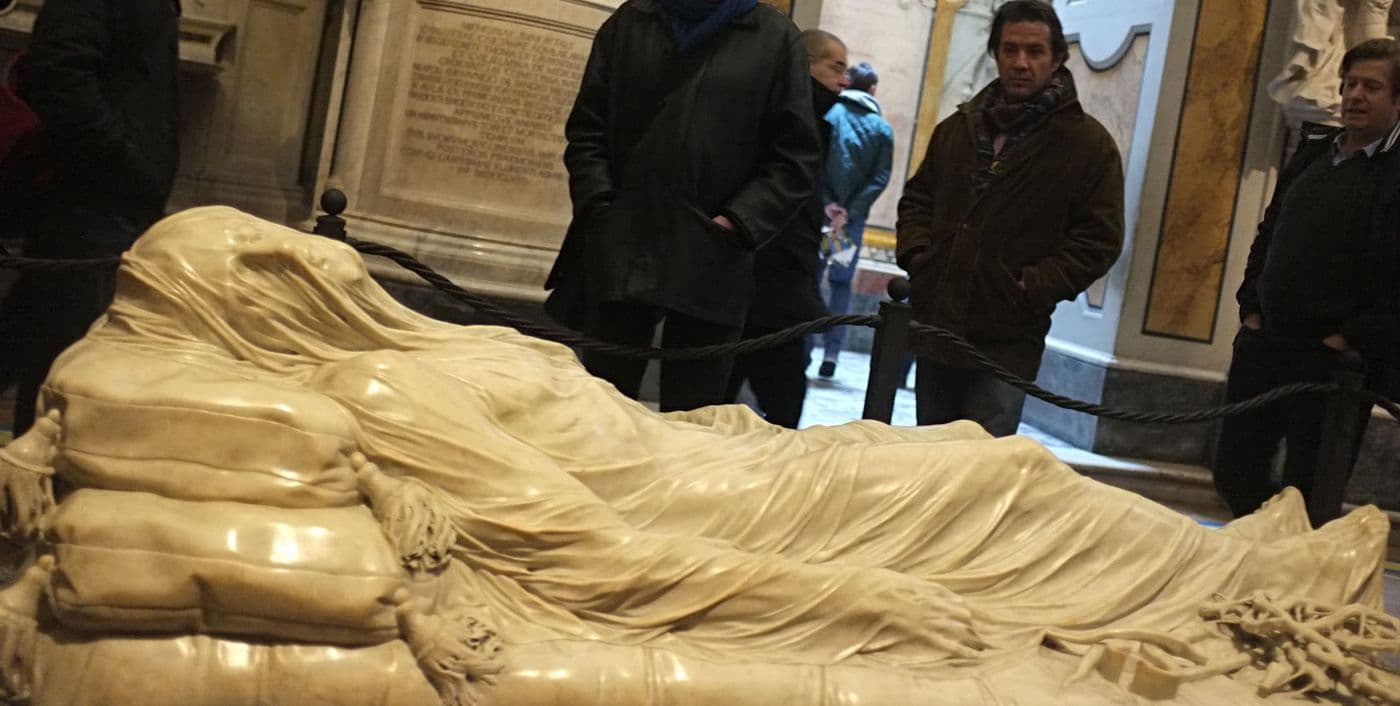
One block of marble, carved by Giuseppe Sanmartino and completed in 1753, is made to read as translucent cloth: this is the single thing to understand standing in front of the Veiled Christ in the Cappella Sansevero. The veil draped over the dead Christ is not fabric laid on stone. It is the same stone as the body beneath it, cut so fine that the marble appears to turn transparent, with the features and wounds pressing up from underneath. That is the whole reason the chapel exists in the form it does, and it is why a small building about a hundred metres north of the main street pulls a steady line of visitors into a space with no grand facade to advertise it.
What you are actually looking at
The chapel sits just off Spaccanapoli, the dead-straight street that follows a line laid out by the Greek founders of Naples and kept by the Romans. To reach it you leave Piazza San Domenico Maggiore and walk about a hundred metres up the lane to the north, Via Francesco De Sanctis, and from the outside there is almost nothing to see. The power is entirely inside. At the center lies the Veiled Christ, commissioned by Raimondo di Sangro, Prince of Sansevero, and executed by Sanmartino. The illusion works because a sculptor has to plan the final surface, the thin ridges and folds of a veil, while removing everything around and beneath it from a solid mass with no margin for error. There is no adding back. A veil this thin means the marble at those points is genuinely thin, and it is carrying the visual job of two materials at once: the cloth on top and the anatomy showing through. It should be impossible, and it is stone.
A room built around a single idea
Hear a stop from this walk
Piazza San Domenico Maggiore: Into the Greek City
The Veiled Christ does not stand alone. Two other veiled works keep it company, and together they turn the chapel into a sustained argument about what marble can be made to do. Antonio Corradini carved Pudicizia, or Modesty, a veiled female figure, in 1752. Francesco Queirolo made Il Disinganno, a figure struggling free of a marble net, between 1753 and 1754. Notice the dates. All three of the chapel's celebrated sculptures were finished inside a tight span in the early 1750s, and the veiled Christ was commissioned by the same prince who assembled the rest. This was not a slow accretion of masterpieces gathered over generations. It was a concentrated program, one patron pushing a single technical obsession to its limit across three different hands. The net around Queirolo's figure is the same trick as Sanmartino's veil, worked in a different direction: solid stone carved to imitate something loose, open, and woven.
That concentration is what separates the Cappella Sansevero from the many other decorated churches along the straight cut. The Basilica di Santa Chiara, a short walk back west, hides a cloister sheathed in painted majolica tiles. The Gesu Nuovo wears a diamond-studded facade lifted from a Renaissance palace. Those are layers stacked by different centuries. The Sansevero chapel, by contrast, is one man's coherent statement, delivered nearly all at once.
The machines in the basement
Downstairs is the chapel's strangest holding, and its most misunderstood. The two Anatomical Machines are skeletons wrapped in an intricate web of red and blue vessels that looks like a fully mapped circulatory system. For a long time people whispered, as Benedetto Croce recorded, that the prince had two of his servants killed and their bodies strangely embalmed. The truth is more interesting than the legend. The museum's own record, drawing on a notarial contract, shows that Raimondo supplied the iron wire and the wax, and that the vessels are a reconstruction in beeswax and colourants, made by the Palermo doctor Giuseppe Salerno. The skeletons are real. The vascular web is a craftsman's model, built by hand around them rather than grown from a corpse by some lost alchemy. Understanding that turns the machines from a horror story into something closer to the veils upstairs: an eighteenth-century display of technical skill so convincing that people preferred to believe it was supernatural.
The one thing to hold onto
Standing in front of the Veiled Christ, the temptation is to read it as a religious object first, a devotional image of the dead Christ under his shroud. That reading is real, but it misses what makes this specific chapel worth a detour. The lesson here is about material and mastery. A prince set three sculptors a nearly impossible problem, to make hard stone behave like soft cloth and open net, and they solved it three times over within a few years. The devotion is the subject. The astonishment is the method. Hold both, and the chapel snaps into focus.
Walking it into the larger city
Practically, the Cappella Sansevero is a ticketed museum, and online booking is required. That makes it worth deciding on before you arrive rather than hoping to wander in. It also means the chapel rewards being treated as one deliberate stop on a longer walk rather than a single destination you rush to and leave. The straight street below it, Spaccanapoli, connects the chapel to the Gesù Nuovo, Santa Chiara and the crib workshops of Via San Gregorio Armeno, and from there the old Greek grid leads north to the cathedral of San Gennaro on Via Duomo, each one another layer of Naples stacked on the same ancient plan.
If you want to see the Veiled Christ in that sequence rather than in isolation, the Roamer self-guided audio walk "Historic Center: Spaccanapoli and the Greek City" stops in Piazza San Domenico Maggiore to tell the prince's story, a hundred metres from the chapel door, on a twelve-stop walk from Piazza del Gesù Nuovo to Piazza Bellini that you take at your own pace, skipping whatever you like. You can browse it and the rest of the city's routes on the Naples walking tours hub, or start from the Naples city page. Either way, book your Sansevero slot first, then let the straight line carry you to it.
Sources
- Museo Cappella Sansevero (museosansevero.it), pages on the Veiled Christ and the legend of the veil. Sanmartino's signature and date (1753), Raimondo di Sangro's 1752 commission, and his own statement that the veil was cut from the same block as the body.
- Museo Cappella Sansevero, pages on Modesty and Disillusion. Corradini's Pudicizia (1752) and Queirolo's Disinganno (1753 to 1754).
- Museo Cappella Sansevero, page on the Anatomical Machines. Giuseppe Salerno, the notarial contract for the iron wire and wax, the beeswax reconstruction, and the servants legend recorded by Croce.
- Treccani, Enciclopedia dell'Arte Antica, "Napoli". The Greek street grid and the line of the Greek city's western wall through Piazza San Domenico.
- Monastero di Santa Chiara (monasterodisantachiara.it). The majolica cloister, remodelled 1739 to 1742.
Ready to experience it?

Historic Center: Spaccanapoli and the Greek City
90 min · 2.1 km · easy
More from Naples
Explore more at your own pace.
Naples Travel Guide: Days, Transport, Timing, Safety, and Budget
Naples Read in Section: The Vertical City Above and Below the Street
The Catacombs That Taught the Rione Sanità to Rewrite Itself
The Hollow City: Reading Naples From the Void Beneath Napoli Sotterranea
Via San Gregorio Armeno: How the Crib Street Reveals the Greek Grid Under Naples