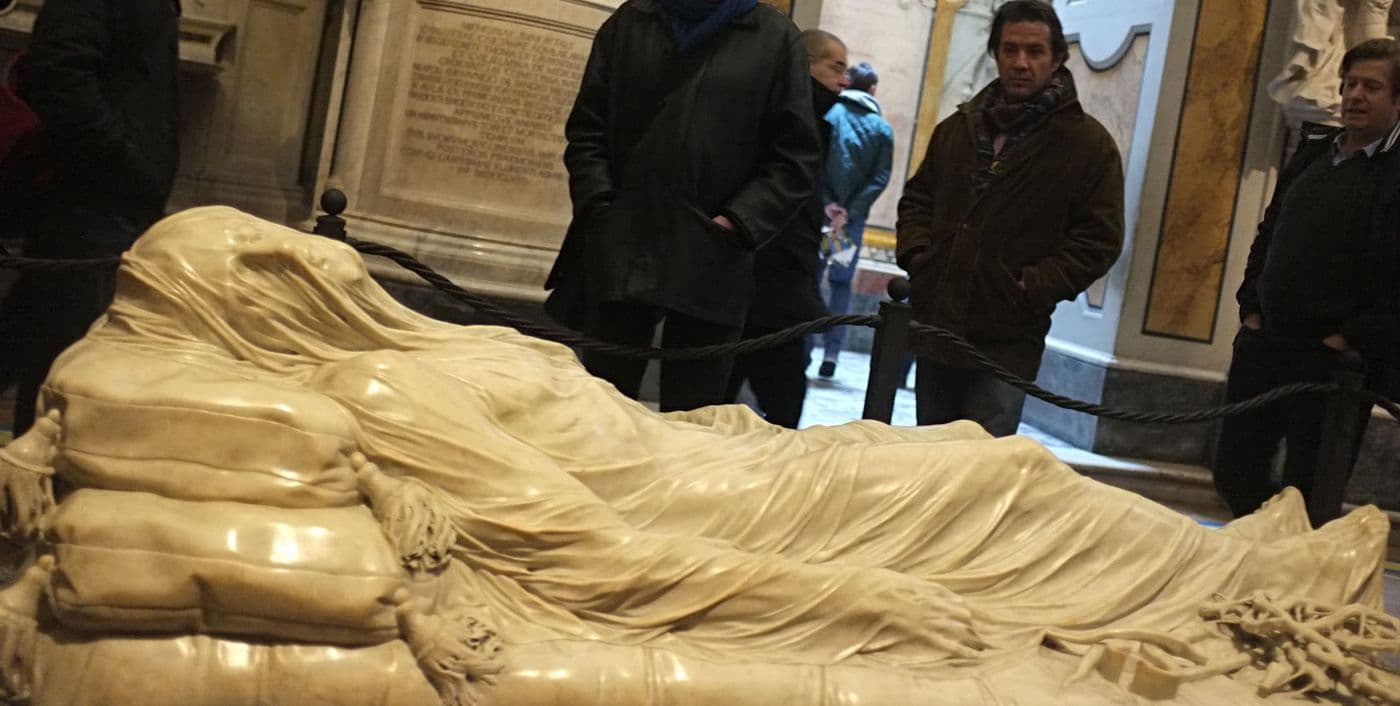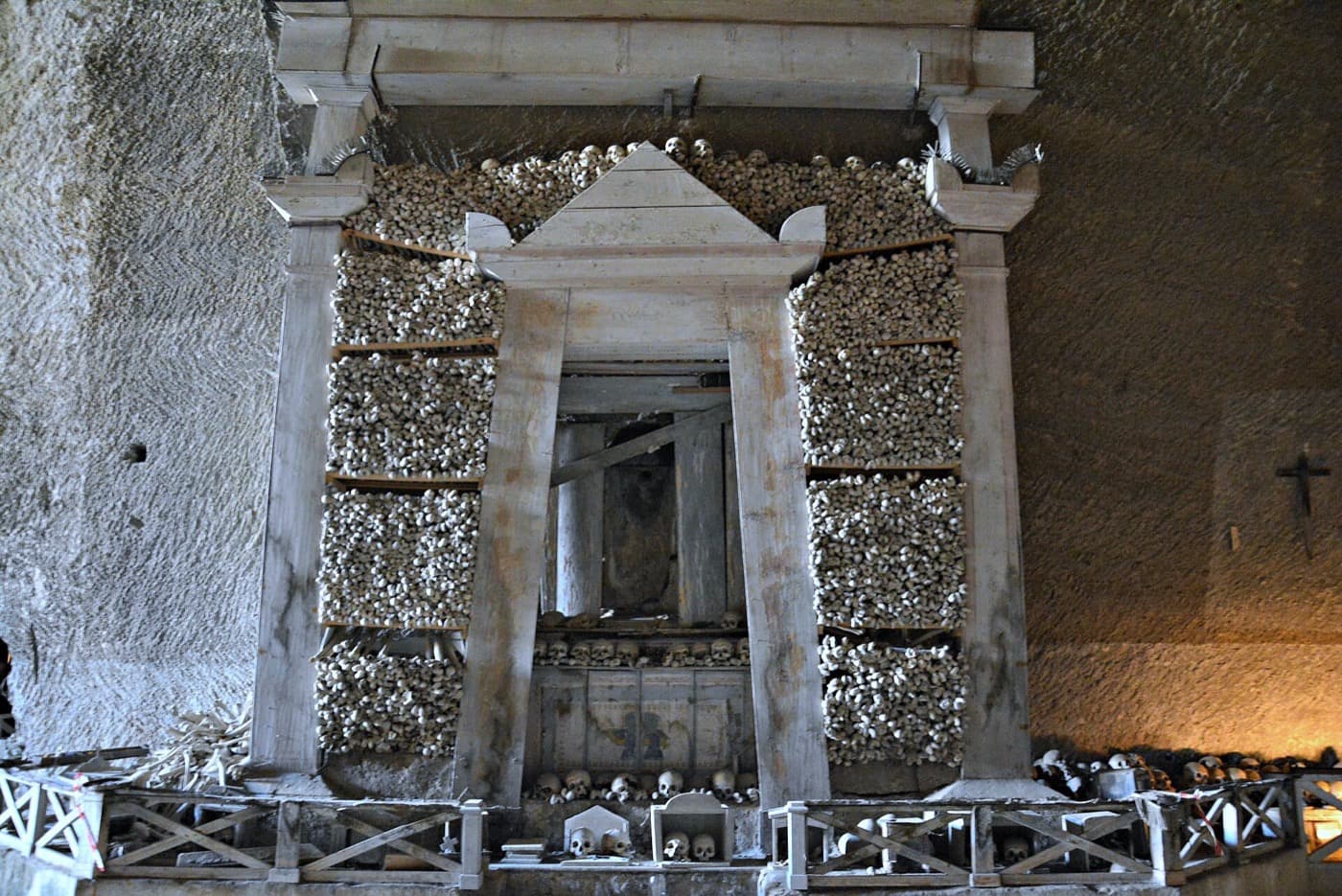
At the Cimitero delle Fontanelle, ordinary Neapolitans adopted the anonymous dead one skull at a time. They cleaned a chosen skull, sheltered it, sometimes learned its name in a dream, brought it flowers, and asked it for favors and protection. This folk devotion, addressed to the anime pezzentelle, the poor little souls, is the single thing to understand while standing in this cave. It reveals the defining instinct of the Rione Sanita, the Naples quarter the city above once wrote off: to tend the forgotten rather than turn away from them.
The place itself is a cave cut into the soft tuff of a hillside, at Via Fontanelle eighty, in the Materdei and Stella section of Naples. It was once a quarry, one of the caves that supplied stone for the city above, and it takes its name, Fontanelle, meaning little fountains, from the water that used to drain down from the surrounding hills through these channels. That origin matters. This was never designed as a cemetery. It was an empty space in the rock that Naples slowly filled with the people it had nowhere else to put.
A cave of the anonymous dead
The bones arrived in waves, and each wave was a catastrophe. Thousands of victims of the great plague of 1656 were brought into this cave. That plague was one of the worst events in the city's history: it arrived early in the year and killed somewhere around 150,000 people, by many estimates roughly half the population of Naples, within months. The cave took the anonymous among them, the poor who could not afford a marked grave. Later, the cholera epidemic of 1837 sent what seems to have been the last great deposit of the indigent dead down into the same rock.
For a long time the bones simply lay in chaos, heaped where floods and gravedigging had left them. What changed the Fontanelle from a dumping ground into a shrine was one man's decision to give the dead order. In 1872 a priest, Father Gaetano Barbati, had the chaotically buried remains disinterred and catalogued, sorting them into the aisles and racks you can still read today. He did not know a single name. He simply insisted that the anonymous deserved to be arranged with care. That gesture, tidying the untended dead, is the seed of everything that followed.
Adopting a soul
Hear a stop from this walk
Cimitero delle Fontanelle: Keeping Faith With the Dead
Once the bones were ordered, a devotion grew around them, and it is unlike almost anything else in European Catholic practice. Neapolitans came to believe that these anonymous spirits were waiting in Purgatory with no one on earth to pray for them. So the living adopted them. A person would choose a single skull, called a capuzzella, clean it, place it on a cloth or in a small wooden box, and begin a relationship with it. You prayed for the soul, easing its time in Purgatory, and in exchange you asked the soul to intercede for you: for a pregnancy, a winning lottery number, a sick child, a safe return.
The clearest sign of how personal this became is the naming. A caretaker often did not know whose skull they tended, so the soul was believed to reveal its name in a dream. From that night the skull had an identity, a history, a personality. Some skulls became famous across the neighborhood for granting favors and drew their own small crowds and offerings.
It is worth being careful about how you read this. It is easy to file the Fontanelle under the macabre and move on. That misses the point entirely. The defenders of the cult made a simple argument: these were people who had received no respect in life, too poor even for a proper burial, and the devotion gave them, at last, someone who cared. The instinct is not ghoulishness. It is tenderness toward the forgotten, and it is the same instinct that runs through the whole quarter, from the early Christian catacombs on the hill above down to this cave in the valley wall.
The Church steps in, and the cave falls quiet
The devotion lasted into the twentieth century, ordinary and widespread. Then in 1969 the Church intervened. Cardinal Corrado Ursi ordered the individual cult of the skulls stopped, judging that the practice had drifted into something closer to fetishism than to sanctioned prayer for the dead, and had the cemetery closed. The cave was shut to the old devotion, and for decades it slipped in and out of neglect and partial access.
That history is why the Fontanelle can feel so charged even now that it has been restored. The bones are no longer supposed to be adopted, yet you will still sometimes find a coin, a flower, or a folded note left beside a favored skull. The devotion was officially ended, but it was never fully extinguished, because it was never really about the bones. It was about a poor city's refusal to let its poorest be forgotten.
What to understand standing here
If you take one idea away from the Cimitero delle Fontanelle, make it this: everywhere else, the dead are separated from the living behind walls and gates. Here the living came down into the dark to sit with the dead, to speak to them by name, and to build a whole economy of small favors on the promise that no soul should be abandoned. The Sanita was the quarter Naples feared, cut off and left behind, and this cave is the proof that it was tending souls all along.
The cemetery reopened to regular public access in the spring of 2026 after restoration, and it now uses timed online booking, so confirm hours and tickets before you climb up to it. Give the cool dark a few minutes of quiet. The cave asks for it.
The Fontanelle is the final stop on the Sanita walk, the one that closes the loop the catacombs open. To read it in sequence, from the hill of the dead down through the valley and back up to this ossuary, walk the full tour. Browse Naples walking tours to see how the quarter fits together, or start from the city page for Naples and plan the route from the top of the Capodimonte slope.
Sources
- Fontanelle cemetery, Wikipedia. history of the ossuary, the 1656 plague and 1837 cholera deposits, Barbati's 1872 cataloguing, and Cardinal Ursi's 1969 closure order.
- Cimitero delle Fontanelle, Comune di Napoli. the city's official page on the site, its tuff-quarry origin, location, and the April 2026 reopening with mandatory booking.
- Fontanelle Cemetery and the cult of pezzentelle souls, Random Times. detailed account of the anime pezzentelle devotion, skull adoption, and dream-revealed names.
- Cimitero delle Fontanelle, official visitor site. current access, restoration, and booking information.
Ready to experience it?
The Quarter They Feared
100 min · 4.3 km · hard
More from Naples
Explore more at your own pace.
Naples Travel Guide: Days, Transport, Timing, Safety, and Budget
Naples Read in Section: The Vertical City Above and Below the Street
The Catacombs That Taught the Rione Sanità to Rewrite Itself
The Hollow City: Reading Naples From the Void Beneath Napoli Sotterranea
Via San Gregorio Armeno: How the Crib Street Reveals the Greek Grid Under Naples