Naples once told outsiders to stay out of the Rione Sanità, a valley in the middle of the city that the streets above decided to forget. Poverty lived there, and so, people said, did crime. Yet the quarter rewrote itself from below, and the clearest place to watch that reversal happen is underground, in the Catacombe di San Gennaro on the Capodimonte hill. The things that once marked the Sanità as a place of the dead, its early Christian catacombs and its hidden ossuary, became the exact things its own young people turned into work and dignity. That is the argument this walk makes, and the catacombs are where it begins.
Why the walk starts above the valley
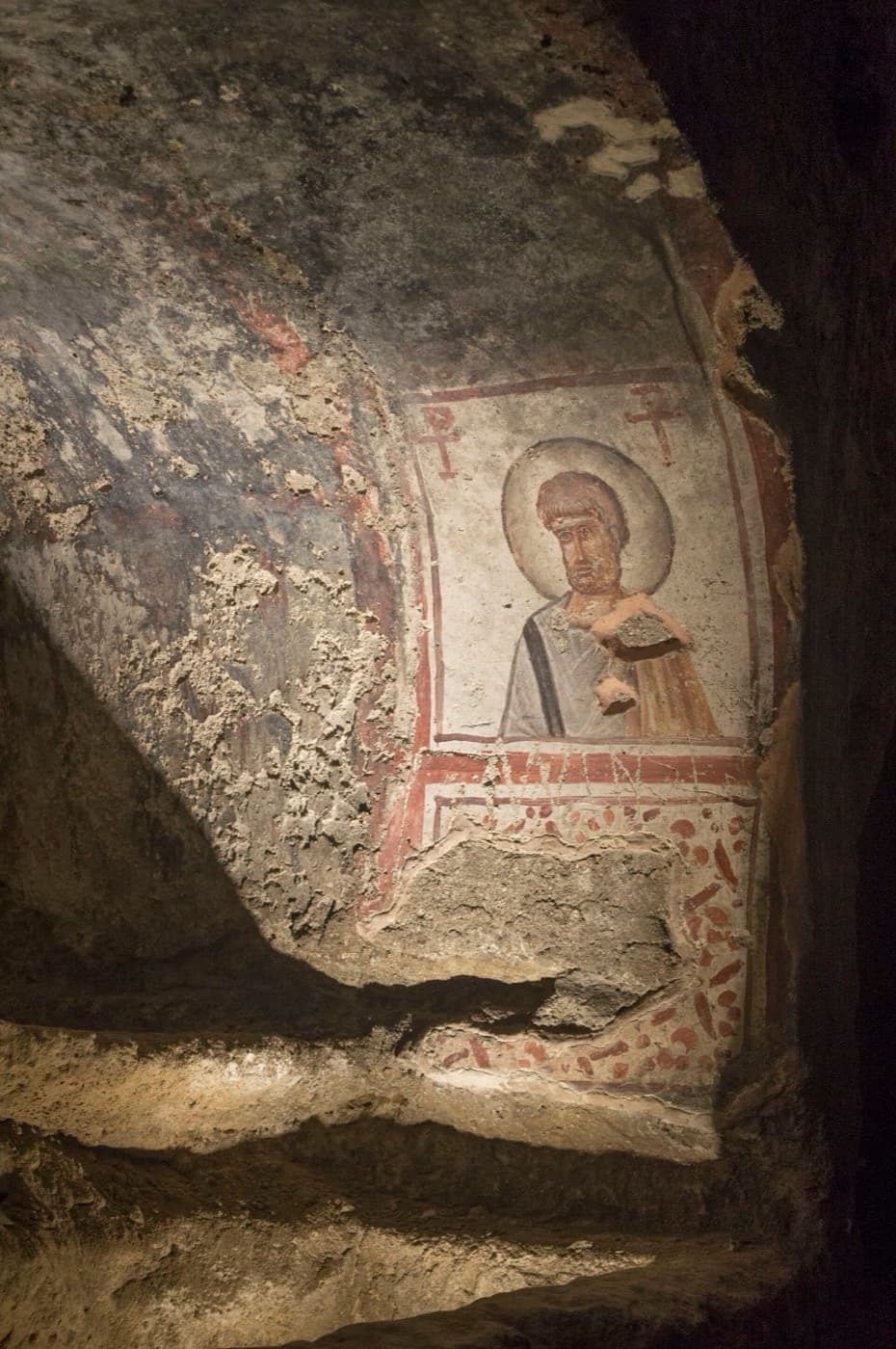
You start high, on the Capodimonte slope, and that is deliberate. Cut into the soft tuff of the hill, the Catacombe di San Gennaro form the largest Christian catacomb complex in southern Italy. That is the honest measure, southern Italy rather than the whole country, and it is enormous. Two levels descend through the rock, San Gennaro Superiore and San Gennaro Inferiore. The lower level goes back to the third and fourth centuries, and the origins reach further still, to the second century, when the place began as the tomb of a single noble family. On the walls are some of the earliest Christian frescoes in the region: lambs, peacocks, quiet symbols of a faith still learning how to picture itself. The complex holds roughly two thousand burial niches and around five hundred sarcophagi carved into the tuff.
In the fifth century the complex was consecrated to San Gennaro, Saint Januarius, the patron saint of Naples, when his remains were entombed here. They did not stay. In the ninth century a bishop moved them up to the Cathedral, so you should not come looking for the saint himself. What is here now matters more for the quarter's story. In the year two thousand and six, local young people formed a cooperative called La Paranza and set about recovering this place, working with the association l'Altra Napoli, to make jobs out of the neighborhood's buried inheritance. The people the city feared reached into the ground beneath their own feet and pulled up a future. That single gesture is the whole thesis of the walk.
Down into the valley
Hear a stop from this walk
Cimitero delle Fontanelle: Keeping Faith With the Dead
From the hill you descend toward a dome you can see from across the city, yellow and green majolica crowning the Basilica di Santa Maria della Sanità. Built between the years sixteen oh two and sixteen thirteen by the Dominican architect Giuseppe Nuvolo, known as Fra Nuvolo, it sits on a Greek cross plan and stands directly over a second early Christian cemetery, the Catacombs of San Gaudioso. The entrance to that crypt is under the altar. Notice the pattern that repeats through the quarter. The living do not turn their backs on the dead here. They build their brightest church directly on top of them, dome and all.
Two courtyards nearby correct any assumption that the Sanità was only ever poor. The Palazzo dello Spagnolo, built in the year seventeen thirty-eight and attributed to Ferdinando Sanfelice, opens onto an octagonal courtyard with an external double-ramp staircase that Neapolitans call ali di falco, hawk wings. A short walk away, the Palazzo Sanfelice, raised between seventeen twenty-four and seventeen twenty-six, is the house the architect built for himself, living on an upper floor while renting out the rest. His arches looked so precarious that people nicknamed him Ferdinando levat a sott, roughly "Ferdinando, get out from under." Nothing ever fell. Stand in either courtyard and the counter-intuitive turn lands: this is the quarter Naples wrote off, and it was once wealthy enough, and inventive enough, to raise staircases like a pair of wings. The ambition came first. The poverty came later.
The cut, and the reason it survived
The reason the Sanità became a world apart is a bridge. The Ponte della Sanità was completed around eighteen oh eight and eighteen oh nine, during the Napoleonic Kingdom of Naples under Joachim Murat, not by Napoleon himself. It runs one hundred and eighteen metres long on six equal arches, carrying a grand new road from the royal palace of Capodimonte down to the rest of the city. The road vaults clean over the valley, bypassing the quarter entirely, so the traffic and money of Naples passed over its head without ever coming down. That severing is the paradox: being cut off is exactly why the Sanità stayed one of the most authentic neighborhoods in Naples. The bridge's official name is a gentle coda. It honors Maddalena Cerasuolo, an antifascist worker who helped save it from German demolition during the Four Days of Naples in the year nineteen forty-three. The cut that isolated the quarter is named, in the end, for one of its defenders.
Closing the loop with the dead
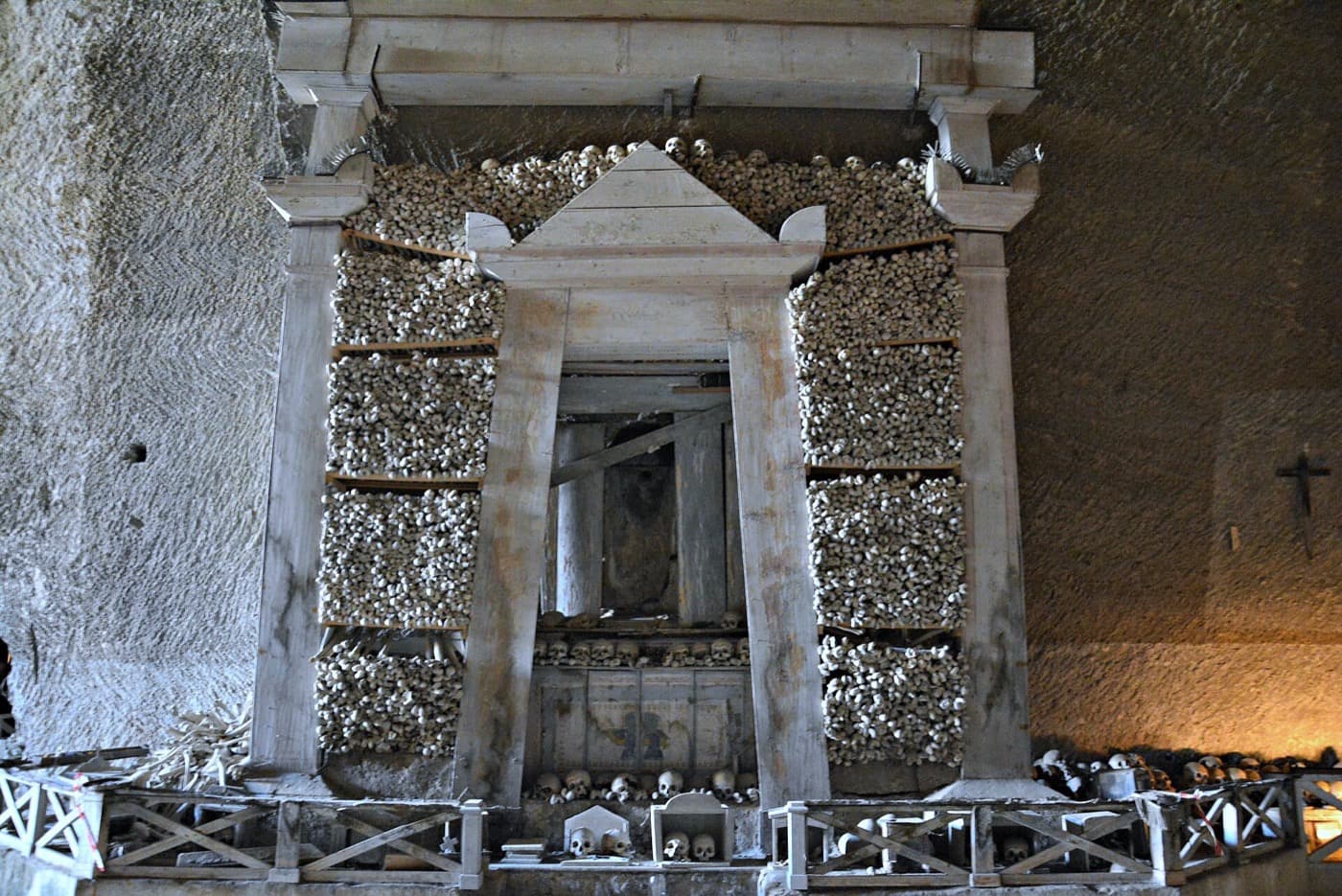
The last climb closes the loop the catacombs opened. The Cimitero delle Fontanelle is an ossuary inside a tuff cave, once a quarry, that took the anonymous dead of the city: thousands of plague victims in the year sixteen fifty-six, and a later deposit after the cholera epidemic of eighteen thirty-seven. In the year eighteen seventy-two, Father Gaetano Barbati had the scattered bones disinterred and sorted into ordered aisles. A devotion grew around them, the anime pezzentelle, the poor little souls, in which a person would adopt a single skull, clean it, sometimes learn its name in a dream, and ask it for protection. In the year nineteen sixty-nine, Cardinal Corrado Ursi ordered the individual cult stopped. The cave has since been restored and, after that work, reopened to regular public access in the spring of two thousand and twenty-six. Standing in the cool dark among the bones, you feel the argument resolve. From the catacombs on the hill to the ossuary in the valley wall, the Sanità has always kept faith with its own dead.
The full walk runs about four kilometres over roughly two and a half to three hours across six stops, with real hills, so go downhill first and save the Fontanelle climb for the end. Two stops go underground and need tickets, and the catacomb tours are worth booking ahead. If you want to plan the route or line it up with other neighborhoods, browse Naples walking tours and the wider Naples city page. Then go read the quarter they feared, one stop at a time.
Sources
- Catacombs of San Gennaro, Wikipedia. Confirms the southern-Italy scale, the two levels, the second-to-fourth-century dating, and La Paranza's 2006 revival.
- Cooperativa La Paranza, catacombedinapoli.it official site. Steward of the complex and its jobs-from-heritage story.
- Santa Maria della Sanità, Naples, Wikipedia. Fra Nuvolo, the Greek-cross plan, and the San Gaudioso crypt beneath.
- Palazzo San Felice and Palazzo dello Spagnolo, Wikipedia. Sanfelice's double-ramp staircases and their dates.
- Cimitero delle Fontanelle, Comune di Napoli official page. The ossuary's history, the anime pezzentelle devotion, and reopening details.
Ready to experience it?
The Quarter They Feared
100 min · 4.3 km · hard
More from Naples
Explore more at your own pace.
Naples Travel Guide: Days, Transport, Timing, Safety, and Budget
Naples Read in Section: The Vertical City Above and Below the Street
The Hollow City: Reading Naples From the Void Beneath Napoli Sotterranea
Via San Gregorio Armeno: How the Crib Street Reveals the Greek Grid Under Naples
Cappella Sansevero: The Marble Veil That Reads as Cloth