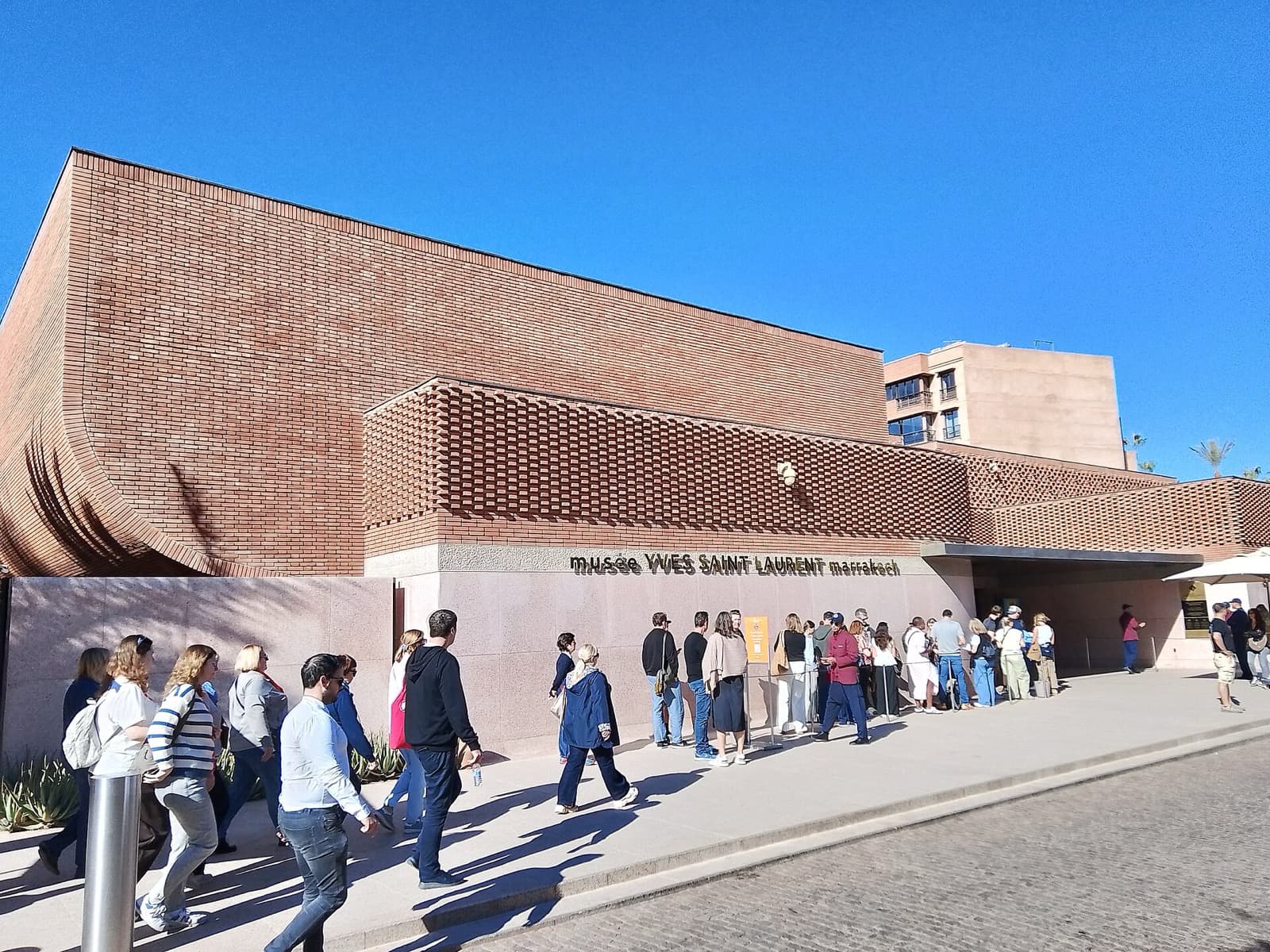
The Yves Saint Laurent Museum in Marrakech translates a couturier's craft into architecture. Its walls are terracotta brick laid to read like woven cloth, and the building houses the collections of a designer who found his palette in this city. Stand in front of it and the first thing to understand is that the facade is not decoration wrapped around a museum. The facade is the argument. A house of fashion built its memorial out of the one thing fashion is made from: fabric, rendered here in brick.
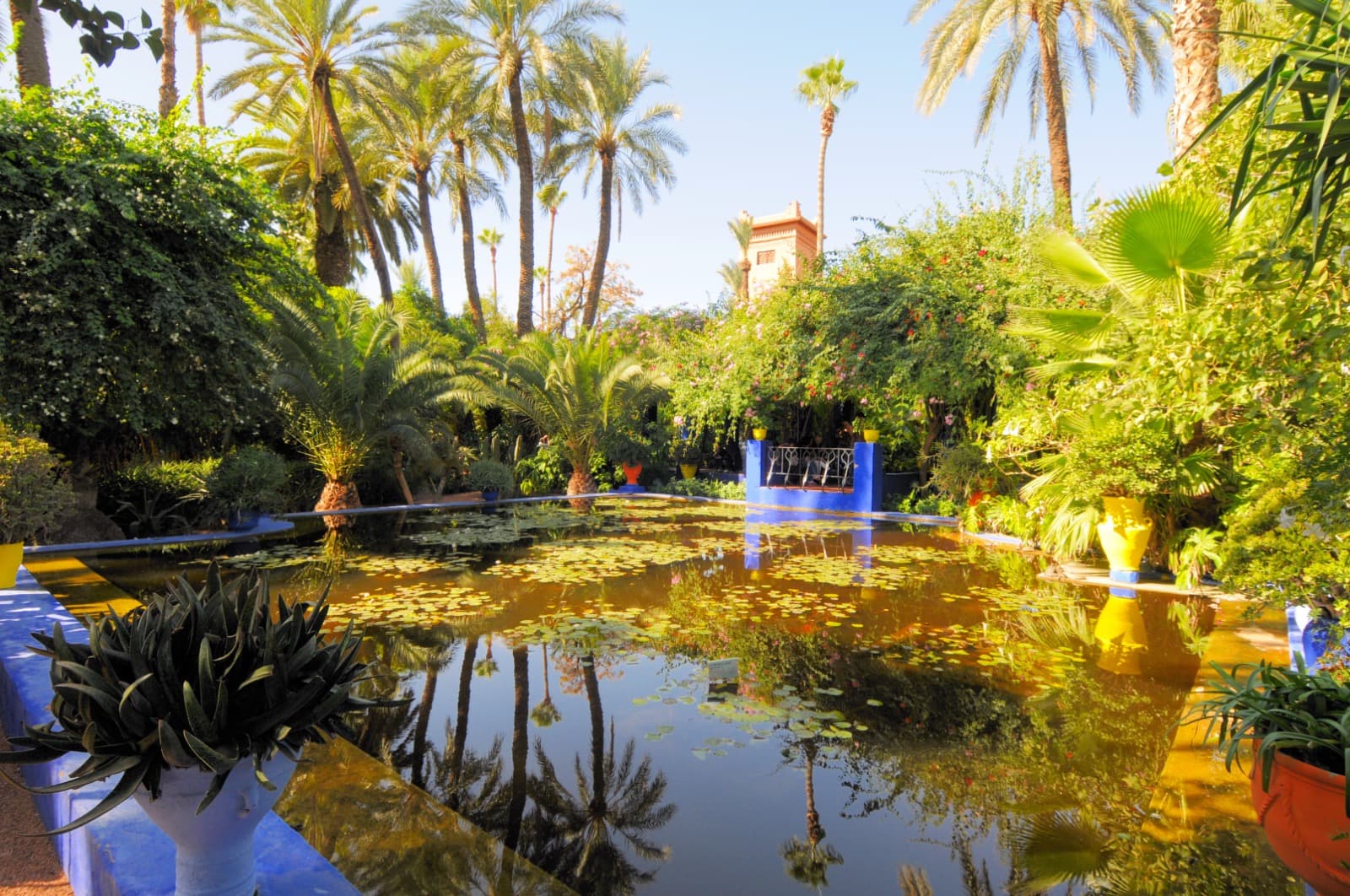
The museum sits a few steps from the gate of the Majorelle Garden, and the two are meant to be read together. The garden is the blue dream a French painter built and a couturier rescued. The museum is the sober brick answer beside it, opened decades later to hold the work itself. You can walk from one to the other in under a minute, which is exactly the point. The artistic chapter and the personal chapter of one man's Marrakech stand side by side, and the short walk between them is the whole story in miniature.
A wall that reads like cloth
The building opened on the nineteenth of October, twenty seventeen, designed by the architecture firm Studio KO. Its earth-colored terracotta brick is laid, in the museum's own words, like a lace of bricks that evoke the weave of fabric. It is an assemblage of cubes and curves made from terra cotta, concrete, and terrazzo, materials drawn from Morocco itself. Look closely at the exterior and you can see the intention: the brickwork is not smooth and flat but textured, patterned, dimensional, the way a bolt of cloth catches light differently along its threads. The architects took the vocabulary of a loom and gave it to a mason.
That choice is worth pausing on, because most museums devoted to an artist try to disappear, to become a neutral white box so the work can speak. This one does the opposite. It insists on being about textile before you have seen a single garment inside. The message lands before you buy a ticket. Fashion is weave, weave is structure, and structure can be architecture. In January of twenty eighteen the building won a Wallpaper Design Award for the best new public building, recognition not of what it holds but of what it is.
What the building holds
Hear a stop from this walk
The Agdal Gardens: The Medieval Orchard-Empire That Still Feeds on Atlas Snow
The museum runs to about four thousand square meters, and it is more than a gallery. Inside are exhibition halls, an auditorium, a research library of thousands of volumes, a bookshop, and a cafe. It was built to be a working institution, a place of study as much as display, which fits a designer whose output was vast. By the museum's own account, his collections ran to thousands of garments and tens of thousands of accessories. That scale explains the research library. You do not archive a life's work of that size and simply hang the best pieces on a wall. You build the infrastructure to hold, protect, and study it.
Standing in front of the entrance, this is the thing to hold onto: the couturier loved this city, and he let its colors run through his work. The museum is not in Marrakech by accident of real estate. It is here because the light and the color of the place shaped what the designer made. The garden next door, with its patented shade of cobalt blue, and the terracotta of the brick facade, and the reds and greens of the medina beyond, are not a backdrop to the collections. They are the source material. The building sits inside its own inspiration.
The garden next door
There is one more thread, and it ties the museum back to the blue garden you may have just left. Yves Saint Laurent died in two thousand eight. By his wishes, his ashes were scattered in the Majorelle Garden, where a memorial bearing his name still stands. You do not need to double back to find it. Simply know that the blue garden and this brick museum are two halves of one man's Marrakech, and that the man himself is present in the garden, not the museum. The building holds the work. The garden holds the person.
That division tells you how to read the pair. The Majorelle Garden was created by the painter Jacques Majorelle in the nineteen twenties and rescued from developers in nineteen eighty by Yves Saint Laurent and his partner Pierre Bergé. The museum came much later, in twenty seventeen, as a deliberate act of memory. One is a place a painter made and a designer saved. The other is a place built for the designer after he was gone. Walking from garden to museum, you move through roughly a century of the same small patch of Marrakech, from private obsession to public monument.
Standing in front of it
Entry is paid, and you are welcome to go in, so this is a stop you can give an hour to or pass by, entirely your call. If you go in, look first at how the light moves across the brick from outside before you step through the door, because the exterior is the design statement and the interior is the archive it protects. If you decide to move on, you have already read the most important thing the place has to say, which it says in brick before you reach the threshold.
That freedom to linger or to keep walking is the whole idea of moving through Marrakech at your own pace. No group is waiting on you, no schedule is pulling you toward the next stop, and the order is yours to set. The museum is one stop on a longer route that follows the green Marrakech hidden behind the red walls, from this brick building to the medieval royal groves and the hidden mountain channels that made a desert city of gardens possible. If the building's quiet argument about craft and color pulls at you, walk the rest of it and see where the color came from.
Ready to see it in person? Browse the full route and more Marrakech walking tours, or start planning your visit to Marrakech.
Sources
- Yves Saint Laurent Museum in Marrakesh, Wikipedia: overview of the museum's opening, Studio KO design, and facilities.
- Musée Yves Saint Laurent Marrakech, official site: the museum's own description of the brick facade, materials, and collections.
- Fondation Jardin Majorelle: history of the Majorelle Garden, its rescue in nineteen eighty, and the memorial to Yves Saint Laurent.
- Roamer tour, "Majorelle Garden: The Green Marrakech Behind the Red Walls": fact-audited stop transcripts for the garden district and museum.
Ready to experience it?
Majorelle Garden: The Green Marrakech Behind the Red Walls
150 min · 15 km · moderate
More from Marrakech
Explore more at your own pace.
The Red City in Three Layers: How to Read Marrakech
El Badi Palace: Reading Marrakech's Royal Quarter Through a Ruin
Jemaa el-Fnaa: The Square That Unlocks the Whole Marrakech Medina
Majorelle Garden: The Blue That Reads the Whole of Marrakech
Bahia Palace: The Vizier Who Built a Palace to Outshine His King