Stand at the foot of the Koutoubia Mosque in Marrakech and you are looking at the tower that a dynasty copied across two continents, the model behind the Giralda of Seville and the Hassan Tower of Rabat, and the reason there are quietly two mosques on this one patch of ground. The Koutoubia is the great twelfth-century mosque of the medina, built by the Almohads after they took the city in 1147, and its roughly seventy-seven-metre minaret is the landmark you have almost certainly been navigating by all day without realizing it. This one place holds three separate stories: a name borrowed from a book market, a tower that became a prototype, and a builder's mistake that left a mosque-shaped scar in the ground beside it.
What you are actually looking at
The Koutoubia is the work of the Almohads, an Amazigh dynasty who wrested Marrakech from the Almoravids in 1147. It replaced the earlier Almoravid layout and announced a new power at the city's heart. The first mosque on this site was founded that same year of the conquest under Abd al-Mumin, the Almohad leader. A second, nearly identical mosque followed shortly after, and the minaret you see was likely completed later in the century, around 1195, under Yacoub el-Mansour.
That minaret is the point. It stands about seventy-seven metres tall, and it is not a decorative afterthought but a designed instrument, meant to command the skyline of the entire medina. Read its face from the ground: tiers of blind arches climbing the shaft, a change of pattern near the top, and the crowning motifs above. It was built to be seen from everywhere inside the walls, a fixed point in a city that is otherwise a maze. The builders wanted you to be able to find it from any lane. Nine centuries later, you still can.
The tower a dynasty carried across two continents
Hear a stop from this walk
Cyber Parc: How to Read an Orchard
Here is the single fact worth carrying away from this stop. The Koutoubia minaret is effectively the ancestor of a whole family of great towers. Scholars connect it directly to the Giralda of Seville, in what was then Almohad Spain, and to the Hassan Tower of Rabat, both raised in the same twelfth-century push of Almohad building. What you are standing in front of is, in a real sense, the prototype.
That changes how you look at it. This is not one beautiful minaret among many. It is a template that a state deliberately reproduced as it expanded, a piece of architecture used as a signature of power from Morocco into Iberia. When you later see photographs of Seville's cathedral tower or Rabat's unfinished stump of a minaret, you will recognize the family resemblance, because it started here. The Koutoubia is the origin, and the others are the copies.
Why there are two mosques on this spot
Now the strange part, and the detail most visitors walk past. There are two Koutoubia mosques, one standing and one gone, side by side. The Almohads built the first, then built a second almost identical to it a few metres over, and abandoned the first. The building went up in the years after the 1147 conquest and was largely finished by the late 1150s; the replacement followed within a decade.
The reason usually given is orientation. Islamic prayer must face the qibla, the direction of Mecca, fixed by the mihrab niche in the prayer wall. The first Koutoubia's alignment was judged wrong, off by a few degrees, so the whole mosque was rebuilt on a corrected axis rather than patched. Scholars still debate the motive. Some hold that the rebuild was purely to fix the qibla; others argue a growing population simply needed a larger hall, and the reorientation came along with the expansion. Either way, the ghost of the first mosque survives in the excavated foundations beside the standing one. Knowing it is there rewards a slow circuit: you are looking at a rare case where you can see a medieval builder's second draft laid out next to the final version.
A mosque named for its booksellers
The name itself is a small trade story. Koutoubia comes from kutubiyyin, the booksellers, because a market of manuscript sellers once clustered at the mosque's foot. The greatest religious monument in the city takes its name not from a caliph or a saint but from the traders who sold books beside it. That fits Marrakech exactly, a city where faith, commerce, and daily life have always shared the same lanes. When the call to prayer sounds across the square, you are hearing the building do the oldest job it was raised for, over a spot where scribes once haggled over pages.
How to see it, and where it fits
The Koutoubia is an active mosque, so non-Muslims cannot go inside. On this walk, treat that as the invitation it is rather than a locked door. Circle the gardens on the mosque's flank, find a bench, and watch the minaret change color as the afternoon light rakes across the medina. Late afternoon into early evening is the finest window, when the red stone softens and the whole quarter shifts toward the storytellers and food stalls of the night. Read the exterior slowly. The blind arches, the proportions, the way the tower anchors the sky above the low roofs of the old city, all of it is legible from the ground.
The Koutoubia sits a short way southwest of Jemaa el-Fnaa, the great performance square, and it is where our self-guided loop through the medina begins and ends. That route runs through the royal Kasbah and the palace quarter, across the square and the covered souks, past a rare surviving Almoravid dome and the Ben Youssef Madrasa you can actually enter, and home through two gardens by the city walls. Going self-guided is the practical gift here: your own quiet map, your own pace, and no faux-guide steering you toward a shop while you try to look up at the tower.
If you want the fuller picture of the old city, browse Marrakech walking tours or start from the Marrakech city page. Then walk the Jemaa el-Fnaa medina loop, and let the Koutoubia be the fixed point you keep circling back to.
Sources
- Koutoubia Mosque, Wikipedia. Construction history under Abd al-Mumin, the two-mosque sequence, qibla realignment, and the roughly seventy-seven-metre minaret.
- UNESCO World Heritage List, Medina of Marrakesh (inscribed 1985). Context for the historic core the mosque anchors.
- Archnet, Jami' al-Kutubiyya, Marrakech. Architectural analysis of the minaret and its influence on Almohad towers.
- Roamer tour, "Jemaa el-Fnaa: The Heart of the Marrakech Medina." Fact-audited stop transcript for the Koutoubia, the booksellers etymology, and the Giralda and Hassan Tower connection.
Ready to experience it?
Medina, Souks and Gardens: What the Red Walls Hide
180 min · 6.2 km · moderate
More from Marrakech
Explore more at your own pace.
Marrakech Travel Guide: Days, Transport, Season, and Safety
The Red City in Three Layers: How to Read Marrakech
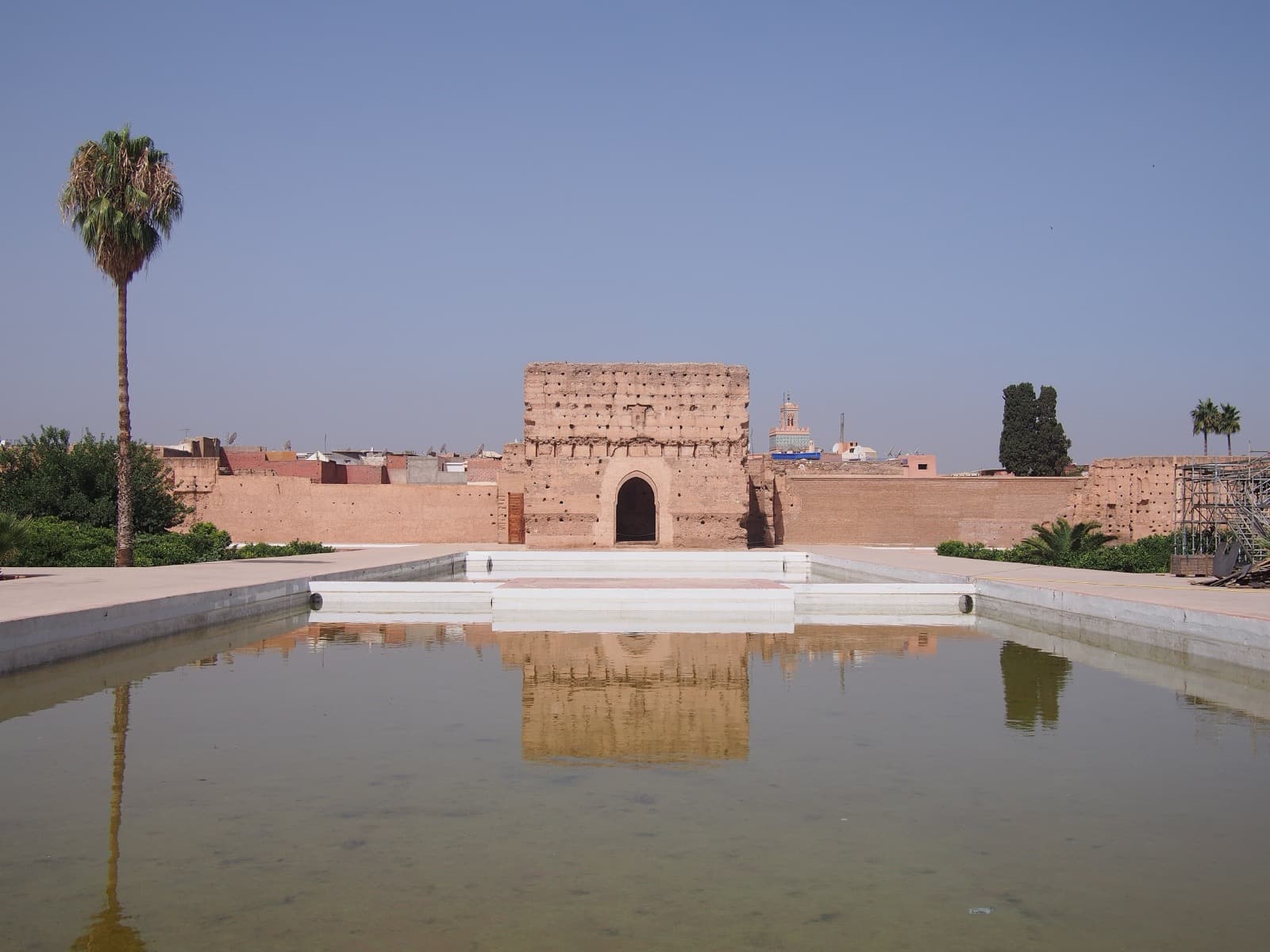
El Badi Palace: Reading Marrakech's Royal Quarter Through a Ruin
Jemaa el-Fnaa: The Square That Unlocks the Whole Marrakech Medina
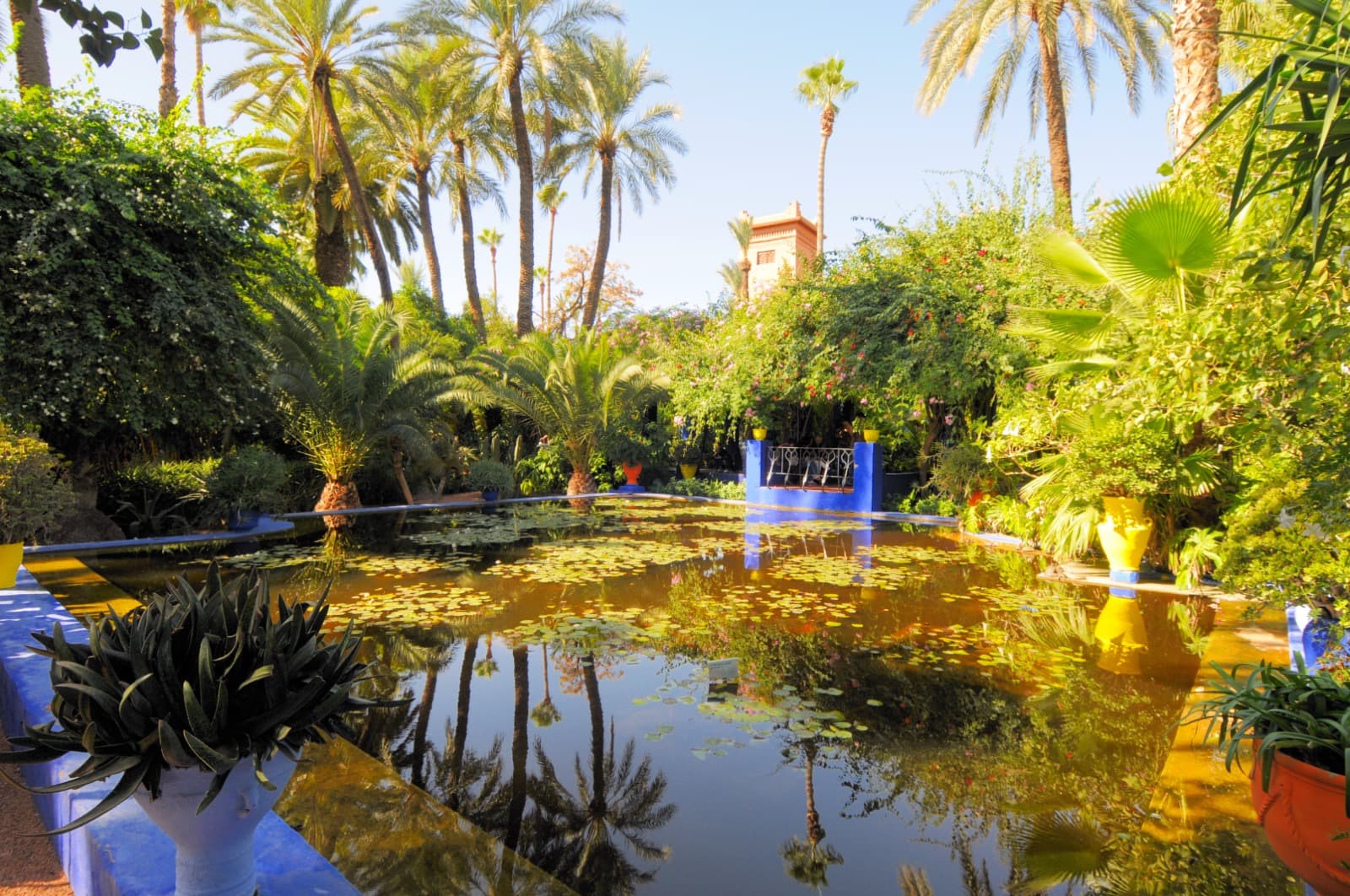
Majorelle Garden: The Blue That Reads the Whole of Marrakech