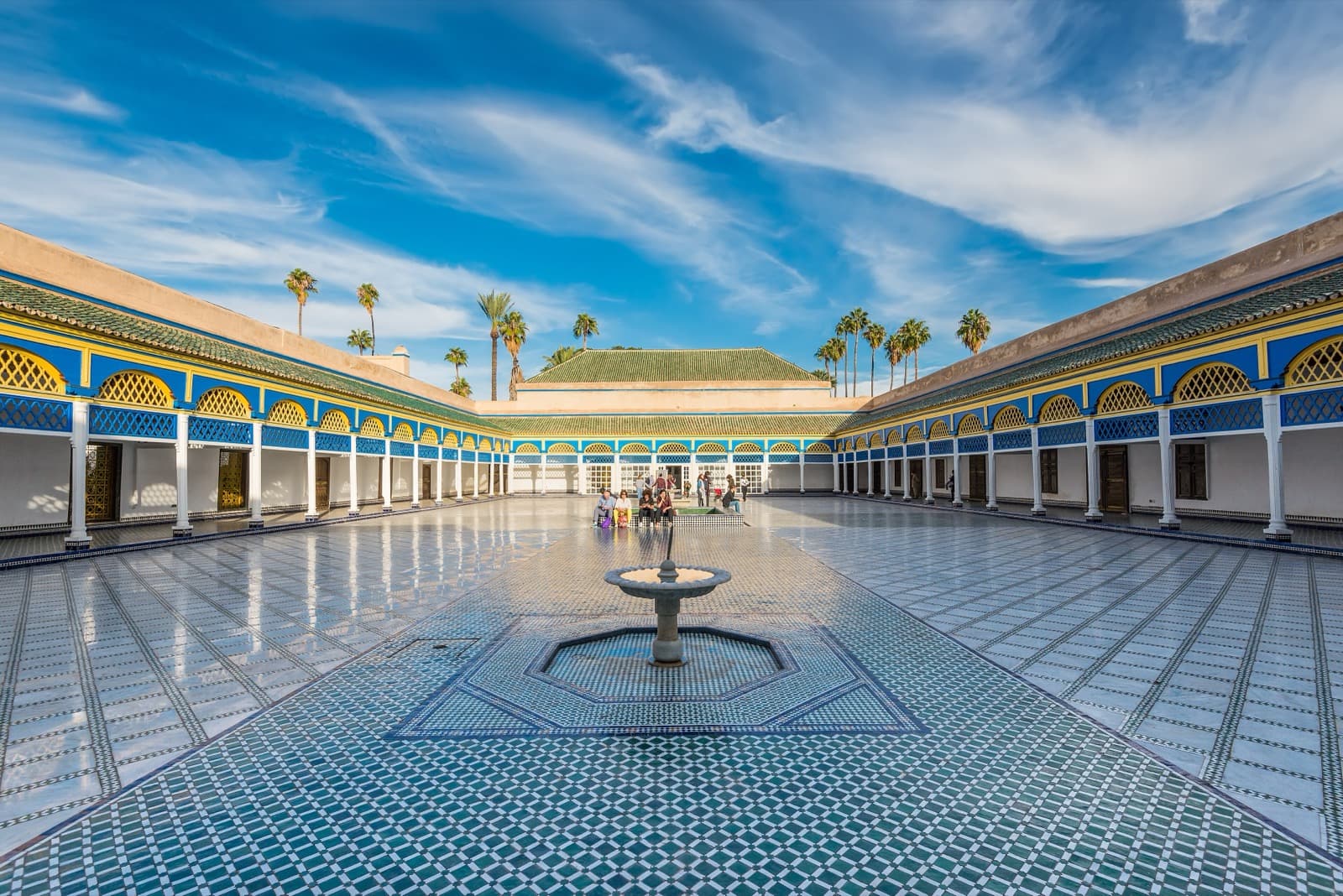
The Bahia Palace was built to outshine a king, and the man who built it was not a king. He was a grand vizier, a servant of the sultan, and across almost two hectares of Marrakech he raised roughly 150 rooms of painted cedar, carved stucco, and cut-tile mosaic to record exactly how much power a servant could gather. That is the one thing to understand standing in front of it. This is not a royal palace. It is the palace of the man who ruled in the royal name, and its opulence is the visible measure of a court where the servant had grown larger than the throne.
A palace built court by court
The Bahia grew in two generations. It was begun in the 1860s for the grand vizier Si Moussa, and the two chambers on either side of its garden carry an inscription dating their construction to around 1866 and 1867. Then his son took the work far beyond anything the father imagined. Between 1894 and 1900, Bou Ahmed, also called Ba Ahmed, expanded the palace into the sprawling complex you walk today.
What strikes a visitor first is that the Bahia has no single plan. It was assembled piece by piece, court by court, as land and rooms were acquired and absorbed. There is no grand axis, no commanding facade, no logic of symmetry running from the front door to a throne room. Instead there are courtyards that open one into the next, riad gardens set between shaded corridors, and rooms that turn corners for no reason a modern architect would recognise. The effect is a gentle labyrinth. This is not a failure of design. It is the honest shape of a building that grew the way its owner's power grew: opportunistically, absorbing whatever came within reach, answering to no master plan because its master answered to no one.
The servant who ruled Morocco
Hear a stop from this walk
Cyber Parc: How to Read an Orchard
To understand the Bahia you have to understand Ba Ahmed. He served as chamberlain to Sultan Moulay Hassan, and when Hassan died, it was Ba Ahmed who managed the succession, securing the throne for Hassan's young son Abdelaziz in 1894 and taking for himself the office of grand vizier. For the next six years he was, in practical terms, the ruler of Morocco. The sultan Abdelaziz was a boy. Ba Ahmed held the machinery of the state, the treasury, and the court, and he spent that authority building himself a palace that no sultan of the day could match.
The name says the ambition out loud. Bahia means the Brilliant, and it is said to come from the name of a favourite wife of the vizier. Inside, the craft is Moroccan decoration at its late-nineteenth-century peak. Ceilings of painted and carved cedar bloom with floral patterns. Carved stucco carries Arabic inscription. Zellij, the cut-tile mosaic of the workshops, runs across the courts, and the marble Grand Courtyard opens roughly fifty metres by thirty. Every surface is worked. Nothing is left plain. A sultan's palace of the same century might have been grander in scale, but few were more insistent in their message: everything here was paid for, commissioned, and controlled by a man who was not born to rule and ruled anyway.
What happened the hour he died
The most telling fact about the Bahia is not in its architecture but in what followed its builder's death. Ba Ahmed died in 1900. Within hours, by the accounts that survive, Sultan Abdelaziz, now grown and taking full power over the country, ordered the palace looted for its valuables. The servant's fortune reverted to the crown almost before his body was cold.
That single detail closes the whole story. A grand vizier had spent six years and a nation's treasury building a monument to his own supremacy, and the moment his protection lifted, the throne he had served simply took it back. The wealth he had accumulated had never truly been his. It was borrowed authority, held only as long as he could hold the young king in his grip, and it dispersed the instant he could not. The Bahia is beautiful, and it is also a lesson in the fragility of power that belongs to a servant.
The palace did not stay empty for long. In 1912, when France established its protectorate over Morocco, the resident-general Lyautey took the Bahia as his own residence. A building raised to prove that a Moroccan vizier could outshine a Moroccan sultan became, within a dozen years, the seat of a foreign administrator. The house kept changing owners while keeping its splendour, each new master finding it useful precisely because it had been built to impress.
Reading the palace on foot
The Bahia rewards wandering rather than route-finding. Because it was never planned as one whole, there is no correct path through it, and hunting for a set order will only frustrate you. Let the courts lead. Move from a shaded corridor into a sunlit garden, back into cedar-ceilinged rooms, and out again into open marble, and let the sequence surprise you the way it was always meant to. Watch the light. In the cooler hours of early morning or late afternoon the low sun warms the painted wood and the tilework glows, which is when the palace looks most like the thing its builder intended.
The Bahia is one of the best-loved sights in the city. In the first four months of 2019 alone it recorded more than four hundred thousand visitors, which tells you both how magnetic it remains and why arriving early or late repays the effort. It is a paid site, with tickets running a little more than the neighbouring monuments, and cash in small dirham notes moves you through fastest.
The palace sits in the royal quarter south of Jemaa el-Fnaa, the ground of sultans and viziers, and it makes most sense walked in sequence with the tombs, gates, and stripped ruins around it. Our self-guided Medina, Souks and Gardens walk passes the Bahia on its loop through the royal quarter, with the Saadian Tombs, the earthen shell of El Badi and the edge of the old mellah close by, so the vizier's brilliance reads against the sultans' ambition and their ruins. For the full set of routes through the city, see our guide to Marrakech walking tours, then walk the quarter at your own pace and read the power in the cedar.
Sources
- Bahia Palace, Wikipedia. Construction dates, the 1866 to 1867 inscription, Ba Ahmed's rise under Abdelaziz, the looting within hours of his 1900 death, and Lyautey's 1912 occupation.
- Roamer tour transcript, "Bahia Palace and the Saadian Tombs: The Marrakech of Sultans." Fact-audited primary source for room count, site size, craft materials, and 2019 visitor figures.
- Archnet, Bahia Palace site record. Architectural description of the courts, riad gardens, and decorative program.
- Barcelo Experiences travel guide, Bahia Palace. Visitor context on the palace layout and its many rooms.
Ready to experience it?
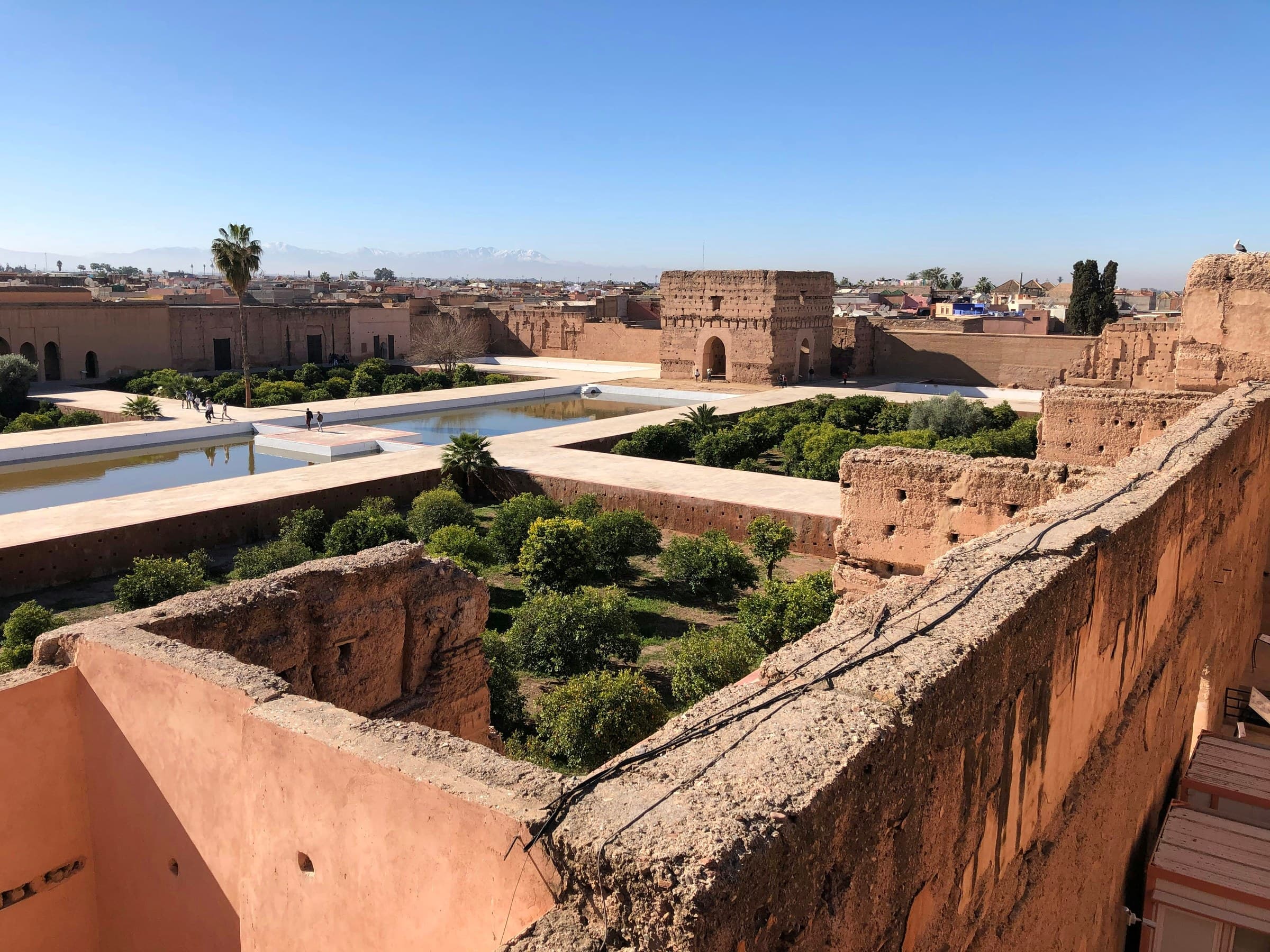
Medina, Souks and Gardens: What the Red Walls Hide
180 min · 6.2 km · moderate
More from Marrakech
Explore more at your own pace.
Marrakech Travel Guide: Days, Transport, Season, and Safety
The Red City in Three Layers: How to Read Marrakech
El Badi Palace: Reading Marrakech's Royal Quarter Through a Ruin
Jemaa el-Fnaa: The Square That Unlocks the Whole Marrakech Medina
Majorelle Garden: The Blue That Reads the Whole of Marrakech