Medina, Souks and Gardens: What the Red Walls Hide
180 min · 6.2 km · moderate
Marrakech is the Red City at the foot of the Atlas, a living medieval capital the Almoravids founded in the late eleventh century, and you can read its whole thousand-year story in three registers: the medina where trade, prayer, and performance still run at full tilt; the royal quarter where sultans and viziers built to dazzle and buried their dead in secret; and the gardens where water and shade, carried underground from mountain snow, were always the truest luxury. Walk those three layers slowly and at your own pace and the city stops being a maze and becomes legible. The red walls that name it, the great minaret a dynasty copied, the palace stripped to its bones, the cobalt garden a couturier saved: they are all one argument about how a desert city made itself great and kept itself alive.
The medina: a machine for trade, prayer, and performance
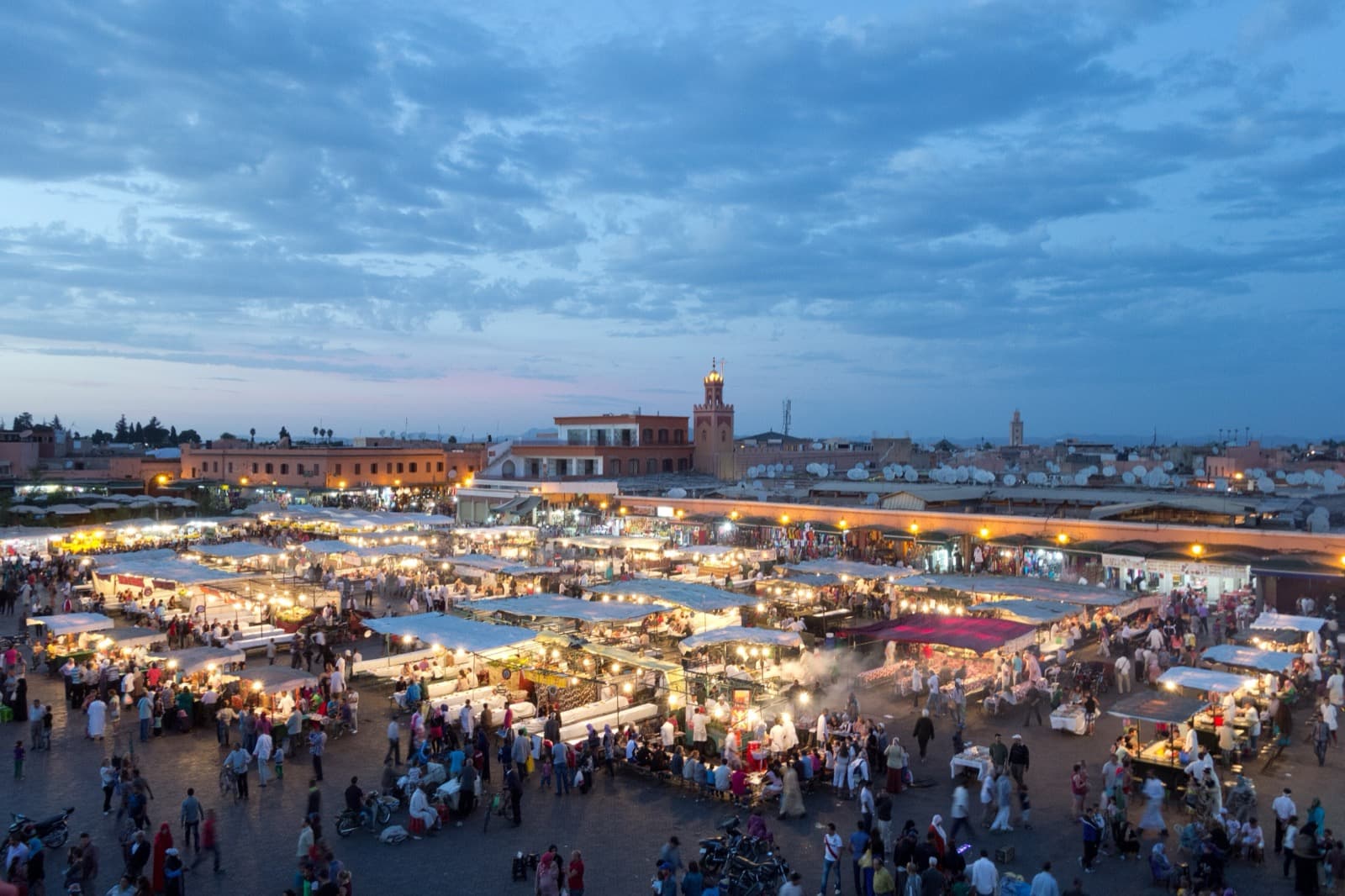
The argument begins at Jemaa el-Fnaa, the great open square at the center of the medina. It behaves less like a plaza than a stage. UNESCO inscribed the whole Medina of Marrakesh as a World Heritage site in 1985, but the square earned a separate honor: in 2001 UNESCO proclaimed its oral and performance culture a Masterpiece of the Oral and Intangible Heritage of Humanity, then added it to the Representative List in 2008. That recognition is not for stone. It is for the halqa, the performance circle of storytellers, musicians, and dancers, and for the way the square keeps two clocks, filling with juice carts and snake charmers by day and turning into an open-air theatre of food stalls and tale-tellers by night.
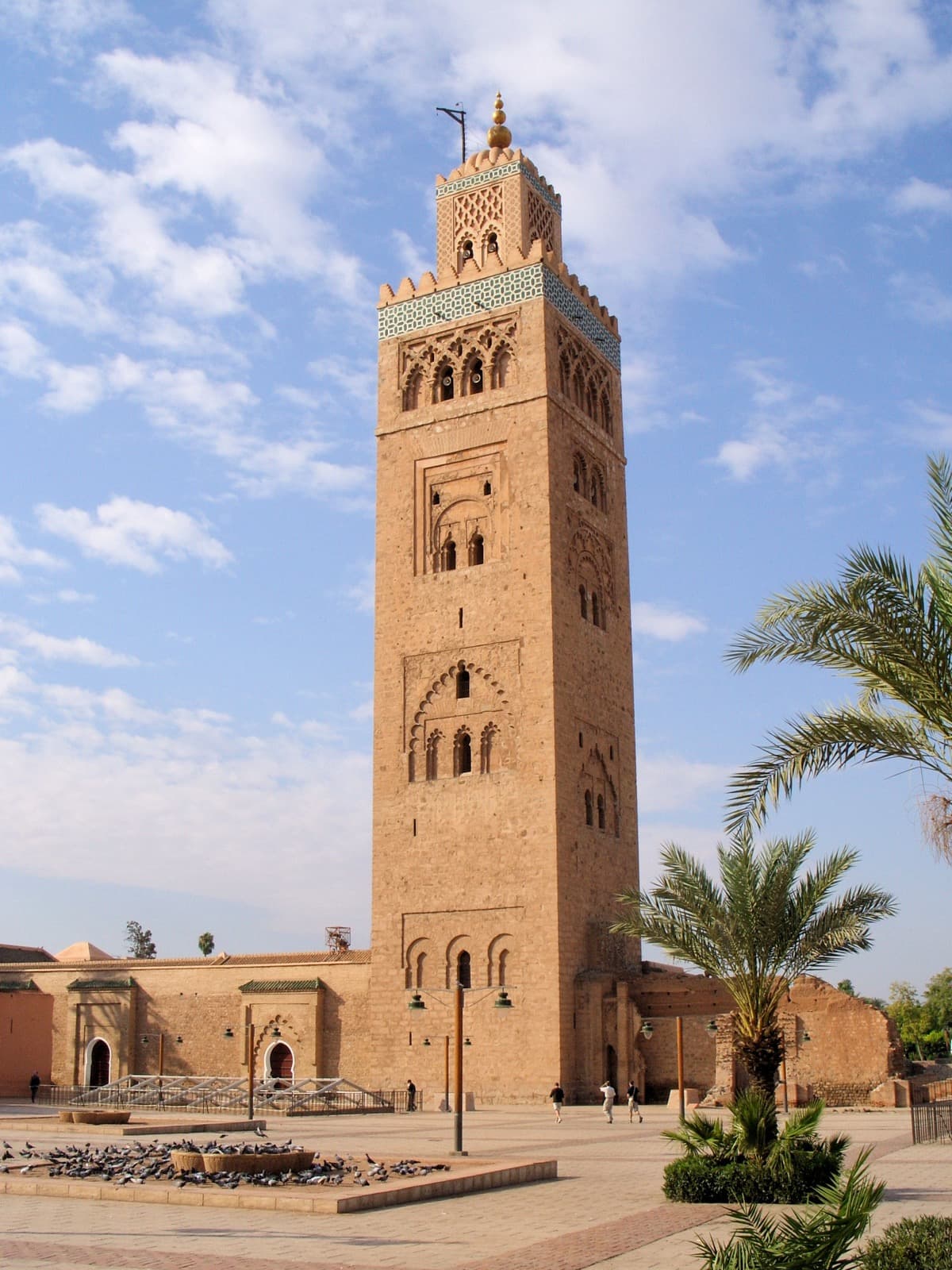
Northwest of the square rises the Koutoubia, the great twelfth-century mosque built by the Almohads who took the city from the Almoravids in 1147. Its minaret stands about seventy-seven metres tall and is the model a dynasty carried across two continents. Scholars connect it to the Giralda of Seville and the Hassan Tower of Rabat, both raised in the same era, so what commands the skyline here is effectively the prototype of a family of great towers. The name itself is a trade story: Koutoubia comes from kutubiyyin, the booksellers whose market once stood at its foot.
North of the square, under an arched gateway, the city becomes a covered labyrinth of souks organized for centuries by craft and guild into named quarters, so the market reads like a walkable trade directory. Souk Semmarine runs heavy with textiles toward the Ben Youssef Mosque; branch off and you reach the dyers with their dripping saffron and indigo skeins, the ringing metalworkers, the spice and apothecary stalls. Near that mosque stands the Almoravid Koubba, an ablutions pavilion raised under Ali ibn Yusuf in the early twelfth century. It is the only surviving example of Almoravid architecture in the whole city, and among the rare Almoravid monuments anywhere, and its dome holds some of the earliest muqarnas, the honeycomb carving that became a hallmark of Moroccan design. Four centuries of craft separate that first draft from its finished sentence, the Ben Youssef Madrasa, once the largest religious college in the Maghreb with roughly one hundred and thirty student rooms, restored and reopened to visitors in April 2022. Everything is held inside the red rammed-earth ramparts, a circuit running roughly nineteen kilometres, whose ochre color earns Marrakech its nickname.
The royal quarter: power built to dazzle, then carried away
Hear a stop from this walk
Cyber Parc: How to Read an Orchard
South of the square, behind the kasbah walls, the Marrakech of sultans tells the same story with a sharper edge. Bab Agnaou, the carved bluish-grey Almohad gate completed around 1188 to 1190, opens inside the city walls, so it was ceremony rather than defence from the start, a threshold onto the ground of kings.
Beyond it lies the quarter's great secret. A narrow passage behind the Kasbah Mosque leads to the Saadian Tombs, where the sixteenth-century sultan Ahmad al-Mansur and his family lie. The Chamber of the Twelve Columns rises about twelve metres on columns of Italian Carrara marble beneath a cedar ceiling worked in stars. When the later Alaouite sultan Moulay Ismail plundered the Saadian palaces, he could not bring himself to destroy this necropolis, so he walled it off instead, and it stayed hidden for roughly two centuries until it was opened to the public in 1917.
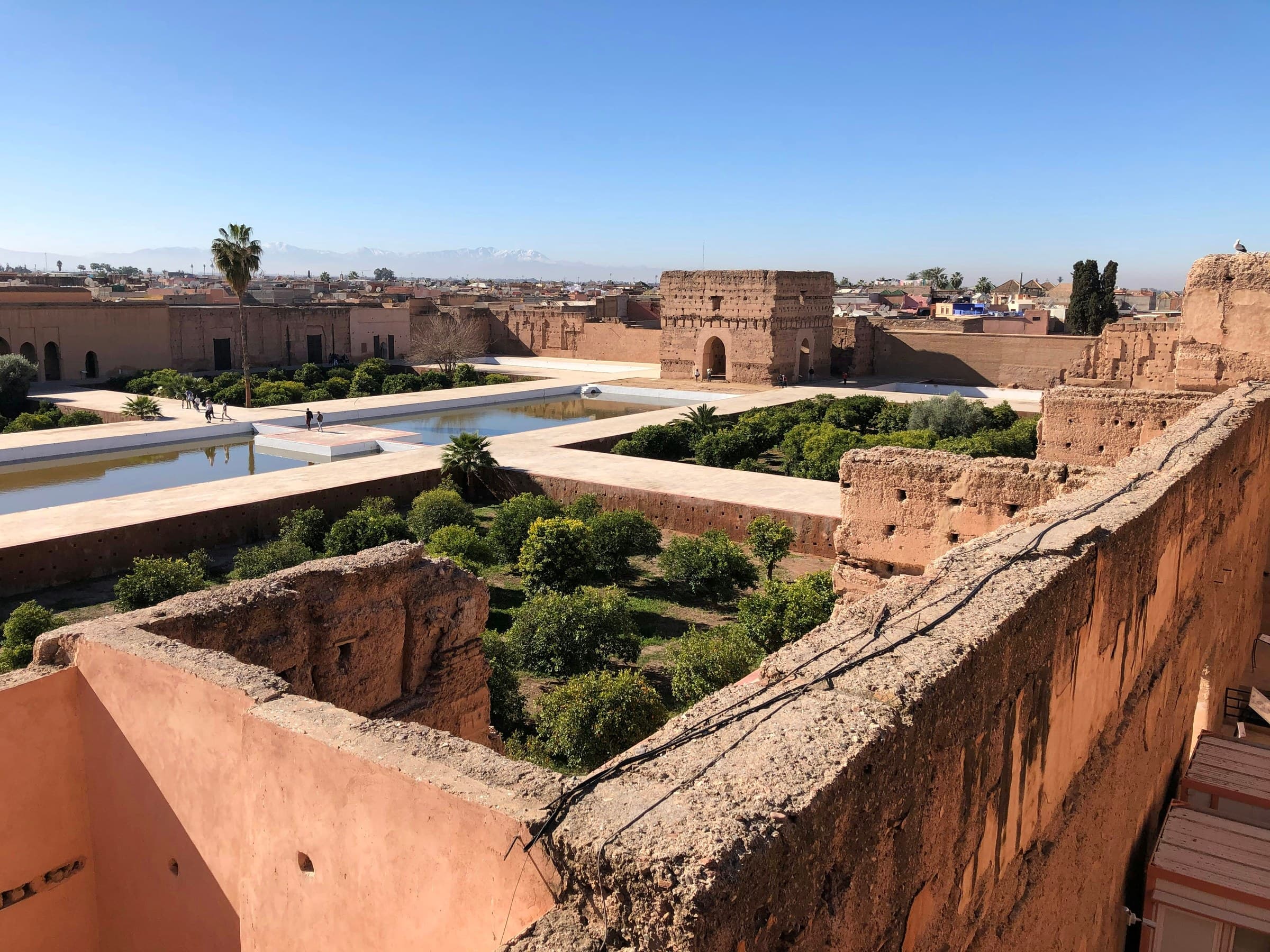
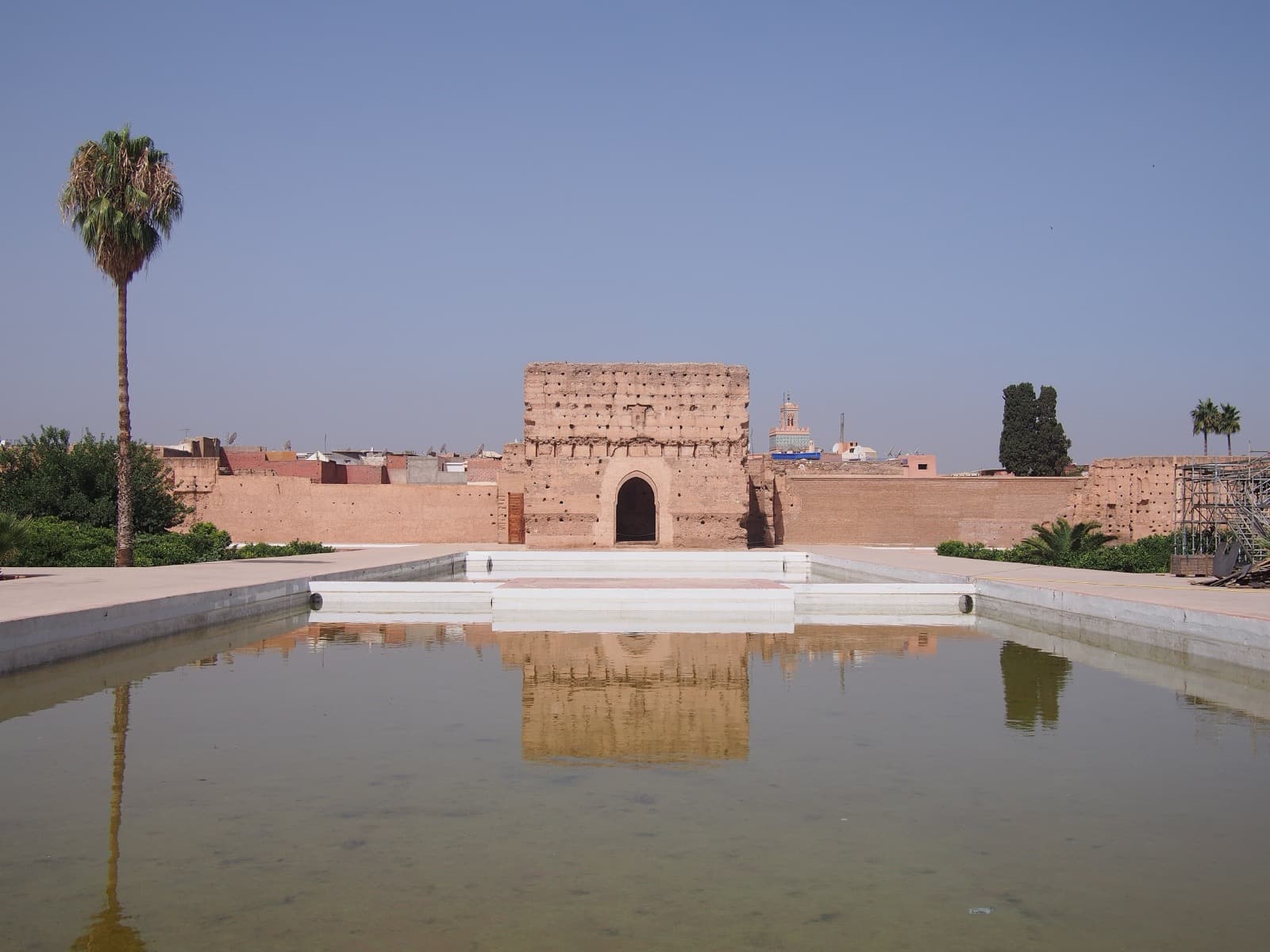
The thesis of the whole quarter stands a short walk away at El Badi, which means the Incomparable, one of the ninety-nine Names of God. Ahmad al-Mansur began it in December 1578 and finished it in 1593, cladding it in Italian marble reportedly bought for its own weight in sugar, along with gold and onyx, funded largely by the ransom after the Battle of the Three Kings and the conquest of the Songhai Empire. Around 1707 Moulay Ismail had it demolished and hauled its precious materials off to build his new capital at Meknes. What you cross today is the skeleton: roofless earthen walls, sunken gardens, a central pool, and storks nesting on the ramparts. Power built to overawe ambassadors, then carried away to the bone.
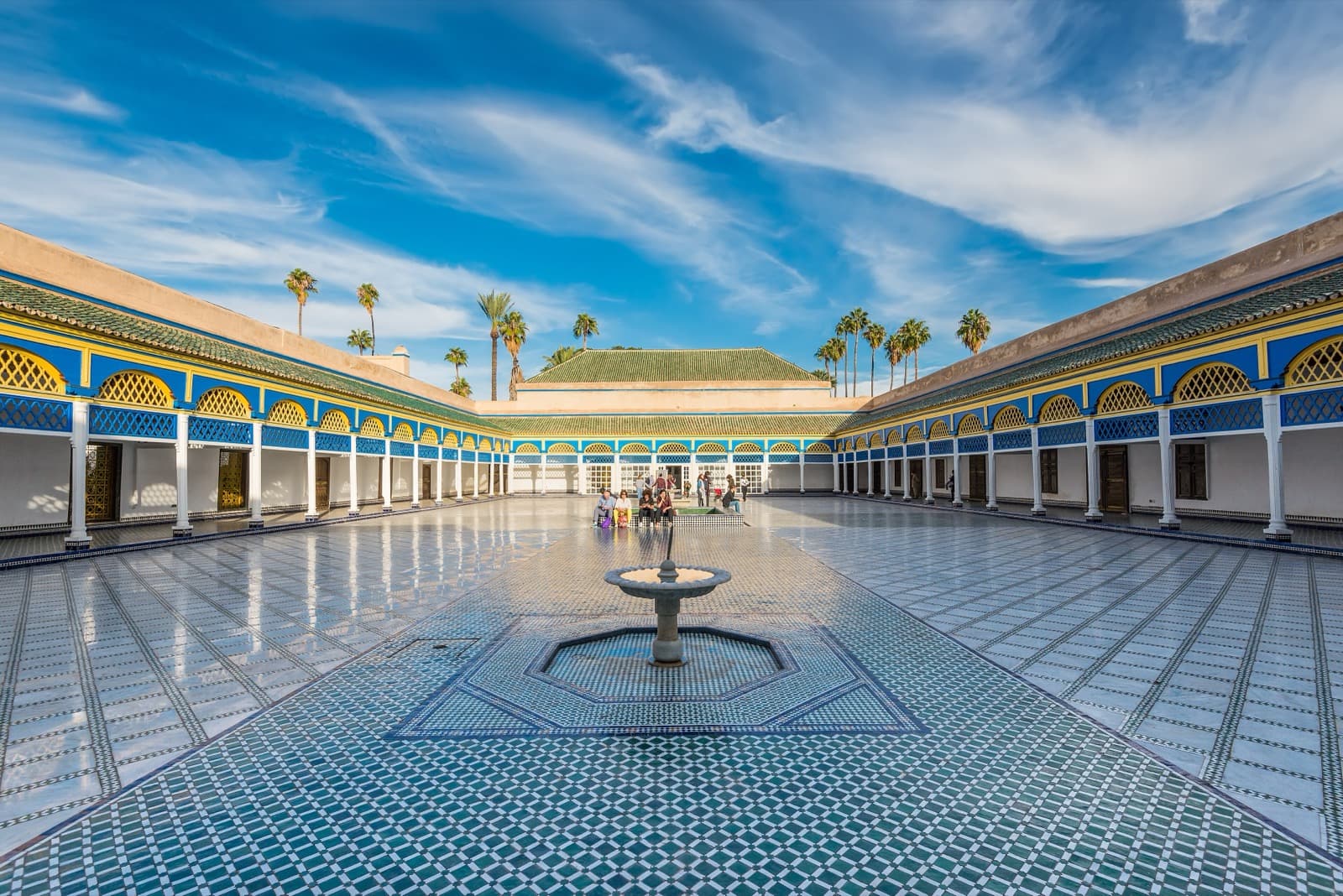
Beside these palaces sits the mellah, the historic Jewish quarter laid out by Saadian decree in 1558. Its position was no accident. This walled commercial hub was central to the sultans' finances, the quarter that helped make them rich. In the late 1940s it held roughly forty thousand people; after most of Morocco's Jews emigrated across the twentieth century, only a small community remains, and the restored Lazama Synagogue and the Miaara cemetery carry the memory. The same craft turns domestic at the Bahia Palace, a labyrinth of about a hundred and fifty rooms built court by court with no master plan for grand viziers who effectively ruled Morocco, and at the neighbouring Dar Si Said, built by a brother of the Bahia's vizier and now the National Museum of Weaving and Carpets, where the making traditions of the whole country are gathered under painted cedar.
The gardens: the invisible engineering that made it all possible
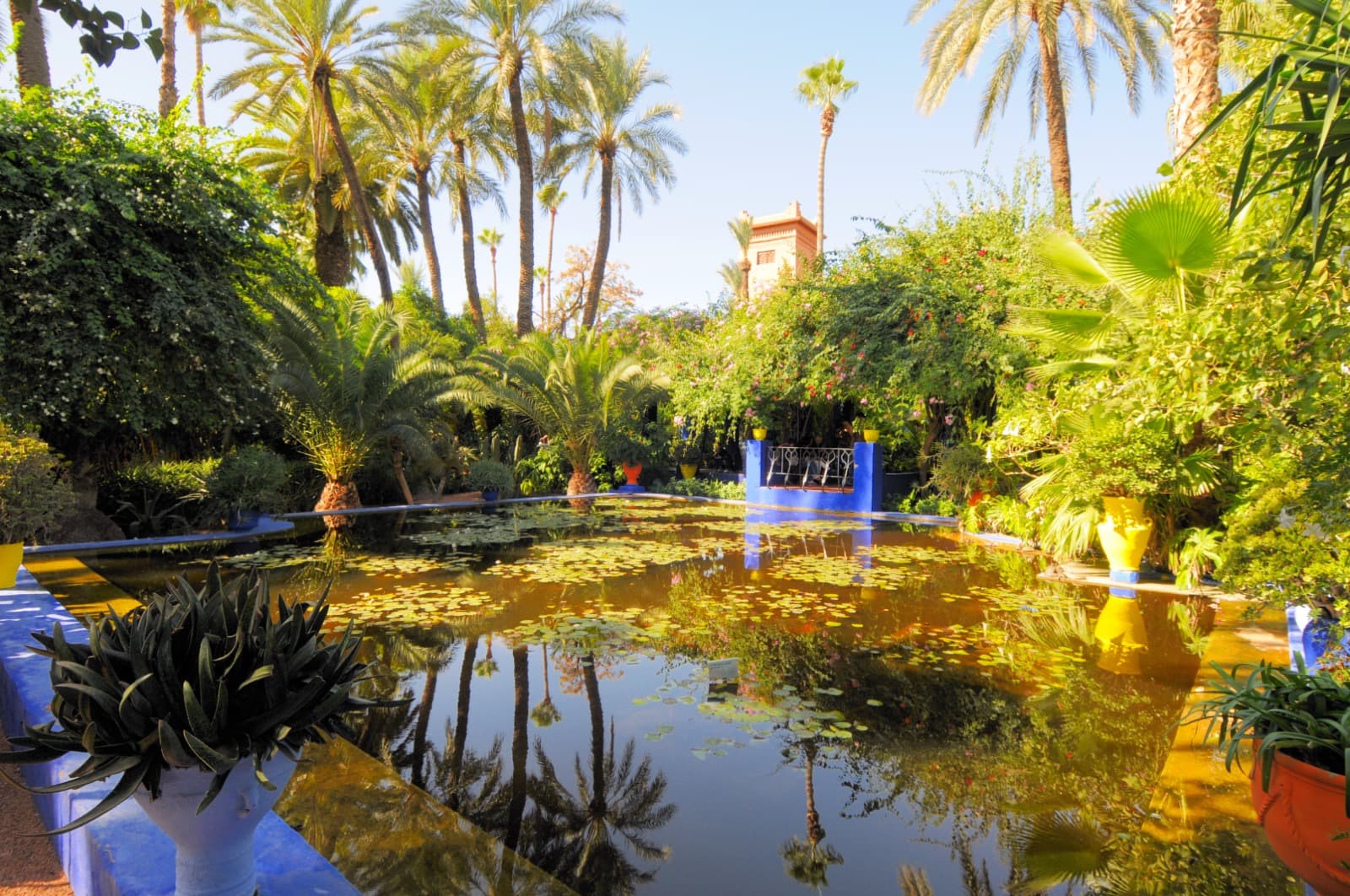
The third register answers the question the other two leave open: how does a red city on a dry plain sustain squares, palaces, and orchards at all? The green Marrakech behind the red walls begins with the marquee, the Majorelle Garden, where the French painter Jacques Majorelle, who lived from 1886 to 1962, built a villa and garden and in 1937 mixed the intense ultramarine that carries his name, bleu Majorelle, now patented. He drew it, he said, from Marrakech tiles and the deep indigo of Amazigh cloaks. After the garden fell into neglect, the couturier Yves Saint Laurent and Pierre Berge bought and restored it in 1980, saving it from developers, and it now draws more than seven hundred thousand visitors a year. The terracotta Musee Yves Saint Laurent Marrakech, designed by Studio KO, opened next door on 19 October 2017.
From there the story turns backward to the medieval royal groves. The Menara, an Almohad olive grove around a basin roughly one hundred and ninety-five by one hundred and sixty metres, is Morocco's most reproduced mirror image, the green-tiled pavilion doubled against the snows of the Atlas. That mirror is not decoration. It is a working reservoir, filled through a khettara and stored to gravity-feed the lower orchards. The Agdal, founded by the Almohads in the twelfth century, covers about three hundred and forty hectares of olives, oranges, and pomegranates ringed by a wall roughly nine kilometres long, and a 1916 census counted nearly thirty thousand olive trees inside.
Both depend on the true hero of the whole city, the khettaras, gently sloping underground channels dug from the foot of the Atlas that carry snowmelt to the plain by gravity alone. Their development is tied to the Almoravid founding of Marrakech between 1070 and 1072 and to the sultan Ali ibn Yusuf, who expanded the supply. That is the click that makes the postcard legible. The mirror at the Menara was never a mirror; it was the visible reward of an invisible machine. The route closes at the Palmeraie, an Almoravid-era grove of over one hundred thousand date palms across some eight kilometres, watered from the start by the same hidden channels. Legend says it sprang from date-pits dropped by a marching army; the quieter truth is deliberate cultivation and deliberate water. Read the medina, the palaces, and the gardens together and you read one red-walled city, best taken slowly and at your own pace. Start with the full set of Marrakech walking tours.
Sources
- UNESCO World Heritage Centre, Medina of Marrakesh (inscribed 1985)
- UNESCO, Representative List of the Intangible Cultural Heritage: Cultural Space of Jemaa el-Fna Square
- Fondation Jardin Majorelle, history of the Majorelle Garden and Yves Saint Laurent
- Musee Yves Saint Laurent Marrakech, building and Studio KO design notes
- National Museum of Weaving and Carpets (Dar Si Said), Marrakech
Frequently asked questions
- Why is Marrakech called the Red City?
- Marrakech is nicknamed the Red City because of the ochre color of its rammed-earth ramparts and buildings. The Almoravid walls, whose circuit runs roughly nineteen kilometres around the medina, are built of local soil packed with lime, and that deep ochre earth gives the whole city its color.
- What is Jemaa el-Fnaa and why is it UNESCO-listed?
- Jemaa el-Fnaa is the great open square at the center of the Marrakech medina, functioning as a marketplace by day and an open-air theatre of storytellers, musicians, and food stalls by night. UNESCO proclaimed its oral and performance culture a Masterpiece of the Oral and Intangible Heritage of Humanity in 2001 and added it to the Representative List in 2008, honoring the living halqa performance tradition rather than any building.
- Why were the Saadian Tombs hidden for two centuries?
- When the Alaouite sultan Moulay Ismail plundered and demolished the nearby Saadian palaces, he could not bring himself to destroy the royal necropolis behind the Kasbah Mosque, so he had it walled off instead. The tombs, including the marble Chamber of the Twelve Columns, stayed sealed and half-forgotten for roughly two centuries until they were opened to the public in 1917.
- What happened to El Badi Palace?
- El Badi, meaning the Incomparable, was built by the Saadian sultan Ahmad al-Mansur between 1578 and 1593 and clad in Italian marble, gold, and onyx. Around 1707 the Alaouite sultan Moulay Ismail had it demolished and hauled its precious materials off to build his new capital at Meknes. Today only its roofless earthen shell, sunken gardens, and central pool survive.
- How does a desert city like Marrakech keep its gardens alive?
- Marrakech is sustained by khettaras, gently sloping underground channels dug from the foot of the Atlas Mountains that carry mountain snowmelt to the city by gravity alone, with no pumps. Tied to the Almoravid founding of the city between 1070 and 1072, this hidden network feeds the reservoirs and orchards of the Menara, the Agdal, and the Palmeraie, making a city of gardens possible on a dry plain.
- Who created the Majorelle Garden and its famous blue?
- The French painter Jacques Majorelle bought the plot in 1923 and in 1937 mixed the intense ultramarine now called bleu Majorelle, which is patented and named after him. After the garden fell into neglect, the couturier Yves Saint Laurent and Pierre Berge bought and restored it in 1980, saving it from developers. It now draws more than seven hundred thousand visitors a year.
Ready to experience it?
Medina, Souks and Gardens: What the Red Walls Hide
180 min · 6.2 km · moderate
More from Marrakech
Explore more at your own pace.
Marrakech Travel Guide: Days, Transport, Season, and Safety
El Badi Palace: Reading Marrakech's Royal Quarter Through a Ruin
Jemaa el-Fnaa: The Square That Unlocks the Whole Marrakech Medina
Majorelle Garden: The Blue That Reads the Whole of Marrakech
Bahia Palace: The Vizier Who Built a Palace to Outshine His King