Fernando the Sixth and Bárbara de Braganza had no children, and that one fact built this church. Spain's royal burial place, the Pantheon of Kings at El Escorial, was meant for kings and the mothers of kings, and a couple who would never be the parents of a king had no place in it. So they built their own church to be buried in, on what was then the edge of Madrid, with a convent school for noble girls beside it. The convent has long since become the courts. The king and queen are still in the church.
A convent with three jobs
The project, known as the Salesas Reales, had more than one purpose. It was a tomb church. It was a school: the Salesas, nuns of the order of Saint Francis de Sales, came to educate daughters of the nobility. And, according to Madrid's tourist office, it was meant as a place where the queen could retire if her husband died first, because in those years this part of town was the outskirts of the city. A small palace for her was joined to the church.
The founding deed was signed in 1747, and the church went up between 1750 and 1757 to the designs of the French architect Carlier, carried out with Francisco Moradillo. Spain's national tourism office describes the result as a Baroque and Rococo ensemble.
Reading the front
Hear a stop from this walk
Mercado de San Antón: The Market Remade
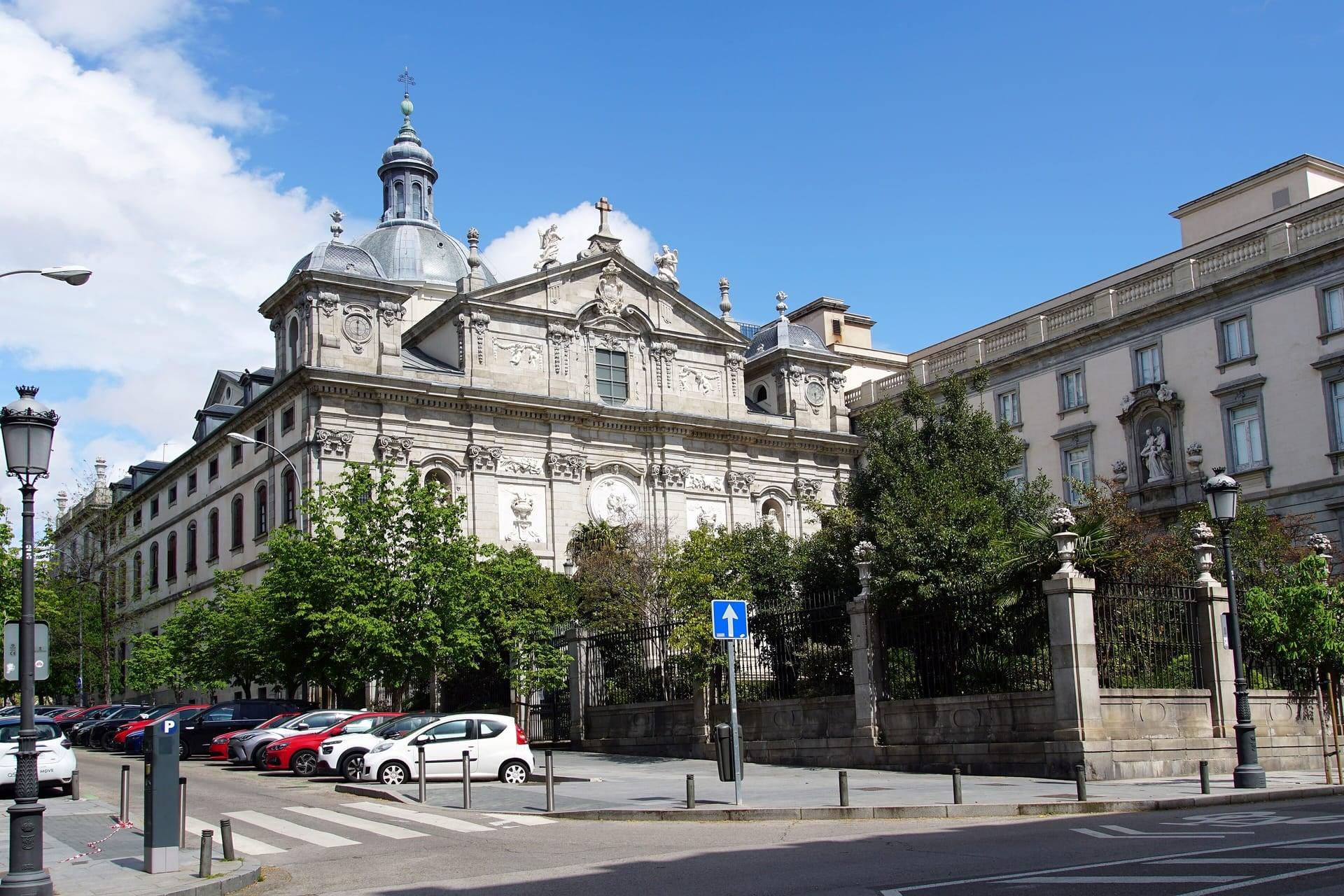
From the tour's stop you look up a railed forecourt to the church at the top of a broad staircase. That staircase is later than it looks: it was built in 1930, when the street named for the queen, Calle de Bárbara de Braganza, was opened in front of the church.
The front itself is the 1750s design. It is a triple portico under a pediment, with a tower on each side, built of brick and masonry. The relief sculpture is by the Italian Gian Domenico Olivieri and by Alfonso Giraldo. Behind it rises a dome. In summer the trees in the forecourt can hide the lower part of the front, so the upper storey and the towers are what to look for.
The tombs inside
The queen died first, in 1758, at the palace of Aranjuez. The king died a year later. His brother, who succeeded him as Carlos the Third, paid for their tombs. They were designed by Francesco Sabatini in marble and porphyry and carved by Francisco Gutiérrez and Juan de León. The king's epitaph says he died without children, but with a numerous progeny of virtues.
The church also holds the tomb of General Leopoldo O'Donnell, a Carrara marble monument by Jerónimo Suñol from the 1870s. The interior is lined with marble and jasper paving, and the church is free to enter at its opening hours, mornings and evenings. It is a working parish, so a visit means going in quietly.
From convent to courts
The convent's own story turned in 1870, when it was converted into the Palace of Justice. The church stayed open for worship, and in 1891 it became the parish of Santa Bárbara, the name it carries today. The old convent buildings now house Spain's Supreme Court.
So the founders' plan came true in an odd way. Their school is gone and their convent belongs to the judiciary, but the church built to hold two people with no heir still does exactly that.
Why it belongs on this walk
The Malasaña and Chueca walk follows Madrid's old northern edge, where the crown put the large institutions that needed space: a guards' barracks, a poorhouse, an artillery park and this royal convent. Each was later taken over by the city for other uses. The Salesas is the cleanest example of the pattern, a royal foundation turned into a public institution with its original purpose kept alive inside.
At your own pace, it is easy to step inside here during opening hours and then rejoin the route, or simply take in the front from the corner and walk on into Chueca.
The church is stop 10 of Malasaña and Chueca: The Old Edge of Madrid, which runs from the Conde Duque barracks to the San Antón market. See all routes on the Madrid page.
Sources
- esmadrid, Iglesia de Santa Bárbara: the convent as a school for noble daughters and a possible retreat for the queen on the edge of Madrid, her death at Aranjuez before the king, the Sabatini mausoleum, the 1870 Palace of Justice, the 1891 parish, the interior marbles and jasper, free entry and opening hours.
- Spain.info (Turespaña), Parish of Santa Bárbara, convent of the Salesas Reales: Carlier and Moradillo, the Baroque and Rococo ensemble, the triple portico with towers, reliefs by Olivieri and Alfonso Giraldo, tombs by Sabatini executed by Gutiérrez and Juan de León, the O'Donnell tomb by Suñol, the Supreme Court in the old convent.
Ready to experience it?
Malasaña and Chueca: The Old Edge of Madrid
75 min · 2.7 km · easy
More from Madrid
Explore more at your own pace.
Barrio de las Letras: Madrid's Writers' Quarter in Three Layers
Gran Vía: How Madrid's Great Way Grew Wider and Taller as It Was Cut
Malasaña and Chueca: Madrid's Old Northern Edge, Taken Back by the City
Edificio Carrión: The Curved Corner at Callao and the Sign That Stayed
Plaza de las Cortes: Cervantes, His Lion and the Congreso Lions